Microsoft is making a major push to integrate social networking tools like Facebook and Twitter into its Bing search engine: users will soon be able to “Ping” search results they like to their friends directly from Bing. Back in January, in “Google, the Innovator’s Dilemma and the Future of Search & Web Ads,” I talked about the implications of this history of search from the WSJ):
Microsoft missed its opportunities to get into paid search not because it was “dumb,” “uninnovative” or a “bad” company, but for the same sorts of reasons that big, highly successful and even particularly innovative companies fail. The reasons companies generally succeed in mastering “adaptive” innovation of the technologies behind their established business models are the very reasons why such great companies struggle to encourage or channel the “disruptive” innovation that renders their core technologies and business models obsolete. This dynamic was described brilliantly in Harvard Business School professor Clayton Christensen’s classic 1997 book The Innovator’s Dilemma: When New Technologies Cause Great Firms to Fail…
Let’s hope that Microsoft—as well as Yahoo!—have carefully studied the vast literature produced by business schools in the wake of Christensen’s book about how big companies can avoid the Innovator’s Dilemma by promoting—and capitalizing on—radical innovation from within. Indeed, this seems to be precisely what has guided Google’s own strategy as it has grown from “disruptive innovator” to become the very sort of behemoth that cannot easily escape the Dilemma, even if corporate managers are fully aware of the problem on a theoretical level. If Google can do it, Microsoft should be able to, too. But let’s also not discount the possibility that, no matter how hard Google’s management might try to retain the innovative culture of a start-up, the giant
can’t do that well enough to prevent its own apparent market dominance from being disrupted by new upstart innovators in search and advertising technologies.
My prediction seems to be coming true: Microsoft, with less to lose and without a huge installed user base to worry about annoying by violating Google’s “Prime Directive” of elegant simplicity, may have an easier time introducing “disruptive” innovations to search than Google. Of course, it’s unlikely that any
one feature will prove the “killer app” that suddenly causes Bing’s market share to explode—and Google’s to plummet—but a steady stream of such nifty features could convince many users to switch to Bing.
At 29, I’m old enough to remember when Microsoft seemed as cool as Google does today. Hell, I remember being thrilled as a sophomore in high school by Bill Gates’ 1995 book
The Road Ahead and the accompanying CD-ROM (which included, as I recall, a tour of Gates’s ultra-futuristic home). If Microsoft can “get its mojo back,” the company could truly become a web services provider to rival Google. We’d all benefit from having more choices in search engines, advertising platforms and related tools. And, driving each other to “build a better mousetrap,” the two companies could lead us down the “Road Ahead” from Search 2.0 to Search 3.0 and beyond. So here’s to hoping that Redmond can solve the “Innovator’s Dilemma” with tools like Google’s “20 percent” time that free engineers to innovate!
 As we’ve noted here before, there are many ways to follow the TLF. [Did you notice those cool icons over on the upper right-hand side of the page?] But we wanted to make sure that our readers were aware of our Twitter feed, in particular, as well as the individual feeds of some of our contributors. So, in case you are interested, here ya go!
Thanks to Mashable, we clearly see power laws at work on Twitter. While many protest this as evidence of “media inequality,” the “non-tweeting will always be with us” (to paraphrase Jesus’s comment about the persistence of “the poor”)—and this is nothing to get bent out of shape about, as Adam has explained.
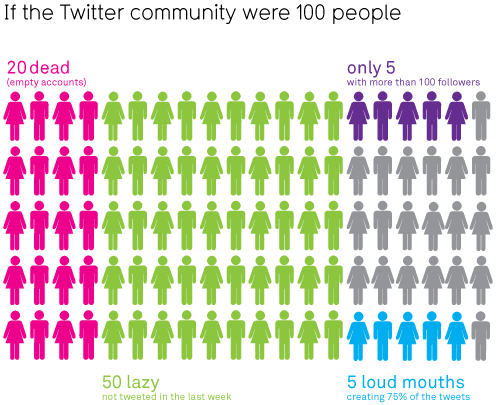
Courtesy of Mashable, David McCandless
The proliferation of Web 2.0 social media services has magnified the old problem of cyber-squatting: Every new service represents the possibility that someone else might claim your name, or your organization’s trademark, as a user name before you do! This problem is especially significant where user names correspond to vanity URLs, as with Twitter and, more recently, Facebook.
So I was intrigued to discover that the market is responding to this need: ClaimMyName (CMN) will take care of user registrations on 30 Web 20 services for $329 or on an astounding 300 services for $799. CMN is a “freemium” service offered by DandyID.com, a nifty free service that allows users to organize all their social media profiles for something like 390 services so that buttons for each service can easily be added to an author bio page on a blog, as we’ve done at the TLF. So if I really wanted to make sure that no one else registered http://<WEB2.0service>.com/berinszoka, or /techliberation or /ProgressFreedom, this service would allow me to do so with just a few clicks—at a price of either $10.97/service for thirty or $2.66/service for 300 services.
CMN is essentially a mini-Mark Monitor, the international company famous for protecting trademarks online—except that CMN facilitates self-help by users outside of trademark law: No registration is required; everything is done on a first-come-first-serve basis. Pretty cool.
Over at Twitter, our TLF blogging colleague Jerry Brito asks a smart question about the Federal Communications Commission’s recently-opened investigation of the Apple-Google spat over Apple’s recent decision to reject the Google Voice app from the iPhone App Store. Jerry asks: “Maybe I should know this, but what authority does the FCC have to demand that Apple explain anything?” Good question, Jerry! But no, I don’t think there’s anything you’re missing. We might consider this merely the latest chapter of the agency’s rogue operator history: If you can’t find the authority to do something, just assert it anyway and go for broke! The idea of living within the confines of the law and paying attention to statutory authority seems like an alien concept to the FCC. As my PFF colleagues Barbara Esbin and Adam Marcus have pointed out in their amazing recent law review article, “The Law Is Whatever the Nobles Do: Undue Process at the FCC,” when all else fails, the agency just asserts “ancillary jurisdiction” and claims that the whole world is their oyster. They argue:
The FCC’s means of asserting regulatory authority over broadband Internet service providers’ (“ISP”) network management practices is unprecedented, sweeping in its breadth, and seemingly unbounded by conventional rules of interpretation and procedure. We should all be concerned, for apparently what we have on our hands is a runaway agency, unconstrained in its vision of its powers.
Of course, even if we ignore the agency’s cavalier attitude about the law and statutory authority, there are other reasons to be concerned about FCC interference in this matter.
Continue reading →
In response to Professor Jonathan Zittrain’s op-ed in The New York Times last Monday about online privacy and open platforms (which Adam thoroughly refuted last week) I have a letter to the editor in today’s The New York Times:
To the Editor:
Re “Lost in the Cloud” (Op-Ed, July 20):
In discussing the privacy risks that have accompanied the growth of the Internet, Prof. Jonathan Zittrain rightly bemoans the willingness of governments to violate individuals’ privacy rights. Unfortunately, he proposes new legal restrictions that would stifle online innovation while doing little to enhance consumer privacy.
Mr. Zittrain proposes a “fair practices law” that would require companies to release personal data back to users upon request. Such a rule may sound workable, but purging specific data across globally dispersed server farms is no simple endeavor. Who is to pay for the implementation of such privacy procedures — especially for free services like Facebook or Twitter that have yet to turn a profit?
A better approach to online privacy is to educate users on safeguarding personal information. Ultimately, however, the only foolproof approach to protecting sensitive data online is to simply not disclose it.
Continue reading →
ReadWriteWeb notes that, after much speculation as to how Twitter would find a business model to support its burgeoning social network, the red-hot start-up is now, finally, showing ads. This anti-climax is almost like Freddie Mercury, the lead singer of the not-so-subtly-named QUEEN, finally revealing that he was gay in 1989: Everybody saw it coming but wondered what took so long!
The flamboyant Mercury waited until AIDS had nearly finished him to admit the obvious (and, sadly, died shortly thereafter). For Twitter, though, embracing advertising is not the end but the beginning. Twitter’s growing popularity has meant little to the company other than increased costs. But now advertising will let Twitter “monetize” its success, while empowering users to “vote” for Twitter without having to pay a cent for the service.
I suspect that Twitter has waited till now to start showing ads—and that venture capital investors were willing to fund Twitter during this stage—because it seemed to make sense to “build critical mass” first, before trying to monetize viewership. This has been, in principle, Facebook’s strategy, too, as I’ve discussed.
By following in the footsteps of so many other ad-supported titans of the Internet—from Yahoo! to Google and everyone in between—Twitter may finally have started to grow up. The next step in its evolution will be allowing advertisers to target ads to users based on their Tweets, which will increase the profitability of ads on the site. After that, Twitter will face pressure to offer advertisers more sophisticated forms of targeting, such as targeting ads to users based on their browsing “behavior” (other sites they’ve looked at). Just imagine the outcry!
The Wired article (“Great Wall of Facebook: The Social Network’s Plan to Dominate the Internet — and Keep Google Out“) I discussed yesterday touched on another issue near & dear to my heart (besides the importance of smarter advertising): the future of online anonymity. The article lays out Facebook’s “4-Step Plan for Online Domination,” which involves “colonizing” the web though Facebook’s Connect (launched Dec. 2008) and Open Stream API (launched April 2009) initiatives, which:
don’t just allow users to access their Facebook networks from anywhere online. They also help realize Facebook’s longtime vision of giving users a unique, Web-wide online profile. By linking Web activity to Facebook accounts, they begin to replace the largely anonymous “no one knows you’re a dog” version of online identity with one in which every action is tied to who users really are.
To hear Facebook executives tell it, this will make online interactions more meaningful and more personal.
Imagine, for example, if online comments were written by people using their real names rather than by anonymous trolls. “Up until now all the advancements in technology have said information and data are the most important thing,” says Dave Morin, Facebook’s senior platform manager. “The most important thing to us is that there is a person sitting behind that keyboard. We think the Internet is about people.”
The bolded prediction of what I would call “Online Identity Integration” is already happening. To take one tiny example, readers can now post comments on the TLF by logging into Disqus (our Comment Management System) through their Facebook (or Twitter) account, which will also allow them to automatically share those comments on Facebook (or Twitter). This is purely opt-in: Users are free to continue to post anonymous comments. But as more websites and platforms implement such Identity Integration functionality, a growing percentage of online speech will be tied to profiles offered by major social networks.
Some free speech advocates are sure to bemoan Identity Integration as directly undermining online anonymity. Continue reading →
It’s fascinating to continue watching developments in Iran via Twitter and other social media.
The fact that Twitter delayed a scheduled outage to late-night Tehran time was laudable, but contrary to a growing belief it wasn’t done at the behest of the State Department. It was done at the behest of Twitter users.
Twitter makes that fairly (though imperfectly) clear on its blog, saying, “the State Department does not have access to our decision making process.”
As my Cato Institute colleague Justin Logan notes, events in Iran are not about the United States or U.S. policy. They should not be, or appear to be, directed or aided from Washington, D.C. Any shifts in power in Iran should be produced in Iran for Iranians, with support from the people of the world – not from any outside government.
People are free to speculate that the State Department asked Twitter to deny its involvement precisely to create the necessary appearances, but without good evidence of it, assuming that just reflects a pre-commitment that governments – not people and the businesses that serve them – are the primary forces for good in the world.
This is just a quick reminder to both faithful and fair-weather readers that there are many ways to keep up with what we’re saying here at the Technology Liberation Front, including:
(1) RSS
 Subscribe in a Reader


(2) Twitter

(3) Facebook

(4) Daily email alert
(5) Podcast



 …
Or just make the TLF your browser’s welcome page! What better way to start each day?
Finally, as always, we appreciate your support, attention, tolerance of our rants.
…
Or just make the TLF your browser’s welcome page! What better way to start each day?
Finally, as always, we appreciate your support, attention, tolerance of our rants.

 The Technology Liberation Front is the tech policy blog dedicated to keeping politicians' hands off the 'net and everything else related to technology.