Posts tagged as:

In case you missed it, the world stopped moving today to witness the birth of another Google product: the much-ballyhooed “Twitter-Killer,” Buzz, which offers much of the functionality of Twitter in a more Facebook-like setting (plus location data) built directly into Gmail. CNET’s Larry Magid started the #GoogSoc (“Google Social”) hashtag for the event, kicking off a discussion about Twitter’s newest competitor on Twitter itself—and he was the first one up to the mic with a question for Google Founder Sergey Brin and his team after their presentation. Larry asked about privacy concerns raised by Buzz and Brin responded, as Larry puts it:

that there are privacy controls built-into both the web and mobile Buzz applications but, by default, much of your information is public. For example, if you don’t specify that a Buzz should only be seen by your friends, it’s made available to everyone and indexed by the Google search engine. Like Facebook, Buzz gives you the ability to create lists so you can have a separate Buzz group for your drinking buddies and another one for people at work. However,as with all privacy tools, the key is how you use them. My concern is that some people might forget to use the privacy tools and send the wrong information to the wrong people. There are also controls on whether your geo-location is disclosed but, again, i t’s up to the user to be careful on how they use them. Imagine sending a post out to your significant other that you’re stuck at work only to accidentally reveal that you’re actually located in a romantic restaurant down the street from the office?

I’m glad that Larry is raising these concern as someone who has done yeoman’s work in educating Internet users, especially kids, about how to “Connect Safely” online (the name of his advocacy group). The fact that companies like Google know they’ll get questions like Larry’s is hugely important in keeping them on their toes to continually plan for “privacy by design.”

But I do worry that those with a political axe to grind will take these same questions and twist them into arguments for regulation based on the idea that if some people forget to use a tool or just don’t get care as much about protecting their privacy as some self-appointed “privacy advocates” think they should, the government—led by Platonic philosopher kings who know what’s best for us all—should step in to protect us all from our own forgetfulness, carefulness or plain ol’ apathy. After all, consumers are basically mindless sheep and if the government doesn’t look after them, the digital wolves will devour them whole! Continue reading →

Most of you have probably already seen this but Pingdom recently aggregated and posted some amazing stats about “Internet 2009 In Numbers.”  Worth checking them all out, but here are some highlights:

  • 1.73 billion Internet users worldwide as of Sept 2009; 18% increase in Internet users since previous year.
  • 81.8 million .COM domain names at the end of 2009; 12.3 million .NET & 7.8 million .ORG
  • 234 million websites as of Dec 2009; 47 million were added in 2009.
  • 90 trillion emails sent on the Internet in 2009; 1.4 billion email users worldwide.
  • 26 million blogs on the Internet.
  • 27.3 million tweets on Twitter per day as of Nov 2009.
  • 350 million people on Facebook; 50% of them log in every day; + 500,000 active Facebook applications.
  • 4 billion photos hosted by Flickr as of Oct 2009; 2.5 billion photos uploaded each month to Facebook.
  • 1 billion videos served by YouTube each day; 12.2 billion videos viewed per month; 924 million videos viewed per month on Hulu in the US as of Nov 2009; + the average Internet user in the US watches 182 online videos each month.

And yet some people claim that digital generativity and online innovation are dead!   Things have never been better.

A new study in the December 2009 Archives of Ophthalmology reports the beginnings of a new public health epidemic: a dramatic increase in nearsightedness (myopia).  The authors compared the prevalence of myopia in Americans aged 12-54  in 1971-72 and 1999-2004. Prevalence of myopia increased from 25 percent of the population in 1971-72 to 41.6 percent in 1999-2004 — a 66.4 percent increase!  Myopia increased for both blacks and whites (the only two racial categories investigated in the study) and for both men and women (the only two gender categories investigated in the study).

According to the article, genetics and environment both play a role in myopia. It cites several previous studies showing that people with more education are at greater risk, presumably because they’re more likely to spend a lot of time doing “up-close” work like reading and using computers. The authors note that although it’s easy to treat myopia with contact lenses or eyeglasses, the costs of having 25 percent of the population with myopia are about $2 billion per year. 

So stop reading this, get outside, and throw that football around! 

More seriously, I am counting the days until some advocate gloms onto this study to justify a tax on e-mails and social networking, the same way advocates have cited the costs of obesity, alcoholism, and smoking to justify higher taxes on “sins” like soda pop, alcohol, and cigarettes. (Yes, a soda pop tax was under discussion to fund this year’s health care bill!) In fairness to the study’s authors, I should note that they suggest no such thing.

Education is a risk factor for myopia, but I doubt anyone would propose a tax on education as a cure. Education, after all, is generally regarded as a good thing that generates significant private and social benefits. E-mails, Facebook, and Twitter, on the other hand, have a “fun” aspect that makes it much easier to classify them as sins in the same category as getting drunk, smoking, and sipping Coca-Cola. They may also be addictive; anybody heard the term “crackberry”?

There are, of course, some counter-arguments:

  • The biggest costs of myopia are borne privately; they are not “externalities” imposed on unwilling recipients. I always wear glasses because I simply hate having blurred vision. My daughter asked for eyeglasses because she couldn’t read the blackboard from the back of the classroom. Bumping into and tripping over things are also costs of myopia that are borne almost completely by the person who has myopia. Those are pretty strong incentives to get it corrected or change behavior to reduce the risk of becoming myopic. Therefore, an e-mail or social networking tax would not likely have a marginal effect on myopia.
  • Social costs of myopia can be corrected with targeted, less restrictive alternatives. My state driver’s license has a restriction saying I have to wear glasses or contacts to drive. This controls the aspect of my myopia that poses the biggest risk of harm to other people.
  • To the extent that treating myopia is costly, we can find ways to reduce the cost. For example, James C. Cooper’s research has found that online vendors and warehouse clubs sell contact lenses for 20 percent less than other brick-and-mortar sellers. State laws or regulations that prevent online sales, or prevent warehouse clubs from selling contacts, increase the cost of treating myopia substantially. 
  • A majority of the population does not have myopia! For them, an e-mail tax would merely siphon money from their electronic wallets or induce them to cut back e-mail use with no effect on the social ills the tax is supposed to cure.  These folks are like the responsible majority who drink rum, cola, or both in moderation and just keep paying the taxes.

That last analogy reminds me —  those counter-arguments might apply to a lot of existing sin taxes too!

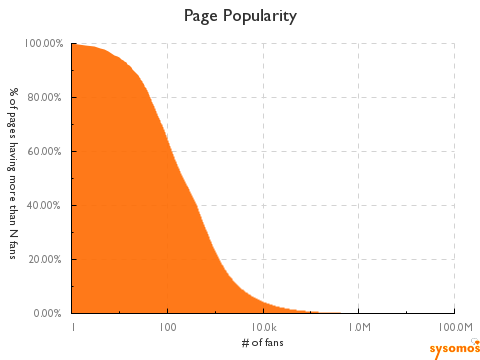
Facebook power lawPerfect media equality is impossible.  There has never been anything close to “equal outcomes” when it comes to the distribution or relative success of old media: books, magazines, music, movies, book, theater tickets, etc.  A small handful of titles have always dominated, usually according to a classic “power law” or “80-20? distribution, with roughly 20% of the titles getting 80% of the traffic / revenue.

But here’s the really interesting thing: This trend is increasing, not decreasing, for newer and more “democratic” online media.  As I pointed out in two previous essays [“YouTube, Power Laws & the Persistence of Media Inequality” & “Cuban on Fragmentation & Attention in the Blogosphere (or Why Power Laws Really Do Govern All Media)”], there is solid evidence that blogs, YouTube, Twitter, and other digital media outlets and platforms not only follow a classic power law distribution but that the distribution is even more heavily skewed toward the “fat head” of the distribution curve, not “the long tail” of it.

The latest evidence of the persistence of power laws across media comes from Facebook. Erick Schonfeld has a new essay up at TechCrunch (“It’s Not Easy Being Popular. 77 Percent Of Facebook Fan Pages Have Under 1,000 Fans“) highlighting some new findings from an upcoming report by Sysomos, a social media monitoring and analytics firm. Here’s the summary from Schonfeld: Continue reading →

Yo people, help me build this list of the best Internet and digital technology (“Info-Tech”) policy reporters on Twitter:

http://twitter.com/AdamThierer/infotech-policy-reporters/members

I’m trying to make sure I’m following the best reporters out there who cover public policy developments related to the Internet, cyberlaw, digital media, and so on. I’ve got just under 50 reporters on there currently, but I’m sure I’m missing some.  I would love to get some other suggestions about who is missing from my list, and I encourage others to follow my list if they find it a useful way to keep track of some of the best reporters on this beat.

Incidentally, I do understand it is hard to define exactly who counts as a “reporter” these days, but my general rule of thumb here is that (I think) almost everybody on my list actually gets paid to write about these issues.  In other words, I kept tech policy bloggers off this list. There’s just too many of them to count.

by Berin Szoka & Adam Thierer, Progress Snapshot 5.11 (PDF)

Ten years ago, Nobel Prize-winning economist Milton Friedman lamented the “Business Community’s Suicidal Impulse:” the persistent propensity to persecute one’s competitors through regulation or the threat thereof. Friedman asked: “Is it really in the self-interest of Silicon Valley to set the government on Microsoft?” After yesterday’s FCC vote’s to open a formal “Net Neutrality” rule-making, we must ask whether the high-tech industry—or consumers—will benefit from inviting government regulation of the Internet under the mantra of “neutrality.”

The hatred directed at Microsoft in the 1990s has more recently been focused on the industry that has brought broadband to Americans’ homes (Internet Service Providers) and the company that has done more than any other to make the web useful (Google). Both have been attacked for exercising supposed “gatekeeper” control over the Internet in one fashion or another. They are now turning their guns on each other—the first strikes in what threatens to become an all-out, thermonuclear war in the tech industry over increasingly broad neutrality mandates. Unless we find a way to achieve “Digital Détente,” the consequences of this increasing regulatory brinkmanship will be “mutually assured destruction” (MAD) for industry and consumers.

New Fronts in the Neutrality Wars

The FCC’s proposed rules would apply to all broadband providers, including wireless, but not to Google or many other players operating in other layers of the Net who favor such broadband-specific rules. With this rulemaking looming, AT&T came after Google with letters to the FCC in late September and then another last week accusing the company of violating neutrality principles in their business practices and arguing that any neutrality rules that apply to ISPs should apply equally to Google’s panoply of popular services. In particular, AT&T accused Google of “search engine bias,” suggesting that only government-enforced neutrality mandates could protect consumers from Google’s supposed “monopolist” control.

The promise made yesterday by the FCC—to only apply neutrality principles to the infrastructure layer of the Net—is hollow and will ultimately prove unenforceable. Continue reading →

Some of the most prominent Internet companies sent a letter yesterday asking for protection from market forces. Among them: Facebook, Google, Amazon, and Twitter.

A Washington Post story summarizes their concerns: “[W]ithout a strong anti-discrimination policy, companies like theirs may not get a fair shot on the Internet because carriers could decide to block them from ever reaching consumers.”

No ISP could block access to these popular services and survive, of course. What they could do is try to charge the most popular services a higher tarriff to get their services through. Thus, weep the helpless, multi-billion-dollar Internet behemoths, we need a “fair shot”!

Plain and simple, these companies want regulation to ensure that ISPs can’t capture a larger share of the profits that the Internet generates. They want it all for themselves. Phrased another way, the goal is to create a subsidy for content creators by blocking ISPs from getting a piece of the action.

It’s all very reminiscent of disputes between coal mines and railroads. The coal mines “produced the coal” and believed that the profitability of the coal-energy ecosystem should accrue only to themselves, with railroads earning the barest minimum. But where is it written that digging coal out of the ground is what creates the value, and getting it were it’s used creates none? Transport may be as valuable as “production” of both commodities and content. The market should decide, not the industry with the best lobbyists.

What happens if ISPs can’t capture the value of providing transport? Of course, less investment flows to transport and we have less of it. Consumers will have to pay more of their dollars out of pocket for broadband, while Facebook’s boy CEO draws an excessive salary from atop a pile of overpriced stock holdings. The irony is thick when opponents of high executive compensation support “net neutrality” regulation.

Another reason why these Internet companies’ concerns are bogus is their size and popularity. They have a direct line to consumers and more than enough capability to convince consumers that any given ISP is wrongly degrading access to their services. As Tim Lee pointed out in his excellent paper, The Durable Internet, ownership of a network service does not equate to control. ISPs can be quickly reined in by the public, as has already happened.

A “net neutrality” subsidy for small start-up services is also unnecessary: They have no profits to share with ISPs. What about mid-size services—heading to profitability, but not there yet? Can ISPs choke them off? Absolutely not.

Large, established companies are not known for being ahead of trends, for one thing, and the anti-authoritarian culture of the Internet is the perfect place to play “beleagured upstart” against the giant, evil ISP. There could be no greater PR gift than for a small service to have access to it degraded by an ISP.

The Internet companies’ plea for regulation is bogus, and these companies are losing their way. The leadership of these companies should fire their government relations staffs, disband their contrived advocacy organization, and get back to innovating and competing.

I really appreciate the venture capitalists (VCs) in Silicon Valley subsidizing my soapbox at Twitter.  Seriously, it is an absolutely awesome platform for getting a message out to the masses.  But at some point I worry that the gravy train will come to an end and that users will have to start picking up part of the tab.  After all, will those VCs continue to subsidize Twitter if it never turns a profit?  According to the Wikipedia entry about Twitter:

In total, Twitter has raised over US$57 million from venture capitalists. The exact amounts of funding have not been publicly released. Twitter’s first round of funding was for an undisclosed amount that is rumored to have been between $1 million and $5 million. Its B round of funding in 2008 was for $22 million and its C round of funding in 2009 was for $35 million from Institutional Venture Partners and Benchmark Capital along with an undisclosed amount from other investors including Union Square Ventures and Spark Capital. Twitter is backed by Union Square Ventures, Digital Garage, Spark Capital, and Bezos Expeditions.

Again, thank you VCs!  But, like them, I do wonder when and how Twitter will bring in some cash.  Is there a “freemium” model that could work?  Perhaps.  “Pro” or corporate accounts have been rumored to be in the works.  Getting someone else to pick up the tab that way might bring in enough cash for Twitter to allow the free ride to continue for the rest of us.  But what about advertising?  It’s been the “mother’s milk” of most online media and platforms for some time now, and Twitter seems perfectly suited to insert a few banner ads or contextual ads here and there.  It could be happening sooner than you think. Austin Modine of The Register notes in a new piece, “Twitter ‘Leaves Door Open’ for Targeted Ads,” that: Continue reading →

I vented my frustration earlier today with the FCC’s failure to make comments it receives easily accessible to the public—which means, more than anything, making them full-text searchable. This may seem like Inside Baseball to many, but it’s not. It’s a failure of the democratic process, a waste of taxpayer dollars, and a testimony to the general incompetence of bureaucracies, regardless of who’s running them. It denies the public an easy way to follow what goes on inside Washington, while essentially subsidizing law firms who get to bill clients for having paralegals or junior associates do things that existing web technology makes completely unnecessary—like reading through every comment in a document (at the rate of hundreds of dollars per hour) instead of just looking for keywords in a full-text search.

Later in the day the FCC announced:

  1. RSS feeds for all news from the agency  (1 general feed + 48 issue-specific feeds);
  2. FCC Connect” a page for Social Media Sites—so you can follow the FCC on Twitter and become a fan on Facebook; and
  3. A “crowdsourcing platform” to discuss the administration’s plan to transfer nearly $8 billion from taxpayers to broadband providers.

I’m thrilled about the RSS feeds, which go a long way in letting all Americans know what the FCC does, supposedly in the “public interest.” Still, I can’t help but note that the FCC waited until after a huge discussion about whether RSS is dead to finally start using RSS in a serious way—fully a decade after the birth of the RSS standard. Better late than never, I suppose.

FCC Connect is also good news: once you have an RSS feed, there’s really no reason not to pipe that feed into as many platforms as possible—which is precisely why RSS isn’t dead, even if most people will never use an RSS reader.

But I’m less thrilled about the crowdsourcing platform. Continue reading →

You might have noticed that we’ve added a Tweetmeme button at the top of each TLF post showing how many times each post has been “retweeted” on Twitter. If you like a TLF post, please take a second to retweet it. Retweeting is an easy way to spread the TLF’s message that politicians should keep their hands off the ‘Net and everything else related to technology! Here are three ways you can help us with viral marketing the message of technology freedom:

  1. If you’re already signed into Twitter, clicking the green “retweet” button will take you to Twitter with a retweet ready to go (“RT @techliberation “). You just have to click “Update.”
  2. You can make retweeting even easier—just one click!—by connecting your Twitter account with Tweetmeme. Just sign in to Tweetmeme with your Twitter log-in and select “Allow” to enable TweetMeme to automatically send your retweets to your Twitter account.
  3. You can tweet your comments on our posts by logging in with your Twitter account or using a Disqus account (assuming you’ve linked Twitter to your Disqus Profile). Each tweeted comment will count as a retweet of the post.

If you click the gray tweetcount button, you’ll be taken to Tweetmeme statistics about that particular post. One of my posts last week really took off, getting over 150 retweets! You can follow the TLF on twitter here and find links to individual TLF authors’ feeds here.

If you’re not already on Twitter, you can use but Tweet counts as an indicator of which TLF posts are hottest. But what are you waiting for, anyway? You’d better claim your name on Twitter before someone else does! It’s easy to set up an account and free, of course, and you can add followers from your webmail contacts. If nothing else, you can easily pipe your Tweets into Facebook as status updates. If you think Twitter is a stupid fad, Kevin Spacey and David Letterman may agree with you. But what do they really know about technology?

http://www.youtube.com/v/2Z1aZ7Gs46A