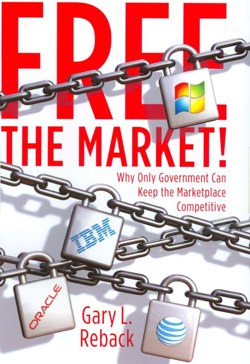
 I recently finished reading Free the Market: Why Only Government Can Keep the Marketplace Competitive, a new book by noted antitrust agitator Gary L. Reback. Unsurprisingly, Reback, who led the antitrust jihad against Microsoft during the 1990s, has written a book that reads like an extended love letter to antitrust law. This man loves antitrust the way teenage girls love the Jonas Brothers — gushing, teary-eyed, ‘I-would-just-die-for-you’ sort of love. In Reback’s world, antitrust seemingly has no costs, no downsides, no trade-offs. It is our salvation and he serves as its high prophet. Everything good that happened in the world of high-tech over the past few decades? Oh, you can thank Almighty Antitrust for that. Anything bad that happened? Well, then, clearly there just wasn’t enough antitrust enforcement! That’s this book in a nutshell.
Think I’m kidding? How about this gem of quote from pg. 247: “Antitrust enforcement spawned Silicon Valley’s software industry as well.” Wow, who knew! Of course, that’s utter poppycock and should be somewhat insulting to the many entrepreneurial men and women in the high-tech world who risked everything in an attempt to build a better mousetrap. In Reback’s view of things, however, none of those mousetraps would have ever gotten built without antitrust there to supposedly shelter them from wicked “monopolists” (read: any large company) already operating in the marketplace. I’m sure many in Silicon Valley will also be surprised to hear Reback’s assertion that, “On closer examination, the Valley looks like one big public welfare project.” (p. 54) Ah yes, the old myth that government gave us the Net we know and love today. Please. Like many others, Reback spins a revisionist history of how early ARPANET involvement and seed money somehow made the Internet great when, in reality, the Net was stuck in the digital dark ages until it was finally allowed to be commercialized in 1992.
What irks me most about this book, however, is Reback’s perpetuation of the myth that antitrust is somehow not a form of economic regulation. I hear this tired old argument trotted out time and time again, even by many conservatives. Reback says, for example, that “Antitrust sets the rules of the road, so to speak, but doesn’t tell people where to drive.” By contrast, he argues, “Advocates of regulation want[] continuing government oversight and rule making to produce what would be the beneficial results of a free market… Neither approach works all the time, and decided between them remains difficult.” (p. 19) Again, this “choice” is largely a fiction since, for many industries, we end up getting both! Continue reading →
 The Federal Trade Commission (FTC) has just announced it will be hosting:
a series of day-long public roundtable discussions to explore the privacy challenges posed by the vast array of 21st century technology and business practices that collect and use consumer data.” Such practices include social networking, cloud computing, online behavioral advertising, mobile marketing, and the collection and use of information by retailers, data brokers, third-party applications, and other diverse businesses. The goal of the roundtables is to determine how best to protect consumer privacy while supporting beneficial uses of the information and technological innovation. The roundtable discussions will consider the risks and benefits of information collection and use in online and offline contexts, consumer expectations surrounding various information management practices, and the adequacy of existing legal and self-regulatory regimes to address privacy interests.
The first of these roundtables will be held on December 7, 2009 at the FTC Conference Center in Washington, D.C. Additional information can be found here.
I’m sure my colleague Berin Szoka will have much more to say about this in coming days and weeks — and I very much hope the FTC will invite him in to testify — but, for now, I just want to reiterate the three key challenges we have been posing again and again and again and again in all our work on this subject:
- Identify the harm or market failure that requires government intervention.
- Prove that there is no less restrictive alternative to regulation.
- Explain how the benefits of regulation outweigh its costs.
I hope those issues are front and center at these workshops and we get some firm answers because the dangers of breaking the very few Internet business models that actually work is a very steep price to pay for the conjectural harms bandied about by some privacy zealots.
In a past life — that is, from roughly 1994-2004 — I spent an enormous amount of time countering the proponents of “open access” regulation for communications and high-tech networks. My work in that field culminated in the publication of a 2003 book with my old Cato colleague Wayne Crews entitled, What’s Yours is Mine: Open Access & the Rise of Infrastructure Socialism. We aimed to counter the efforts of bureaucrats and central planners to command technology companies and industry sectors to share networks, facilities, or specific technologies with rivals in the name of “competition.” Simply stated, sharing is not competing, and
competition in the creation of networks is just as important as competition in the goods, services, and information that move across those networks. Moreover, there are property right considerations that come into play when governments seek to commandeer networks or take over network management decisions.
But let’s just stick to the economic issue here regarding the incentives created by the network-sharing mentality of the “forced access” movement and the fiction associated with the belief that network sharing can create competition. My old PFF colleague Randy May, who currently serves as President of the Free State Foundation, continues to cover developments in this field far closer than I do, and has always done much better work on the subject than me. Recently, Randy addressed some new fictions put forth by the radical Leftist activity group, the (Un-)Free Press who are, once again, spinning a revisionist history of telecom and media policy. Specifically, Free Press has recently suggested that in the late 1990s we lived in a veritable communications nirvana, with thousands of Internet Service Providers and/or “competitive exchange carriers” hotly “competing” for our business. Here’s how Randy May addresses this:
Continue reading →
 Sometimes the most revealing conversations about policy issues happen with our loved ones at the breakfast table. Although loyal TLF readers may remember my partner Michael as my “Posterboy for Advertising’s Pro-Consumer Quid Pro Quo,” he doesn’t usually get into the policy issues I cover. But this morning, we fell into a conversation about the bitterly contentious issue of marketing to kids:
Michael: Growing up in South Korea, on a military base, we didn’t have any commercials on television. We had three channels and all they showed was public service announcements.
Sounds like paradise for anti-advertising zealots like Jeff Chester and the media reformistas who want to re-create the old media scarcity in the name of “media democracy“! Anyway:
We moved back to the U.S. when I was nine, and suddenly, during all my favorite cartoons, there were ads for toys. It was exciting—and more than a little bit overwhelming! It wasn’t just that I wanted these toys; it was that felt this incredible sense of urgency: I thought we had to go get the toys right now or they’d be gone!
What did Rousseau call his innocent man, the Noble Savage? That’s what we were: The noble savage, coming into this world of sophisticated toy advertisements.
But it didn’t take long for me to get over this initial bewilderment. My parents explained to me that we didn’t really have to go to the store
right away. (They also explained to me that I couldn’t haggle with the staff at Toys ‘R Us the same way I’d haggled with street vendors back in Korea—something that utterly mystified the staff.) After one trip to Toys Toys ‘R Us, I got the toys I wanted most and, over the next few months, realized that they weren’t anywhere near as exciting as I had imagined.
After that, I enjoyed the toy ads on TV, but I lost interest in many of the toys I already had, preferring to create my own toys or play outside.
I explained that advertising of toys to kids has long been the
cause celebre of anti-advertising crusaders:
Michael: But kids are acquisitive, too! How are they supposed to know about the latest toys if you can’t advertise to them? And what’s the big deal, anyway? I got used to toy ads and I think most kids would, too. The thing that’s different is incentive programs at stores.
Continue reading →
Berin has already done a fine job tearing apart this latest effort by 10 activist groups to break the Internet by imposing burdensome regulation or punishing legal liability on Internet operators for the crime of trying to deliver relevant advertising to users that can actually pay for the content and services given away to users for free. To that, I would add my deep disappointment that the Electronic Freedom Foundation (EFF) choose to join this cabal. After all, the other members of the coalition are frequently heard calling for regulation of one variety or another. But EFF always prides itself on supposedly avoiding online regulatory schemes. That’s what makes it so surprising that they chose to jump on this bandwagon for an Internet industrial policy in the name of “protecting privacy.”
EFF’s embrace of regulation is particularly inconsistent given their excellent filing in the FCC’s “Child Safe Viewing Act” proceeding this summer. As I’ve previously noted, this proceeding raises the specter of “convergence-era content regulation” with Congress authorizing the FCC to look into “advanced blocking controls” for “wired, wireless, and Internet” platforms. EFF’s comments rightly stressed dangers of expanded content controls or Internet regulation, and noted the many “less-restrictive means” available to the public that provide compelling alternatives to government regulation: “Blocking technologies are widely available in the market and do not require further government support.” And EFF has been instrumental throughout the years of making the case in courts for applying the less-restrictive means test and strict scrutiny when it comes to government efforts to regulate speech.
Why, then, does EFF take the diametrically opposite position when privacy concerns enter the picture? Continue reading →
A coalition of ten self-described “consumer and privacy advocacy organizations” today demanded legislation that would restrict the collection and use of data online for customizing advertising based on Internet users’ interests. I’ll have more to say on this but here are my initial comments:
These so-called “consumer advocates” are actually anti-consumer elitists. Not only do they presume that consumers are too stupid or lazy to make their own decisions about privacy, but they ignore the benefits to consumers: more relevant advertising plus more and better content.
Advertising has been the “mother’s milk” of media in America since colonial times and the future of media depends on the ability of publishers to replicate that revenue model online. Micropayments, donations, subscriptions alone simply can’t fund a vibrant marketplace of ideas. Only personalized advertising can sustain publishers through the Digital Revolution.
Regulatory advocates haven’t demonstrated any harm to consumers that would justify such sweeping preemptive regulation. By strangling funding for new media, such regulations would amount to an “Industrial Policy” for the Internet. Instead, policymakers should focus on educating consumers and empowering them by promoting development of better privacy management tools.
Make sure to read George Ou’s two recent articles over at the Digital Society blog setting the record straight about broadband usage caps: “Putting American Bandwidth Caps into Context” and “We Need to be Reasonable about Broadband Usage Caps.” George is one sharp cookie. I particularly like the way he takes apart Free Press for their hypocrisy on this issue, something I have commented on here before after George brought it to my attention. See:
… and here’s some older material on the issue…
 by Adam Thierer & Berin Szoka — (Ver. 1.0 — Summer 2009)
We are attempting to articulate the core principles of cyber-libertarianism to provide the public and policymakers with a better understanding of this alternative vision for ordering the affairs of cyberspace. We invite comments and suggestions regarding how we should refine and build-out this outline. We hope this outline serves as the foundation of a book we eventually want to pen defending what we regard as “Real Internet Freedom.” [Note: Here’s a printer-friendly version, which we also have embedded down below as a Scribd document.]
I. What is Cyber-Libertarianism?
Cyber-libertarianism refers to the belief that individuals—acting in whatever capacity they choose (as citizens, consumers, companies, or collectives)—should be at liberty to pursue their own tastes and interests online.
Generally speaking, the cyber-libertarian’s motto is “Live & Let Live” and “Hands Off the Internet!” The cyber-libertarian aims to minimize the scope of state coercion in solving social and economic problems and looks instead to voluntary solutions and mutual consent-based arrangements.
Cyber-libertarians believe true “Internet freedom” is freedom
from state action; not freedom for the State to reorder our affairs to supposedly make certain people or groups better off or to improve some amorphous “public interest”—an all-to convenient facade behind which unaccountable elites can impose their will on the rest of us.
Continue reading →
What Unites Advocates of Speech Controls & Privacy Regulation? [pdf]
by Adam Thierer & Berin Szoka
The Progress & Freedom Foundation,
Progress on Point No. 16.19
Anyone who has spent time following debates about speech and privacy regulation comes to recognize the striking parallels between these two policy arenas. In this paper we will highlight the common rhetoric, proposals, and tactics that unite these regulatory movements. Moreover, we will argue that, at root, what often animates calls for regulation of both speech and privacy are two remarkably elitist beliefs:
- People are too ignorant (or simply too busy) to be trusted to make wise decisions for themselves (or their children); and/or,
- All or most people share essentially the same values or concerns and, therefore, “community standards” should trump household (or individual) standards.
While our use of the term “elitism” may unduly offend some understandably sensitive to populist demagoguery, our aim here is not to launch a broadside against elitism as
Time magazine culture critic William H. Henry once defined it: “The willingness to assert unyieldingly that one idea, contribution or attainment is better than another.”[1] Rather, our aim here is to critique that elitism which rises to the level of political condescension and legal sanction. We attack not so much the beliefs of some leaders, activists, or intellectuals that they have a better idea of what it in the public’s best interest than the public itself does, but rather the imposition of those beliefs through coercive, top-down mandates.
That sort of elitism—elitism enforced by law—is often the objective of speech and privacy regulatory advocates. Our goal is to identify the common themes that unite these regulatory movements, explain why such political elitism is unwarranted, and make it clear how it threatens individual liberty as well as the future of free and open Internet. As an alternative to this elitist vision, we advocate an empowerment agenda: fostering an environment in which users have the tools and information they need to make decisions for themselves and their families. Continue reading →
I’ve spent a lot of time here deconstructing and criticizing the proposals set forth by the Free Press, the radical media “reformista” group founded by the prolific Marxist media theorist Robert McChesney. I have been trying to shine more light on their proposals and activities because I believe they are antithetical to freedom of speech and a free society. That’s because, as media scholar Ben Compaine has noted, “What the hard core reformistas really want, it seems, is not diversity or an open debate but a media that promotes their own vision of society and the world.” That’s exactly right and, more specifically, as I argued in my 2005 Media Myths book, the media reformistas want to impose this control by taking the fantasy that “the public owns the [broadcast] airwaves” and extending it to ALL media platforms and outlets. In other words, McChesney and the Free Press want an UnFree Press. To cast things in neo-Marxist terms that they could appreciate, they want to take control of the information means of production. And it begins, McChesney argues, by all of us having to give up this “sort of religious attachment to the idea of a ‘free-press'” from which we all suffer.
Some people accuse me of “red-baiting” or “McCarthyite” tactics when I use the “M-word” (Marxism) or the “S-Word” (socialism) to describe McChesney, the Free Press, and the movement they have spawned. But these are labels with real meaning and ones that McChesney himself embraces in his work. In his 1999 book
Rich Media, Poor Media, he says that “Media reform cannot win without widespread support and such support needs to be organized as part of a broad anti-corporate, pro-democracy movement.” He casts everything in “social justice” terms and speaks of the need “to rip the veil off [corporate] power, and to work so that social decision making and power may be made as enlightened and as egalitarian as possible.” What exactly would all that mean in practice for media? In his 2002 book Our Media, Not Theirs: The Democratic Struggle against Corporate Media with John Nichols of The Nation, McChesney argues that media reform efforts must begin with “the need to promote an understanding of the urgency to assert public control over the media.” They go on to state that, “Our claim is simply that the media system produces vastly less of quality than it would if corporate and commercial pressures were lessened.”
If you want additional proof of his intentions, then I encourage you to read this lengthy interview with McChesney that appears in the new edition of The Bullet, an online newsletter produced by the Canada-based “Socialist Project.” (If you ask me, there’s something strangely appropriate about a socialist newsletter named “The Bullet” in light of the millions of people who died while living under socialist tyranny!) Anyway, let’s ignore that and focus on what neo-Marxist media reform entails according to McChesney. Because never before has he laid his cards on the table as clearly as he does in this interview. Continue reading →

 The Technology Liberation Front is the tech policy blog dedicated to keeping politicians' hands off the 'net and everything else related to technology.