Posts tagged as:

More restraint is in order when it comes to the Obama administrations intent to escalate “antitrust” enforcement against business and enterprise in America.

A skeptical interpretation of antitrust’s realities—up to and including recent campaigns targeting Intel, Google, XM-Sirius; and earlier campaigns against Microsoft and the AOL Time Warner merger, as well as rejected mergers like Echostar/DirecTV—is that antitrust often advances the well being of various species of political predators rather than consumers.

Antitrust is a form of economic regulation. And like all economic regulation, it transfers wealth from somebody to somebody else, often in response to special-interest urging. Partly in recognition of such shortcomings, many economic sectors like transportation and telecommunications were (partly) deregulated and liberalized during the last quarter of the 20th century. But antitrust regulation typically gets a pass. Even in the “new economy,” this century-old smokestack era concept is used to justify constraints and conditions imposed on vigorously competitive modern companies. Antitrust is wrongly seen as being in the public interest, as having a superior role to play in policing markets relative to the alternatives.


Continue reading →

iphoneDespite my frequent disagreements with his policy conclusions, Farhad Manjooo of Slate is one of the most gifted tech policy pundits around today and everything he writes is worth reading (and I whole-heartedly agreed with his recent article on the high-tech and antitrust).  Alas, I find myself again disagreeing with him again today.

In his latest column, “The Great iPhone Lockdown: Should the FCC force Apple to sell Google’s apps?” Manjoo responds to a recent essay by TLF contributor Ryan Radia (“Newsflash to FCC: The iPhone is a Closed Platform, and Consumers Love It“). In that essay, Ryan generally argued that: (a) a lot of people own and love the iPhone despite some silly restrictions on certain apps; and (b) if they don’t like that, there are plenty of other options from which they can choose. Consequently, regulation seems unwarranted and likely highly misguided in light of the potential unitended consequences in might yield.  It’s an argument I very much agree with, of course.  Anyway, Manjoo responds:

Radia’s argument isn’t crazy. Just the other day, I argued that the government shouldn’t go after Google for antitrust violations because the tech industry is fluid; companies that are on top today can fall tomorrow. So what if Apple rejects apps capriciously? If its actions are so terrible, consumers will eventually abandon it.

But then Manjoo counters that argument and goes completely off-the-rails with several assertions that I find quite perplexing: Continue reading →

Nick Wingfield has a great piece in today’s WSJ: Yahoo Tie-Up Is Latest Sign Tide Turning for Microsoft’s Ballmer (subscription required but can be found through a Google News search) about how Microsoft’s fortunes may be looking up across the board—especially with yesterday’s Yahoo!/Microsoft search/advertising partnership. The most interesting passage is this one:

For [Microsoft CEO Steve] Ballmer, the agreement provides some redemption in an area he has stressed is critical to Microsoft’s future. In an interview, he says the Yahoo deal received “more of my personal attention over the last 18 months than anything else we’re involved with,” including focusing on its most important new product in years, Windows 7. “It’s a big deal,” he says.

Of course, complex partnerships always require lots of time from senior management, but in this case, Ballmer’s quip speaks directly to the costs of antitrust scrutiny in terms of one of the most valuable resources available to any company: the time and attention of senior management. The “attentional cost” can of this deal for Microsoft could be broken into four parts beyond the normal costs of structuring any deal to make the most business sense:

  1. How to structure the a Microsoft/Yahoo! deal so that it would be approved by regulators (defensive);
  2. How to block a Google/Yahoo! deal (offensive);
  3. Nursing the deal through the regulatory approval process over the coming months; and
  4. The possibility that all of these costs could be wasted, to varying degrees, if antitrust regulators decide to block or restrict the deal.

These are all “deadweight losses” on the economy pure and simple—and ultimately costs to consumers.

Continue reading →

We’ve just published an op-ed over at Forbes.com about today’s big Yahoo!-Microsoft deal.


Searching For Success: Web 1.0 Titans Struggle to Reinvent Themselves by Berin Szoka & Adam Thierer

Yahoo! and Microsoft on Wednesday announced a partnership in which Microsoft’s Bing search engine technology will power search for both companies, but Yahoo! will manage advertising sales and content creation.

This should be cause for celebration as a good thing for consumers. By providing a strong competitor with a combined 28% market share, the deal should also be a source of relief at Google, which has come under increasing attack for its supposed market dominance. But if recent concerns about online search, advertising, competition and privacy are any guide, many will fail to appreciate why the deal is pro-consumer, or what it says about the rapid evolution of the Internet.

It’s easy to forget that just a decade ago most of us still hadn’t done our first Google search, Microsoft was still focused on the desktop and Yahoo! was still serving up the online equivalent of the Yellow Pages. AltaVista, AOL, CompuServe and Geocities still ruled the roost.

Today, as we enjoy the fruits of a true cyber-renaissance, cyberspace circa 1999 increasingly looks like the Digital Dark Ages: The old online walled gardens have crumbled, desktop applications have migrated to the cloud and search has redefined our experience of the Web.

Oh, and did we mention just about all of it is “free“? Sounds like exactly the sort of vigorous innovation, expanding consumer choice, falling prices and cut-throat competition that policymakers should want, right?

Alas, regulators seem stuck in the past. European officials in particular seem hell-bent on continuing the antitrust crusade of the ’90s against Microsoft, myopically focused on fading paradigms (desktop operating systems and Web browsers). But instead of narrowly defining high-tech markets based on yesterday’s technologies or market structures, policymakers should embrace the one constant of the Internet economy: dynamic, disruptive and irrepressible change.

Continue reading →

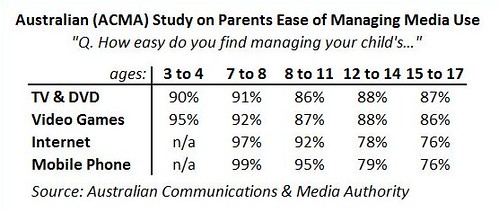
An interesting new survey has just been released by the Australian Communications and Media Authority (ACMA), which is the rough equivalent of the Federal Communications Commission here in the U.S., but with somewhat broader authority. ACMA’a latest report is entitled Use of Electronic Media and Communications: Early Childhood to Teenage Years and it takes a look at media technology usage among Australian youngsters in 5 age groupings (3 to 4 years of age, 7 to 8, 8 to 11, 12 to 14, and 15 to 17).

The survey also asked Australian parents “How easy do you find managing your child’s ___ use.”  They asked that question for four different media or communications technologies: TV & DVD; video games; Internet; and mobile devices.  They results, summarized in the table below, were quite interesting and seem to indicate that Australian parents find it much easier to manage their children’s media use than some of their elected leaders imagine.

Australian ACMA parents ease of use survey

Continue reading →

I’ve just had a new article published by the American Legislative Exchange Council (ALEC) in which I make the case against “techno-panics,” which refers to public and political crusades against the use of new media or technologies by the young. The article is entitled “Parents, Kids & Policymakers in the Digital Age: Safeguarding Against ‘Techno-Panics‘” and it appears in the July 2009 Inside ALEC newsletter.  This is something I have spent a lot of time writing about here in recent years (See 1, 2, 3, 4, 5) and I finally got around to putting it altogether in a concise essay here.  I have pasted the full text below. [And I just want to send a shout-out to my friend Anne Collier of Net Family News.org, whose work on this topic has been very influential on my thinking.]


Parents, Kids & Policymakers in the Digital Age: Safeguarding Against ‘Techno-Panics‘” by Adam Thierer

A cursory review of the history of media and communications technologies reveals a reoccurring cycle of “techno-panics” — public and political crusades against the use of new media or technologies by the young.  From the waltz to rock-and-roll to rap music, from movies to comic books to video games, from radio and television to the Internet and social networking websites, every new media format or technology has spawned a fresh debate about the potential negative effects they might have on kids.

Inevitably, fueled by media sensationalism and various activist groups, these social and cultural debates quickly become political debates. Indeed, each of the media technologies or outlets mentioned above was either regulated or threatened with regulation at some point in its history. And the cycle continues today. During recent sessions of Congress, countless hearings were held and bills introduced on a wide variety of media and content-related issues. These proposals dealt with broadcast television and radio programming, cable and satellite television content, video games, the Internet, social networking sites, and much more.  State policymakers, especially state Attorneys General (AGs), have also joined in such crusades on occasion.  The recent push by AGs for mandatory age verification for all social networking sites is merely the latest example.

What is perhaps most ironic about these techno-panics is how quickly yesterday’s boogeyman becomes tomorrow’s accepted medium, even as the new villains replace old ones.  For example, the children of the 1950s and 60s were told that Elvis’s hip shakes and the rock-and-roll revolution would make them all the tools of the devil. They grew up fine and became parents themselves, but then promptly began demonizing rap music and video games in the ‘80s and ‘90s.  And now those aging Pac Man-era parents are worried sick about their kids being abducted by predators lurking on MySpace and Facebook. We shouldn’t be surprised if, a decade or two from now, today’s Internet generation will be decrying the dangers of virtual reality.

Continue reading →

In an earlier post, I mentioned an important new online child safety task force report that has just been released from the “Point Smart. Click Safe.” Blue Ribbon Working Group. It’s a great report and I encourage you to read the whole thing. It was my great pleasure to serve on this task force, and as we started finalizing our conclusions and recommendations, I started thinking about how much of what we were finding and recommending was consistent with what past online safety task forces had also concluded.

By way of background, over the past decade, five major online safety task forces or blue ribbon commissions have been convened to study online safety issues. Two of these task forces were convened in the United States and issued reports in 2000 (“COPA Commission”) and 2002 (“Thornburgh Commission“). Another was commissioned by the British government in 2007 and issued in a major report in March 2008 (“Byron Review“). Finally, two additional online safety task forces were formed in the U.S. in 2008 and concluded their work, respectively, in January (“Internet Safety Technical Task Force“) and July (“Point Smart. Click Safe.“) of 2009. [And yet another task force — the Online Safety Technology Working Group — was recently formed and has now gotten underway.]

In a new PFF white paper, ” Five Online Safety Task Forces Agree: Education, Empowerment & Self-Regulation Are the Answer,” I walk through a chronological summary of each of these past task forces [click on covers of each report below to read them in their entirety] and highlight some of the similar themes and recommendations from them.

COPA Commission cover Thornburgh Commission cover Byron Commission report cover

ISTTF cover Point Smart Click Safe report cover Continue reading →

The advocates of regulation pay lip service to the importance of advertising in funding online content and services but don’t seem to understand that this quid pro quo is a fragile one:  Tipping the balance, even slightly, could have major consequences for continued online creativity and innovation.

Michael-Mr-YogatoWho is this handsome young man and why does he have “Mr. Yogato Stamped Me!!!” on his forehead? More importantly, why does he look so darn happy?

Flashback: Earlier this week, my partner Michael (pictured) and I visited Mr. Yogato, a frozen yogurt shop in Washington’s Dupont Circle neighborhood which describes itself as “the FUNNEST yogurt experience you’ll ever have.”

Apart from serving exceptionally tasty frozen yogurt and letting customers play a vintage Nintendo, Mr. Yogato is famous for the eight “Rules of Yogato,” which offer discounts if users achieve certain feats, including:

  • Answering devilishly difficult trivia (10% off—or extra if you fail)
  • Reciting the Stirling battlefield speech from Braveheart in a great Scottish accent (20% off)

But the best discount, which Michael does every time (unless I’m there to help identify, say, countries that end in ‘L’), is offered for wearing the Yogato stamp on your forehead. Being stamped is, of course, almost as much fun as singing along to “Mr. Roboto” if you’re lucky enough to hear that played while you’re in the shop (10% off).  But the real fun is in engaging passersby on the street about the icy-sweet joys of Yogato. It’s also, of course, probably the most effective advertising Mr. Yogato could ever want.

So, the next time you hear Adam Thierer and I talk about the benefits of advertising, especially online, just remember that while there is no free lunch (nor free frozen yogurt), there is discounted frozen yogurt.  It’s a simple, obvious quid pro quo:  10% off in exchange for spreading the Gospel of Yogato. Continue reading →

Fred Vogelstein’s essay in Wired, “Great Wall of Facebook: The Social Network’s Plan to Dominate the Internet — and Keep Google Out” describes the intensifying clash between Google and Facebook—a clash that focuses on the ability to target advertising:

Like typical trash-talking youngsters, Facebook sources argue that their competition is old and out of touch. “Google is not representative of the future of technology in any way,” one Facebook veteran says. “Facebook is an advanced communications network enabling myriad communication forms. It almost doesn’t make sense to compare them.”

Apart from noting that Facebook directs users to Microsoft’s Bing as its default search engine for the Internet at large, the most interesting part of the article is Facebook’s “4-Step Plan for Online Domination”:

1. Build critical mass. In the eight months ending in April, Facebook has doubled in size to 200 million members, who contribute 4 billion pieces of info, 850 million photos, and 8 million videos every month. The result: a second Internet, one that includes users’ most personal data and resides entirely on Facebook’s servers. 2. Redefine search. Facebook thinks its members will turn to their friends—rather than Google’s algorithms—to navigate the Web. It already drives an eyebrow-raising amount of traffic to outside sites, and that will only increase once Facebook Search allows users to easily explore one another’s feeds. 3. Colonize the Web. Thanks to a pair of new initiatives—dubbed Facebook Connect and Open Stream—users don’t have to log in to Facebook to communicate with their friends. Now they can access their network from any of 10,000 partner sites or apps, contributing even more valuable data to Facebook’s servers every time they do it. 4. Sell targeted ads, everywhere. Facebook hopes to one day sell advertising across all of its partner sites and apps, not just on its own site. The company will be able to draw on the immense volume of personal data it owns to create extremely targeted messages. The challenge: not freaking out its users in the process.

Facebook can’t keep losing money forever.  Indeed, investors are willing to keep sinking money into Facebook during Phases 1-3 because they think it will pay off in Phase 4—when Facebook really threatens to be a fGoogle-killer.  But rather the fact that investors are willing to subsidize the creation of a wonderful platform now used by 200 million people (one fifth of all Internet users worldwide), or that Facebook might finally provide a counter-weight to the fearsome Google, the People for the Ethical Treatment of Data (PETD) are appalled.  One commenter on the Wired story put it best: Continue reading →

PFF Adjunct Fellow Mike Palage, who served on the ICANN board from 2003 to 2006, filed these comments (PDF) on the NTIA’s recent Notice of Inquiry regarding ICANN’s future.  Mike’s four key points were as follows:

  1. ICANN’s Periodic Review of its internal operations and supporting organizations has failed, and has become nothing more than a “perpetual motion machine of public comments and documentation producing no meaningful results.” Only a second Evolution and Reform Process can solve ICANN’s current deficiencies;
  2. ICANN must hardcode into its policies and its contracts the principle that its policies cannot supersede national laws;
  3. ICANN must cease any operational role in technical infrastructure as required by its bylaws and focus instead on its mission as a technical coordinator; and
  4. Congress must avoid “kicking the JPA can down the road” and instead provide much-needed leadership by creating a solid foundation for ICANN 3.0 in legislation after proper consultation with the Government Accountability Office.

Continue reading →