Posts tagged as:

A recent study by Cecil Bohanon and Michael Hicks at Ball State University’s Digital Policy Institute found that statewide cable franchising has increased broadband deployment.

Half of the US states have now enacted legislation that creates statewide cable franchising. These laws allow new entrants into the video business (principally the phone companies) to get permission to offer video from the state, instead of having to deal with local governments to get cable franchises. Previous research, much of it cited here, found that cable competition reduces cable rates and expands the number of channels available to subscribers. Local franchising often delayed or prevented new competitors from entering the market.

Since the same wires get used to transmit video, telephone, and broadband, Bohanon and Hicks reasoned that opening up entry into cable would also increase competition in broadband and hence increase broadband subscribership. And that’s precisely what their econometric study finds. After controlling for other factors, broadband subscribership is 2-5 percent higher in states that have statewide video franchising. Based on this finding, Bohanon and Hicks estimate that statewide video franchising increased broadband subscribership by about 5 million.

Their study covers the years 1999-2008. Maybe some of these 5 million would eventually have gotten broadband anyway. At worst, this study shows that 5 million subscribers got broadband sooner than they otherwise would have.

The study does not test whether the increase in broadband subscribership occurred because statewide video franchising sped up investment and deployment of infrastructure, or if it simply spurred competition in places where phone and cable companies already had the relevant infrastructure deployed.  I don’t know how one would get the confidential data on broadband investment in order to test this.  But given the large amount of new investment related to broadband, I’d be willing to bet that statewide franchising encouraged both new broadband deployment and more intense competition where infrastructure was already in place.

The Washington Post carried an article earlier this week by Cecilia Kang that noted the Federal Trade Commission could gain enforcement power over online businesses as a result of the financial services legislation under discussion in Congress. Ms. Kang contrasted the possibility of an empowered FTC issuing fast-track regulations against the recent experience of the Federal Communications Commission, which has become bogged down in its search for legal authority to issue net neutrality regulations. 

The comparison is insightful, but not for the reasons you might expect. Part of the debate over the FTC revolves around language in the House financial services bill that would repeal the “Magnuson-Moss” provisions that govern FTC promulgation of consumer protection regulations. (The name comes from the fact that these restrictions on FTC rulemaking were included in the Magnuson-Moss Warranty Act, which got the FTC into the business of regulating car warranties.)

If the FTC wants to regulate some type of general business practice under the FTC Act, it has to establish a factual record substantiating that there is actually a systemic problem that regulation can solve, hold a public hearing, allow cross-examination on factual matters, and conduct an economic analysis of the regulation’s effects.  In short, the commission has to do the homework necessary to demonstrate that its proposed regulation will actually solve a widespread problem that actually exists.

When Tim Muris directed the FTC’s Bureau of Consumer Protection in the early 1980s, he authored an article in Regulation magazine pointing out that when the FTC does careful analysis before issuing a rule, the rule is more likely to benefit consumers, more likely to be upheld in court, and more likely to be issued expeditiously. He contrasted the evidence-based eyeglass rule, which took three years to issue, with the anecdote-based funeral rule, which took ten. Muris noted wryly, “Some critics of my position charge that it is revolutionary to ask a body of lawyers and economists not to impose its own view of proper regulation on the world without first systematically evaluating the problem.” Muris went on to serve as chairman of the FTC between 2001-04, and last month he defended the Magnuson-Moss restrictions in testimony before Congress.  

What does this have to do with the FCC?  The FCC lost its case against Comcast on appeal, precisely because the FCC tried to take shortcuts. The FCC tried to promote net neutrality by enforcing a set of “principles” that originated in a former chairman’s speech and were never promulgated in a notice-and-comment rulemaking. The FCC commissioners endorsed these principles without investigating whether there was a systemic problem (ie, more than a few anecdotes of misbehavior). Indeed, Chairman Martin’s Notice of Inquiry on “Broadband Industry Practices” that was launched around the same time the FCC took its enforcement action against Comcast turned up no evidence of a systemic problem. If the FCC now tries to impose net neutrality by reclassifying broadband as a “Title II” common carrier, it will have to do the difficult but necessary work of demonstrating, with real factual evidence, that broadband is more like a common carrier than like the lightly-regulated “information service” the commission previously decided it was.

We don’t need Congress to free the FTC from Magnuson-Moss. Instead, Congress should impose the same requirements on the FCC. Sometimes, taking the time to do your homework leads to better decisions, sooner.

Wine (and beer) lovers who want to order hard-to-get vintages online have benefited greatly from federal court decisions that say state alcohol laws cannot discriminate against out-of-state sellers. Federal legislation introduced last week could threaten electronic commerce as it further entrenches middlemen who normally profit from every bottle of alcohol that passes from producers to consumers.

To understand what’s going on, you have to know something about Commerce Clause litigation. I’m not a lawyer, though I once played the teetotaling William Jennings Bryan character in a high school production of Inherit the Wind.  This proves my motives are pure. And since a lot of lawyers practice economics without a license, I figure I’ll return the favor.

The Commerce Clause of the US Constitution says that Congress, not the states, can regulate interstate commerce. A longstanding judicial interpretation, the “dormant” Commerce Clause, holds that if Congress has not chosen to regulate some aspect of interstate commerce, that means Congress doesn’t want the states to regulate it either.  So, normally a state can regulate interstate commerce only if Congress has given explicit permission.

If state law discriminates against out-of-state sellers who compete with in-state sellers, the state is regulating interstate commerce.  A state is not allowed to do this unless it can prove the discrimination is necessary to accomplish some clear state purpose that cannot be accomplished in some other way. States have to present evidence that proves these points, not just make arguments. 

The 21st Amendment, which repealed Prohibition, gave states the right to regulate alcohol.  Recent court cases involving direct wine shipment clarified that when states regulate alcohol, they must still obey the Commerce Clause. This makes good sense. Imagine if the 21st Amendment freed states from the rest of the Constitution when they regulate alcohol. The police could break into your house without warning if they imagined you might give your 20-year-old a beer, but they’d still need a search warrant if they thought you were cooking meth. 

In Granholm v. Heald (2005), the Surpeme Court said that states could either allow in-state and out-of-state sellers to ship wine directly to consumers, or prohibit it for both, but states couldn’t ban direct shipment for out-of-state sellers and allow it for in-state sellers. In response, most states have liberalized their direct shipment laws rather than making them more restrictive. In Family Wine Makers of California v. Jenkins (2008), federal courts said that an ostensibly neutral law that had a discriminatory effect on out-of-state sellers was also unconstitutional. Massachusetts had enacted a law that allowed only wineries producing 30,000 gallons or less to ship directly to consumers; the production cap was large enough to allow all in-state wineries to direct ship but small enough to exclude 637 larger out-of-state wineries that produce 98 percent of all wine in the United States.  The judge’s opinion essentially said, “By their fruits you shall know them,” and it reserved special grapes of wrath for the blatantly protectionist motives voiced by advocates of the law. Massachusetts appealed this decision to the First Circuit Court of Appeals, lost, and on April 12 decided not to appeal to the Supreme Court.

On April 15, Massachusetts Rep. Bill Delahunt introduced federal legislation that would turn alcoholic Commerce Clause litigation sideways. The legislation makes four big changes in the rules of the game:

  1. It says that states may not “facially discriminate without justification.” This standard might reverse Granholm, because the state laws were clearly discriminatory but the states offered justifications. It would likely reverse Family Wine Makers, because the law was “facially” neutral but had discriminatory effects. (Of course, if this thing passes, I’d be delighted to see a consumer or winery plaintiff prove me wrong.)
  2. It repeals the “dormant” Commerce Clause for alcohol by stating that congressional silence on interstate commerce in alcohol should not be interpreted as a prohibition on state regulation of interstate commerce in alcohol.
  3. It shifts the burden of proof by requiring that anyone challenging a state alcohol law must prove “by clear and convincing evidence” that the law is invalid. Normally, states have the obligation to present evidence that a discriminatory law accomplishes a state purpose and is no more discriminatory than necessary.  
  4. Any state law that burdens interstate commerce or contradicts any other federal law (!) would be upheld unless the person challenging it proves that the state law has no effect on temperance, orderly markets, tax collection, the structure of the distribution system, or underage drinking.  Since there’s plenty of economic evidence that state alcohol laws increase prices, a state could argue its laws reduce consumption and promote temperance, and the law would be upheld.  In other words, any state alcohol law that harms consumers by increasing prices would automatically be OK, even if it blatantly conflicted with other federal laws (such as antitrust laws, which are intended to protect consumers from the high prices associated with monopoly) or the Commerce Clause.

Word on the street is that the biggest pushers of this legislation are the beer wholesalers. Since most of this litigation has involved wine, what’s going on here?

The real goal of this legislation is not harrassing wineries that want to ship a few bottles to out-of-state customers. The real goal is to preserve anti-competitive state laws that force brewers, wine makers, and distillers to market most of their product through beer, wine, and spirits wholesalers, instead of marketing directly to retailers and restaurants. The proposed legislation would effectively insulate these state laws from challenge under the Commerce Clause, federal antitrust laws, or any other federal laws that might give alcohol producers and consumers some leverage to break the wholesalers’ lock on the market.

Call it states’ rights kool-aid with a chaser of economic protectionism.  A strange brew indeed.

As mentioned here before, PFF has been rolling out a new series of essays examining proposals that would have the government play a greater role in sustaining struggling media enterprises, “saving journalism,” or promoting more “public interest” content. We’re releasing these as we get ready to submit a big filing in the FCC’s “Future of Media” proceeding (deadline is May 7th).  Here’s a podcast Berin Szoka and I did providing an overview of the series and what the FCC is up to.

In the first installment of the series, Berin Szoka and I critiqued an old idea that’s suddenly gained new currency: taxing media devices or distribution systems to fund media content. In the second installment, I took a hard look at proposals to impose fees on broadcast spectrum licenses and channeling the proceeds to a “public square channel” or some other type of public media or “public interest” content. The third installment dealt with proposals to steer citizens toward “hard news” and get them to financially support it through the use of “news vouchers” or “public interest vouchers.”

In our latest essay, “The Wrong Way to Reinvent Media, Part 4: Expanding Postal Subsidies,” Berin and I argue that expanding postal subsidies won’t likely do much to help failing media enterprises, will raise the risk of greater meddling by politicians with the press, and can’t be absorbed by the Postal Service without a significant increase in cost for ratepayers or taxpayers.  The entire essay is attached down below.

Continue reading →

I have a long opinion piece on CNet today, arguing that much of the talk of “reclassifying” or “relabeling” broadband Internet access to bring it under the FCC’s regulatory authority is just that—talk.

On April 6th, the D.C. Circuit Court of Appeals ruled definitively that the squishy doctrine of “ancillary jurisdiction” provides no authority for the FCC to impose its net neutrality rules on broadband Internet providers.

Law professors and paid advocates are doing a good job of convincing journalists who don’t understand the finer points of administrative law that all the FCC needs to undo that decision is the will to change the classification of broadband and…problem solved.

Not quite.  Those who argue the FCC can simply waive a regulatory wand and give itself all the jurisdiction it needs under Title II of the Communications Act are engaging in serious wishful thinking, or worse.

Continue reading →

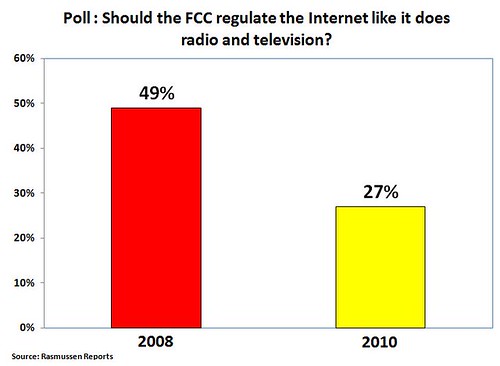
I don’t place a lot of stock in polls… until they confirm what I have long believed, that is! According to this new poll by Rasmussen Reports, 53% of Americans oppose FCC regulation of the Internet. Specifically, in response to the question, “Should the Federal Communications Commission regulate the Internet like it does radio and television?” the breakdown was: 27% =Yes, 53% = No, 19% = Not sure.

But here’s what is more interesting. The 27% of “yes” votes represents a stunning 22-point drop in support for federal regulation of the Internet since a June 2008 poll by Rasmussen, which asked the exact same question. Now, what has changed since 2008 that might have led to such rapidly declining support for Net regulation? Could it have had something to do with the FCC’s ambitious plan to centrally plan broadband markets via its 376-page National Broadband Plan? Or its incessant crusade to impose burdensome Net neutrality regulations, which could decimate investment and innovation?

No, I think what really must be to blame for this sudden public uprising against the FCC was Chairman Julius Genachowski’s alliance with the evil Elmo. People have had enough of the little red demon. That’s my theory and I’m stickin’ to it.  I mean, after all, from what my friends on the Left tell me, the American people are just dying to get Net neutrality regulations on the books and have a massive infusion of taxpayer support for Soviet-style broadband plans and media bailouts.  So clearly those things just can’t be driving this sudden public skepticism about the FCC, right?  It must be Elmo.

Public Wants Less Net Regulation

Several years ago at a conference on universal telecommunications service, one panel moderator noted, “Everything that can be said about universal service has already been said, but not everybody has had a chance to say it, so that’s why we still have these conferences.” After hearings and a study by the Federal Trade Commission, a Federal Communications Commission Notice of Inquiry during the previous administration, the National Broadband Plan, the FCC’s still-open Open Internet proceeding, and Wednesday’s extension of the reply comment period in the Open Internet proceeding, net neutrality is starting to have the same vibe.

That’s why, instead of virtually killing some more virtual trees by writing more lengthy comments and replies, Jerry Brito and I signed onto a declaration by telecommunications researchers which explains that there is no empirical evidence of a systemic problem that would justify net neutrality rules, and these rules might actually ban practices that benefit consumers. Since the world probably doesn’t need another blog post rehashing arguments about this issue, I’ll simply point you to the comment here. It was masterfully written by economist Jeff Eisenach, a veteran of the Federal Trade Commission. (The teeming throngs of humanity who are curious to know whether Jerry and I have any original thoughts to contribute to the issue can read this CommLaw Conspectus article.)

Now that I’ve gotten the shameless self-promotion out of the way, let me MoveOn to a broader point. The debate over net neutrality illustrates how important it is to identify and demonstrate the nature of the problem before trying to solve it.  This applies whether the issue is net neutrality or health care or financial market regulation. Two points in particular bear repeating.

First, ensure that there is empirical evidence of a system-wide problem. The arguments for net neutrality are based on concerns about things the broadband companies might have the ability to do – not empirical proof of widespread abuses that have actually occurred. Less than a handful of famous anecdotes support the argument for net neutrality. Sweeping, systemwide policy changes should only occur when a sweeping, systemwide problem actually exists.

Second, understand the actual nature of the problem. Have a coherent theory of cause and effect that explains why the problem occurs with reasoning that is consistent with what we know about human behavior. Ignoring this point has led to some odd decisions on issues far afield from net neutrality. In 2009, for example, the Department of Energy proposed energy efficiency standards for clothes washers to be used in laundromats and apartment buildings. The justification for the regulation assumed that greedy business owners and landlords willfully ignored opportunities to earn higher profits by investing in energy-efficient appliances! One might argue about whether consumers always identify and act on opportunities to save energy, but assuming that businesses will ignore opportunities to save money is a much bigger stretch.

If you don’t get the problem right, you won’t get the solution right!

Broadband Baselines

by on April 1, 2010 · 0 comments

The national broadband plan drafted by Federal Communications Commission staff has a lot of goals in it. Goals for broadband infrastructure deployment include:

  1. Make broadband with 4 Mbps download speeds available to every American
  2. Over the long term, have broadband with 100 Mbps download and 50 Mbps upload speeds available to 100 million American homes, with 50 Mbps downloads available to 100 million homes by 2015
  3. Have the fastest and most extensive wireless broadband networks in the world
  4. Ensure that no state lags significantly behind in 3G wireless coverage
  5. Ensure that every community has access to 1 Gbps broadband service in institutions like schools, libraries, and hospitals

The plan also outlines a number of policy steps that the FCC and other federal agencies could take to help accomplish these goals.

So far, so good. But to truly hold federal agencies accountable for achieving these objectives, we need more than goals, measures, and a list of policy proposals. We also need a realistic baseline that tells us how the market is likely to progress toward these goals in the absence of new federal action, and some way to determine how much the specific policy initiatives affect the amount of the goal achieved.

Here’s what will happen in the absence of a well-defined baseline and analysis that shows how much improvement in the goals is actually caused by federal policies: The broadband plan announces goals. The government will take some actions. Measurement will show that broadband deployment improved, moving the nation closer to achieving the goals. The FCC and other decisionmakers will then claim that their chosen policies have succeeded, because broadband deployment improved.

But in the absence of proof that the policies cause a measurable change in outcomes, this is like the rooster claiming that his crowing makes the sun rise. Scientists call this the ” post hoc, ergo propter hoc” fallacy: “B happened after A, therefore A must have caused B.” (Brush up on your Latin a little more, and you’ll even find out what Mercatus means. But I digress.)

Enough abstractions. Let me give a few examples.

The first goal listed above is to ensure that all Americans have access to broadband with 4 Mbps download speeds. In his second comment on my March 17 “Broadband Funding Gap” post, James Riso notes that the plan acknowledges that 5 out of the 7 million households that currently lack access to 4 Mbps broadband will soon be covered by 4th generation wireless. That means coverage for 83 percent of the households that lack 4 Mbps broadband is already “baked into the cake.” 

Accurate accountability must avoid giving future policy changes credit for this increase in deployment, because it was going to happen anyway.  (Of course, policymakers need to avoid taking steps that would discourage this deployment, such as levying the 15 percent universal service fee on 4th generation wireless.) The relevant question for evaluating future policy changes is, “How do they affect deployment to the remaining 2 million households?”

Similarly, the goal of 50 Mbps to 100 million households by 2015 seems to have been chosen because cable and fiber broadband providers indicate that they plan to cover more than that many homes by 2013 with broadband capable of delivering those speeds (pp. 21-22). Future policy initiatives should get zero credit for contributing toward this goal unless analysis demonstrates that the initiatives increased deployment of very high speed broadband over and above what the companies were already planning.

If you think this point is so basic that it’s not worth mentioning, you haven’t read enough government reports. Post hoc, ergo propter hoc is endemic, and not just on technology-related topics. For example, both sides regularly display this fallacy whenever the unemployment figures get released: “Unemployment increased after Obama’s election, therefore his administration caused the unemployment.” “The recession started when Bush was president, therefore his administration caused the unemployment.” These are at best hypotheses whose truth, untruth, and quantititive significance needs to be established by analysis that controls for other factors affecting the results.

Just take this as an advance warning on reporting results of the national broadband plan: Tone down the triumphalism.  

Note: For those of you who just can’t get enough discussion of the national broadband plan, Jerry Brito and I will have a dialog on other aspects of the plan in a future podcast that will be available here on Surprisingilyfree.com.

Google v. Everyone

by on March 23, 2010 · 9 comments

I had a long interview this morning with the Christian Science Monitor. Like many of the interviews I’ve had this year, the subject was Google. At the increasingly congested intersection of technology and the law, Google seems to be involved in most of the accidents.

Just to name a few of the more recent pileups, consider the Google books deal, net neutrality and the National Broadband Plan, Viacom’s lawsuit against YouTube for copyright infringement, Google’s very public battle with the nation of China, today’s ruling from the European Court of Justice regarding trademarks, adwords, and counterfeit goods, the convictions of Google executives in Italy over a user-posted video, and the reaction of privacy advocates to the less-than-immaculate conception of Buzz.

In some ways, it should come as no surprise to Google’s legal counsel that the company is involved in increasingly serious matters of regulation and litigation. After all, Google’s corporate goal is the collection, analysis, and distribution of as much of the world’s information as possible, or, as the company puts it,” to organize the world’s information and make it universally accessible and useful.” That’s a goal it has been wildly successful at in its brief history, whether you measure success by use (91 million searches a day) or market capitalization ($174 billion).

As the world’s economy moves from one based on physical goods to one driven by information flow, the mismatch between industrial law and information behavior has become acute, and Google finds itself a frequent proxy in the conflicts.

Continue reading →

Tom HazlettNow that the broadband plan is out, and the FCC has its sights set on 500 MHz of broadcast spectrum, come listen to what it all means. In the latest episode of the Surprisingly Free Conversation podcast, Thomas Hazlett, Professor of Law & Economics and Director of the Information Economy Project at George Mason University School of Law, discusses the economics of spectrum. The discussion also turns to the history of spectrum regulation, ongoing inefficiencies in the current system, and suggestions for possible improvements.

Listen to other episodes and remember to subscribe to the podcast using RSS or iTunes.