Posts tagged as:

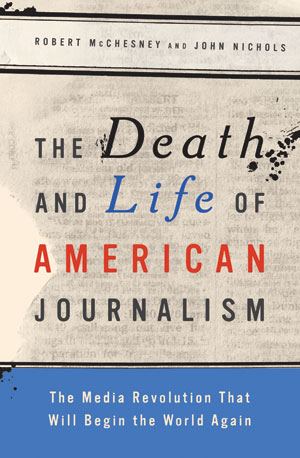
I’ve been so busy trying to cover breaking developments related to Washington’s new efforts to “save journalism” (FTC) and steer the “future of media” (FCC) — see all my recent essays & papers here — that I forgot to do a formal book review of the book that is partially responsible for whipping policymakers into a lather about this issue: The Death and Life of American Journalism, the media-takeover manifesto by the neo-Marxist media scholar Robert W. McChesney and Nation editor John Nichols. Their book is horrifying in its imperial ambitions since it invites the government become the High Lord and Protector of the Fourth Estate. [For an in-depth look at all of McChesney’s disturbing views on these issues, see: “Free Press, Robert McChesney & the “Struggle” for Media.”] Anyway, I put together a formal review of the book for City Journal.  It’s online here and I’ve also pasted it down below.


A Media Welfare State?

by Adam Thierer

Imagine a world of “post-corporate” newsrooms, where the state serves as the primary benefactor of the Fourth Estate. Billions flow from bureaucracies to media entities and individual journalists in the name of sustaining a “free press.” And this new media welfare state is funded by steep taxes on our mobile phones, broadband connections, and digital gadgets.

Sound Orwellian? Well, it’s the blueprint for a press takeover drawn up by Robert W. McChesney and John Nichols in their new book, The Death and Life of American Journalism. McChesney, the prolific neo-Marxist media scholar who teaches at the University of Illinois at Urbana-Champaign, and Nichols, a journalist with The Nation, aren’t shy about their intentions. Along with Free Press, the absurdly misnamed regulatory activist group they co-founded, McChesney and Nichols outline a self-described “radical” agenda for what they hope will become a media “revolution.” And, shockingly, some folks in the Obama administration are listening. Continue reading →

Not surprisingly, FCC Commissioners voted 3 to 2 today to open a Notice of Inquiry on changing the classification of broadband Internet access from an “information service” under Title I of the Communications Act to “telecommunications” under Title II.  (Title II was written for telephone service, and most of its provisions pre-date the breakup of the former AT&T monopoly.)  The story has been widely reported, including posts from The Washington Post, CNET, Computerworld, and The Hill.

As CNET’s Marguerite Reardon counts it, at least 282 members of Congress have already asked the FCC not to proceed with this strategy, including 74 Democrats.

I have written extensively about why a Title II regime is a very bad idea, even before the FCC began hinting it would make this attempt.  I’ve argued that the move is on extremely shaky legal grounds, usurps the authority of Congress in ways that challenge fundamental Constitutional principles of agency law, would cause serious harm to the Internet’s vibrant ecosystem, and would undermine the Commission’s worthy goals in implementing the National Broadband Plan.  No need to repeat any of these arguments here.  Reclassification is wrong on the facts, and wrong on the law. Continue reading →

This is a post for all those broadband fans out there who want to talk about something today besides the Federal Communication’s Commission’s decision to take comments on which legal classification it should use to regulate broadband.

A recent FCC survey revealed that 80 percent of home broadband users do not know the speed of their broadband service. I can easily imagine how this statistic could be spun to “prove” that consumers are woefully uninformed and the broadband market must be plagued with “market failures” because consumers do not have even the basic information they need to make intelligent decisions.

Before we go down that road, let me explain, based on my own experience, why this is a non-issue.

I’m part of that 80 percent. I do not know the speed of my broadband service at home.  I know that when I signed up several years ago, I selected the slowest and cheapest broadband speed the provider offered.  I also know that this speed is still plenty fast for anything we need to do at home (and usually faster than the speed at my university office). I remain blissfully ignorant of the actual speed, even though it would be very easy for me to find out by looking at the materials I received when I signed up or checking the provider’s web site online.

In economic jargon, I am “rationally ignorant” of my home broadband speed. I don’t know (or remember) the speed, but to me this information is not worth the 45 seconds it would take me to find out. And that also means any FCC initiatives to “improve consumer information” or “educate” me about it will not, for me, be worth the time and money the FCC might spend on them.

If some of our Internet applications were not working in a satisfactory manner, we would probably do an online speed test, check to see what other speeds our provider offers, and check offers from competing providers. All of these steps would be easy and would require no FCC policy initiatives to facilitate (beyond making sure that the providers aren’t lying about what speeds they will provide).

I’m probably not alone.  The same survey reveals that 50 percent of Americans are satisfied with their broadband speeds, and another 41 percent are “somewhat satisfied.” So, 91 percent of consumers are more or less satisfied, even though 80 percent don’t know their speeds.

It would have been quite useful and instructive if the FCC survey had included an additional question: “Is your broadband speed adequate for the Internet applications you want to use?” And then cross-tabulate the responses with the responses on knowledge of broadband speed. Wanna bet that a substantial majority of people who do not know their speed would also have said that it is adequate?

Surely there are some broadband customers who use applications that require specific (fast) speeds, and these customers have a greater need to know what speed they’re receiving. That’s why providers tell prospective customers what speed tiers they offer. And that’s why one can find multiple web-based speed tests. This information is not hard to find if you want it.

But for some of us, it just ain’t worth it. And shame on anyone who tries to use my willful ignorance as an excuse for some new policy initiative. Rational ignorance is bliss, and I’m a bliss-ter.

So, I’m sitting here at today’s Federal Trade Commission (FTC) workshop, “Will Journalism Survive the Internet Age?” and several panelists have argued that private “professional” media is toast, not just because of the rise of the Net and digital media, but also because the inherent cross-subsidy that advertising has traditionally provided is drying up.  It very well could be the case that both statements are true and that private media operators are in some trouble because of it. But what nobody seems to be acknowledging is that our government is currently on the regulatory warpath against advertising and that this could have profound impact on the outcome of this debate.

As Berin Szoka and I noted in a recent paper, “The Hidden Benefactor: How Advertising Informs, Educates & Benefits Consumers,” the FTC, the FCC, the FDA, and Congress are all considering, or already imposing, a host of new rules that will seriously affect advertising markets.  This article in AdAge today confirms this:

The advertising industry is heading for a “tsunami” of regulation and is at a “tipping point” of greatly increased scrutiny, warned a panel on social media and privacy at the American Advertising Federation conference here [in Orlando].

The reason this is so important for the ongoing debate about the future of media and journalism is because, as Berin and I argued in our paper: Continue reading →

I was interviewed yesterday for the local Fox affiliate on Cal. SB 1411, which criminalizes online impersonations (or “e-personation”) under certain circumstances.

On paper, of course, this sounds like a fine idea.  As Palo Alto State Senator Joe Simitian, the bill’s sponsor, put it, “The Internet makes many things easier.  One of those, unfortunately, is pretending to be someone else.  When that happens with the intent of causing harm, folks need a law they can turn to.”

Or do they?

The Problem with New Laws for New Technology

SB1411 would make a great exam question of short paper assignment for an information law course.  It’s short, is loaded with good intentions, and on first blush looks perfectly reasonable—just extending existing harassment, intimidation and fraud laws to the modern context of online activity.  Unfortunately, a careful read reveals all sorts of potential problems and unintended consequences.

Continue reading →

The announcement yesterday from key Congressional Democrats of an effort to reform the Communications Act put me in a nostalgic mood. Here follows one of my longest efforts yet to bury the lede.

One of my favorite courses in law school was Abner Mikva’s “Legislative Process” course, which he taught while serving on the D.C. Circuit Court of Appeals and before his tenure as White House counsel to President Clinton. Mikva had previously served in Congress; indeed, one of the first votes I ever cast was for Mikva while an undergraduate at Northwestern University.

(It was a remarkable period at the law school. The year Mikva signed on as a lecturer was also the first year on the faculty for three professors just starting their academic careers: Larry Lessig, Elena Kagan, and Barack Obama. I took two classes with Lessig, including an independent study on the impact of technology on the practice of law, but regrettably none from the other two.) Continue reading →

Back on St. Paddy’s Day, I offered a few comments on the “funding gap” identified in the FCC’s just-released national broadband plan. Since then, the FCC has put out a notice of proposed rulemaking and notice of inquiry seeking public comment on reforms that would allow its universal service fund to subsidize broadband. The FCC has also released a 137-page technical paper that details how the staff calculated the broadband “availability gap” and funding gap.

So, now there’s more to chew on, and another round of online mastication would be timely given the open FCC proceeding.  Here are three big issues:

  1. Definition of broadband

The plan announced a goal of making broadband with actual download speeds of 4 mbps available to all Americans.  In the plan, this goal appeared to be based on the actual average speed of broadband service (4 mbps), even though the median speed is just 3.1 mbps (p. 21). The technical paper, however, also projects that, based on past growth rates in broadband speed, “the median will likely be higher than 4 mbps by the end of 2010.” (p. 43)  Contrary to what I thought back in March, it appears the FCC is justifying the 4 mbps goal based on the median speed, not the average. 

The technical report also argues that 4 mbps is necessary to run high-speed video, which a “growing portion of subscribers” (not including me) apparently use. (p. 43) So, if the broadband plan achieves its goals, every Amercian will have the opportunity to subscribe to Internet access capable of delivering high-quality porn! Fortunately, the technical report uses a different and more productive example — streamed classroom lectures. 

Reasonable people could still question whether the median is the appropriate benchmark to guide government actions intended to equalize broadband access opportunities.  The technical report includes a helpful graphic that shows the most common broadband speed users actually buy is 2 mbps, and 38 percent of all subscribers have speeds of 2 mbps or less. (p. 43) The FCC staff’s model calculates that if the goal were set at 1.5 mbps, the number of “unserved” households would fall from 7 million to 6.3 million, and the required subsidy would fall from $18.6 billion to $15.3 billion. (p. 45) 

If almost half of broadband subscribers have decided that something less than 4 mbps is perfectly adequate, that suggests 4 mbps may go far beyond what is necessary to ensure that all Americans have access to basic broadband service. So, that 4 mbps goal is still questionable.

  1. Omission of 3G wireless

The 4 mbps goal allowed the FCC to ignore third generation wireless when it estimated the “availability gap.” The technical paper shows that 95 percent of households have 4 mbps broadband available. About 3 percent of households have no broadband available, while 2 percent have broadband available at speeds ranging from 384 kbps – 3 mbps. (p. 17)  That 2 percent probably includes households with slow DSL and 3G wireless.

The technical paper also revealed that it did not include service from fixed Wireless Internet Service Providers due to data availability. (p. 25) These serve 2 million subscribers in rural areas (p. 66), so the omission potentially accounts for a large chunk of the households considered “unserved.” No telling how many, since apparently the data aren’t available.

Back in March, I guesstimated that the 7 million household “availability gap” might overstate the size of the problem by more than half, simply because 3G wireless is available to 98 percent of American households. Looks like my guesstimate is pretty much in line with the more detailed figures in the FCC technical paper.

 3. Role of satellite

The broadband plan did not count satellite broadband when assessing availability. The technical paper (pp. 89-94)provides a much more detailed explanation of the capacity constraints the FCC staff believes will prevent satellite broadband from serving more than a couple million subscribers.   (The current satellite subscriber base is approximately 900,000.)

The technical paper pointed out that satellites are expensive and take three years to build. (p. 92) To put the time frame in perspective, that’s about as long as the FCC and the Federal-State Joint Board on Universal Service have been discussing universal service subsidies for broadband. Lord knows we shouldn’t make consumers wait that long!

There is, however, something a little asymmetrical about the way the FCC staff treated satellite and other forms of broadband. The point of estimating the broadband availability gap was to determine how much of a subsidy would be required to induce the private sector to build the infrastructure to close the gap. But while the study assumed that the subsidies would call forth the requisite cable, DSL, and wireless infrastructure within some unnamed but acceptable time frame, it decided that three years is just too long to wait for satellite infrastructure to expand. So, satellite plays a minimal role in the FCC’s plan.

Yet even this minimal role has a big impact. To its credit, the technical paper calculated how satellite broadband could dramatically slash the cost of serving the most expensive 250,000 homes. It estimated (pp. 91-92) that the net present value of subsidies required to serve these homes with satellite would range between $800 million and $2 billion — compared to a $13.4 billion subsidy required to serve these homes with terrestrial broadband. (This implies an annual subsidy of $105-255 million, which is pretty close to my March 17 guesstimate of $100-200 million.)

So, satellite broadband could help prevent costs from skyrocketing, even assuming it plays only the limited role envisioned in the FCC staff’s analysis.
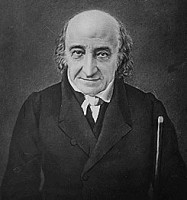
Over the weekend, I published an op-ed in The Des Moines Register encouraging the FCC to heed the lessons of the first national broadband plan, the one Secretary of the Treasury Albert Gallatin sent to Congress in 1808.

Gallatin was a remarkable figure in the early history of the federal government, and his accomplishments include being the longest-serving Treasury secretary (1801-1812) to date. His report on the Subject of Public Roads and Canals, completed at the request of Congress, remains one of the seminal documents in the history of American infrastructure. It is a masterpiece of dispassionate policy-making and clear-headed writing.

Alas, the document is available nowhere online, and the only in-print copy I can find is published by the aptly-named Dodo Press. This is indeed unfortunate given the renewed interest in network infrastructure as a form of national technology. The NBP published in March by the FCC, despite its nearly 400 pages and thousands of footnotes, makes no reference to Gallatin or his plan. Continue reading →

I appeared this afternoon on the inaugural edition of TechCrunch TV to talk about–what else?–Net Neutrality.

http://c.brightcove.com/services/viewer/federated_f9/63890987001?isVid=1&isUI=1 Multiple media sources are now reporting that the FCC, contrary to reports from earlier this week, has decided to go ahead with an effort to change the classification of broadband Internet service from a Title I “information service” to a Title II “telecommunications service,” if only to salvage the proposed rulemaking on the open and transparent Internet.  (See stories on The Wall Street Journal and The Washington Post as well as Ars Technica.) Those of us who aren’t on the FCC’s official leak list will have to wait with the rest of the rabble to get a look at just how the FCC proposes to effect this radical change in communications law.  Will it apply to all broadband Internet–including cable, fiber, DSL, satellite, wireless and broadband over power lines?  Will the FCC propose to regulate only as much as needed to get the jurisdiction the D.C. Circuit says it doesn’t have under Title I to implement the NPRM, or will they throw in some additional provisions to achieve other goals–such as the reform of the Universal Service Fund?  Will state and local regulators get to share in the fun of telling ISPs how best to run their business? Continue reading →

The Progress & Freedom Foundation today filed comments in the Federal Communication Commission’s (FCC) “Future of Media” proceeding. Berin Szoka, Ken Ferree, and I urged the FCC to “reject Chicken Little-esque calls for extreme media ‘reform’ solutions,” and counseled policymakers to move cautiously so that media reform can be “organic and bottom-up, not driven by heavy-handed, top-down industrial policies for the press.”

Our 79-page filing covers a wide range of ideas being examined by Washington policymakers to help struggling media outlets and unemployed journalists, or to expand public media / “public interest” content and regulation. Among the major issues explored in our filing:

  • First Amendment concerns implicated by government subsidies;
  • The pitfalls of imposing new “public interest” obligations on media operators;
  • How advertising restrictions could harm the provision of media and news;
  • Taxes, fees and other regulations to be avoided;
  • The limited role in reform that public media subsidies can play; and
  • Positive steps government could take.

We note that as “With many operators struggling to cope with intensifying competition, digitization, declining advertising budgets, and fragmenting audiences, some pundits and policymakers are wondering what the ‘future of media’ entails. The answer: Nobody knows.”  While this uncertainty has put concerned policymakers at the ready to “help” the press, we warn that: “There is great danger in rash government intervention.” Instead, policymakers should be “careful to not inhibit potentially advantageous marketplace developments, even if some are highly disruptive.” Marketplace meddling, or government attempts to tinker with private media business models in the hopes that something new and better can be created, are misguided. Moreover, “Our constitutional traditions warn against it, history suggests it would be unwise, and practical impediments render such meddling largely unworkable, anyway.”

Continue reading →