I have a new oped in the Orange County Register discussing reforms that can help address the growing problem of “zombie government,” or old government policies and programs that just seem to never die even thought they have long outlived their usefulness. While there is no single solution to this sort of “set-it-and-forget-it” approach to government that locks in old policies and programs, but I note that:
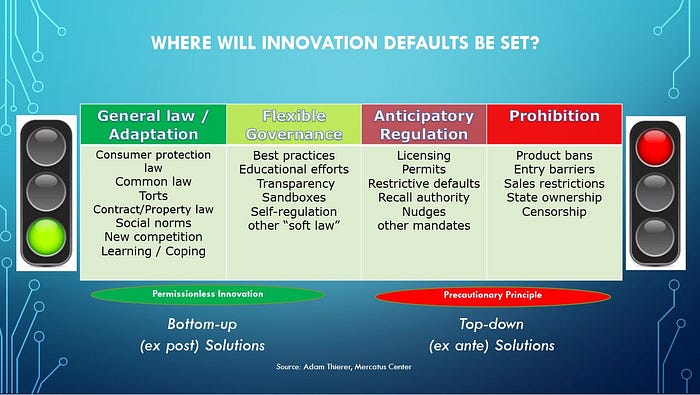
sunsets and sandboxes are two policy innovations that can help liberate California from old and cumbersome government regulations and rules. Sunsets pause or end rules or programs regularly to ensure they don’t grow stale. Sandboxes are policy experiments that allow for the temporary relaxation of regulations to see what approaches might work better.
When California, other states, and the federal government fail to occasional do spring cleanings of unneeded old rules and programs, it creates chronic regulatory accumulation that has real costs and consequences for the efficient operation of markets and important government programs.
Jump over to the OCR site to read the entire oped.

 The Technology Liberation Front is the tech policy blog dedicated to keeping politicians' hands off the 'net and everything else related to technology.
Running List of My Research on AI, ML & Robotics Policy
by Adam Thierer on July 29, 2022 · 0 comments
[last updated 4/3/2025 – Check my Medium page for latest posts]
This a running list of all the essays and reports I’ve already rolled out on the governance of artificial intelligence (AI), machine learning (ML), and robotics. Why have I decided to spend so much time on this issue? Because this will become the most important technological revolution of our lifetimes. Every segment of the economy will be touched in some fashion by AI, ML, robotics, and the power of computational science. It should be equally clear that public policy will be radically transformed along the way.
Eventually, all policy will involve AI policy and computational considerations. As AI “eats the world,” it eats the world of public policy along with it. The stakes here are profound for individuals, economies, and nations. As a result, AI policy will be the most important technology policy fight of the next decade, and perhaps next quarter century. Those who are passionate about the freedom to innovate need to prepare to meet the challenge as proposals to regulate AI proliferate.
There are many socio-technical concerns surrounding algorithmic systems that deserve serious consideration and appropriate governance steps to ensure that these systems are beneficial to society. However, there is an equally compelling public interest in ensuring that AI innovations are developed and made widely available to help improve human well-being across many dimensions. And that’s the case that I’ll be dedicating my life to making in coming years.
Here’s the list of what I’ve done so far. I will continue to update this as new material is released: Continue reading →