[This is a draft of a section of a forthcoming study on “A Flexible Governance Framework for Artificial Intelligence,” which I hope to complete shortly. I welcome feedback. I have also cross-posted this essay at Medium.]
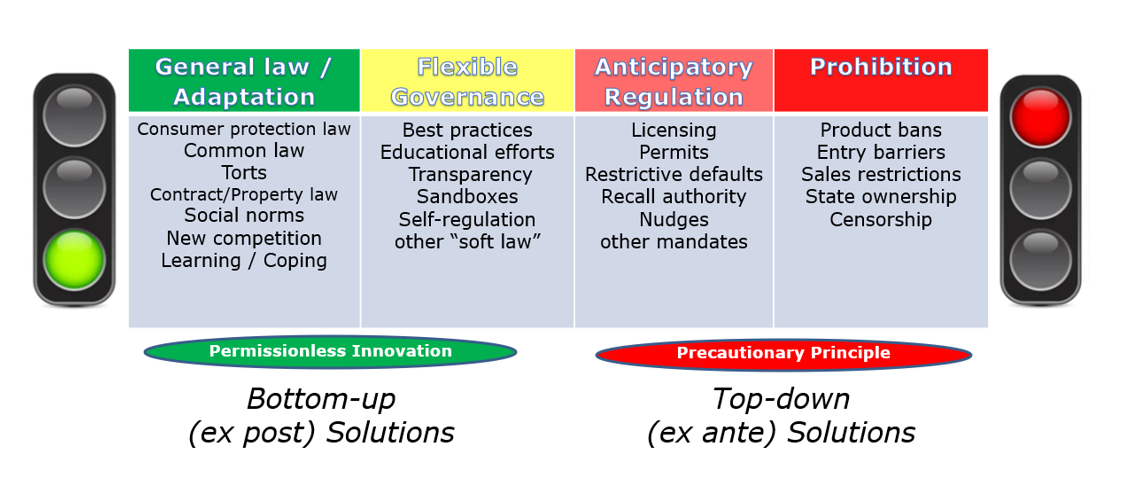
Debates about how to embed ethics and best practices into AI product design is where the question of public policy defaults becomes important. To the extent AI design becomes the subject of legal or regulatory decision-making, a choice must be made between two general approaches: the precautionary principle or the proactionary principle.[1] While there are many hybrid governance approaches in between these two poles, the crucial issue is whether the initial legal default for AI technologies will be set closer to the red light of the precautionary principle (i.e., permissioned innovation) or to the green light of the proactionary principle (i.e., (permissionless innovation). Each governance default will be discussed.
The American Enterprise Institute (AEI) has kicked off a new project called “Digital Platforms and American Life,” which will bring together a variety of scholars to answer the question: How should policymakers think about the digital platforms that have become embedded in our social and civic life? The series, which is being edited by AEI Senior Fellow Adam J. White, highlights how the democratization of knowledge and influence in the Internet age comes with incredible opportunities but also immense challenges. The contributors to this series will approach these issues from various perspectives and also address different aspects of policy as it pertains to the future of technological governance.
It is my honor to have the lead paper in this new series. My 19-page essay is entitled, Governing Emerging Technology in an Age of Policy Fragmentation and Disequilibrium, and it represents my effort to concisely tie together all my writing over the past 30 years on governance trends for the Internet and related technologies. The key takeaways from my essay are:
Traditional governance mechanisms are being strained by modern technological and political realities. Newer technologies, especially digital ones, are developing at an ever-faster rate and building on top of each other, blurring lines between sectors.
Congress has failed to keep up with the quickening pace of technological change. It also continues to delegate most of its constitutional authority to agencies to deal with most policy concerns. But agencies are overwhelmed too. This situation is unlikely to change, creating a governance gap.
Decentralized governance techniques are filling the gap. Soft law—informal, iterative, experimental, and collaborative solutions—represents the new normal for technological governance. This is particularly true for information sectors, including social media platforms, for which the First Amendment acts as a major constraint on formal regulation anyway.
No one-size-fits-all tool can address the many governance issues related to fast-paced science and technology developments; therefore, decentralized governance mechanisms may be better suited to address newer policy concerns.
My arguments will frustrate many people of varying political dispositions because I adopt a highly pragmatic approach to technological governance. Continue reading →
As I note in my latest regular column for The Hill, it seems like everyone these days is talking about the importance of America “building again.” For example, take a look at this compendium of essays I put together where scholars and pundits have been making the case for “building again” in various ways and contexts. It would seem that the phrase is on everyone’s lips. “These calls include many priorities,” I note, “but what unifies them is the belief that the nation needs to develop new innovations and industries to improve worker opportunities, economic growth and U.S. global competitive standing.”
What I fear, however, is that “building again” has become more of a convenient catch line than anything else. It seems like few people are willing to spell out exactly what it will take to get that started. My new column suggests that the most important place to start is “to cut back the thicket of red tape and stifling bureaucratic procedures that limit the productiveness of the American workforce.” I cite recent reports and data documenting the enormous burden that regulatory accumulation imposes on American innovators and workers. I then discuss how to get reforms started at all levels of government to get the problem under control and help us start building again in earnest. Jump over to
The Hill to read the entire essay.
An important new book launched this week in Europe on issues related to innovation policy and industrial policy. “Questioning the Entrepreneurial State: Status-quo, Pitfalls, and the Need for Credible Innovation Policy” (Springer, 2022) brings together more than 30 scholars who contribute unique chapters to this impressive volume. It was edited by Karl Wennberg of the Stockholm School of Economics and Christian Sandström of the Jönköping (Sweden) International Business School.
As the title of this book suggests, the authors are generally pushing back against the thesis found in Mariana Mazzucato’s book
The Entrepreneurial State (2011). That book, like many other books and essays written recently, lays out a romantic view of industrial policy that sees government as the prime mover of markets and innovation. Mazzucato calls for “a bolder vision for the State’s dynamic role in fostering economic growth” and innovation. She wants the state fully entrenched in technological investments and decision-making throughout the economy because she believes that is the best way to expand the innovative potential of a nation.
The essays in
Questioning the Entrepreneurial State offer a different perspective, rooted in the realities on the ground in Europe today. Taken together, the chapters tell a fairly consistent story: Despite the existence of many different industrial policy schemes at the continental and country level, Europe isn’t in very good shape on the tech and innovation front. The heavy-handed policies and volumes of regulations imposed by the European Union and its member states have played a role in that outcome. But these governments have simultaneously been pushing to promote innovation using a variety of technocratic policy levers and industrial policy schemes. Despite all those well-intentioned efforts, the EU has struggled to keep up with the US and China in most important modern tech sectors. Continue reading →
Gabrielle Bauer, a Toronto-based medical writer, has just published one of the most concise explanations of what’s wrong with the precautionary principle that I have ever read. The precautionary principle, you will recall, generally refers to public policies that limit or even prohibit trial-and-error experimentation and risk-taking. Innovations are restricted until their creators can prove that they will not cause any harms or disruptions. In an essay for The New Atlantis entitled, “Danger: Caution Ahead,” Bauer uses the world’s recent experiences with COVID lockdowns as the backdrop for how society can sometimes take extreme caution too far, and create more serious dangers in the process. “The phrase ‘abundance of caution’ captures the precautionary principle in a more literary way,” Bauer notes. Indeed, another way to look at it is through the prism of the old saying, “better to be safe than sorry.” The problem, she correctly observes, is that, “extreme caution comes at a cost.” This is exactly right and it points to the profound trade-offs associated with precautionary principle thinking in practice.
In my own writing about the problems associated with the precautionary principle (see list of essays at bottom), I often like to paraphrase an ancient nugget of wisdom from St. Thomas Aquinas, who once noted in his
Summa Theologica that, if the highest aim of a captain were merely to preserve their ship, then they would simply keep it in port forever. Of course, that is not the only goal of a captain has. The safety of the vessel and the crew is essential, of course, but captains brave the high seas because there are good reasons to take such risks. Most obviously, it might be how they make their living. But historically, captains have also taken to the seas as pioneering explorers, researchers, or even just thrill-seekers.
This was equally true when humans first decided to take to the air in balloons, blimps, airplanes, and rockets. A strict application of the precautionary principle would have instead told us we should keep our feet on the ground. Better to be safe than sorry! Thankfully, many brave souls ignored that advice and took the heavens in the spirit of exploration and adventure. As Wilbur Wright once famously said, “If you are looking for perfect safety, you would do well to sit on a fence and watch the birds.” Needless to say, humans would have never mastered the skies if the Wright brothers (and many others) had not gotten off the fence and taken the risks they did. Continue reading →
Discourse magazine has just published my review of Where Is My Flying Car?, by J. Storrs Hall, which I argue is the most important book on technology policy written in the past quarter century. Hall perfectly defines what is at stake if we fail to embrace a pro-progress policy vision going forward. Hall documents how a “Jetsons” future was within our grasp, but it was stolen away from us. What held back progress in key sectors like transportation, nanotech & energy was anti-technological thinking and the overregulation that accompanies it. “[T]he Great Stagnation was really the Great Strangulation,” he argues. The culprits: negative cultural attitudes toward innovation, incumbent companies or academics looking to protect their turf, litigation-happy trial lawyers, and a raft of risk-averse laws and regulations.
Hall coins the term “the Machiavelli Effect” to identify why many people simultaneously fear the new and different, and they also want to protect whatever status quo they benefit from (or at least feel comfortable with). He builds on this passage from Niccolò Machiavelli’s classic 1532 study of political power, “The Prince”: Continue reading →
The Mercatus Center has just released a new special study that I co-authored with Connor Haaland entitled, “Does the United States Need a More Targeted Industrial Policy for High Tech?” With industrial policy reemerging as a major issue — and with Congress still debating a $250 billion, 2,400-page industrial policy bill — our report does a deep dive into the history various industrial policy efforts both here and abroad over the past half century. Our 64-page survey of the historical record leads us to conclude that, “targeted industrial policy programs cannot magically bring about innovation or economic growth, and government efforts to plan economies from the top down have never had an encouraging track record.”
We zero in on the distinction between
general versus targeted economic development efforts and argue that:
whether we are referring to federal, state, or local planning efforts—the more highly targeted development efforts typically involve many tradeoffs that are often not taken into consideration by industrial policy advocates. Downsides include government steering of public resources into unproductive endeavors, as well as more serious problems, such as cronyism and even corruption.
We also stress the need to more tightly define the term “industrial policy” to ensure rational evaluation is even possible. We argue that, “industrial policy has
intentionality and directionality, which distinguishes it from science policy, innovation policy, and economic policy more generally.” We like the focus definition used by economist Nathaniel Lane, who defines industrial policy as “intentional political action meant to shift the industrial structure of an economy.”
Our report examines the so-called “Japan model” of industrial policy that was all the rage in intellectual circles a generation ago and then compares it to the Chinese and European industrial policy efforts of today, which many pundits claim that the US needs to mimic. Continue reading →
Over at Discourse magazine I’ve posted my latest essay on how conservatives are increasingly flirting with the idea of greatly expanding regulatory control of private speech platforms via some sort of common carriage regulation or new Fairness Doctrine for the internet. It begins:
Conservatives have traditionally viewed the administrative state with suspicion and worried about their values and policy prescriptions getting a fair shake within regulatory bureaucracies. This makes their newfound embrace of common carriage regulation and media access theory (i.e., the notion that government should act to force access to private media platforms because they provide an essential public service) somewhat confusing. Recent opinions from Supreme Court Justice Clarence Thomas as well as various comments and proposals of Sen. Josh Hawley and former President Trump signal a remarkable openness to greater administrative control of private speech platforms.
Given the takedown actions some large tech companies have employed recently against some conservative leaders and viewpoints, the frustration of many on the right is understandable. But why would conservatives think they are going to get a better shake from state-regulated monopolists than they would from today’s constellation of players or, more importantly, from a future market with other players and platforms?
I continue on to explain why conservatives should be skeptical of the administrative state being their friend when it comes to the control of free speech. I end by reminding conservatives what President Ronald Reagan said in his 1987 veto of legislation to reestablish the Fairness Doctrine: “History has shown that the dangers of an overly timid or biased press cannot be averted through bureaucratic regulation, but only through the freedom and competition that the First Amendment sought to guarantee.”
Read more at Discourse, and down below you will find several other recent essays I’ve written on the topic.
Here’s a new animated explainer video that I narrated for the Federalist Society’s Regulatory Transparency Project. The 3-minute video discusses how earlier “tech giants” rose and fell as technological innovation and new competition sent them off to what the New York Times once appropriately called “The Hall of Fallen Giants.” It’s a continuing testament to the power of “creative destruction” to upend and reorder markets, even as many pundits insist that there’s no possibility change can happen.
The Technology Liberation Front is the tech policy blog dedicated to keeping politicians' hands off the 'net and everything else related to technology. Learn more about TLF →


 Discourse magazine has just published
 The Technology Liberation Front is the tech policy blog dedicated to keeping politicians' hands off the 'net and everything else related to technology.