Posts tagged as:

By Berin Szoka & Adam Thierer

As we noted in our intro to this ongoing series, Google’s tenth anniversary has passed with Googlephobia reaching new heights of hysteria.

But is Google really too big and dangerous, or are people just too lazy to find other alternatives to each of the wonderful services that Google offers?  If one is truly paranoid about the firm’s supposed dominance, it doesn’t take much effort to live a Google-free life. To prove it, we set out to find alternatives to each of the services that Google provides.  After awhile, we got a little tired of compiling alternatives in each category and just provided links for the additional choices at your disposal.  It’s tough to see what the fuss is about with the cornucopia of choices at our disposal.  If you don’t like Google, then just don’t use it or any of its services.  The choice is yours.

In each case, we’ve listed Google first, even though Google may not be the market leader ( e.g., Google’s relatively unknown social network Orkut).

Search Engines

Continue reading →

Googlephobia: The Series

by on September 11, 2008 · 9 comments

By Berin Szoka & Adam Thierer as part of an ongoing series

With Google celebrating its 10th anniversary this week, many panicky pundits are using the occasion to claim that Google has become the Great “Satan” of the Internet.  Nick Carr wonders what the future holds for “The OmniGoogle.” The normally level-headed Mike Malone worries that Google is “turning into Big Brother.”  And Washington Post’s Rob Dubbin says that he can’t escape Google’s “tentacles,” even for just 24 hours.  Meanwhile, speculation abounds that the Justice Department is preparing a major antitrust lawsuit against Google concerning its advertising partnership with Yahoo! or perhaps even a broader suit concerning Google’s “dominance” of online advertising generally.

Carr quotes Google co-founder Sergey Brin’s now-famous 2003 interview:

I think people tend to exaggerate Google’s significance in both directions.  Some say Google is God.  Others say Google is Satan.  But if they think Google is too powerful, remember that with search engines, unlike other companies, all it takes is a single click to go to another search engine. People come to Google because they choose to.  We don’t trick them.

In the last five years, Google has become far more than just a search engine.  As Google’s suite of suite of complementary products continues to grow, so too does the specter of Google as an all-knowing and therefore all-powerful economic colossus.  Yet Google isn’t even close to being the sort of nefarious monopolist out to destroy user privacy at every turn, as some seem to imply—if not exclaim.  Indeed, in our view, the Net is overall a far better place because of the existence of Google and the many free services it provides consumers.

Our point is not that Google should be immune from criticism.  Indeed, healthy criticism of corporate actions plays a vital role in the free market by disciplining corporate policies and behavior—often thus providing an effective alternative to government regulation.  This is particularly important in the area of consumer privacy protection, as demonstrated by Google’s quick response to public concern about its Chrome EULA. Continue reading →

By Adam Thierer & Berin Szoka

The goal of our “Privacy Solution Series,” as we noted in the first installment, is to detail the many “technologies of evasion” (i.e., user-empowerment or user “self-help” tools) that allow web surfers to better protect their privacy online—and especially to defeat tracking for online behavioral advertising purposes.  These tools and methods form an important part of a layered approach that, in our view, provides an effective alternative to government-mandated regulation of online privacy.

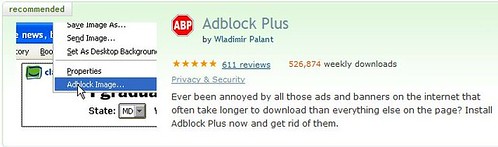
In this second installment in this series, we will highlight Adblock Plus (ABP), a free downloadable extension for the Firefox web browser (as well as for the Flock browser, though we focus on the Firefox version here).
Adblock Plus

Purpose: The primary purpose of Adblock Plus is to block online ads from being downloaded and displayed on a user’s screen as they browse the Web.  In a broad sense, this functionality might be considered a “privacy” tool by those who consider it an intrusion upon, or violation of, their “privacy” to be “subjected” to seeing advertisements as they browse the web.  But if one thinks of privacy in terms of what others know about you, Adblocking is not so much about “privacy” as about user annoyance (measured in terms of distracting images cluttering webpages or simply in terms of long download times for webpages).  In this sense, ABP may not qualify as a “technology of evasion,” strictly speaking.  But, as explained below the fold, ABP does allow its users to “evade” some forms of online tracking by blocking the receipt of some, but not all, tracking cookies.

Cost: Like almost all other Firefox add-ons, both the ABP extensions and the filter subscriptions on which it relies (as described below) are free.

Popularity / Adoption: While there are a wide variety of ad-blocking tools available, Adblock Plus is far and away the leader.  ABP has proven enormously popular since its release in November 2005 as the successor to Adblock, which was first developed in 2002 and reached over 10,000,000 downloads before being abandoned by its developer and even today garners nearly 40,000 downloads a week.  This history of Adblock provides further details.

ABP was named one the 100 best products of 2007 by PC World magazine and is now the #1 most downloaded add-on for Firefox with over 500,000 weekly downloads, up significantly for just a few months.  In a blog post last month, ABP creator Wladimir Palant estimated that “no more than 5% of Firefox users have Adblock Plus installed,” but that percentage is bound to grow larger as more people discover Adblock.  As one indicator of ABP’s popularity, the number of Google searches for “Adblock” has nearly eclipsed the number of searches for “identity theft,” which seems like a far more serious concern than having to look at web ads. Continue reading →

By Adam Thierer & Berin Szoka

Whatever ordinary Americans actually think about online privacy, it remains a hot topic inside the Beltway. While much of that amorphous concern focuses on government surveillance and government access to information about web users, many in Washington have focused on targeted online advertising by private companies as a dire threat to Americans’ privacy — and called for prophylactic government regulation of an industry that is expected to more than double in size to $50.3 billion in 2011 from $21.7 billion last year.

In 1998, when targeted advertising was in its infancy, the FTC proposed four principles as the basis for self-regulation of online data collection: notice, choice, access & security. In 2000, the Commission declared that too few online advertisers adhered to these principles and therefore recommended that Congress mandate their application in legislation that would allow the FTC to issue binding regulations. Subsequent legislative proposals (indexed by CDT by Congress here along with other privacy bills) have languished in Congress ever since. During this time self-regulation of data collection (e.g., the National Advertising Initiative) has matured, the industry has flourished without any clear harm to users and the FTC has returned to its original support for self-regulation over legislation or regulatory mandates.

But over the last year, the advocates of regulation have succeeded in painting a nightmarish picture of all-invasive snooping by online advertisers using more sophisticated techniques of collecting data for targeted advertising. The Federal Trade Commission (FTC) has responded cautiously by proposing voluntary self-regulatory guidelines intended to address these concerns, because the agency recognizes that this growing revenue stream is funding the explosion of “free” (to the user) online content and services that so many Americans now take for granted, and that more sophisticated targeting produces ads that are more relevant to consumers (and therefore also more profitable to advertisers).

Continue reading →

Most debates–from privacy to net neutrality–about consumer protection in Internet policy come down to the following increasingly-cliched exchange:

1. Advocate of Regulation: “The government must intervene to protect users against Companies who want to [___________] by writing new laws or regulations!”

2. Regulatory Skeptic: “Why don’t we rely on the FTC’s enforcement of End User License Agreements (EULAs), privacy policies and other terms of service (TOS) under existing law?  If companies spell out their policies clearly and then are required to stick to them, those policies will become part of competition:  Companies will compete for consumers by offering attractive policies the same way they compete for consumers by offering attractive products & prices.”

3. Advocate of Regulation: “That doesn’t work because nobody actually reads all that legalese!  They’re impossibly dense for non-lawyers, so companies always make such agreements as broad as possible to allow them to do whatever they damn well please–and bury all the really scary provisions.”

And yet… within 12 hours of releasing its new Chrome Browser, Google removed a clause from the Chrome EULA that essentially would have Given Google the right to whatever it liked with all content posted by users anywhere online using Chrome.  If this incident demonstrates anything, it’s that there are significant “market forces” at work to restrain companies from writing agreements & policies that allow them to screw consumers.  Indeed, it beautifully demonstrates why the Regulatory Skeptic ultimately wins this debate with one final response:

4. Regulatory Skeptic: “It doesn’t matter if 99%+ of users never read a EULA or TOS.  No matter how hard companies might try to bury some ominous provision, the relatively small number of consumer protection watchdogs who do read such provisions protect everyone else by calling attention to true areas of concern.  Not every blogger who complains about something he doesn’t like in a EULA is going to make Slashdot, but overall, provisions that cross a certain line will get public attention and most companies will bend over backwards to avoid bad PR.  So, the market does work to protect consumers without the need for further government regulation.”

Continue reading →

Over on Techdirt, Mike Masnick discusses an interesting new survey that highlights the sharp disconnect between how much we claim privacy matters to us and how far we’re willing to go to safeguard it. America Online polled 1,000 users in the United Kingdom, and the results further reinforce what other recent studies have suggested:

The study found 84% of users say they carefully guard their info online — but when tested, 89% of people actually did give away info in the same exact survey.

The AOL survey brings to mind security guru Bruce Schneier’s insightful quip on privacy from back in 2001:

If McDonald’s in the United States would give away a free hamburger for a DNA sample they would be handing out free lunches around the clock. So people care about their privacy, but they don’t care to pay for it.

When presented with the option of sacrificing a bit of privacy for something of value, like a chocolate bar or a free gift certificate, many users are surprisingly willing to dole out data to third parties for commercial use. And the value of personal details to marketers is massive. As social networking sites and ad-serving networks amass ever greater knowledge of our hobbies, political views, and even our favorite music, these sites are getting better at mining data to tailor ads with pinpoint precision, commanding high click rates while sustaining server farms and original content publishers.

Continue reading →

Anyone interested in the long-running debate over how to balance online privacy with anonymity and free speech, whether Section 230‘s broad immunity for Internet intermediaries should be revised, and whether we need new privacy legislation must read the important and enthralling NYT Magazine piece  “The Trolls Among Us” by Mattathias Schwartz about the very real problem of Internet “trolls“–a term dating to the 1980s and defined as “someone who intentionally disrupts online communities.”

While all trolls “do it for the lulz” (“for kicks” in Web-speak) they range from the merely puckish to the truly “malwebolent.”  For some, trolling is essentially senseless web-harassment or “violence” (e.g., griefers), while for others it is intended to make a narrow point or even as part of a broader movement.  These purposeful trolls might be thought of as the Yippies of the Internet, whose generally harmless anti-war counter-cutural antics in the late 1960s were the subject of the star-crossed Vice President Spiro T. Agnew‘s witticism:

And if the hippies and the yippies and the disrupters of the systems that Washington and Lincoln as presidents brought forth in this country will shut up and work within our free system of government, I will lower my voice.

But the more extreme of these “disrupters of systems” might also be compared to the plainly terroristic Weathermen or even the more familiar Al-Qaeda.  While Schwartz himself does not explicitly draw such comparisons, the scenario he paints of human cruelty is truly nightmarish:  After reading his article before heading to bed last night, I myself had Kafka-esque dreams about complete strangers invading my own privacy for no intelligible reason.  So I can certainly appreciate how terrifying Schwartz’s story will be to many readers, especially those less familiar with the Internet or simply less comfortable with the increasing readiness of so many younger Internet users to broadcast their lives online.

But Schwartz leaves unanswered two important questions.  The first question he does not ask:  Just how widespread is trolling? However real and tragic for its victims, without having some sense of the scale of the problem, it is difficult to answer the second question Schwartz raises but, wisely, does not presume to answer:  What should be done about it? The policy implications of Schwartz’s article might be summed up as follows:  Do we need new laws or should we focus on some combination of enforcing existing laws, user education and technological solutions?  While Schwartz focuses on trolling, the same questions can be asked about other forms of malwebolence–best exemplified by the high-profile online defamation Autoadmit.com case, which demonstrates the effectiveness of existing legal tools to deal with such problems.

Continue reading →

First, an excerpt:

[W]hen you search with Cuil, we do not collect any personally identifiable information, period. We have no idea who sends queries: not by name, not by IP address, and not by cookies (more on this later). Your search history is your business, not ours.

Next, the obligatory read the whole thing.

Because you can. It’s just a little over 500 words.

In case you’ve been in a pre-holiday daze this week, the blogosphere has been atwitter (not to mention a-twittering) with the news that the Hon. Louis L. Stanton, the Federal district judge presiding over Viacom’s massive copyright infringement suit against YouTube has ordered Google, which owns YouTube, to turn over its viewership records (12 terabytes).  Most notably, TechCrunch’s Michael Arrington has called Judge Stanton a “moron” for failing to appreciate that “handing over user names and a list of videos they’ve watched to a highly litigious copyright holder is extremely likely to result in lawsuits against those users that have watched copyrighted content on YouTube.”  Whatever one thinks of the Viacom v. YouTube/Google case, Arrington’s concern is misplaced (if not hysterical) and his logic betrays his ignorance of how litigation actually works.  Continue reading →

While the Wall Street Journal has noted one disturbing aspect of Sen. Chris Dodd (D-CN)’s sprawling mortgage industry bailout bill (HR 3221) –the required fingerprinting of mortgage loan “originators”–Sen. Dodd and his Republican colleague Richard Shelby (R-AL) last week introduced an even more disturbing amendment (Subtitle B of S.AMDT.4983) that would require the nation’s payment systems to track, aggregate, and report information on nearly every electronic transaction to the federal government,” as reported by FreedomWorks (and noted briefly by the WSJ).

Specifically, online payment systems such as eBay’s Paypal, Amazon, and Google Checkout (along with banks and credit card networks such as Visa, MasterCard and Discover) would be required to report,

(1) the name, address, and [Taxpayer Identification Number] of each participating payee to whom one or more payments in settlement of reportable transactions are made, and (2) the gross amount of the reportable transactions with respect to each such participating payee.

This requirement would produce, starting in 2011, a detailed record of information about every “participating payee”– i.e., anyone receiving at least 200 online payments in a year worth at least $10,000 in total.  This record would include entries for not only most online merchants but also the “long tail” of small sellers through sites like eBay who eke out more than $10,000 in revenue (not profit) as well as those who collect donations online, as many non-profits, blogs and other user-supported sites do.  Such granular data collection becomes particularly troubling when one considers that, individual payees would be identified by social security number, as would sole proprietors of small businesses who use their own social security number instead of obtaining a separate Employer Identification Number.  Continue reading →