In interviews last week and this week (see KUOW’s “The Conversation”), I argue that the convictions of three Google executives by an Italian court for “illegal handling of personal data” threaten the future of all hosted content. More than that, I said that the convictions had a disturbing subtext: the on-going effort of the Italian government to intimidate the remaining media outlets in that country it doesn’t already control. (See “Larger Threat is Seen in Google Case” by the New York Times’ Rachel Donadio for the details.)
In Italy and other countries (think of the Twitter revolt following dubious elections in Iran), TCP/IP is quickly becoming the last bastion of a truly free press. In that sense, the objectionable nature of the video in question made Google an easy target for a prosecutor who wanted to give the appearance of defending human dignity rather than threatening a free press.
In a post that was picked up on Saturday by TechMeme, I explained my position in detail:
The case involved a video uploaded to Google Videos (before the acquisition of YouTube) that showed the bullying of a person with disabilities.
Internet commentators were up-in-arms about the conviction, which can’t possibly be reconciled with European law or common sense. The convictions won’t survive appeals, and the government knows that as well as anyone. They neither want to or intend to win this case. If they did, it would mean the end of the Internet in Italy, if nothing else. Still, the case is worth worrying about, for reasons I’ll make clear in a moment.
But let’s consider the merits of the prosecution. Prosecutors bring criminal actions because they want to change behavior—behavior of the defendant and, more important given the limited resources of the government, others like him. What behavior did the government want to change here? Continue reading →
By Adam Thierer & Berin Szoka
Progress & Freedom Foundation Progress Snapshot No. 6.5, Feb 2010 [.pdf]
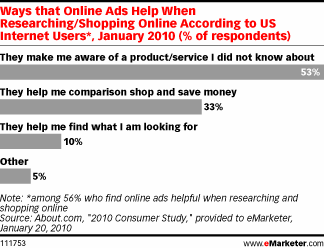 Advertising is increasingly under attack in Washington. In fact, we’re busy finishing up a paper with the working title: “The New Assault on Advertising: What it Means for the Future of Media & Culture.” Among other things, the paper inventories the many ways in which policymakers in Washington and elsewhere are stepping up regulation of commercial advertising and marketing efforts-and highlights the common themes that unite them. Unfortunately, the report is already over 50 pages long and we keep finding new threats to discuss!
This regulatory tsunami could not come at a worse time, of course, since an attack on advertising is tantamount to an attack on media itself, and media is at a critical point of technological change. As we have pointed out repeatedly, the vast majority of media and content in this country is supported by commercial advertising in one way or another-particularly in the era of “free” content and services.[1]
An Attack on Advertising Will Hurt Consumers
But there’s a more important reason to fear Washington’s new war on advertising:
It will hurt consumer welfare. That’s because advertising provides important information and signals to consumers about goods and services that are competing for their attention and business—and that scarcest of all things in the modern world, consumers’ attention. Continue reading →
Yesterday fellow TLFers Jim Harper and Berin Szoka joined me for an episode of the Surprisingly Free Conversations podcast in which we discussed the buzz around Google Buzz. You can listen to it here. You might also want to check out our other recent episodes, which include:
Check them all out and subscribe at the podcast page.
By Berin Szoka & Adam Thierer
 We learned from The Wall Street Journal yesterday that “Federal Communications Commission Chairman Julius Genachowski gets a little peeved when people suggests that he wants to regulate the Internet.” He told a group of Journal reporters and editors today that: “I don’t see any circumstances where we’d take steps to regulate the Internet itself,” and “I’ve been clear repeatedly that we’re not going to regulate the Internet.”
We’re thankful to hear Chairman Julius Genachowski to make that promise. We’ll certainly hold him to it. But you will pardon us if we remain skeptical (and, in advance, if you hear a constant stream of “I told you so” from us in the months and years to come). If the Chairman is “peeved” at the suggestion that the FCC might be angling to extend its reach to include the Internet and new media platforms and content, perhaps he should start taking a closer look at what his own agency is doing—and think about the precedents he’s setting for future Chairmen who might not share his professed commitment not to regulate the ‘net. Allow us to cite just a few examples:
Net Neutrality Notice of Proposed Rulemaking
We’re certainly aware of the argument that the FCC’s proposed net neutrality regime is not tantamount to Internet regulation—but we just don’t buy it. Not for one minute.
First, Chairman Genachowski seems to believe that “the Internet” is entirely distinct from the physical infrastructure that brings “cyberspace” to our homes, offices and mobile devices. The WSJ notes, “when pressed, [Genachowski] admitted he was referring to regulating Internet content rather than regulating Internet lines.” OK, so let’s just make sure we have this straight: The FCC is going to enshrine in law the principle that “gatekeepers” that control the “bottleneck” of broadband service can only be checked by having the government enforce “neutrality” principles in the same basic model of “common carrier” regulation that once applied to canals, railroads, the telegraph and telephone. But when it comes to accusations of “gatekeeper” power at the content/services/applications “layers” of the Internet, the FCC is just going to step back and let markets sort things out? Sorry, we’re just not buying it. Continue reading →
Today’s Online Safety Technical Working Group (OSTWG) meeting included some heated debate about whether online intermediaries should be doing more to assist law enforcement to help track down child predators and those producing and distributing child pornography. (It’s not clear whether or when NTIA will actually put the archived video or a transcript online at this point).
Most interesting was the third panel of the day (agenda), which devolved into a shouting match as Dr. Frank Kardasz (resume) of the Arizona Internet Crimes Against Children (ICAC) Task Force basically accused Internet intermediaries of being willing accomplices in crimes of sexual abuse against children—and suggested that they could be charged as co-defendants in child porn prosecutions. A few industry folks in the room expressed their outrage at such slander. A retired law enforcement officer perhaps put it best when he said that he had never dealt with an ISP that didn’t sincerely want to help law enforcement stop this monstrous crime.
Apart from those pyrotechnics, and a superb morning presentation by the Pew Internet Project’s Amanda Lenhart about “Social Media & Young Adults,” the most interesting part of the day concerned data retention mandates. Even as a debate rages in Washington about how much collection and use of online data should be permitted, Dr. Kardasz suggested online service providers should be required to hold user data for 5 years. A number of attendees noted the staggering costs of such a mandate given the sheer volume of information shared every day by use, especially for startups for whom building monitoring and compliance infrastructure can be a significant barrier to entry. Of course, practical objections are always answered with practical counter-solutions—in this case, several attendees asked why we couldn’t just provide tax incentives or stimulus money to defray such costs. One attendee joked that we’d have to devote the entire state of Montana just to house all the necessary server farms.
But the strongest objection came from John Morris of the Center for Democracy & Technology, who rightly noted that no amount of government subsidies for data retention could prevent leakage of sensitive private data. For this reason and because of the basic civil liberties at stake whenever the government has access to large pools of data about its citizens, Morris argued that we need to strike a balance between how we protect children & the values of free society. Dave McClure of the US Internet Industry Association (USIIA) seconded this point powerfully: If such vast data is retained, it will be abused.
Then the riposte from advocates of data retention mandates: Aren’t online intermediaries
already retaining huge amounts of consumer information? If they can do that, why can’t they retain the data we need to track down child predators and child porn distributors? Continue reading →
I’m attending the FTC’s 2nd “Exploring Privacy” roundtable event, which is taking place at the University of California-Berkeley School of Law. Here’s the agenda. (I’ll be live Tweeting @AdamThierer). FTC Commissioner Pamela Jones Harbour & FTC Bureau of Consumer Protection Director David Vladeck kicked things off. Here’s a quick summary of their remarks:
- Data collection has vast opportunities but drawbacks also
- “non-price dimensions” of privacy important
- Talking about recent Facebook privacy changes
- Privacy is not “over” as McNealy once said; recent public outcry about Facebook changes make that clear
- “delicate balance” between data collection and consumer control
- Concerned about privacy in the mobile environment
- “Apple could do more to require baseline level of privacy disclosures”; other could set such defaults too
- Similar fears about privacy in the cloud; difficult for consumers to define privacy expectation in the cloud; fear of lock-in concerns
- Wants more data portability
- Concerned that anonymization doesn’t work good enough; Perhaps our faith in current technologies is misplaced
- Must address the question of privacy by design sooner rather than later
Continue reading →
Betcha didn’t know that January 28th is Data Privacy Day. That’s the day on which it’s customary to give gifts of cash and money to your favorite privacy advocate. No, not really. Though Hallmark hasn’t gotten a hold of it, it is a day on which some extra attention gets paid to privacy issues.
I’ll be speaking at two events coinciding with Data Privacy Day. On Wednesday, I’ll be speaking at the 2010 Internet Data Privacy Colloquium put on by a group called Dialogue on Diversity. Register here.
And on Thursday I’ll be speaking at an event put on by the Future of Privacy Forum called “Online Privacy: Your Reputation is ON the LINE.” (Get it? “ON the LINE”? Online? We’re talkin’ computers, folks.) You can register for it on the event’s page.
There you have it! Data Privacy Day! The one day this year, among many, that you should lavish your favorite privacy expert with gifts and praise. And gifts.
Over this past week, a lot of people were making hay over this recent ReadWriteWeb story, “Facebook’s Zuckerberg Says The Age of Privacy is Over.” Seems that some people were taking issue with Facebook founder Mark Zuckerberg’s suggestion that Facebook’s recent site policy changes, which generally encouraged more sharing or information, were in line with public expectations. Most people put words in Zuckerberg’s mouth and accused him of saying that “privacy is over” or that he claimed he “is a prophet,” neither of which he actually said. But let’s ignore the fact that some people made stuff up and get back to the point: What set people off about Facebook’s recent site changes and Zuckerberg’s rationalization of them?
I think it goes back to the fact that a lot of people want to have their cake and eat it too. “It is the paradox of the cyber era,” notes
Washington Post
columnist Michael Gerson: We are “a nation of exhibitionists demanding privacy.” Indeed, that’s true, but there’s a good reason why this so-called “privacy paradox” exists. As Larry Downes, author of the brilliant new book,
The Laws of Disruption, argues:
People value their privacy, but then go out of their way to give it up. There’s nothing paradoxical about it. We do value privacy. It’s just that we’re willing to trade it for services we value even more. Consumers intuitively look at the information being requested and decide whether the value they receive for disclosing it is worth the cost of their privacy. (p. 80)
That’s exactly right. When confronted with
real world choices about privacy and information sharing, we often are willing to accept some trade-offs in exchange for something of value. But when we are asked about this process we are loathe to admit that we would willingly engage in such privacy-for-services trade-offs even if we do it every day of our lives. As Michael Arrington of TechCrunch rightly points out:
Continue reading →
by Adam Thierer & Berin Szoka, Progress Snaphot 6.1
Stephanie Clifford of the
New York Times posted a very interesting article this week summarizing a recent “on-the-record chat” the Times staff had with Federal Trade Commission (FTC) chairman Jon Leibowitz and FTC Bureau of Consumer Protection chief David Vladeck. The interview [discussed by Braden here] is profoundly important in that it reveals an alarming disconnect regarding the relationship between “privacy” regulation and the future of media, which were the subjects of their discussion with Times staff. Namely, Leibowitz and Vladeck apparently fail to appreciate how the delicate balance between commercial advertising and journalism is at risk precisely because of the sort of regulations they apparently are ready to adopt. Because the value of online advertising depends on data about its effectiveness and consumers’ likely interests, and because advertising is indispensable to funding media, what’s ultimately at stake here is nothing short of the future of press freedom.
The “Day of Reckoning” Is Upon Us
Leibowitz and Vladeck spend the first half of
The Times interview wringing their hands about “privacy policies,” the declarations made by websites and advertising networks about their data collection and use practices (for which the FTC can and must hold them accountable). But the two feel that privacy policies don’t adequately inform consumers. Chairman Leibowitz claims that online companies “haven’t given consumers effective notice, so they can make effective choices.” And Mr. Vladeck states that advise-and-consent models “depended on the fiction that people were meaningfully giving consent.” But he and the FTC seem ready to abandon the notice and choice model because the “literature is clear” that few people read privacy policies, Vladeck told the Times. He and Leibowitz continue:
“Philosophically, we wonder if we’re moving to a post-disclosure era and what that would look like,” Mr. Vladeck said. “What’s the substitute for it?” He said the commission was still looking into the issue, but it hoped to have an answer by June or July, when it plans to publish a report on the subject. Mr. Leibowitz gave a hint as to what might be included: “I have a sense, and it’s still amorphous, that we might head toward opt-in,” Mr. Leibowitz said.
This clearly foreshadows the regulatory endgame we have long suspected was coming. When the FTC released its “Self-Regulatory Principles for Online Behavioral Advertising” eleven months ago, we asked: “What’s the Harm & Where Are We Heading?” Their answers to both questions have become clearer with each new calculated comment—all apparently intended to slowly “turn up the heat” on the advertising industry so that the proverbial frog will stay in the pot until the water finally boils. Leibowitz’s FTC has simply dodged the “harm” question with a four-part strategy: Continue reading →

 The Technology Liberation Front is the tech policy blog dedicated to keeping politicians' hands off the 'net and everything else related to technology.