PFF has just released the transcript of an excellent panel discussion I moderated last week entitled, “Let’s Make a Deal: Broadcasters, Mobile Broadband, and a Market in Spectrum.” As I’ve mentioned here before, one of the hottest issues in DC right now is the question of broadcast TV spectrum reallocation. Blair Levin, who serves as the Executive Director of the Omnibus Broadband Initiative at the Federal Communications Commission, recently raised the possibility of reallocating a portion of broadcast television spectrum for alternative purposes, namely, mobile broadband. Such a “cash-for-spectrum” swap would give mobile broadband providers to spectrum they need to roll out next generation wireless broadband networks while making sure broadcaster receive compensation for any spectrum they hand over. The FCC just recently released a public notice on “Data Sought on Users of Spectrum,” (NBP Public Notice # 26) that looks into the matter. “This inquiry,” the agency says,” takes into account the value that the United States puts on free, over-the-air television, while also exploring market-based mechanisms for television broadcasters to contribute to the broadband effort any spectrum in excess of that which they need to meet their public interest obligations and remain financially viable.” Meanwhile, the House Energy and Commerce Communications Subcommittee is set to hold a hearing on the issue next Tuesday.
PFF’s panel discussion on this issue featured an all-star cast of characters, including opening remarks by Blair Levin, and a terrific discussion ensued. [You can hear the full audio from the event here.] Down below I have highlighted some of the major points each speaker made during the discussion and also embedded the complete transcript in a Scribd reader. Also, just a reminder that my PFF colleague Barbara Esbin and I authored a short paper on this issue recently: “An Offer They Can’t Refuse: Spectrum Reallocation That Can Benefit Consumers, Broadcasters & the Mobile Broadband Sector.”
Continue reading →
One of the more troubling aspects of the contentious debate over Net neutrality regulation is the way some proponents have sought to cast Net neutrality as “the Internet’s First Amendment.” As a die-hard free speech advocate, I find this truly outrageous and a complete contortion of the true purpose of the First Amendment. As I have argued here before, it is incredibly dangerous thinking that puts our real First Amendment liberties at stake by empowering a regulatory agency with more means of controlling online speech and expression. Simply stated, the Internet’s First Amendment is the First Amendment, not some new, top-down, heavy-handed regulatory regime that puts the Federal Communications Commission in control of the Digital Economy.
On this point, I wanted to bring two things to your attention. The first is an outstanding address delivered today by Kyle McSlarrow, President & CEO of the National Cable & Telecommunications Association, at a Media Institute event here in Washington, DC. And the second is this new paper by my PFF colleague Barbara Esbin.
McSlarrow’s speech was entitled, “Net Neutrality: First Amendment Rhetoric in Search of the Constitution” and it squarely addressed the fundamental fallacy set forth by the Net neutralitistas when it comes to the First Amendment. “Whatever our present-day policy disagreements about net neutrality, or even differing politics, let’s not forget that the First Amendment is framed as a shield for citizens, not a sword for government,” he argued. “By its plain terms and history, the First Amendment is a limitation on government power, not an empowerment of government,” McSlarrow said. “And… if there’s one thing the Supreme Court has made clear, it’s that rules that directly restrict protected speech cannot be justified by a government interest that is merely hypothetical.”
Absolutely correct. And these views are buttressed by the comments of Barbara Esbin in her new paper, in which she argues that “Net Neutrality is not the First Amendment for the Internet.” She continues: Continue reading →
Along with my colleague Barbara Esbin, the Director of PFF’s Center for Communications and Competition Policy, I have just released a new paper on discussing the possibility of reallocating a portion of broadcast television spectrum for alternative purposes, namely, mobile broadband. As I discussed here before, Blair Levin, the Executive Director of the FCC’s Omnibus Broadband Initiative, has been suggesting that it might be possible to craft a grand bargain whereby broadcasters get cash for some (or all) of their current spectrum allocations if they return spectrum to the FCC for reallocation and re-auction, likely to mobile broadband services.
In our paper, “An Offer They Can’t Refuse: Spectrum Reallocation That Can Benefit Consumers, Broadcasters & the Mobile Broadband Sector,” [PDF] Barbara and I argue that:
the benefits of such a deal could be enormous for wireless broadband providers, developers of digital technologies, and consumers. Expanding the pool of spectrum available for next-generation wireless broadband offerings will ensure that innovative new networks, devices, and services are made available to the public on a timely basis. Ultimately, that will mean more high-speed choices for consumers, especially those in rural areas harder to reach with high-speed wireline networks. Finally, more generally, anything that moves us in the direction of a freer market in spectrum is a good thing.
But fairness to broadcasters lies at the heart of this spectrum reallocation plan. If a deal can’t be structured that broadcasters would find acceptable, they should not be forced to come to the table. When we speak of an offer they can’t refuse, we mean one so attractive that no rational businessperson or investor would pass it up. It is essential broadcasters be willing partners in the deal, and be full participants in the process of shaping its contours.
Read the entire thing here, or below the fold as a Scribd document. Continue reading →
Today I was invited to the Federal Communications Commission (FCC) to testify at one of the agency’s Broadband Working Group workshops. This particular workshop was on “Broadband Consumer Context,” which focused on “a range of challenges and opportunities as the internet becomes a focal point for commercial transactions, social networking, and a host of activities pertaining to information gathering and exchange.”
I was asked to address the issue of whether there is a relationship between online safety concerns and broadband uptake. In my testimony, I noted that, in my 15 years of research in this area, I have never unearthed any substantive empirical evidence suggesting a correlation between parental concerns about online activity and overall household broadband uptake. I have seen occasional anecdotal news stories discussing the concerns some parents have had about their kids online that led them to reject online connectivity, but these stories have been exceedingly rare (and I haven’t seen any in recent memory).
I also argued that I did not think it at all surprising that such anecdotes are harder to find, or that empirical evidence on this front seems non-existent. I argued that there were four logical explanations for why parental concerns about online safety haven’t “moved the broadband needle” much in the negative direction:
- Not every home has children present
- Parents use a variety of household media rules to control media & Internet usage
- A vibrant marketplace of parental control technologies exists
- Likely that most parents believe that the benefits of broadband outweigh the potential downsides
For all the details on each of those, read my entire testimony or check out the presentation embedded below that I made to the FCC today. Continue reading →
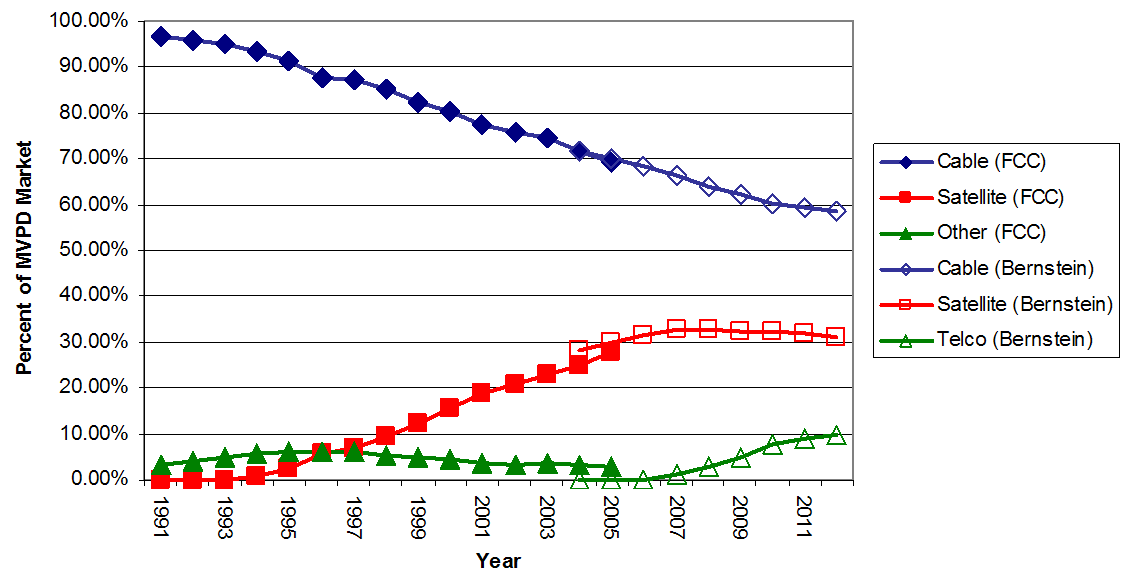
The D.C. Circuit has struck down as arbitrary and capricious the FCC’s “cable cap.” The cap prevented a single cable operator from serving more than 30% of U.S. homes—precisely the same percentage limit struck down by the court in 2001. The court ruled that the FCC had failed to demonstrate that “allowing a cable operator to serve more than 30% of all cable subscribers would threaten to reduce either competition or diversity in programming.”
The court’s decision rested on the two critical charts (both generated by my PFF colleague Adam Thierer in his excellent
Media Metrics special report) at the heart of the PFF amicus brief I wrote with our president, Ken Ferree:
First, the record is replete with evidence of ever increasing competition among video providers: Satellite and fiber optic video providers have entered the market and grown in market share since the Congress passed the 1992 Act, and particularly in recent years. Cable operators, therefore, no longer have the bottleneck power over programming that concerned the Congress in 1992.
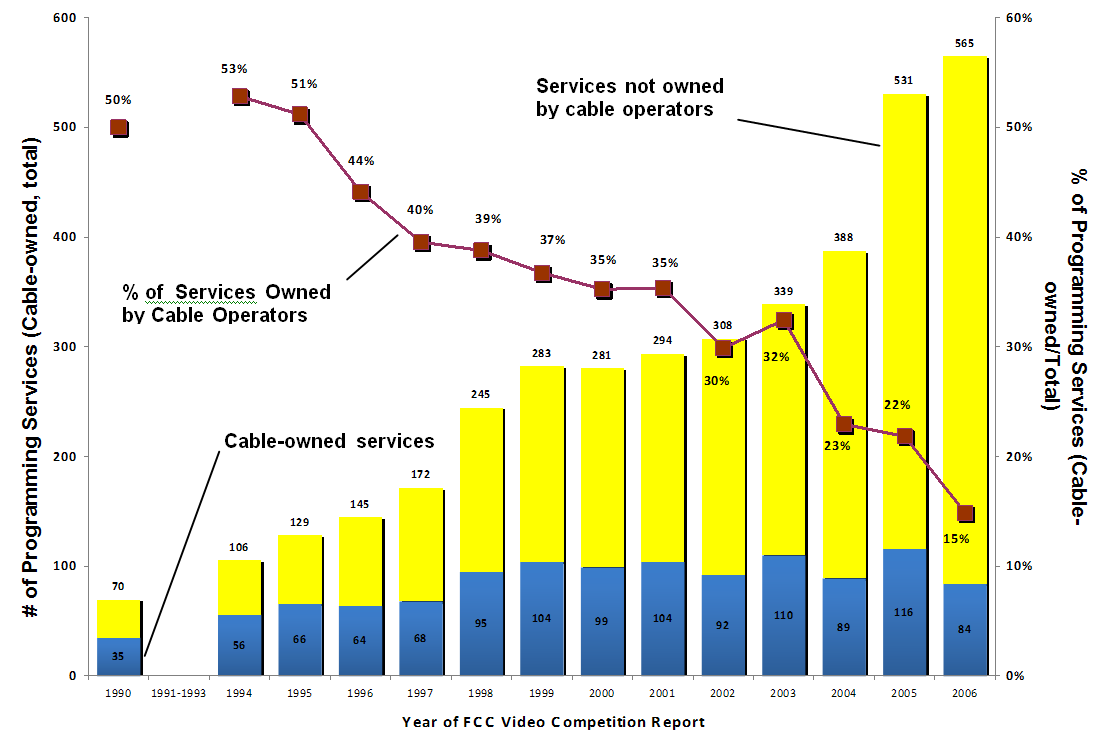
Second, over the same period there has been a dramatic increase both in the number of cable networks and in the programming available to subscribers.
Our chart shows the explosion in the number of programmers (though not the total amount of programming), as well as the falling rate of affiliation between cable operators and programmers, which was among the prime factors motivating Congress when it authorized a cable cap in the 1992 Cable Act:
Continue reading →
On July 27th, The Progress & Freedom Foundation hosted a Capitol Hill panel discussion entitled “Online Child Safety, Privacy, and Free Speech: An Overview of Challenges in Congress & the States.” The event featured remarks from:
- Parry Aftab, Executive Director, WiredSafety.org
- Todd Haiken, Senior Manager of Policy, Common Sense Media
- Jim Halpert, Partner, DLA Piper
- Berin Szoka, Senior Fellow, The Progress & Freedom Foundation
We’ve just released the transcript of the event, which I have also pasted down below the fold in a Scribd document reader. Also, the audio for this event can be heard by clicking below:
Download mp3
Here is the full event description: Continue reading →
I’ve just had a new article published by the American Legislative Exchange Council (ALEC) in which I make the case against “techno-panics,” which refers to public and political crusades against the use of new media or technologies by the young. The article is entitled “Parents, Kids & Policymakers in the Digital Age: Safeguarding Against ‘Techno-Panics‘” and it appears in the July 2009 Inside ALEC newsletter. This is something I have spent a lot of time writing about here in recent years (See 1, 2, 3, 4, 5) and I finally got around to putting it altogether in a concise essay here. I have pasted the full text below. [And I just want to send a shout-out to my friend Anne Collier of Net Family News.org, whose work on this topic has been very influential on my thinking.]
“Parents, Kids & Policymakers in the Digital Age: Safeguarding Against ‘Techno-Panics‘”
by Adam Thierer
A cursory review of the history of media and communications technologies reveals a reoccurring cycle of “techno-panics” — public and political crusades against the use of new media or technologies by the young. From the waltz to rock-and-roll to rap music, from movies to comic books to video games, from radio and television to the Internet and social networking websites, every new media format or technology has spawned a fresh debate about the potential negative effects they might have on kids.
Inevitably, fueled by media sensationalism and various activist groups, these social and cultural debates quickly become political debates. Indeed, each of the media technologies or outlets mentioned above was either regulated or threatened with regulation at some point in its history. And the cycle continues today. During recent sessions of Congress, countless hearings were held and bills introduced on a wide variety of media and content-related issues. These proposals dealt with broadcast television and radio programming, cable and satellite television content, video games, the Internet, social networking sites, and much more. State policymakers, especially state Attorneys General (AGs), have also joined in such crusades on occasion. The recent push by AGs for mandatory age verification for all social networking sites is merely the latest example.
What is perhaps most ironic about these techno-panics is how quickly yesterday’s boogeyman becomes tomorrow’s accepted medium, even as the new villains replace old ones. For example, the children of the 1950s and 60s were told that Elvis’s hip shakes and the rock-and-roll revolution would make them all the tools of the devil. They grew up fine and became parents themselves, but then promptly began demonizing rap music and video games in the ‘80s and ‘90s. And now those aging Pac Man-era parents are worried sick about their kids being abducted by predators lurking on MySpace and Facebook. We shouldn’t be surprised if, a decade or two from now, today’s Internet generation will be decrying the dangers of virtual reality.
Continue reading →
 My friend Larry Magid, the co-director of ConnectSafely.org (with Anne Collier) and founder of SafeKids.com, has a sharp new piece up at CBS News.com entitled, “Stop Cyberbullying with Education,” in which he rightly points out how “we need to be careful with legislation that would outlaw cyberbullying.” He points out that although cyberbullying is “not an epidemic and it’s not killing our children”:
Bullying has always been a problem among adolescents and, sadly, so has suicide. In the few known cases of suicide after cyberbullying, there are other contributing factors. That’s not to diminish the tragedy or suggest that the cyberbullying didn’t play a role but–as with all online youth risk, we need to look at what else was going on in the child’s life. Even when a suicide or other tragic event doesn’t occur, cyberbullying is often accompanied by a pattern of offline bullying and sometimes there are other issues including long-term depression, problems at home, and self-esteem issues.
He goes on to provide some solid advice:
Continue reading →
Just a heads up for those of you in the DC-area… On Monday, July 27th, PFF will be hosting a Hill event on “Online Child Safety, Privacy, and Free Speech: An Overview of Challenges in Congress & the States.” I will be moderating the discussion and we will be joined by Parry Aftab, Executive Director of WiredSafety.org, Jim Halpert a Partner with the law firm of DLA Piper, Todd Haiken, Senior Manager of Policy for Common Sense Media, and my colleague Berin Szoka also of PFF.
The event will focus on the intersection of online child safety, privacy, and free speech issues at both the federal and state level. Bills introduced in Congress to address cyberbullying concerns propose either educational initiatives or a criminalization approach. Access to objectionable content also remains a concern and a new, government-mandated task force is looking into those issues. Meanwhile, state officials, including many state attorneys general, continue to explore age verification mandates for social networking sites and some have considered building on the federal Children’s Online Privacy Protection Act (COPPA) to expand “parental notification” mandates. The Federal Trade Commission (FTC) has recently announced an expedited review of COPPA to see if it is keeping up with new developments. The FTC is also exploring child safety in virtual worlds. New concerns about “sexting,” or the sending of sexual explicit images over mobile devices, has also raised new concerns led some lawmakers to ponder penalties.
How serious are these concerns? Is legislation or regulation needed to address them? What free speech issues are at stake? Should Congress take the lead or leave it to the States to experiment with different models? These and other issues will be discussed by the panelists at our July 27th event.
The logistical details are below and you
RSVP here.
“Online Child Safety, Privacy, and Free Speech: An Overview of Challenges in Congress & the States”
July 27, 2009
12:00 p.m. to 1:30 p.m.
Room SVC-208
Capitol Visitor Center
1st Street and East Capitol Street, NE (entrance across from Supreme Court)

 The Technology Liberation Front is the tech policy blog dedicated to keeping politicians' hands off the 'net and everything else related to technology.