In an earlier post, I mentioned an important new online child safety task force report that has just been released from the “Point Smart. Click Safe.” Blue Ribbon Working Group. It’s a great report and I encourage you to read the whole thing. It was my great pleasure to serve on this task force, and as we started finalizing our conclusions and recommendations, I started thinking about how much of what we were finding and recommending was consistent with what past online safety task forces had also concluded.
By way of background, over the past decade, five major online safety task forces or blue ribbon commissions have been convened to study online safety issues. Two of these task forces were convened in the United States and issued reports in 2000 (“COPA Commission”) and 2002 (“Thornburgh Commission“). Another was commissioned by the British government in 2007 and issued in a major report in March 2008 (“Byron Review“). Finally, two additional online safety task forces were formed in the U.S. in 2008 and concluded their work, respectively, in January (“Internet Safety Technical Task Force“) and July (“Point Smart. Click Safe.“) of 2009. [And yet another task force — the Online Safety Technology Working Group — was recently formed and has now gotten underway.]
In a new PFF white paper, ”
Five Online Safety Task Forces Agree: Education, Empowerment & Self-Regulation Are the Answer,” I walk through a chronological summary of each of these past task forces [click on covers of each report below to read them in their entirety] and highlight some of the similar themes and recommendations from them.

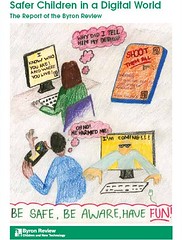

 Continue reading →
As I noted recently, Berin Szoka and I just released a big PFF white paper (PDF) entitled, “Cyberbullying Legislation: Why Education is Preferable to Regulation,” which examines two very different federal approaches to the issue. One approach is focused on the creation of a new federal crime to punish cyberbullying, which would include fines and jail time for violators. One approach, set forth by Rep. Linda Sánchez (D-CA) in H.R. 1966 (originally H.R. 6123), the “Megan Meier Cyberbullying Prevention Act,” would create a new federal felony: “Whoever transmits in interstate or foreign commerce any communication, with the intent to coerce, intimidate, harass, or cause substantial emotional distress to a person, using electronic means to support severe, repeated, and hostile behavior, shall be fined under this title or imprisoned not more than two years, or both.”
The other legislative approach is education-based and would create an Internet safety education grant program to address the issue in schools and communities. In mid-May, the “School and Family Education about the Internet (SAFE Internet) Act” (S. 1047) was introduced in the Senate by Sen. Robert Menendez (D-NJ) and in the House by Rep. Debbie Wasserman Schultz (D-FL). The measure proposes an Internet safety education grant program that will be administered by the Department of Justice, in concurrence with the Department of Education, and the Department of Health & Human Services.
On June 12, the Family Online Safety Institute (FOSI) hosted a discussion about these bill on Cap Hill, which was moderated by FOSI CEO Stephen Balkam. Representatives from both Rep. Sanchez’s and Sen. Menendez’s offices were on hand to discuss their bills, and I provided some feedback based upon what Berin and I concluded in our paper. It was a good discussion and I encourage you to watch the whole thing because there were some good questions from the audience later in the show.
http://www.youtube.com/v/FsCpOgwTqQM&hl=en&fs=1&
PFF Adjunct Fellow Mike Palage, who served on the ICANN board from 2003 to 2006, filed these comments (PDF) on the NTIA’s recent Notice of Inquiry regarding ICANN’s future. Mike’s four key points were as follows:
- ICANN’s Periodic Review of its internal operations and supporting organizations has failed, and has become nothing more than a “perpetual motion machine of public comments and documentation producing no meaningful results.” Only a second Evolution and Reform Process can solve ICANN’s current deficiencies;
- ICANN must hardcode into its policies and its contracts the principle that its policies cannot supersede national laws;
- ICANN must cease any operational role in technical infrastructure as required by its bylaws and focus instead on its mission as a technical coordinator; and
- Congress must avoid “kicking the JPA can down the road” and instead provide much-needed leadership by creating a solid foundation for ICANN 3.0 in legislation after proper consultation with the Government Accountability Office.
Continue reading →
As anyone who has spent time searching for comments on the FCC’s website can tell you, the agency doesn’t exactly have the most user-friendly website. In the interest of making it easier for others to read the comments that came in last week in the agency’s “Child Safe Viewing Act” Notice of Inquiry, I have compiled all the major comments (those over 3 or 4 pages) and provided links to them below the fold.
Again, this proceeding was required under the “Child Safe Viewing Act of 2007,” which Congress passed last year and President Bush signed last December. The goal of the bill and the FCC’s proceeding (MB 09-26) is to study “advanced blocking technologies” that “may be appropriate across a wide variety of distribution platforms, including wired, wireless, and Internet platforms.” I filed 150+ pages worth of comments in this matter last week, and here’s my analysis of why this bill and the FCC’s proceeding are worth monitoring closely.
Continue reading →
Today I filed comments with the Federal Communications Commission (FCC) in its proceeding examining the marketplace for “advanced blocking technologies.” This proceeding was required under the “Child Safe Viewing Act of 2007,” which Congress passed last year and President Bush signed last December. The goal of the bill and the FCC’s proceeding (MB 09-26) is to study “advanced blocking technologies” that “may be appropriate across a wide variety of distribution platforms, including wired, wireless, and Internet platforms.” My colleagues will no doubt laugh about the fact that I have dropped an absurd 150 pages worth of comments on the FCC in this matter, but I had a lot to say on this topic! Parental controls, child safety, and free speech issues have been the focus of much of my research agenda over the past 10 years.
In my filing, I argue that the FCC should tread carefully in this matter since the agency has no authority over most of the media platforms and technologies described in the Commission’s recent Notice of Inquiry. Moreover, any related mandates or regulatory actions in in this area could diminish future innovation in this field and would violate the First Amendment rights of media creators and consumers alike. The other major conclusions of my filing are as follows:
- There exists an unprecedented abundance of parental control tools to help parents decide what constitutes acceptable media content in their homes and in the lives of their children.
- There is a trade-off between complexity and convenience for both tools and ratings, and no parental control tool is completely foolproof.
- Most homes have no need for parental control technologies because parents rely on other methods or there are no children in the home.
- The role of household media rules and methods is underappreciated and those rules have an important bearing on this debate.
- Parental control technologies work best in combination with educational efforts and parental involvement.
- The search for technological silver-bullets and “universal” solutions represent a quixotic, Holy Grail-like quest and it will destroy innovation in this marketplace.
- Enforcement of “household standards” made possible through use of parental controls and other methods negates the need for “community standards”-based content regulation.
My entire filing can be found here and down below in a Scribd reader. All comments in the matter are due tomorrow and then reply comments are due on May 18th.
Continue reading →
By Mike Palage, PFF Adjunct Fellow & former ICANN Board Member
TPI’s Tom Lenard and Larry White released a study yesterday entitled ICANN at a Crossroads: A Proposal for Better Governance and Performance (PDF). ICANN is, indeed, at a crossroads: A number of critical Internet governance issues will be decided over the next 6-12 months-such as:
- How to roll out new gTLDs like .BLOG, which I’ve discussed here and here (PDF).
- ICANN’s future as an increasingly independent organization, which I’ve discussed here.
There is an acute need to better educate the public and policymakers about these complex issues and about how ICANN works-something that will be addressed by my upcoming primer on ICANN. For that reason, I welcome TPI’s contribution to this important debate about the future of the Internet. I share TPI’s concerns about the inadequacy of mechanisms currently in place to ensure ICANN’s accountability and the absence of any checks on ICANN’s ever-expanding budget.
But I strongly disagree with TPI’s conclusion that:
ICANN should remain a nonprofit organization, but it should be governed by and accountable to its direct users: the registries and the registrars. The seats on ICANN’s board could be rotated among the major operators in a manner that would reflect the diversity of viewpoints among the registries and registrars.
Having worn many hats in the ICANN eco-system-as a consultant for
both registries and registrars and as a business user and IP attorney-I must say that adopting this model of direct-user control would be suicidal for ICANN. Filling the ICANN Board with registries and registrars would create at least the appearance of a cartel, allowing those opposed to ICANN’s underlying model of public/private-partnership to capture the organization. Neither capture by private interests opposed to the “public” part of the model nor a counter-attack by those who object to the “private” part of the model would be a good thing for Internet users or ICANN stakeholders.
Having invested over 10 years of my life in ICANN’s diverse and inclusive public/private partnership model, I speak from first-hand experience that ICANN is
far from perfect as an organization. I’ve often feared that ICANN is heading in the wrong direction and I’ve never hesitated to say so. But despite these shortcomings, the various stakeholders I work with in the seemingly byzantine “ICANN process” remain as committed as ever to the principles set forth in NTIA’s 1998 White Paper as the foundations of Internet governance. The staying-power of this shared belief in a common set of principles among all stakeholders reaffirms my faith in the public/private partnership-whatever other changes need to be made.
Lenard and White are right about one thing: We
do need a new model for ensuring ICANN’s accountability after the expiration of ICANN’s current relationship with the U.S. Government. But the model they suggest isn’t it—as Steve Delbianco has pointed out.
I’ve got a new PFF paper out today entitled, “Who Needs Parental Controls? Assessing the Relevant Market for Parental Control Technologies.” In this piece, I address the argument made by some media and Internet critics who say that government intervention (perhaps even censorship) may be necessary because parental control technologies are not widely utilized by most Americans. But, as I note in the paper, the question that these critics always fail to ask is: How many homes really need parental control technologies? The answer: Far fewer than you think. Indeed, the relevant universe of potential parental control users is actually quite limited.
I find that the percentage of homes that might need parental control technologies is certainly no greater than the 32% of U.S. households with children in them. Moreover, the relevant universe of potential parental control users is likely much less than that because households with very young children or older teens often have little need for parental control technologies. Finally, some households do not utilize parental control technologies because they rely on alternative methods of controlling media content and access in the home, such as household media rules. Consequently, policymakers should not premise regulatory proposals upon the limited overall “take-up” rate for parental control tools since only a small percentage of homes might actually need or want them.
If you don’t care to read the whole nerdy thing, I’ve created this short video summarizing the major findings of the paper.
http://www.youtube.com/v/a7Fnf3Ztt-U&hl=en&fs=1
And the document is embedded below the fold in a Scribd reader.
Continue reading →
Sid Rosenzweig, who recently joined PFF to study patent issues, has a very thoughtful piece about Apple’s new patent on the multi-touch interface on the iPhone, which ends as follows:
It is striking how protection for user interfaces has changed over the years. It is not clear that patent protection for user interfaces is a step in the right direction, even for iconic breakthroughs in interfaces such as for the iPhone and iPod Touch. The 300 diagrams in this Apple patent call to mind the 189 graphical user-interface elements of the Apple v. Microsoft copyright infringement case from the early 1990s. The Apple v. Microsoft case prevented Apple from obtaining the protection on the overall look-and-feel of its software, and instead treated as discrete each element of the user interface. This patent, and others like it, purport to cover the combination of several elements — here the web scrolling with the photo-album browsing — and not the discrete elements themselves. With the Apple v. Microsoft case largely having thrown copyright out the window, and with trade dress protection excluding functional elements, patents are really the only option for companies like Apple, until and unless another solution is found.
On this week’s show, we discuss government transparency—a topic a number of us here at the TLF have written about lately. Among other things, we discuss:
- Why transparency is important
- What data the government should provide and how
- Good and bad examples of transparency
- President Obama’s promise to have the most accountable administration in history
- Obama’s plans to appoint a Chief Technology Officer
My guests for this show are:
You can subscribe to our podcast here or through iTunes here. Or, you can play or download this podcast using the online player below.
[display_podcast]
Continuing the “Cutting the (Video) Cord” series started by my PFF colleague Adam Thierer: The WSJ had two great pieces yesterday about the increasing competitive relevance of television distributed by Internet—a trend that was at the heart of an amicus
brief PFF recently filed in support of C omcast’s challenge of the FCC’s 30% cap on cable ownership. The first WSJ piece declares that:
After more than a decade of disappointment, the goal of marrying television and the Internet seems finally to be picking up steam. A key factor in the push are new TV sets that have networking connections built directly into them, requiring no additional set-top boxes for getting online. Meanwhile, many consumers are finding more attractive entertainment and information choices on the Internet — and have already set up data networks for their PCs and laptops that can also help move that content to their TV sets.
The easier it is for consumers to receive traditional television programming (in addition to other kinds of video content) distributed over the Internet on their television, the less “gatekeeper” or “bottleneck” power cable distributors have over programming. So the Netflix-capable and Yahoo-widget-capable televisions described by the WSJ piece go a long way to increasing the substitutability of what we call Internet Video Programming Distributors (IVPDs) for Multichannel Video Programming Distributors (MVPDs), such as cable, satellite television and fiber services offered by telcos such as Verizon’s FiOS.
While such televisions are only expected to reach 14% of all TV sales by 2012, one must remember that a growing number of set-top boxes (
e.g., the Roku Digitial Video Player, game consoles like the Microsoft XBox 360 and Sony PlayStation 3, and TiVo DVRs) allow users to users to receive IVPD programming on their existing televisions.
As we argued in our amicus brief, the immense competitive importance of IVPDs lies not in the potential for some users to “cut the cord” to cable and other MVPDs (though that will surely happen), but in the immediate impact IVPDs have as an alternative distribution channel for programmers. In the pending D.C. Circuit case, we argue that both the FCC’s 30% cap, issued in December 2007, and the underlying portions of the 1992 Cable Act authorizing such a cap should be struck down as unconstitutional because the ready availability of IVPDs as an alternative distribution channel means that cable no longer has the “special characteristic” of gatekeeper/bottleneck power that would justify imposing such a unique burden on the audience size of cable operators. (Of course, Direct Broadcast Satellite and Telco Fiber are also eating away at cable’s share of the MVPD marketplace.)
The second WSJ piece, an op/ed, illustrates beautifully how cable operators are already losing “market power” (or at least negotiating leverage) in a very tangible way: they’re having to pay more for programming. Specifically, the Journal describes how Viacom plaid chicken with Time Warner—and won. Continue reading →

 The Technology Liberation Front is the tech policy blog dedicated to keeping politicians' hands off the 'net and everything else related to technology.