I’ve spent a lot of time here deconstructing and criticizing the proposals set forth by the Free Press, the radical media “reformista” group founded by the prolific Marxist media theorist Robert McChesney. I have been trying to shine more light on their proposals and activities because I believe they are antithetical to freedom of speech and a free society. That’s because, as media scholar Ben Compaine has noted, “What the hard core reformistas really want, it seems, is not diversity or an open debate but a media that promotes their own vision of society and the world.” That’s exactly right and, more specifically, as I argued in my 2005 Media Myths book, the media reformistas want to impose this control by taking the fantasy that “the public owns the [broadcast] airwaves” and extending it to ALL media platforms and outlets. In other words, McChesney and the Free Press want an UnFree Press. To cast things in neo-Marxist terms that they could appreciate, they want to take control of the information means of production. And it begins, McChesney argues, by all of us having to give up this “sort of religious attachment to the idea of a ‘free-press'” from which we all suffer.
Some people accuse me of “red-baiting” or “McCarthyite” tactics when I use the “M-word” (Marxism) or the “S-Word” (socialism) to describe McChesney, the Free Press, and the movement they have spawned. But these are labels with real meaning and ones that McChesney himself embraces in his work. In his 1999 book
Rich Media, Poor Media, he says that “Media reform cannot win without widespread support and such support needs to be organized as part of a broad anti-corporate, pro-democracy movement.” He casts everything in “social justice” terms and speaks of the need “to rip the veil off [corporate] power, and to work so that social decision making and power may be made as enlightened and as egalitarian as possible.” What exactly would all that mean in practice for media? In his 2002 book Our Media, Not Theirs: The Democratic Struggle against Corporate Media with John Nichols of The Nation, McChesney argues that media reform efforts must begin with “the need to promote an understanding of the urgency to assert public control over the media.” They go on to state that, “Our claim is simply that the media system produces vastly less of quality than it would if corporate and commercial pressures were lessened.”
If you want additional proof of his intentions, then I encourage you to read this lengthy interview with McChesney that appears in the new edition of The Bullet, an online newsletter produced by the Canada-based “Socialist Project.” (If you ask me, there’s something strangely appropriate about a socialist newsletter named “The Bullet” in light of the millions of people who died while living under socialist tyranny!) Anyway, let’s ignore that and focus on what neo-Marxist media reform entails according to McChesney. Because never before has he laid his cards on the table as clearly as he does in this interview. Continue reading →
On the problems with the newspaper industry, Michael Kinsley writes in the Washington Post:
You may love the morning ritual of the paper and coffee, as I do, but do you seriously think that this deserves a subsidy? Sorry, but people who have grown up around computers find reading the news on paper just as annoying as you find reading it on a screen. (All that ink on your hands and clothes.) If your concern is grander – that if we don’t save traditional newspapers we will lose information vital to democracy – you are saying that people should get this information whether or not they want it. That’s an unattractive argument: shoving information down people’s throats in the name of democracy.
I rarely say it, but the whole thing is worth reading.
Speaking of socializing media, acting FCC Chairman Michael Copps is someone who has devoted much of his life to regulating the media marketplace into the ground. If he had his way, federal bureaucrats would be controlling virtually every aspect of the media universe. Nothing would get done with Big Nanny’s permission.
That’s what makes his recent comments about the impact of media regulation so delicious.. and hypocritical. According to an article Bloomberg ran on Thursday, Copps is now saying that, with newspapers struggling to remain afloat, the FCC should now reconsider regulations that prohibit combined ownership of broadcast stations and newspapers. The agency should “visit this whole problem” before long, Copps apparently told Bloomberg.
“Visit this problem before long”?? Please! Congress and the FCC have had opportunities to “visit” and revisit this problem for many years now, but it has been Michael Copps and his merry band of media reformistas who have stopped every reform effort dead in its tracks. (See my essays “Congress Fiddles, Newspapers Burn” and “Media Deregulation is Dead” for more evidence of how these radicals hijacked media policy in this country.) As I documented in my 2005 Media Myths book, these charlatans have used hyperbolic rhetoric, shameless fear-mongering, and unsubstantiated claims in opposition to each and every sensible effort to reform our nation’s outdated media ownership policies. Those laws and regulations have created artificial market structures and hindered the ability of media operators to find new business models that might throw them a lifeline in difficult times.
Consider the fact that it was just 14 months ago that then-Commissioner Copps issued this gem of a hysteria-ridden statement in response to the agency’s last effort to ever-so-slightly loosen the newspaper-broadcast cross ownership rule:
Continue reading →
I’ve got a new essay up over at the
City Journal about John Nichols and Robert McChesney’s proposal to have the government heavily subsidize failing media enterprises to “save journalism.” It follows below:
“Socializing Media in Order to Save It“
by Adam D. Thierer
City Journal March 27, 2009
With proposals to nationalize or heavily subsidize various segments of our economy more in vogue than ever, it was probably only a matter of time before someone suggested that America’s media marketplace should be brought into the government fold. John Nichols of The Nation and the prolific neo-Marxist media theorist Robert W. McChesney have now provided the road map for media’s march to serfdom. The cost to the American taxpayer would be at least $60 billion, but the cost for the First Amendment and our democracy would be incalculable.
Nichols and McChesney have coauthored several books and essays about media policy that view the world through the prism of class struggle, “manufactured consent” (á la Noam Chomsky), and the rest of the typical Marxoid tripe about history and economics. In their view, private, for-profit media cannot be trusted. As they stated in their 2003 call to arms,
Our Media, Not Theirs: The Democratic Struggle Against Corporate Media, media-reform efforts must begin with “the need to promote an understanding of the urgency to assert public control over the media.” “Our claim,” they continue, “is simply that the media system produces vastly less of quality than it would if corporate and commercial pressures were lessened.”
In a new
Nation essay, “The Death and Life of Great American Newspapers,” the authors bring their earlier work to its logical conclusion. Saving journalism, they argue, essentially requires that media become an appendage of the state. Journalism, they claim, is a “public good,” which—like education and defense—requires constant government oversight and support: “A moment has arrived at which we must recognize the need to invest tax dollars to create and maintain news gathering, reporting and writing with the purpose of informing all our citizens.” They propose that government devote $60 billion to “subscription subsidies, postal reforms, youth media and investment in public broadcasting.” Think of it as a “free press ‘infrastructure project,’” they say. “It would keep the press system alive. And it has the added benefit of providing an economic stimulus.” (Isn’t it amazing how everything stimulates the economy these days?)
Continue reading →
I’ve been catching up on Radio Berkman, the podcast produced by our friends at the Berkman Center for Internet & Society and a great companion to the TLF’s own Tech Policy Weekly Podcast. There’s been a lot of talk about government transparency on the TLF lately, including TPW 40: Obama, e-Government & Transparency. But that conversation has been mainly focused on how to make “public” records accessible.
The most recent Radio Berkman episode, “Can you Keep a Secret?” explores the thorny questions about what should be deemed public in the first place, and what should be classified:
The government keeps secrets. We take that for granted. But should we? Some speculate that intelligence agencies and elected officials are a little bit trigger happy with the “Top Secret” stamp, and that society would benefit from greater openness. With the government classifying millions of pages of documents per year – in a recent year the U.S. classified about five times the number of pages added to the Library of Congress – a great deal of useful human knowledge gets put under lock and key. But some argue that secrecy is still crucial to our national security.
Radio Berkman pokes its head into a recent talkback with the directors of the film
Secrecy, Harvard University professors Peter Galison and Robb Moss. They are joined by Harvard Law School professors Jonathan Zittrain, Martha Minow, and Jack Goldsmith.
I look forward to seeing the film (when it comes out on Netflix).
What I found most interesting was the discussion of the essential trade-off in the relationship between the media and the state has always been between the media’s “independence” and its “responsibility” (~33:30 in). Even the staunchest critics of the national security state would probably accept that there are
some stories in the media shouldn’t publish because they’d jeopardize the safety of Americans. But we all want the media to blow the whistle on the bad stuff that goes on behind a veil of secrecy. Drawing that line is a terribly difficult task. But it becomes even more complicated with the decline of traditional professional investigative journalism and the rise of blog/amateur journalism. Continue reading →
There’s been plenty written about the death spiral that America’s newspaper industry finds itself stuck in — here’s an amazing summary of the recent online debates — and I’ve spent a lot of time writing on this issue here in the past, too. Ben Compaine, one of America’s sharpest media analysts and the co-author of the classic study Who Owns the Media?, has added his own two cents in his latest essay over at the Rebuilding Media blog. Like everything Ben writes, it is well worth reading:
If newspapers have essentially been able to thrive on the revenue from advertisers alone (again, with cost of printing more or less covered by circulation revenue), why are they having so much trouble today? The answer is not one single factor, but a major contributor is that newspapers – whether print or digital—are just worth less to advertisers than they were 20 years ago. Back then, local advertisers did not have many options for reaching the mass local audience. What was the alternative for auto dealers? For real estate agents? Supermarkets or department stores? For some, direct mail was one possible option. But that was about it. Using pre-prints instead of ROP became attractive for some large display advertisers, leaving the publishers with a piece of the cash flow. Advertisers were hit with regular rate increases. And they pretty much had to pay, The publishers made good money.
But then a double whammy. Just about the time the Internet became a real alternative for classified listings—think Craigslist, Monster.com, eBay, Autotrader.com—and for retailers—think DoubleClick, Google, et al—the boys at the cable operators had perfected the insertion of highly local spots into their feeds. Between 1989 and 2007 local cable advertising increased from $500 million to $4.3 billion—or from 0.4% of all advertising to 1.6%. Advertising in newspapers fell from 26% to 15% in this period. Although some of the highly local advertisers going to cable may have taken some of their funds from budgets for radio or other local media, it is probable that a significant share came from the hides of newspapers. I estimate perhaps up to 20% of the decline in local newspaper advertising share can be attributed to local cable spots.
The other whammy, the gorilla in the room, is Internet advertising. No need to elaborate. But its impact on newspapers is not just that it has siphoned off dollars per se. Much more importantly is that
the Internet has given most advertisers greater market power against newspaper publishers. Many big advertisers—like car dealers, real estate offices and big box retailers—don’t need the newspapers as much.
Ben’s got it exactly right. The decline of newspapers comes down to the death of “protectable scarcity” (thanks to Canadian media expert Ken Goldstein for that phrase). There’s just too much other competition out there online already for our eyes and ears. We’re witnessing substitution effects on a scale never seen in the media world, with disruptive digital technologies and networks splintering our attention spans. That de-massification of media means that high fixed cost endeavors like daily newspapers are not going to be able to sustain the cross-subsidies they’ve long gotten from advertisers.
If you want to boil the newspaper death spiral down to an equation, it would look something like this:
Continue reading →
[This represents a bit of a departure from the traditional format of my ongoing “Media Deconsolidiation Series,” but you will see how it ties in…]
So, some guy from the (Un)Free Press — the activist group that wants to regulate every facet of the media and broadband universe — has created a scary looking chart about “Information Control” [seen below]. It’s based loosely on the Periodic Table of Elements, you know, to give it the aura of science and fact. In reality, it’s just another silly scare tactic that tells us very little about the true nature of our modern media marketplace.
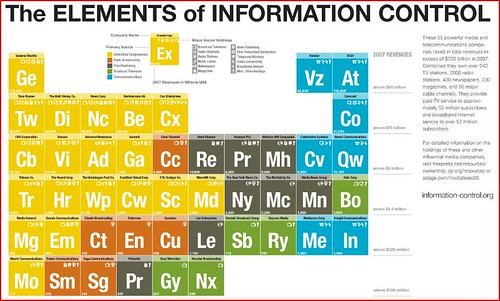
The chart is accompanied by the typical Free Press gloom-and-doom rhetoric about the unfolding media apocalypse. “Nearly everything you see, hear and read that isn’t from a friend — whether on TV, the radio, or even on the Web — comes from a for-profit gatekeeper.” And then comes the obligatory A.J. Liebling quote about how “Freedom of the press belongs to those who own one,” followed quickly by the typical punch line about how just a handful of companies (in this case 55 of ’em) are puppeteering all our thoughts in America today:
Combined, these 55 powerful media and telecommunications companies raked in total revenues in excess of $700 billion in 2007. Together they own over 540 TV stations, 2000 radio stations, 430 newspapers, 230 magazines, and 80 major cable channels in the United States. They provide paid TV service to approximately 52 million subscribers and broadband Internet service to over 57 million subscribers. They’re the bottlenecks through which our news, our entertainment, and our political discourse must travel. What they want to promote becomes prominent; what they suppress stays out of the mainstream. As such, these companies are the elements of information control.
Oh my God! We are all just brainwashed sheep!
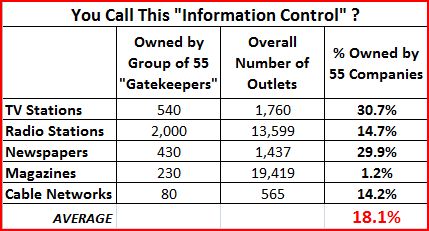
Except we’re not. It amazes me how these “information control” and “media monopoly” myths keep getting widespread circulation. But the first thing to note is how the media reformistas can’t get even their story straight when it comes to how many “monopolists” are supposedly out there today. As I noted in my 2005 book, Media Myths: Making Sense of the Debate over Media Ownership, the critics seem to just pull their numbers out of a hat. Some say as few as 3 companies control everything. Others says 5 or 6. Still others say it might be a few dozen. And now this guy says its 55. Hey, that’s progress that even the Free Press should love!
Regardless of the number, does this really represent the totality of our modern media universe? Do those 55 companies really “own most of the 21st-century presses in America” as the “Info Control” website states? Answer: NOT. EVEN. CLOSE. Here are the facts. [I happened to have compiled them for a PFF special report entitled Media Metrics: The True State of the Modern Media Marketplace to debunk myths just like this.]
Continue reading →
This is just a listing of the installments of my ongoing “Media Deconsolidation Series.” I needed to create a single repository of all the essays so I could point back to them in future articles and papers. For those not familiar with it, this series represents an effort to set the record straight regarding the many myths surrounding the media marketplace. These myths are usually propagated by a group of radical anti-media regulatory activists who I call the “media reformistas.” Sadly, however, many policymakers, journalists, and members of the public are buying into some of these myths, too.
In particular, I have spent much time here debunking the notion that rampant consolidation is taking place and that media operators are only growing larger and devouring more and more companies. In fact, nothing could be further from the truth. Over the past several years, traditional media operators and sectors have been coming apart at the seams in the face of unprecedented innovation and competition. The volume of divestiture activity has been quite intense, and most traditional media operators have been getting smaller, not bigger. As a result, America’s media marketplace is growing more fragmented and atomistic with each passing day.
Anyway, here’s the series so far…
Continue reading →
I’m fond of quoting Diane Mermigas, editor-at-large at MediaPost, who is one of the finest media market watchers in the journalism business today. Her latest MediaPost column offers another sobering look at the radical changing sweeping through the media marketplace today. In that article, she notes that even though we are in an era of Big Government bailouts for financial institutions and (possibly) auto makers, old media operators will be left to to fend for themselves, and many will likely die off as a result:
What we do know is there will be no federally funded bail for media, Internet, entertainment and advertising. Big media by definition is not nimble and innovative enough to simply dump what’s not working, modify what can be saved, and grow what works. There isn’t much that big media companies can bank on or reliably forecast moving into 2009. They are hamstrung between deteriorating traditional costs and revenues and evolving digital business models that do not offset the losses, generating less than 10% of their overall incomes. Big media isn’t just being ravaged by recession; it is being sacked by a technological transformation of enormous proportions.
I discussed a lot of the forces behind the current media meltdown in my recent PFF special report, “Media Metrics: The True State of America’s Marketplace.” As I noted there, this Schumpeterian “creative destruction” we are witnessing today is a normal (but gut-wrenching) part of any major technological transformation, and it need not be addressed with government subsides or interference. However, the problem for many traditional media providers is, as I noted in my special report:
Continue reading →
In a City Journal article earlier this year, I wondered “how long some local papers have left when they are barred from restructuring their businesses or partnering with other local media operators to stem the bleeding and reinvent their business models.” I was responding to the Senate’s smack-down of a half-hearted reform effort that FCC chairman Kevin Martin pushed through in November 2007, which proposed relaxing the FCC’s newspaper/broadcast cross-ownership rule. That rule, unrevised since going into effect in 1975, prohibits a newspaper operator from also owning a radio or television station in the same media market. However, waivers were granted to grandfather in some combined newspaper and broadcast operations that had existed long before the ban took effect. Martin’s proposal was to simply tweak the rule to permit similar combinations in just the nation’s 20 largest media markets.
Martin’s limited liberalization proposal, however, led to howls of disapproval from FCC democrats like Michael Copps and many folks on both side of the aisle in Congress. Supposedly, this was nothing more than a “giveaway” to the newspaper industry, which critics said was doing just fine. It really makes you wonder if any of those critics even both reading the news about newspapers today.
As I have documented here on many occasions, as well as in my big Media Metrics report, the newspaper industry is in huge trouble with every financial variable of importance rapidly heading south. Alan Mutter does a good job here of summarizing “the secular forces dragging down newspapers: Declining readership, shrinking advertising, high fixed costs and growing online competition that makes it increasingly difficult to charge the premium ad rates that were possible prior to the Internet.” As a result of these forces, everyday brings another headline like this one today in the New York Times: “The Star-Ledger of Newark Plans 40% Cut,” or this one in the Wall Street Journal: “Some Newspapers Shed Unprofitable Readers.” The numbers are just miserable, and they just get worse and worse.
Continue reading →

 The Technology Liberation Front is the tech policy blog dedicated to keeping politicians' hands off the 'net and everything else related to technology.