Over on the Poynter Online blog, Amy Gahran has a very smart piece on some of the confusion surrounding debates about “media localism.” In her essay asking “How Important is Local, Really?”, she challenges some of the assumptions underlying the Knight Foundation’s new Commission on the Information Needs of Communities in a Democracy.
I particularly like her line about how, “in many senses, ‘local’ is just one set of ripples on the lake of information — especially when it comes to ‘news.’ And for many people, it’s not even the biggest or most important set of ripples.” That is exactly right. Today, local choices are just a few more choices along the seemingly endless continuum of media choices. It’s foolish to assume that “media localism”
in a geographic sense is as important now as it was in the past for the reasons Gahran makes clear in her essay:
I’m glad that the Knight Foundation is asking basic questions about what kinds of information people need support community and democracy. However, I question the Commission’s strong focus on geographically defined local communities. It seems to me that with the way the media landscape has been evolving, geographically defined local communities are becoming steadily less crucial from an information perspective. I suspect that defining communities by other kinds of commonalities (age, economic status/class, interests, social circles, etc.) would be far more relevant to more people — although more complex to define.
Continue reading →
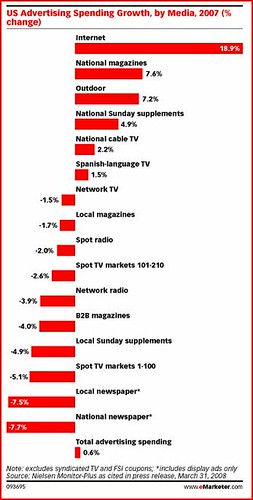 As we’ve discussed here before, newspapers are struggling. We all know that. The question is what, if anything, will save them? Most pundits tend to point to a two-fold solution: (1) get serious about leveraging the natural local advantages newspapers hold; (2) and find away to do so online as quickly as possible before they lose the bulk of the local online ad market to other competitors. This is why there’s a lot of talk these days about turning traditional papers into “hyper-local” web portals for their communities. Of course, there’s no guarantee that will work, especially in light of changing attitudes about “media localism.”
But let’s assume that that is indeed the best path forward. Will it really save newspapers? As eMarketer reports in today’s newsletter on “Can Local Web Ads Save Newspapers,” it’s a bit of a good news–bad news story:
The good news is that newspaper site ad revenues are growing along with other online ad spending, especially for local news sites. Local newspaper online ad revenues are predicted to reach $3.7 billion this year, according to eMarketer calculations based on Borrell Associates data.
The bad news is that this spending will not make up for print ad losses for some time, according to Lisa Phillips, senior analyst at eMarketer. Ms. Phillips noted that advertisers still pay more for print readers than for online readers. “This is a transition that will take several years,” she said. “Local advertisers are paying attention to the shift in reader behavior, but it will take a while for everyone to adjust.”
And so we will have to wait to see how it all plays out. But I am highly skeptical that traditional newspapers operators will be able to make up anywhere near the amount of revenue online that they are hemorrhaging over on the print side of the business. There’s just too much other competition out there online already for our eyes and ears. The age of “protectable scarcity” is dead and that means newspapers just don’t have the lock on local or regional markets they once did.
Over at Technology 360, Dennis Haarsager points out that there’s probably too much gloom-and-doom out there in the blogosphere regarding the future of various media platforms. He did phrase searches “to see how the media stacked up in the death department.” He got back the following results:
“death of television”, 13,000 results
“death of TV”, 28,200 results
“death of radio”, 227,000 results
“death of newspapers”, 331,000 results
“death of blogs”, “death of the blogs”, “death of the blog”, 81,400 results
“death of the web”, 215,000 results
“death of the net”, 746,000 results
“death of the internet”, 1,910,000 results
No doubt—as Mark Twain might have said—the rumors of the death of media have been greatly exaggerated. And, as Mike Mansick of TechDirt points out, not all papers or media outlets are facing gloom and doom scenarios.
Nonetheless, many traditional media sectors and providers
do find themselves in troubled waters today as tsunami of creative destruction tears through their markets. In our new “Media Metrics” report, Grant Eskelsen and I show how two sectors in particular—radio broadcasting and newspapers—are getting hammered particularly hard by a sort of “media perfect storm”:
-
loss of protected markets or “protected scarcity” = there’s just no guaranteed audience anymore
-
rapid technological change = the way media is created and transmitted has been completely transformed
-
massive inflow of new competitors / platforms = no way to stop the deluge of new voices, including user-generated content
-
loss of consumer confidence and allegiance = people have plenty of other places to turn their attention
-
loss of advertiser confidence and allegiance = advertisers have plenty of other places to promote their goods and services (including direct-to-consumer appeals and ‘word-of-mouth’ marketing efforts)
-
loss of investor confidence and allegiance = shareholders have lots of other places to invest their capital today
The results have been particularly grim for newspaper in recent months as various reports have noted.
Continue reading →
 Faithful readers will recall that, several months ago, I penned a 7-part “Media Metrics” series that took a hard look at the health of the media marketplace. Today, the Progress & Freedom Foundation is releasing a greatly expanded version of these essays that I have put together with my PFF colleague Grant Eskelsen. In this 100-page special report, “Media Metrics: The True State of the Modern Media Marketplace,” we begin by noting that heated debates about the state of the media marketplace continue to rage in Washington, and opinions seem to range from grim to outright apocalyptic. As we note on pg. 1:
Many people—including a large number of legislators and regulators—argue that America’s media marketplace is in a miserable state. Some claim that citizens lack choice in media outlets and that options are just as scarce as ever. Others believe that media “localism” is dead or that many groups or niches go underserved because of a lack of true “diversity” in media. Others argue that the market is hopelessly over-concentrated in the hands of a few evil media barons who are hell-bent on force-feeding us corporate propaganda. And still others say that the quality of news and entertainment in our society has deteriorated because of a combination of all of the above. It all sounds quite troubling, but is any of it true?
After taking an objective look at the true state of America’s media marketplace, we conclude that such pessimism is unwarranted. Indeed, a careful review of the facts reveals that—contrary to what those media critics suggest—we have more media choice, more media competition, and more media diversity than ever before. Indeed, to the extent there was ever a “golden age” of media in America, we are living in it today. The media sky has never been brighter and it is getting brighter with each passing year.
Continue reading →

 The Technology Liberation Front is the tech policy blog dedicated to keeping politicians' hands off the 'net and everything else related to technology.