I debated PK’s Art Brodsky last week about net neutrality on the international news channel, RussiaToday. Here are a few of my key points of disagreement with Art:
- The glittering generality of “Neutrality,” once enshrined in law for one layer of the Internet will be extended, sooner or later, to other layers. As Adam and I have warned, “the same rationale would apply equally to any circumstance in which access to a communications platform is supposedly limited to a few ‘gatekeepers.'” We’re already seeing this with fights over application neutrality and device neutrality, and calls for search neutrality are growing.
- Art insists that antitrust suits work too slowly. But he doesn’t address the basic question of what standard should govern network management. Should it be “neutrality uber
alles” or, if we’re going to regulate in fashion, why shouldn’t we ask what’s good for consumers—the standard proposed by PFF’s 2005 Digital Age Communications Act (DACA)? Neutrality isn’t always best!
- Common carriage regulation didn’t work well for railroads (contrary to popular myth) and it worked even less well for communications media, retarding the development of new services like faxes, Internet services and cell phones. Regulating broadband providers the same way will work even more poorly because they aren’t just “big dumb pipes” providing a plain vanilla service and incapable of innovation that can benefit consumers.
http://www.youtube.com/v/fVcZO7KxyG4
Is the Internet in clear and present danger? Yes, say proponents of neutrality regulation of the Internet. In his speech last month calling for FCC neutrality regulations, Chairman Julius Genachowski stopped short of quoting Oliver Wendell Holmes, but did all he could to paint a dire picture of the Internet’s future: “This is not about protecting the Internet against imaginary dangers,” he said. If we wait too long to preserve a free and open Internet, it will be too late.”
The warning evoked a certain sense of
deja vu, and for good reason. As Link Hoewing over at Verizon pointed out the other day, proponents of neutrality regulation “have been yelling ‘fire’ in the movie theater ever since 1999,” when they decried the trend toward cable firms providing exclusive ISP service on broadband networks, saying that the move would result in “more price increases and fewer choices for consumers and content providers alike.”
The end has been nigh many times since. In 2003, when a court upheld the FCC’s decision not to regulate broadband as a telecommunications service, Commissioner Michael Copps said “the Internet may be dying,” glumly predicting that if the Commission continued its free-market policies, “we will look back, shake our heads and wonder whatever happened to that open, dynamic and liberating Internet that once we knew.” Continue reading →
Peter VanDoren (editor of Regulation magazine) points me to some revealing passages in a new article in the Journal of Economic Perspectives. In “Subsidizing Creativity through Network Design: Zero-Pricing and Net Neutrality,” Robin S. Lee and Tim Wu caution against tiered pricing for Internet access services, writing:
[U]nless sufficient bandwidth and quality of service can be guaranteed for the “free” Internet, there is a risk that . . . tiering will serve to sidestep de facto prohibition on termination fees. . . . [A] priced-priority system could simply become a de facto fee charged for all content providers if the “free” Internet was of sufficiently poor quality and consumers shifted their usage behavior accordingly. . . . [T]his might dampen the introduction of new content and services and eliminate the subsidy for content innovation currently provided by net neutrality.
Locking in net neutrality by regulation would lock in a subsidy to content providers. Lee and Wu prefer it, and many of us may like the results, but it’s hard to call a subsidy regime “neutral.”
Last Wednesday, Holman Jenkins penned a column in The Wall Street Journal about net neutrality (Adam discussed it here). In response, I have a letter to the editor in today’s The Wall Street Journal:
To the Editor:
Mr. Jenkins suggests that Google would likely “shriek” if a startup were to mount its servers inside the network of a telecom provider. Google already does just that. It is called “edge caching,” and it is employed by many content companies to keep costs down.
It is puzzling, then, why Google continues to support net neutrality. As long as Google produces content that consumers value, they will demand an unfettered Internet pipe. Political battles aside, content and infrastructure companies have an inherently symbiotic relationship.
Fears that Internet providers will, absent new rules, stifle user access to content are overblown. If a provider were to, say, block or degrade YouTube videos, its customers would likely revolt and go elsewhere. Or they would adopt encrypted network tunnels, which route around Internet roadblocks.
Not every market dispute warrants a government response. Battling giants like Google and AT&T can resolve network tensions by themselves.
Ryan Radia
Competitive Enterprise Institute
Washington
To be sure, the market for residential Internet service is not all that competitive in some parts of the country — Rochester, New York, for instance — so a provider might in some cases be able to get away with unsavory practices for a sustained period without suffering the consequences. Yet ISP competition is on the rise, and a growing number of Americans have access to three or more providers. This is especially true in big cities like Chicago, Baltimore, and Washington D.C.
Instead of trying to put a band-aid on problems that stem from insufficient ISP competition, the FCC should focus on reforming obsolete government rules that prevent ISP competition from emerging. Massive swaths of valuable spectrum remain unavailable to would-be ISP entrants, and municipal franchising rules make it incredibly difficult to lay new wire in public rights-of-way for the purpose of delivering bundled data and video services.
The Post, hardly a bastion of radical cyber-libertarianism, has come out strongly against FCC Chairman Julius Genachowski’s plans to have the FCC issue “Net Neutrality” regulations. The editorial asks the critical threshold question we crazy cyber-libertarians always insist on:
Is this intervention necessary?
Mr. Genachowski claims to have seen “breaks and cracks” in the Internet that threaten to change the “fundamental architecture of openness.” He and other proponents of federal involvement cite a handful of cases they say prove that, left to their own devices, ISPs… will choke the free flow of information and technology. One example alluded to by the chairman: Comcast’s blocking an application by BitTorrent that would allow peer-to-peer video sharing. Yet that conflict was ultimately resolved by the two companies — without FCC intervention — after Comcast’s alleged bad behavior was exposed by a blogger.
Thus, the FCC oppposes pre-emptive regulation that would “prohibit ISPs from ‘discriminating against’ different applications,” noting that this would mean that “ISPs, which have poured billions of dollars into building infrastructure, would have little control — if any — over the kinds of information and technology flowing through their pipes.”
Three cheers for the
Post for recognizing both the property rights of ISPs in their networks and the fact that, even with Genachowski’s “slight concession” to allow “managed services in limited circumstances… unneeded regulation could still interfere with [ISPs] ability to manage bandwidth-hogging applications that can hamper service, especially during peak times.” Instead, the Post called for simple transparency, supporting a requirement that “ISPs be candid with the agency and the public about network management practices. The last paragraph hits the ball out of the park:
Mr. Genachowski claims that the FCC “will do as much as we need to do, and no more, to ensure that the Internet remains an unfettered platform for competition, creativity and entrepreneurial activity.” He will advance this goal by insisting on transparency; he will jeopardize it — and stifle further investments by ISPs — with attempts to micromanage what has been a vibrant and well-functioning marketplace.
Amen! The Post is about as “mainstream” as it gets in American journalism, so their strong opposition really underscores that preemptive “net neutrality” regulation isn’t the popular cause some in Washington think it is. It is simply infrastructure socialism.
Adam Thierer and I have warned that neutrality regulation, once imposed on broadband providers, will
extend to other Internet services wherever “gatekeepers” are alleged to control access to a platform used by others. In short, the slippery slope of creeping common carriage is real and we’re already heading down it, with cyber-collectivist “luminaries” like Jonathan Zittrain and Frank Pasquale demanding neutrality regulation for devices, application platforms like iTunes and Facebook, and search!
TLF Reader Jim Reardon made a particularly astute observation on my post asking whether Americans really want net neutrality regulation:
Regulation of any service, product or industry is preceded by definition. Once defined, it is subject to taxation.
[Net Neutrality regulation] is a prelude to taxation of Internet products and services. It will likely start with telephony services and proceed accordingly to financial services, and continue from there.
As such, the activity is essentially neutral insofar as technology innovation is concerned — so long as applicable taxes are paid the government will ensure that the service is not disfavored by the network operators.
Absolutely right! One of the greatest barriers to government regulation and taxation of the Internet today is the lack of clear definitions: The FCC rules will tell you precisely what “cable television” or “commercial radio” mean, but the concepts of “social networking,” “Internet video,” “blogging,” and even “search” are indeterminate and constantly evolving.
Ronald Reagan once quipped:
Government’s view of the economy could be summed up in a few short phrases: If it moves, tax it. If it keeps moving, regulate it. And if it stops moving, subsidize it.
Fortunately, government’s
ability to implement this view depends—to paraphrase President Clinton—”on what the meaning of the word ‘is’ ‘it’ is”: Allowing “it” to remain beautifully amorphous may be the best way to keep government at bay.
Whatever you think about this messy dispute between AT&T and Google about how to classify web-based telephony apps for regulatory purposes — in this case, Google Voice — the key issue not to lose site of here is that we are inching ever closer to FCC regulation of web-based apps! Again, this is the point we have stressed here again and again and again and again when opposing Net neutrality mandates: If you open the door to regulation of one layer of the Net, you open up the door to the eventual regulation of all layers of the Net.
You might not buy that story initially but if you doubt it then I invite you to read just about any history of American broadcast media regulation over the course of the past seven decades. (You might want to start with Krattenmaker & Powe’s Regulating Broadcast Programming or Jonathan Emord’s
Freedom, Technology, and the First Amendment). In such histories you will find a common theme: Once regulation of media and communications platforms gets underway, the natural progression of things is uni-directional — Up! That is, when new questions arise about how to “deal with” a new service, network, platform, or technology, the general tendency is the “regulate up” instead of “deregulating down.” When regulators are given a greater say about the contours of markets as technologies evolve and/or converge, we shouldn’t be surprised that their first instinct is to “bring them into the fold.”
And, sadly, that is exactly what is likely to occur eventually with Google Voice. The only really interesting question is what else regulators start mucking with in the search and applications layer once they get their hands on it. And if you still insist that I am being overly paranoid about “regulatory creep” and the prospect of the FCC gradually transforming into the Federal Information Commission, then consider what the agency had to say about cloud computing in paragraph 60 (pg. 21) of the FCC’s recent Wireless Innovation and Investment Notice of Inquiry, which was launched on August 27th: Continue reading →
FOXNews.com has just published an editorial that I penned about Monday’s net neutrality announcement from the FCC.
by Ryan Radia
The federal government may gain broad new powers to regulate Internet providers next month if Federal Communications Commission Chairman Julius Genachowski gets his way. In a milestone speech on Monday, Genachowski proposed sweeping new regulations that would give the FCC the formal authority to dictate application and network management practices to companies that offer Internet access, including wireless carriers like AT&T and Verizon Wireless.
Genachowski’s proposed rules would make good on a pledge that President Obama made in his campaign to enshrine net neutrality as law. The announcement was met with cheers by a small but vocal crowd of activists and academics who have been pushing hard for net neutrality for years. But if bureaucrats and politicians truly care about neutrality, they would be wise to resist calls to expand the government’s power over private networks. Instead, policymakers should recognize that it is far more important for government to remain neutral to competing business models — open, closed, or any combination thereof.
Continue reading →
Those who advocate regulating Internet service providers as common carriers subject to “open access” mandates (a/k/a “Net Neutrality”) want us to believe that their cause is the “Civil Rights” issue of the digital age, with huge popular support and opposed only by self-interested cable companies and their henchmen. In fact, such regulations would actually harm consumers, increase broadband prices, retard the heretofore-explosive growth of bandwidth, and dramatically increase government control over the Internet. Of course, the degree of public interest in a cause doesn’t actually tell us anything about its justice and, fortunately, we live in a democratic oligarchic republic, not a pure democracy. But it’s worth asking whether Americans are really up in arms about the need for “Net Neutrality” regulations. Google Trends suggests not:
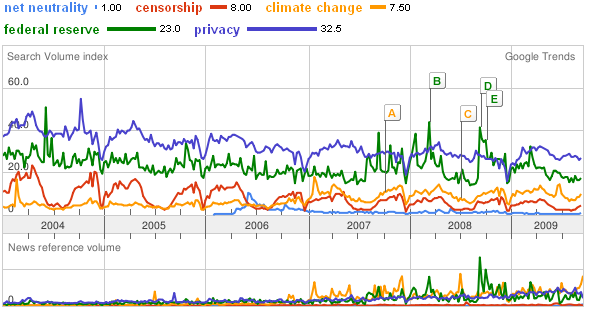 This kind of comparison should dispel once and for all the myth of a popular groundswell for net neutrality regulation—especially since online search volumes heavily over-represent the interests of the digerati, thus over-stating general interest in web-related topics.
In fact, “Net Neutrality” regulation is a
niche cause trumpeted incessantly by the blogosphere with about the same level of broad popular interest online as “housing rights”—a topic about which most of us probably don’t often fall into conversation (unless we happen to live in Bakuninist Berkeley or the Bolivarian Caliphate of Cambridge, MA, ground-zero of American Chavismo). Continue reading →
Forbes.com has just published an editorial that Berin Szoka and I penned about yesterday’s net neutrality announcement from the FCC.
by Adam Thierer & Berin Szoka
There was a time, not so long ago, when the term “Internet Freedom” actually meant what it implied: a cyberspace free from over-zealous legislators and bureaucrats. For a few brief, beautiful moments in the Internet’s history (from the mid-90s to the early 2000s), a majority of Netizens and cyber-policy pundits alike all rallied around the flag of “Hands Off the Net!” From censorship efforts, encryption controls, online taxes, privacy mandates and infrastructure regulations, there was a general consensus as to how much authority government should have over cyber-life and our cyber-liberties. Simply put, there was a “presumption of liberty” in all cyber-matters.
Those days are now gone; the presumption of online liberty is giving way to a presumption of regulation. A massive assault on real Internet freedom has been gathering steam for years and has finally come to a head. Ironically, victory for those who carry the banner of “Internet Freedom” would mean nothing less than the death of that freedom.
We refer to the gradual but certain movement to have the federal government impose “neutrality” regulation for all Internet actors and activities—and in particular, to yesterday’s announcement by Federal Communications Commission (FCC) Chairman Julius Genachowski that new rules will be floated shortly. “But wait,” you say, “You’re mixing things up! All that’s being talked about right now is the application of ‘simple net neutrality,’ regulations for the infrastructure layer of the net.” You might even claim regulations are not really regulation but pro-freedom principles to keep the net “free and open.”
Such thinking is terribly short-sighted. Here is the reality: Because of the steps being taken in Washington right now, real Internet Freedom—for all Internet operators and consumers, and for economic and speech rights alike—is about to start dying a death by a thousand regulatory cuts. Policymakers and activists groups are ramping up the FCC’s regulatory machine for a massive assault on cyber-liberty. This assault rests on the supposed superiority of common carriage regulation and “public interest” mandates over not just free markets and property rights, but over general individual liberties and freedom of speech in particular. Stated differently, cyber-collectivism is back in vogue—and it’s coming very soon to a computer near you! Continue reading →

 The Technology Liberation Front is the tech policy blog dedicated to keeping politicians' hands off the 'net and everything else related to technology.