Posts tagged as:

Adam Thierer, Senior Research Fellow at the Mercatus Center discusses his recent working paper with coauthor Brent Skorup, A History of Cronyism and Capture in the Information Technology Sector. Thierer takes a look at how cronyism has manifested itself in technology and media markets — whether it be in the form of regulatory favoritism or tax privileges. Which tech companies are the worst offenders? What are the consequences for consumers? And, how does cronyism affect entrepreneurship over the long term?

Download

Related Links

Patrick Ruffini, political strategist, author, and President of Engage, a digital agency in Washington, DC, discusses his latest book with coauthors David Segal and David Moon: Hacking Politics: How Geeks, Progressives, the Tea Party, Gamers, Anarchists, and Suits Teamed Up to Defeat SOPA and Save the Internet. Ruffini covers the history behind SOPA, its implications for Internet freedom, the “Internet blackout” in January of 2012, and how the threat of SOPA united activists, technology companies, and the broader Internet community.

Download

Related Links


Washington Post columnist Robert J. Samuelson published an astonishing essay today entitled, “Beware the Internet and the Danger of Cyberattacks.” In the print edition of today’s Post, the essay actually carries a different title: “Is the Internet Worth It?” Samuelson’s answer is clear: It isn’t. He begins his breathless attack on the Internet by proclaiming:

If I could, I would repeal the Internet. It is the technological marvel of the age, but it is not — as most people imagine — a symbol of progress. Just the opposite. We would be better off without it. I grant its astonishing capabilities: the instant access to vast amounts of information, the pleasures of YouTube and iTunes, the convenience of GPS and much more. But the Internet’s benefits are relatively modest compared with previous transformative technologies, and it brings with it a terrifying danger: cyberwar.

And then, after walking through a couple of worst-case hypothetical scenarios, he concludes the piece by saying:

the Internet’s social impact is shallow. Imagine life without it. Would the loss of e-mail, Facebook or Wikipedia inflict fundamental change? Now imagine life without some earlier breakthroughs: electricity, cars, antibiotics. Life would be radically different. The Internet’s virtues are overstated, its vices understated. It’s a mixed blessing — and the mix may be moving against us.

What I found most troubling about this is that Samuelson has serious intellectual chops and usually sweats the details in his analysis of other issues. He understands economic and social trade-offs and usually does a nice job weighing the facts on the ground instead of engaging in the sort of shallow navel-gazing and anecdotal reasoning that many other weekly newspaper columnist engage in on a regular basis.

But that’s not what he does here. His essay comes across as a poorly researched, angry-old-man-shouting-at-the-sky sort of rant. There’s no serious cost-benefit analysis at work here; just the banal assertion that a new technology has created new vulnerabilities.  Really, that’s the extent of the logic at work here. Samuelson could have just as well substituted the automobile, airplanes, or any other modern technology for the Internet and drawn the same conclusion: It opens the door to new vulnerabilities (especially national security vulnerabilities) and, therefore, we would be better off without it in our lives. Continue reading →

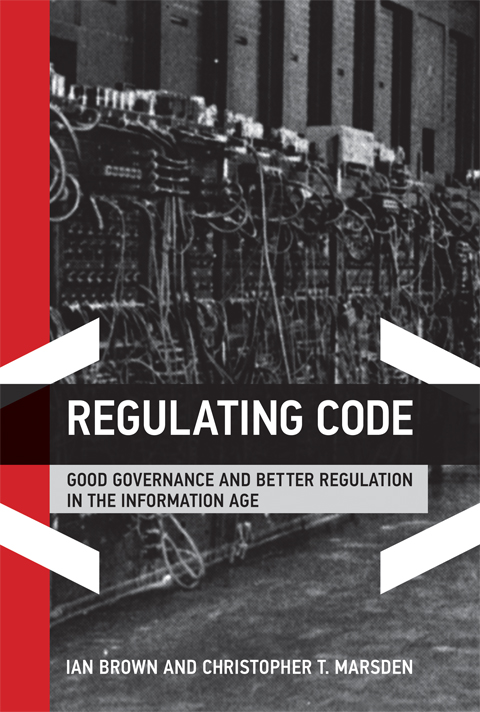
Regulating Code book coverIan Brown and Christopher T. Marsden’s new book, Regulating Code: Good Governance and Better Regulation in the Information Age, will go down as one of the most important Internet policy books of 2013 for two reasons. First, their book offers an excellent overview of how Internet regulation has unfolded on five different fronts: privacy and data protection; copyright; content censorship; social networks and user-generated content issues; and net neutrality regulation. They craft detailed case studies that incorporate important insights about how countries across the globe are dealing with these issues. Second, the authors endorse a specific normative approach to Net governance that they argue is taking hold across these policy arenas. They call their preferred policy paradigm “prosumer law” and it envisions an active role for governments, which they think should pursue “smarter regulation” of code.

In terms of organization, Brown and Marsden’s book follows the same format found in Milton Mueller’s important 2010 book Networks and States: The Global Politics of Internet Governance; both books feature meaty case studies in the middle bookended by chapters that endorse a specific approach to Internet policymaking. (Incidentally, both books were published by MIT Press.) And, also like Mueller’s book, Brown and Marsden’s Regulating Code does a somewhat better job using case studies to explore the forces shaping Internet policy across the globe than it does making the normative case for their preferred approach to these issues. Continue reading →

Richard Brandt, technology journalist and author, discusses his new book, One Click: Jeff Bezos and the Rise of Amazon.Com. Brandt discusses Bezos’ entrepreneurial drive, his business philosophy, and how he’s grown Amazon to become the biggest retailer in the world. This episode also covers the biggest mistake Bezos ever made, how Amazon uses patent laws to its advantage, whether Amazon will soon become a publishing house, Bezos’ idea for privately-funded space exploration and his plan to revolutionize technology with quantum computing.

Download

Related Links


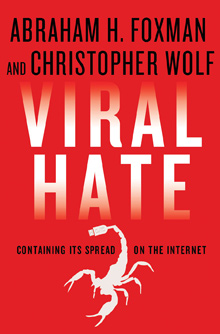
Viral Hate coverThe Internet’s greatest blessing — its general openness to all speech and speakers — is also sometimes its biggest curse. That is, you cannot expect to have the most widely accessible, unrestricted communications platform the world has ever known and not also have some imbeciles who use it to spew insulting, vile, and hateful comments.

It is important to put things in perspective, however. Hate speech is not the norm online. The louts who spew hatred represent a small minority of all online speakers. The vast majority of online speech is of a socially acceptable — even beneficial — nature.

Still, the problem of hate speech remains very real and a diverse array of strategies are needed to deal with it. The sensible path forward in this regard is charted by Abraham H. Foxman and Christopher Wolf in their new book, Viral Hate: Containing Its Spread on the Internet. Their book explains why the best approach to online hate is a combination of education, digital literacy, user empowerment, industry best practices and self-regulation, increased watchdog / press oversight, social pressure and, most importantly, counter-speech. Foxman and Wolf also explain why — no matter how well-intentioned — legal solutions aimed at eradicating online hate will not work and would raise serious unintended consequences if imposed.

In striking this sensible balance, Foxman and Wolf have penned the definitive book on how to constructively combat viral hate in an age of ubiquitous information flows. Continue reading →

Declan McCullagh, chief political correspondent for CNET and former Washington bureau chief for Wired News, discusses recent leaks of NSA surveillance programs. What do we know so far, and what more might be unveiled in the coming weeks? McCullagh covers legal challenges to the programs, the Patriot Act, the fourth amendment, email encryption, the media and public response, and broader implications for privacy and reform.

Download

Related Links


Are we as globalized and interconnected as we think we are? Ethan Zuckerman, director of the MIT Center for Civic Media and author of the new book, Rewire: Digital Cosmopolitans in the Age of Connection, argues that America was likely more globalized before World War I than it is today. Zuckerman discusses how we’re more focused on what’s going on in our own backyards; how this affects creativity; the role the Internet plays in making us less connected with the rest of the world; and, how we can broaden our information universe to consume a more healthy “media diet.”

Download

Related Links


***Cross-posted from Forbes.com***

It was, to paraphrase Yogi Berra, déjà vu all over again.  Fielding calls last week from journalists about reports the NSA had been engaged in massive and secret data mining of phone records and Internet traffic, I couldn’t help but wonder why anyone was surprised by the so-called revelations.

Not only had the surveillance been going on for years, the activity had been reported all along—at least outside the mainstream media.  The programs involved have been the subject of longstanding concern and vocal criticism by advocacy groups on both the right and the left.

For those of us who had been following the story for a decade, this was no “bombshell.”  No “leak” was required.  There was no need for an “expose” of what had long since been exposed.

As the Cato Institute’s Julian Sanchez and others reminded us, the NSA’s surveillance activities, and many of the details breathlessly reported last week, weren’t even secret.  They come up regularly in Congress, during hearings, for example, about renewal of the USA Patriot Act and the Foreign Intelligence Surveillance Act, the principal laws that govern the activity.

In those hearings, civil libertarians (Republicans and Democrats) show up to complain about the scope of the law and its secret enforcement, and are shot down as being soft on terrorism.  The laws are renewed and even extended, and the story goes back to sleep.

But for whatever reason, the mainstream media, like the corrupt Captain Renault in “Casablanca,” collectively found itself last week “shocked, shocked” to discover widespread, warrantless electronic surveillance by the U.S. government.  Surveillance they’ve known about for years.

Let me be clear.  As one of the long-standing critics of these programs, and especially their lack of oversight and transparency, I have no objection to renewed interest in the story, even if the drama with which it is being reported smells more than a little sensational with a healthy whiff of opportunism. Continue reading →

In mid-April, the Federal Trade Commission (FTC) requested comments regarding “the consumer privacy and security issues posed by the growing connectivity of consumer devices, such as cars, appliances, and medical devices” or the so-called “Internet of Things.” This is in anticipation of a November 21 public workshop that the FTC will be hosting on the same issue.

These issues are finally starting to catch the attention of the public and policymakers alike with the rise of wearable computing, remote home automation and monitoring technologies, smart grids, autonomous vehicles and intelligent traffic systems, and so on. The Internet of Things represents the next great wave of Internet innovation, but it also represents the next great battleground in the field of Internet policy.

I filed comments with the FTC today in this proceeding and made a few simple points about why they should proceed cautiously here. A summary of my filing follows. Continue reading →