By Berin Szoka & Adam Thierer
As we noted in our intro to this ongoing series, Google’s tenth anniversary has passed with Googlephobia reaching new heights of hysteria.
But is Google really too big and dangerous, or are people just too lazy to find other alternatives to each of the wonderful services that Google offers? If one is truly paranoid about the firm’s supposed dominance, it doesn’t take much effort to live a Google-free life. To prove it, we set out to find alternatives to each of the services that Google provides. After awhile, we got a little tired of compiling alternatives in each category and just provided links for the additional choices at your disposal. It’s tough to see what the fuss is about with the cornucopia of choices at our disposal. If you don’t like Google, then just don’t use it or any of its services. The choice is yours.
In each case, we’ve listed Google first, even though Google may not be the market leader (
e.g., Google’s relatively unknown social network Orkut).
Search Engines
Continue reading →
By Berin Szoka & Adam Thierer
as part of an
ongoing series

With Google celebrating its 10th anniversary this week, many panicky pundits are using the occasion to claim that Google has become the Great “Satan” of the Internet. Nick Carr wonders what the future holds for “The OmniGoogle.” The normally level-headed Mike Malone worries that Google is “turning into Big Brother.” And Washington Post’s Rob Dubbin says that he can’t escape Google’s “tentacles,” even for just 24 hours. Meanwhile, speculation abounds that the Justice Department is preparing a major antitrust lawsuit against Google concerning its advertising partnership with Yahoo! or perhaps even a broader suit concerning Google’s “dominance” of online advertising generally.
Carr quotes Google co-founder Sergey Brin’s now-famous 2003 interview:
I think people tend to exaggerate Google’s significance in both directions. Some say Google is God. Others say Google is Satan. But if they think Google is too powerful, remember that with search engines, unlike other companies, all it takes is a single click to go to another search engine. People come to Google because they choose to. We don’t trick them.
In the last five years, Google has become far more than just a search engine. As Google’s suite of suite of complementary products continues to grow, so too does the specter of Google as an all-knowing and therefore all-powerful economic colossus. Yet Google isn’t even close to being the sort of nefarious monopolist out to destroy user privacy at every turn, as some seem to imply—if not exclaim. Indeed, in our view, the Net is overall a far better place because of the existence of Google and the many free services it provides consumers.
Our point is not that Google should be immune from criticism. Indeed, healthy criticism of corporate actions plays a vital role in the free market by disciplining corporate policies and behavior—often thus providing an effective alternative to government regulation. This is particularly important in the area of consumer privacy protection, as demonstrated by Google’s quick response to public concern about its Chrome EULA. Continue reading →
C|Net’s Charles Cooper reports today that Department of Justice trustbusters are considering a comprehensive antitrust attack on Google.
Sources who have provided testimony to the government say a departmental debate revolves around whether antitrust regulators should challenge Google’s proposed revenue-sharing deal with Yahoo, or go for the whole enchilada–and haul Google into court on broader charges related to its dominance in search advertising.
C|Net’s Declan McCullagh speculated earlier this week about how Google would fare under an Obama administration:
[Obama’s] technology campaign platform pledges to “reinvigorate antitrust enforcement” and “step up review of merger activity.” He complained to the American Antitrust Institute that “the current administration has what may be the weakest record of antitrust enforcement of any administration in the last half century.” If the Bush administration’s current antitrust probe of Google, coupled with this week’s apparent threat of a federal lawsuit, amounts to a “weak” record, imagine what antitrust true believers in an Obama administration might do. (A three-way split of Google into search, applications, and display ads, anyone?)
I’m not sure whether structural separation is on Google’s near-term horizon, but Washington, D.C.’s parasite economy will make its move.
Most debates–from privacy to net neutrality–about consumer protection in Internet policy come down to the following increasingly-cliched exchange:
1. Advocate of Regulation: “The government must intervene to protect users against Companies who want to [___________] by writing new laws or regulations!”
2. Regulatory Skeptic: “Why don’t we rely on the FTC’s enforcement of End User License Agreements (EULAs), privacy policies and other terms of service (TOS) under existing law? If companies spell out their policies clearly and then are required to stick to them, those policies will become part of competition: Companies will compete for consumers by offering attractive policies the same way they compete for consumers by offering attractive products & prices.”
3. Advocate of Regulation: “That doesn’t work because nobody actually reads all that legalese! They’re impossibly dense for non-lawyers, so companies always make such agreements as broad as possible to allow them to do whatever they damn well please–and bury all the really scary provisions.”
And yet… within 12 hours of releasing its new Chrome Browser, Google removed a clause from the Chrome EULA that essentially would have Given Google the right to whatever it liked with all content posted by users anywhere online using Chrome. If this incident demonstrates anything, it’s that there are significant “market forces” at work to restrain companies from writing agreements & policies that allow them to screw consumers. Indeed, it beautifully demonstrates why the Regulatory Skeptic ultimately wins this debate with one final response:
4. Regulatory Skeptic: “It doesn’t matter if 99%+ of users never read a EULA or TOS. No matter how hard companies might try to bury some ominous provision, the relatively small number of consumer protection watchdogs who do read such provisions protect everyone else by calling attention to true areas of concern. Not every blogger who complains about something he doesn’t like in a EULA is going to make Slashdot, but overall, provisions that cross a certain line will get public attention and most companies will bend over backwards to avoid bad PR. So, the market does work to protect consumers without the need for further government regulation.”
Continue reading →
Over at Ars, Ben Kuchera has a review of Ask.com’s redesign of its web portal for kids, AskKids.com. It’s a great new addition to the growing list of safe seach tools and web portals geared toward younger surfers.

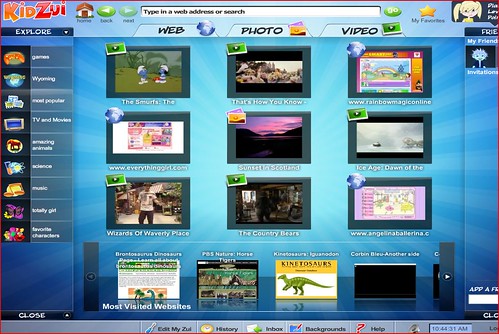
I’m also a big fan of KidZui, the new browser for kids that provides access to over 800,000 kid-friendly websites, videos, and pictures that have been pre-screened by over 200 trained teachers and parents. The company employs a rigorous 5-step “content selection process” to determine if it is acceptable for kids between 3-12 years of age. My kids, both under the age of 7, just love it, but I can’t see many kids older than 10 enjoying it because it is mostly geared toward the youngest web surfers.
Last year, as part of my 10-part series coinciding with “Internet Safety Month,” I wrote about the market for safe search tools and web portals for kids. I generally divide these sites and services into two groups:
(1)
“Safe Search” Tools and Portals for Kids
(2)
Child- and Teen-Oriented Websites
Below I will describe each group and list the many sites and services currently available. I encourage readers to offer additional suggestions for sites that belong on the list. (I keep a running list of these sites and services in my book, “Parental Controls and Online Child Protection: A Survey of Tools & Methods.”)
Continue reading →
I used to get endless grief from pro-regulatory media activists here in DC when I put forward the argument in days past that Google was a media company and a major player in the battle for eyes, ears and ad dollars in America’s media marketplace. Increasingly, however, more people are coming around to seeing that point, even the crusty old media giants themselves.
In a smart essay over at the Freedom to Tinker blog, David Robinson takes the New York Times to task for an article today again wondering, “Is Google a Media Company?” As David rightly argues:
Continue reading →
Google’s Chief Internet Evangelist Vint Cerf, one of the fathers of the Net, has a very thoughtful post up on the Google Public Policy Blog today asking “What’s a Reasonable Approach for Managing Broadband Networks?” He runs through a variety of theoretical approaches to network load management. There’s much there to ponder, but I just wanted to comment briefly on the very last thing he says in the piece:
Over the past few months, I have been talking with engineers at Comcast about some of these network management issues. I’ve been pleased so far with the tone and substance of these conversations, which have helped me to better understand the underlying motivation and rationale for the network management decisions facing Comcast, and the unique characteristics of cable broadband architecture. And as we said a few weeks ago, their commitment to a protocol-agnostic approach to network management is a step in the right direction.
I found this of great interest because for the last few months I have been wondering: (a) why isn’t there more of that sort of inter- and intra-industry dialogue going on, and (b) what could be done to encourage more of it? With the exception of those folks at the extreme fringe of the Net neutrality movement, most rational people involved in this debate accept the fact that there will be legitimate network management issues that industry must deal with from time to time. So, how can we get people in industry — from all quarters of it — to sit down at a negotiating table and hammer things out voluntarily before calling in the regulators to impose ham-handed, inflexible solutions? What we are talking about here is the need for a technical dispute resolution process that doesn’t involve the FCC.
Continue reading →
First, an excerpt:
[W]hen you search with Cuil, we do not collect any personally identifiable information, period. We have no idea who sends queries: not by name, not by IP address, and not by cookies (more on this later). Your search history is your business, not ours.
Next, the obligatory read the whole thing.
Because you can. It’s just a little over 500 words.
I’ve run across the most curious thing today.
Searches on Google that should turn up the Cato@Liberty blog (at http://www.cato-at-liberty.org) do not return any result with that URL in it.
Berin took great care the other day to report on the temporary demotion of some Progress & Freedom Foundation content by the Google search engine. I want to do a similar, careful job with this because it’s a sensitive area.
Could I ask you, our visitors, to check what you get from Google? Visit Cato@Liberty and then craft the Google search that you think is most likely to return that Web site. (I’ve tried searching “site:cato-at-liberty.org the” for example, which would return instances of the word “the” on the cato-at-liberty.org domain, and gotten no results.)
Next, if you have any technical knowledge, please opine on what might be causing this to occur. Cato@Liberty is a fairly high-traffic site with a large following. Its disappearance from Google search results is unusual. Any ideas on how to get it restored would be welcome.
Update: It’s a problem with robots.txt on the site.

 The Technology Liberation Front is the tech policy blog dedicated to keeping politicians' hands off the 'net and everything else related to technology.