Forbes.com has just published an editorial that Berin Szoka and I penned about yesterday’s net neutrality announcement from the FCC.
by Adam Thierer & Berin Szoka
There was a time, not so long ago, when the term “Internet Freedom” actually meant what it implied: a cyberspace free from over-zealous legislators and bureaucrats. For a few brief, beautiful moments in the Internet’s history (from the mid-90s to the early 2000s), a majority of Netizens and cyber-policy pundits alike all rallied around the flag of “Hands Off the Net!” From censorship efforts, encryption controls, online taxes, privacy mandates and infrastructure regulations, there was a general consensus as to how much authority government should have over cyber-life and our cyber-liberties. Simply put, there was a “presumption of liberty” in all cyber-matters.
Those days are now gone; the presumption of online liberty is giving way to a presumption of regulation. A massive assault on real Internet freedom has been gathering steam for years and has finally come to a head. Ironically, victory for those who carry the banner of “Internet Freedom” would mean nothing less than the death of that freedom.
We refer to the gradual but certain movement to have the federal government impose “neutrality” regulation for all Internet actors and activities—and in particular, to yesterday’s announcement by Federal Communications Commission (FCC) Chairman Julius Genachowski that new rules will be floated shortly. “But wait,” you say, “You’re mixing things up! All that’s being talked about right now is the application of ‘simple net neutrality,’ regulations for the infrastructure layer of the net.” You might even claim regulations are not really regulation but pro-freedom principles to keep the net “free and open.”
Such thinking is terribly short-sighted. Here is the reality: Because of the steps being taken in Washington right now, real Internet Freedom—for all Internet operators and consumers, and for economic and speech rights alike—is about to start dying a death by a thousand regulatory cuts. Policymakers and activists groups are ramping up the FCC’s regulatory machine for a massive assault on cyber-liberty. This assault rests on the supposed superiority of common carriage regulation and “public interest” mandates over not just free markets and property rights, but over general individual liberties and freedom of speech in particular. Stated differently, cyber-collectivism is back in vogue—and it’s coming very soon to a computer near you! Continue reading →
 Google today unveiled the Data Liberation Front, a team of engineers in Chicago dedicated to ensuring that Google build “liberated products”—ones that have “built in features that make it easy (and free) to remove your data from the product in the event that you’d like to take it elsewhere.” We’ve spent a lot of time here warning about the dangers of Googlephobia, but now that Google has brazenly appropriated the TLF’s unique mock-Communist iconography, we’re starting to think that Jeff Chester and Scott Cleland may be right: Maybe Google really is trying to take over the world!
So we regret to announce our filing of a lawsuit in the Twelfth Circuit Court of Appeals to challenge Google’s infringement of our mark. We demand 50% of the $0.00 Google earns every time they “allow” users to port their application data out of Google to a competitor’s services! We will, of course, dedicate these royalties to the important project of educating and empowering users about how they can determine their own destiny online.
But seriously… We heartily agree with our Data Liberation Front comrades that users should be fully empowered to switch from one service to another online. This kind of competition is clearly the best protection for consumers in the Digital Age. Making switching easy should assuage not just antitrust concerns, but also concerns about how much privacy or security each web service offers to its users, no matter how big its market share: If you don’t like what a service offers, just take your data and leave! Who needs the government micro-managing the Internet when users have that kind of control?
Viva la (Technology) Revolution!
P.S. In case you haven’t seen it the Monty Python video we’re all riffing on:
Continue reading →
I vented my frustration earlier today with the FCC’s failure to make comments it receives easily accessible to the public—which means, more than anything, making them full-text searchable. This may seem like Inside Baseball to many, but it’s not. It’s a failure of the democratic process, a waste of taxpayer dollars, and a testimony to the general incompetence of bureaucracies, regardless of who’s running them. It denies the public an easy way to follow what goes on inside Washington, while essentially subsidizing law firms who get to bill clients for having paralegals or junior associates do things that existing web technology makes completely unnecessary—like reading through every comment in a document (at the rate of hundreds of dollars per hour) instead of just looking for keywords in a full-text search.
Later in the day the FCC announced:
- RSS feeds for all news from the agency (1 general feed + 48 issue-specific feeds);
- “FCC Connect” a page for Social Media Sites—so you can follow the FCC on Twitter and become a fan on Facebook; and
- A “crowdsourcing platform” to discuss the administration’s plan to transfer nearly $8 billion from taxpayers to broadband providers.
I’m thrilled about the RSS feeds, which go a long way in letting
all Americans know what the FCC does, supposedly in the “public interest.” Still, I can’t help but note that the FCC waited until after a huge discussion about whether RSS is dead to finally start using RSS in a serious way—fully a decade after the birth of the RSS standard. Better late than never, I suppose.
FCC Connect is also good news: once you have an RSS feed, there’s really no reason
not to pipe that feed into as many platforms as possible—which is precisely why RSS isn’t dead, even if most people will never use an RSS reader.
But I’m less thrilled about the crowdsourcing platform. Continue reading →
Interesting piece from Jeff Jarvis about “Google Bigotry,” or his belief that “media people are going after Google’s success for no good reason other than their own jealousy.” Jarvis argues that reporters penning hard-nosed stories about Google are, in reality, just a bunch of envious cry-babies:
newspaper people will use their last drops of ink to complain about Google’s success and try to blame it for their own failures rather than changing their own businesses. .. It’s not just that they dislike the competition – and they do, for it is a new experience for too many of them. If they were smart, they’d use Google to get more audience and make more money but they don’t know how to (or rather, they’d prefer not to change). No, the problem is that Google represents change and a new world they’ve refused to understand.
Well, yes and no. I don’t believe that
every story penned about Google by a mainstream media reporter is rooted in envy, and certainly not the one that Jarvis alludes to as prompting him to pen this piece. Jarvis apparently received an inquiry from a French journalist at Le Monde asking for comment about “an article about Google facing a rising tide of discontent concerning privacy and monopoly.” That doesn’t necessarily sound like an unreasonable journalistic inquiry to me. So, I’m not sure it’s fair to accuse every journalist who calls with a hard-nosed question about privacy and antitrust as being guilty of “Google bigotry.”
That being said,
some journalists are likely feeling a bit miffed about Google’s recent success, thinking it comes at their expense, and, therefore, their envy might be prompting some of them to pen attack stories on the company. I think Jarvis in on stronger ground, however, in asserting that most privacy and antitrust complaints about Google are unfounded, and also based on envy. Indeed, Berin Szoka and I have have been cataloging the complaints that we believe are driven by an irrational form of corporate envy we call “Googlephobia.” And in prior years we saw a similar form of Microsoft-bashing at work that we still have with us today. That’s why I think Jarvis is on to something when he notes that Google-bashing represents a broader sociological phenomenon: Continue reading →
I’ve noted that Google and Microsoft both face what Clayton Christensen famously called the “Innovator’s Dilemma” in trying to handle disruptive innovation in search technology. But noting Microsoft’s innovations in bringing social functionality to search with its “Ping” tools in Bing, I pointed out a few days ago that, “Microsoft, with less to lose and without a huge installed user base to worry about annoying by violating Google’s ‘Prime Directive’ of elegant simplicity, may have an easier time introducing ‘disruptive’ innovations to search than Google.”
The trick will be for Microsoft to find ways of promoting radical innovation from inside, despite the forces of inertia inherent in any large company. One way to do that, as I noted, would be by imitating Google’s “20 percent” program. But a more radical way would be for Microsoft to make Bing a “skunkworks” much like Lockheed Martin’s original “skunkworks,” Xerox’s Palo Alto Research Center (PARC), AT&T’s Bell Labs, GM’s Saturn Motors—or Microsoft’s own XBox. That’s precisely what SEO guru Rand Fishkin (CEO of SEOmoz) suggests Microsoft needs to do to “get serious” in an interview with Affilorama:
I think Google[‘s search market share] could be reduced from like 85% to like 75%, and you could see Microsoft, basically Bing taking over 25%. I don’t think they’ll get more than that. I don’t think they have the ability to do it. Until or unless they are willing do with Bing what they did with Xbox.
So Microsoft had, you know, the game market was well established – Sony competing head to head with Nintendo and other players like Neo Geo coming in and this kind of thing and how is Microsoft going to win this? They didn’t know the first thing about it, you know, they weren’t in this field. So what they did with XBox is they
made it a startup. They didn’t even put it on Microsoft campus, they made it a different team of people who were only reporting to Xbox people, they basically built a separate company. The fact that it was owned by Microsoft just means that they get the benefits of the cash and the relationships. That’s extremely powerful. The fact that they’re unwilling to do this with search tells me they’re not serious about it. Right? So you might hear like Steve Balmer and other executives from Microsoft say like “search is very important to us, we’re really serious about it”. I think it’s like “serious to them” and I’m using air quotes here, like serious to them in the same way that Google says “competing with Microsoft Office is serious to us”. It’s just sort of like, “Oh yeah?! You’re going to fight us there, well we’re going to fight you on this front!” Like, serious my ass. I just don’t see it.
If they do serious and spin it out, I’ll be interested – I’ll be very interested if it becomes it’s own startup if it becomes like its own XBox, that kind of thing, that could be exciting – that could be interesting.
Interesting piece by Farhad Manjoo of Slate today entitled “So Gmail Was Down. Get Over It.” Manjoo notes that Google’s Gmail service went down briefly this week — for an hour and a half — and that led to a lot of people “freaking out” over the downtime. He asks” “Google’s e-mail service works 99.9 percent of time. Why do we freak out during the other 0.1 percent?”
That’s an good question, but I actually didn’t hear all that many people bitching about it this time around. In fact, I am rather surprised
how little I heard about this incident. I think that’s because many of us are gradually growing accustomed to a world in which communications networks and digital devices deliver something less than the holy grail of “five 9s” uptime. That was the standard for telephony and computing in the world I grew up in: 99.999% was the magic number that network engineers aspired to and that many of us in the public generally demanded.
Today, however, we settle for something less. As Manjoo’s piece about Gmail suggests, we’ll settle “three 9s,” as in 99.9% reliability. And sometimes we’ll settle for far less than that. Why is that? I think Robert Capps has part of the answer in his recent
Wired essay, “The Good Enough Revolution: When Cheap and Simple Is Just Fine.” Capps points out the modern Digital Age has seen the “triumph of what might be called Good Enough tech. Cheap, fast, simple tools are suddenly everywhere.” He continues: Continue reading →
Microsoft is making a major push to integrate social networking tools like Facebook and Twitter into its Bing search engine: users will soon be able to “Ping” search results they like to their friends directly from Bing. Back in January, in “Google, the Innovator’s Dilemma and the Future of Search & Web Ads,” I talked about the implications of this history of search from the WSJ):
Microsoft missed its opportunities to get into paid search not because it was “dumb,” “uninnovative” or a “bad” company, but for the same sorts of reasons that big, highly successful and even particularly innovative companies fail. The reasons companies generally succeed in mastering “adaptive” innovation of the technologies behind their established business models are the very reasons why such great companies struggle to encourage or channel the “disruptive” innovation that renders their core technologies and business models obsolete. This dynamic was described brilliantly in Harvard Business School professor Clayton Christensen’s classic 1997 book The Innovator’s Dilemma: When New Technologies Cause Great Firms to Fail…
Let’s hope that Microsoft—as well as Yahoo!—have carefully studied the vast literature produced by business schools in the wake of Christensen’s book about how big companies can avoid the Innovator’s Dilemma by promoting—and capitalizing on—radical innovation from within. Indeed, this seems to be precisely what has guided Google’s own strategy as it has grown from “disruptive innovator” to become the very sort of behemoth that cannot easily escape the Dilemma, even if corporate managers are fully aware of the problem on a theoretical level. If Google can do it, Microsoft should be able to, too. But let’s also not discount the possibility that, no matter how hard Google’s management might try to retain the innovative culture of a start-up, the giant
can’t do that well enough to prevent its own apparent market dominance from being disrupted by new upstart innovators in search and advertising technologies.
My prediction seems to be coming true: Microsoft, with less to lose and without a huge installed user base to worry about annoying by violating Google’s “Prime Directive” of elegant simplicity, may have an easier time introducing “disruptive” innovations to search than Google. Of course, it’s unlikely that any
one feature will prove the “killer app” that suddenly causes Bing’s market share to explode—and Google’s to plummet—but a steady stream of such nifty features could convince many users to switch to Bing.
At 29, I’m old enough to remember when Microsoft seemed as cool as Google does today. Hell, I remember being thrilled as a sophomore in high school by Bill Gates’ 1995 book
The Road Ahead and the accompanying CD-ROM (which included, as I recall, a tour of Gates’s ultra-futuristic home). If Microsoft can “get its mojo back,” the company could truly become a web services provider to rival Google. We’d all benefit from having more choices in search engines, advertising platforms and related tools. And, driving each other to “build a better mousetrap,” the two companies could lead us down the “Road Ahead” from Search 2.0 to Search 3.0 and beyond. So here’s to hoping that Redmond can solve the “Innovator’s Dilemma” with tools like Google’s “20 percent” time that free engineers to innovate!
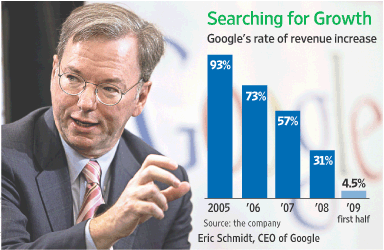 The Google juggernaut’s revenue growth has slowed steadily in the last five years, causing the Wall Street Journal to caution investors about buying Google stock. While much of the slow-down in Google’s revenue may be attributed to the recession, the WSJ cautions that:
- Microsoft is offering stiffer competition in search, which will only intensify once antitrust regulators approve its partnership with Yahoo! and the two companies actually implement their partnership (which could take another year);
- YouTube’s promise as an ad platform remains uncertain;
- Google lags behind Apple and Research in Motion in developing mobile phone operating systems, with Android still unproven;
- It remains unclear how successful the company will be in expanding beyond its existing lead in small text ads into the potentially lucrative realm of banner ads.
Somehow I doubt Google’s fall to Earth will do much to allay the concerns of those who see Google as the kind of evil monopolist Microsoft was made out to be in the 90s.
As the Journal concludes, “It would be foolish to predict that Google won’t have another business success, of course… Google may itself discover the next Google-like business.” As long as someone’s out there working to turn today’s idle fantasies into tomorrow’s multi-billion dollar businesses, consumers win—whoever that bold innovator might be.
Mediapost has published an interview I gave to Omar Tawakol, founder of the BlueKai registry entitled “User Empowerment, Not Regulation, Is The Answer to Privacy Concerns About Targeted Ads” in which I summarize the arguments Adam Thierer and I have been making since our “Principles to Guide the Debate” piece last September.
We argue for user empowerment over restrictive defaults (like “opt-in”) for data use and collection because, as the Supreme Court held in 2000: “Technology expands the capacity to choose; and it denies the potential of this revolution if we assume the Government is best positioned to make these choices for us.”
We promote tools that let users make their own decisions about privacy, not only because those decisions are fundamentally subjective, but because regulatory mandates could stifle the development of online content and commerce.
I also note the parallels between speech controls and privacy regulation, and call for a consistent, principled approach to both:
Since 1997, the Supreme Court has struck down multiple legislative attempts to censor online and offline content [especially the CDA] because there were “less restrictive alternatives” that would not so heavily burden free speech rights. In a 2000 cable-related decision, the Court held that “targeted blocking [by users] is less restrictive than banning, and the Government cannot ban speech if targeted blocking is a feasible and effective means of furthering its compelling interests.”
Courts have struck down other federal and state speech controls because parents had the tools to filter their kids’ access to information online, in video games, etc., as described in my PFF colleague Adam Thierer’s ongoing catalog of these tools…
Many who oppose industry self-regulation are not really “consumer advocates” because they don’t recognize that consumers have many, competing values. Those regulatory advocates are more interested in their preferred one-size-fits-all mandates than in empowering users to determine their own privacy preferences.
Like advocates of censorship, privacy zealots assert great dangers to which citizens are supposedly oblivious but which urgently require government intervention-dismissing arguments to the contrary as either uninformed or irresponsible.
The comments on the interview are equally worth reading. Jeff Chester, who has made a career out of attacking advertising, quickly posted a comment dismissing, but ignoring, my arguments about consumer welfare as corporate propaganda—just as he did with his comment on the post Adam and I wrote in June about congressional hearings on the issue featuring Chester (and Scott Cleland, the right-wing “Bizarro Chester“). I’ve had it with Chester’s ad hominem attacks on the motives of those who disagree with him, as I explained in my reply to Chester: Continue reading →

 The Technology Liberation Front is the tech policy blog dedicated to keeping politicians' hands off the 'net and everything else related to technology.
More on the FCC’s e-Government Transparency Efforts: ECFS, RSS, Social Media & Setting Priorities
by Berin Szoka on September 11, 2009 · 12 comments
I vented my frustration earlier today with the FCC’s failure to make comments it receives easily accessible to the public—which means, more than anything, making them full-text searchable. This may seem like Inside Baseball to many, but it’s not. It’s a failure of the democratic process, a waste of taxpayer dollars, and a testimony to the general incompetence of bureaucracies, regardless of who’s running them. It denies the public an easy way to follow what goes on inside Washington, while essentially subsidizing law firms who get to bill clients for having paralegals or junior associates do things that existing web technology makes completely unnecessary—like reading through every comment in a document (at the rate of hundreds of dollars per hour) instead of just looking for keywords in a full-text search.
Later in the day the FCC announced:
I’m thrilled about the RSS feeds, which go a long way in letting all Americans know what the FCC does, supposedly in the “public interest.” Still, I can’t help but note that the FCC waited until after a huge discussion about whether RSS is dead to finally start using RSS in a serious way—fully a decade after the birth of the RSS standard. Better late than never, I suppose.
FCC Connect is also good news: once you have an RSS feed, there’s really no reason not to pipe that feed into as many platforms as possible—which is precisely why RSS isn’t dead, even if most people will never use an RSS reader.
But I’m less thrilled about the crowdsourcing platform. Continue reading →