 As I noted here a few days ago, the Federal Communications Commission held a workshop on Tuesday about “Speech, Democratic Engagement, and the Open Internet.” It was a shockingly one-sided affair with the deck being stacked almost entirely in favor of advocates of Net neutrality regulation. Worse yet, those advocates shamelessly made up spooky stories about a future of “private censorship” that could only be remedied by using the First Amendment as a club to beat private players into submission. The token opposition at this Chicken Little circus was Robert Corn-Revere, a Partner at the law firm of Davis Wright Tremaine LLP in Washington, D.C. Bob set the record straight–both in terms of baseless accusations that were flying that day as well as the revisionist histories of the First Amendment that were being put forward. I’m happy to report that Bob allowed PFF to reprint his remarks as a new white paper entitled, “The First Amendment, the Internet & Net Neutrality: Be Careful What You Wish For.”
In his essay, Corn-Revere discusses the relationship between the First Amendment and regulatory policy, particularly the treatment of new communications technologies, and he warns that government regulation of broadband networks could “provide the vehicle for advancing new First Amendment theories for media regulation” and online speech and expression more generally. “It should not be forgotten,” he argues, “that the federal government’s initial impulse was to censor the Internet and to subject it to a far lower level of First Amendment protection. It pursued this agenda for more than a decade but was blocked by a series of First Amendment rulings.” The Communications Decency Act and the Child Online Protection Act are just two notable examples. Luckily, the courts determined that “the open Internet would be at great risk if the government is allowed to exercise such power,” he notes, and they struck down such laws.
Continue reading →
Thanks to Mashable, we clearly see power laws at work on Twitter. While many protest this as evidence of “media inequality,” the “non-tweeting will always be with us” (to paraphrase Jesus’s comment about the persistence of “the poor”)—and this is nothing to get bent out of shape about, as Adam has explained.
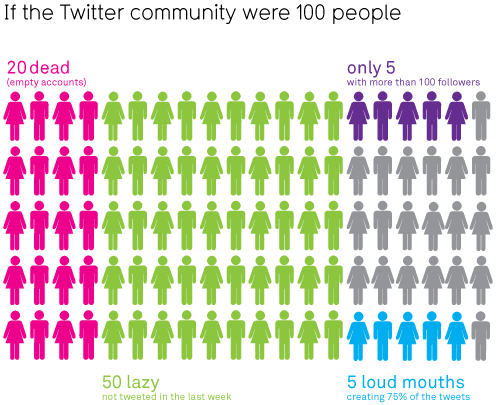
Courtesy of Mashable, David McCandless
In response to my essay last night about this new Free Press campaign to layer price controls on the Internet by banning metered prices via Rep. Massa’s new bill (the “Broadband Internet Fairness Act“), George Ou and Richard Bennett reminded me of some of the contradictory statements that the (Un)Free Press crew have made on this issue. Indeed, if you look back at what Free Press and their chairman have said about the matter over just the past 18 months, they seem to be whistling two very different tunes.
For example, George Ou reminded me of what Free Press had to say in its November 2007 filing in the FCC’s Comcast-Bit Torrent proceeding:
“More importantly, if Comcast is concerned that the collective set of users running P2P applications are affecting quality of service for other users on a cable loop… they could also charge by usage.” (p. 29)
[…]
“Indeed, in many nations, network providers do meter, and bill their customers on the basis of amount used. So the transaction costs of doing so must not be prohibitively high. Indeed, a network provider can apparently meter cheaply because, in most networks, users’ traffic to and from the Internet passes through a single gateway, the network access server.” (p. 31)
And Richard Bennett reminded me of what Tim Wu, chairman of the Free Press, had to say about metering to the Washington Post just one year ago:
“I don’t quite see [metering] as an outrage, and in fact is probably the fairest system going — though of course the psychology of knowing that you’re paying for bandwidth may change behavior.”
So, what gives? Will the real Free Press please stand up? Does the Free Press believe in pricing freedom or price controls for the Internet?
Cory Doctorow has called for a Wikipedia-style effort to build an open source, non-profit search engine. From his column in The Guardian:
What’s more, the way that search engines determine the ranking and relevance of any given website has become more critical than the editorial berth at the New York Times combined with the chief spots at the major TV networks. Good search engine placement is make-or-break advertising. It’s ideological mindshare. It’s relevance…
It’s a terrible idea to vest this much power with one company, even one as fun, user-centered and technologically excellent as Google. It’s too much power for a handful of companies to wield.
The question of what we can and can’t see when we go hunting for answers demands a transparent, participatory solution. There’s no dictator benevolent enough to entrust with the power to determine our political, commercial, social and ideological agenda. This is one for The People.
Put that way, it’s obvious: if search engines set the public agenda, they should be public.
He goes on to claim that “Google’s algorithms are editorial decisions.” For Doctorow, this is an outrage: “so much editorial power is better vested in big, transparent, public entities than a few giant private concerns.”
I wish Doctorow well in his effort to crowdsource a Google-killer, but I’m more than a little skeptical that anyone would actually want to use his search engine of The People. My guess is that, like most things produced in the name of “The People” (Soviet toilet paper comes to mind), it will probably won’t be much fun to use, and will likely chafe noticeably. (For the record, I love and regularly use Wikipedia; I just don’t think that model is unlikely to produce a particularly useful search engine. As Doctorow himself has noted of Google, “they make incredibly awesome search tools.”)
But I’m glad to see that Doctorow has conceded an important point of constitutional law:
The First Amendment protects the editorial discretion of search engines, like all private companies, to decide what to content to communicate. For a newspaper, that means deciding which articles or editorials to run. For a library or bookstore, it means which books to carry. For search engines, it means how to write their search algorithims. Continue reading →
I was over at the Federal Communications Commission (FCC) the other day chatting with someone about various regulatory issues and Rush Limbaugh’s WSJ editorial came up. The person I was speaking with made a comment about how conservatives have really been energized and unified in opposition to the re-imposition to the Doctrine. I reminded them, however, that it wasn’t always the case that conservatives stood together in the fight over the Fairness Doctrine. In fact, when I first came to town almost 20 years ago, there were still plenty of conservatives who actually favored it. I was reminded of that fact when reading a new piece in Engage about “Broadcast ‘Fairness’ in the Twenty-First Century” by my friend Robert Corn-Revere. Bob is one America’s great First Amendment defenders and his new essay offers an excellent history of efforts to micro-manage speech on the broadcast airwaves over the years. In it, he reminds us that:
Given the recent vocal opposition to the Fairness Doctrine in the interest of preserving conservative talk radio, it is easy to forget that many prominent conservatives championed the doctrine before its demise. Phyllis Schlafly was a vocal proponent of the Fairness Doctrine because of what she described as “the outrageous and blatant anti-Reagan bias of the TV network newscasts,” and she testified at the FCC in the 1980s in support of the policy “to serve as a small restraint on the monopoly power wielded by Big TV Media.” Senator Jesse Helms was another long-time advocate of the Fairness Doctrine, and conservative groups Accuracy in Media and the American Legal Foundation actively pursued fairness complaints at the FCC against network newscasts.
Likewise, in our book, A Manifesto for Media Freedom, Brian Anderson and I note that some other prominent right-leaning politicians, such as Sen. Trent Lott, favored the Fairness Doctrine. Moreover, even though most of those conservative individuals and groups have now turned against the Fairness Doctrine, some Republicans still defend (or even seek to expand) the same underlying regulatory concepts that served as the foundation of the Fairness Doctrine. As Corn-Revere notes: Continue reading →

 The Technology Liberation Front is the tech policy blog dedicated to keeping politicians' hands off the 'net and everything else related to technology.