Posts tagged as:

After cracking down on both international and domestic journalists, Iran is now looking to America for ways to squelch dissent. So, naturally, they’re copying America’s disastrous experience with censorship:  the so-called “Fairness Doctrine” imposed by the FCC (despite the First Amendment’s plain language) in 1949 until its repeal in 1987:

Iran’s State Inspectorate Organization, a sort of superregulatory agency that supervises a wide range of government administrations, said the guidelines will ensure that any criticism communicated through state media is “constructive,” “nonjudgmental” and doesn’t “stray from objectivity,” Iran’s state-controlled English-language news site Press TV quoted SIO chief Mostafa Pourmohammadi as saying. He didn’t give details of the new rules, and it wasn’t clear which outlets are being specifically targeted — the government-controlled media or the heavily monitored independent press. It is also unclear how much clout the agency has in pursuing violations or referring them to authorities for enforcement.

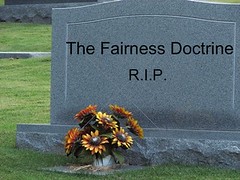
TombstoneWhen the history books are finally written documenting America’s failed experiment with broadcast industry content regulation, this past week may go down as a critical moment in the story.  The obvious reason this week was so important was the Senate’s 87-11 vote on Thursday to prevent the Federal Communications Commission (FCC) from reinstating the Fairness Doctrine.  But an equally important development this past week was the release of a new white paper by the radical Leftist activist group Free Press.

The Free Press, which was founded by the socialist media theorist Robert McChesney, doesn’t typically publish many things admitting to the failures of coercive government regulation. Nonetheless, in “The Fairness Doctrine Distraction,” a paper by Josh Silver and Marvin Ammori, the media reformistas at Free Press told their Big Government comrades in Congress and academia that it was finally OK to let go of at least this one old pet project of theirs.  In their paper, Silver and Ammori note that, “The Fairness Doctrine put the federal government in the position of judging content and controlling speech” and “Reinstating the Doctrine will not result in greater viewpoint diversity in broadcasting.”  They continue:

The Fairness Doctrine, while originally well-intentioned, is not wise public policy. [T]he Doctrine places the FCC in charge of determining what is fair in political speech — a difficult task in the best of circumstances. Placing the government in the role of monitoring and judging political speech will inevitably produce controversy that is impossible to resolve.

I applaud the Free Press for finally fessing up to the Fairness Doctrine’s many failings.  This First Amendment-violating abomination should have never been allowed to be enforced by the FCC to begin with, but at least we can now all finally agree it should stay off the books for good.

Of course, the radicals at the (Un)Free Press weren’t about to let one of the Left’s old favorite regulations go so away without asking for something in return.  One of the reasons that Silver and Ammori are suddenly willing to give their blessing to the Doctrine’s burial is because they want to get on with the more far-reaching agenda of micro-managing media markets using a variety of less visible regulations.

Continue reading →

I was over at the Federal Communications Commission (FCC) the other day chatting with someone about various regulatory issues and Rush Limbaugh’s WSJ editorial came up.  The person I was speaking with made a comment about how conservatives have really been energized and unified in opposition to the re-imposition to the Doctrine.  I reminded them, however, that it wasn’t always the case that conservatives stood together in the fight over the Fairness Doctrine.  In fact, when I first came to town almost 20 years ago, there were still plenty of conservatives who actually favored it.  I was reminded of that fact when reading a new piece in Engage about “Broadcast ‘Fairness’ in the Twenty-First Century” by my friend Robert Corn-Revere.  Bob is one America’s great First Amendment defenders and his new essay offers an excellent history of efforts to micro-manage speech on the broadcast airwaves over the years.  In it, he reminds us that:

Given the recent vocal opposition to the Fairness Doctrine in the interest of preserving conservative talk radio, it is easy to forget that many prominent conservatives championed the doctrine before its demise. Phyllis Schlafly was a vocal proponent of the Fairness Doctrine because of what she described as “the outrageous and blatant anti-Reagan bias of the TV network newscasts,” and she testified at the FCC in the 1980s in support of the policy “to serve as a small restraint on the monopoly power wielded by Big TV Media.” Senator Jesse Helms was another long-time advocate of the Fairness Doctrine, and conservative groups Accuracy in Media and the American Legal Foundation actively pursued fairness complaints at the FCC against network newscasts.

Likewise, in our book, A Manifesto for Media Freedom, Brian Anderson and I note that some other prominent right-leaning politicians, such as Sen. Trent Lott, favored the Fairness Doctrine.  Moreover, even though most of those conservative individuals and groups have now turned against the Fairness Doctrine, some Republicans still defend (or even seek to expand) the same underlying regulatory concepts that served as the foundation of the Fairness Doctrine.  As Corn-Revere notes: Continue reading →

Here at TLF we often worry about government encroachment on the latest and greatest technologies.  It seems that federal regulators want to control everything that has to do with our beloved and still largely free Internet—how data moves around, whether or not we can encrypt it, how long it is stored, who owns it, and how we can get their hands on it.

But even relatively low-tech means of communication are under attack too, or at least are rumored to be.

Lately there has been so much clamor over the Fairness Doctrine—an abandoned rule mandating equal time for all sides of controversial issues discussed on broadcast radio & television—that the Obama administration has stated publicly that the President is against reviving it.

Even so, the mascot of the anti-Fairness Doctrine crowd, Rush Limbaugh, has voiced his opinion in an op-ed in today’s The Wall Street Journal.

Mr. Limbaugh’s position is obvious: he doesn’t like the Fairness Doctrine.  Not because he’s against fairness or thinks that liberal voices shouldn’t be heard, but because, as he puts it, “The dangers of an overly timid or biased press cannot be averted through bureaucratic regulation, but only through the freedom and competition that the First Amendment sought to guarantee.”

Continue reading →

Matt Lasar of Ars tells us not to worry about the Fairness Doctrine being revived, only to go on and cite several lawmakers who have said they’d like to revive it. Meanwhile, over at the American Spectator, somebody called “The Prowler” seems to have all sorts of unnamed sources on the Hill telling him the Fairness Doctrine will be revived any day now.

Who knows what to believe. But let’s keep our eye on the real issue here. The danger is not that the Fairness Doctrine gets back on the books in the same form; it’s that versions of it sneak in through the back door via other regulatory initiatives. As Cord Blomquist pointed out here last April, “localism is the new Fairness Doctrine.”  There are a lot of people are running around Washington today insisting that government must intervene in the marketplace to “save media localism” and “strengthen the public interest obligations” of local TV and radio broadcasters.  There’s been an FCC proceeding open on this issue for some time, and everything about it reeks of the Fairness Doctrine in drag.

This effort is being spearheaded by the media reformistas whose short-term goal is to reinvigorate the amorphous “public interest standard” such that the FCC has open-ended powers to regulate everything under the sun going forward. That’s why a key part of the “localism” battle is their effort to breathe new life into “ascertainment rules,” which used to be more formal and required broadcasters to strictly report everything they aired and did in their communities. There’s lots of talk of ensuring more “accountability” from broadcasters regarding how they serve their local communities, and there’s even rumblings of “local community boards” who will sit as mini-free speech Star Chambers and pass judgment on whether local media outlets are doing their job.  Again, it’s all just the Fairness Doctrine by another name. Continue reading →

Here’s some good background and analysis from the Congressional Research Service (CRS) about the history and constitutional issues surrounding the Fairness Doctrine. (Matt Lasar has a summary of it over at Ars). The report, authored by CRS legislative attorney Kathleen Ann Ruane, does a nice job of outlining why, given heightened Supreme Court scrutiny of speech controls since the Red Lion days, the Fairness Doctrine would face serious constitutional scrutiny is it was re-instituted today:

It is possible that, in light of the proliferation of different types of media outlets since Red Lion, the Supreme Court will abandon the scarcity rationale for applying a lower standard of scrutiny to restrictions on broadcasters’ speech. If the scarcity rationale is abandoned, the Court will likely begin to apply strict scrutiny to broadcaster speech restrictions like the Fairness Doctrine. Because the Supreme Court has struck down regulations similar to the Fairness Doctrine when applied to other types of media, it seems unlikely that the Fairness Doctrine would survive review under strict scrutiny. […] Assuming that the Supreme Court would continue to apply intermediate scrutiny to government restrictions on broadcasters’ speech, the Court would then need to decide whether the Fairness Doctrine withstands such scrutiny. The Court may choose to uphold Red Lion and the Fairness Doctrine under the principle of stare decisis, which requires courts to adhere to precedent. The Court also may choose to analyze a newly established Fairness Doctrine in light of evidence regarding its effects on speech that has developed since the Red Lion decision. To do so, it would have to answer two questions: (1) whether the Fairness Doctrine advances a substantial government interest, and (2) whether the doctrine is narrowly tailored to achieve that interest.

But it most certainly would not pass muster is applied to cable or satellite:

Continue reading →

Clearly, something must be done to counter the evil corporate cabal known as “the Cloud Elders” and the “Knights Doppler” who are behind the blatant pro-weather bias displayed daily on the Weather Channel. Perhaps a Fairness Doctrine for Weather Reporting?

Thank God the hard-working folks at Fairness in Media unearthed this vicious anti-democratic conspiracy.


Weather Channel Accused of Pro-Weather Bias

Is $1,200,000,000,000.00.  That’s the expected 2009 Federal budget deficit.  Since the current Federal debt is estimated at a “mere” $10.6 trillion, this means that we’re expected to add nearly 9% in a single year to a debt accumulated over 233 years (since 1774).  This number also amounts to more than 8% of the U.S. economy. 

So what does this have to do with technology policy?  To start with, this figure comes from Congressional Budget Office estimates, which “don’t account for the huge economic stimulus bill Obama is expected to propose soon to try to jolt the economy.”  So, while the Obama team has talked about big “public works” and “infrastructure” spending (which used to be called, variously, “make-work,” “pork barrel” and “corporate welfare”), there’s sure to be huge pressure not to waste more taxpayer money on top of this staggering figure.  Whatever blame Bush deserves, Obama probably doesn’t want to go down in history as the man who finally caused the U.S. government to default on its unmanageable debt burden.

One certainly could make an argument that the kind of technology-related “infrastructure” stimulus Obama has talked about (e.g., broadband subsidies) would be less of a waste of money than, say, simply building more bridges (as Japan did in the 1990s, its “lost decade”) or other reflexively Keynesian responses.  But even so, I suspect that the total amount of funding made available for such projects won’t be anywhere near enough to satisfy the technology policy Left.  

This could result in increased pressure on the Administration to increase regulation of the technology sector in order to implement tech-leftist ideas about “protecting” users’ privacy, promoting media diversity or “fairness”, mandating net “neutrality,” “opening up” spectrum, etc.  Such  proposals might seem attractive precisely because they generally wouldn’t require increased Federal expenditures other than the cost of hiring more bureaucrats (which means more government employee union jobs anyway—hardly a bad thing for Democrats)—while the economic consequences of such proposals for companies and consumers will probably surely be trivialized.  For example, if the advocates of government control at the so-called “Free Press” can’t get universal broadband, they’ll probably press that much harder to cripple online advertising and traffic management by ISPs, just to name two popular bogeymen.obamas-new-new-deal
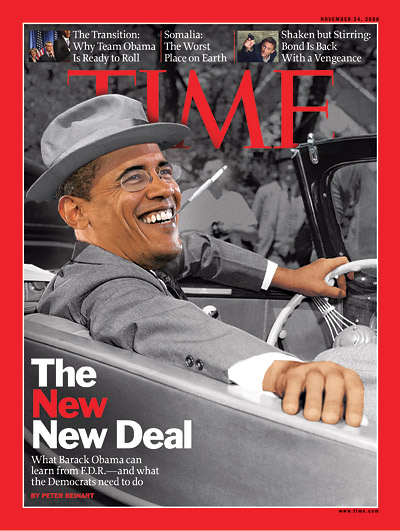
One might think that a sharp economic decline would cause policy-makers to think twice before undermining the business models that have supported IT innovation and real infrastructure investment.  But one has only to look at the policies of FDR’s first two terms to see how even an amiable, soft-spoken president elected on a mantra of change and “uniting” the nation in a time of crisis could consistently choose to place “Reform” (i.e., increased regulation) over “Recovery” (i.e., the health of the economy)—with devastating economic consequences.

Continue reading →

SunsteinPresident-elect Barack Obama will soon be naming Cass Sunstein, an old friend of his from their University of Chicago Law School days together, the new head the White House Office of Information and Regulatory Affairs (OIRA). OIRA oversees regulation throughout the U.S. government. Basically, Sunstein’s position is the equivalent of the federal regulatory czar.

Sunstein certainly possess excellent qualifications for the job. During his time at the University of Chicago and Harvard Law School, Sunstein has established himself as a leading liberal thinker in the field of law and economics. And, as I have joked in writing about him before, he is so insanely prolific that it seems every time I finish reading one of his new books a new title by him lands on my desk. I am quite convinced that both he and Richard Posner are actually cyborgs. I just don’t understand how two humans can compose words so rapidly!

Anyway, Professor Sunstein’s new position as head of OIRA gives him the ability influence federal regulatory decisions in both a procedural and substantive way. In terms of substance, it gives him an important platform to subtly “nudge” the regulatory philosophy and direction of the Obama Administration on many matters, including Internet policy. So, what has Professor Sunstein had to say about Internet policy in his recent work? Sunstein has developed his thinking about these issues primarily in his two recent books: Republic.com (2000) and Infotopia: How Many Minds Produce Knowledge (2006). But he’s also had a few relevant things to say about Internet issues in his recent book with Richard Thaler, Nudge: Improving Decisions About Health, Wealth, and Happiness (2008).

There are 3 Internet policy-related things from his work that I’d like to focus on here because I find them all quite troubling. Continue reading →

George Will’s weekly Washington Post column focuses on the Fairness Doctrine and calls out those on the Left who would support its reinstatement:

Because liberals have been even less successful in competing with conservatives on talk radio than Detroit has been in competing with its rivals, liberals are seeking intellectual protectionism in the form of regulations that suppress ideological rivals. If liberals advertise their illiberalism by reimposing the fairness doctrine, the Supreme Court might revisit its 1969 ruling that the fairness doctrine is constitutional. The court probably would dismay reactionary liberals by reversing that decision on the ground that the world has changed vastly, pertinently and for the better.

Mr. Will was kind enough to cite my new book with Brian Anderson, A Manifesto for Media Freedom [more info here] on the explosion of media outlets and options since the Supreme Court’s disastrous 1969 Red Lion decision, which blessed the Fairness Doctrine.  Some of those stats: today there are about 14,000 radio stations, twice as many as in 1969; 18.9 million subscribers to satellite radio, up 17 percent in 12 months; and that 86 percent of households with either cable or satellite television receive an average of 102 of the 500 available channels.

No need to be putting the “Unfairness Doctrine” back on the books with unprecedented abundance like that.