Last night, I appeared on the Jim Bohannon radio show for 30 minutes and discussed the past, present, and future of the Fairness Doctrine and broadcast industry regulation in general. More specifically, we got into efforts to drive Fairness Doctrine-like regulations back on the books via backdoor efforts like “localism” mandates, community oversight boards, and other public interest requirements. These are issues that Brian Anderson and I discuss in our new book, A Manifesto for Media Freedom, which I blogged about here when it was released in October.
If you’re interested, you can listen to the entire show by clicking here.
Tim Lee has been taking some heat here from Richard Bennett and Steve Schultze about various aspects of his new Net neutrality paper. I haven’t had much time this week to jump into these debates, but I did want to mention one important portion of Tim’s paper that is being overlooked. Specifically, I like the way Tim took head-on some of the silly free speech arguments being put forth as a rationale for net neutrality regulation. As Tim notes in the introduction of the paper:
Concerns that network owners will undermine free speech online are particularly misguided. Network owners have neither the technology nor the manpower to effectively filter online content based on the viewpoints being expressed, nor do profit-making businesses have any real incentive to do so. Should a network owner be foolish enough to attempt large-scale censorship of its customers, it would not only fail to suppress the disfavored speech, but the network would actually increase the visibility of the content as the effort at censorship attracted additional coverage of the material being censored.
I think that’s exactly right and, later in his paper (between pgs 22-3), Tim nicely elaborates about the “Herculean task” associated with any attempt by a broadband provider to “manipulate human communication.” Not only is it true, as Tim argues, that “no widescale manipulation would go unnoticed for very long,” but he is also correct in noting that the public and press backlash would be enormous.
Again, I agree wholeheartedly with all these sentiments, but I think Tim missed another important angle here when discussing the unfounded fears about corporate censorship and the misguided attempts to use free speech as a justification for imposing net neutrality regulations.
Continue reading →

What’s the right way to allocate the airwaves? For years and years and years, the governing policy of federal communications was that the electro-magnetic spectrum was too “scarce” to be left to the devices of the marketplace. This kind of reasoning has always lacked substance. As I wrote in a piece occoccasioned by the rise of indecency enforcement:
Congress began regulating broadcasters in 1927 on the grounds of scarcity. In return for free and exclusive use of a given wavelength, broadcasters agreed to serve the “public interest, convenience, and necessity” — or at least to do what Congress and the FCC ordered. One element of this agreement was a ban on obscene, indecent and profane language.
This scarcity theory has always lacked substance. Nobel Prize-winning economist Ronald Coase’s reputation is based, in part, on a notable paper he wrote in 1959 that criticized the rationale behind the FCC’s command and control regime of licensing broadcasters. “It is a commonplace of economics that almost all resources in the economic system (and not simply radio and television frequencies) are limited in amount and scarce, in that people would like to use more than exists,” Coase argued in his seminal essay.
From Shouldn’t FCC Rules Over Indecency Just Grow Up? Reflections on Free Speech and Converging Media
The FCC eventually came to realize that it could endow electromagnetic frequencies with property rights-like characteristics. In 1993, under Bill Clinton and a Democratic congress, the United States finally moved to such a system — at least in those frequencies used by cell-phone operators. As in so many other ways, broadcasters have remained immune from historical trends.
This backdrop is important to understand our current moment in wireless policy. Tomorrow, on Wednesday, November 12, at 4 p.m., those near Washington will be able to gain insight into how other nations have approached radio frequency regulation. The Information Economy Project at the George Mason University School of Law (
Disclosure: I’m the Assistant Director at the Information Economy Project, a part-time position that I currently hold) will host its next “Big Ideas About Information Lecture” featuring an address by Dr. William Webb, a top policy maker at OFCOM, the U.K. telecommunications regulator.
OFCOM’s ambitious liberalization strategy, announced in 2004, permits the large majority of valuable frequencies to be used freely by competitive licensees, offering an exciting and informative experiment in public policy. Dr. Webb’s lecture, “Spectrum Reform: A U.K. Regulator’s Perspective,” will offer a timely progress report for the American audience.
Continue reading →
As TLF readers may already have noticed, Alex Harris, a law student at Stanford and Adjunct Analyst at the Competitive Enterprise Institute, has joined us as a contributor to TLF.

Alex, who was a Google Policy Fellow at CEI this past summer, has done a lot of top-notch blogging over on OpenMarket.org. He also wrote a very interesting essay that appeared in The American Spectator recently which argued against the reimposition the Fairness Doctrine. Alex’s writing focuses on issues ranging from civil liberties to intellectual property reform to competition policy. Alex is also the man behind the hilarious “Liberty Lolcats” series.
I’m sure Alex will be a great addition to TLF—in fact, his first TLF post ever (discussing shrinkwrap contracts) generated heated discussion and was linked to by Reason Hit & Run (more on this issue from Tim Lee here).
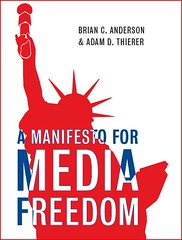 I’m pleased to announce the publication of A Manifesto for Media Freedom, which I co-authored with Brian C. Anderson of the Manhattan Institute. Brian serves as editor of Manhattan Institute’s excellent City Journal and he is the author of best-selling books like South Park Conservatives and Democratic Capitalism and Its Discontents.
In this little manifesto, we highlight one of the central ironies of the Information Age. Namely, that despite “the breathtaking abundance of new and old media outlets for obtaining news, information, and entertainment…”
many people hate this profusion, and never more than when it involves political speech. The current media market, they charge, doesn’t represent true diversity, or isn’t fair, or is subject to manipulation by a small and shrinking group of media barons. They want the government to regulate it into better shape, which just happens to be a shape that benefits them. Doing so… would be a disaster, a kind of soft or not-so-soft tyranny that would wipe out whole sectors of media, curtailing free speech and impoverishing our democracy.
In other words, instead of celebrating the unprecedented cornucopia of media choices at our collective disposal, many policymakers and media critics are calling for just as much media regulation as ever. We itemize these threats in our chapters and they include: efforts to revive the “Fairness Doctrine”, media ownership regulations, “localism” requirements, Net neutrality mandates, a la carte regulations, cable and satellite censorship, video game censorship, regulation of social networking sites, campaign finance-related speech restrictions, and so on.
In each case, we advance a pro-freedom paradigm to counter the advocates of media control. What do we mean by the “media freedom” that we advocate as the alternative to these new regulatory crusades? Here’s how we put it in the book:
Continue reading →
Writing at Slate, Tim Wu tries to make Obama out to be the real Big Government candidate on media policy, who will deliver “if not a chicken in every pot, a fiber-optic cable in every home.” By contrast, Wu implies that McCain is just another pro-big business lackey who doesn’t understand “that the media and information industries are special—that like the transportation, energy, or financial industries, they are deeply entwined with the public interest.” Wu goes on to say:
Ultimately, most of the difference in Obama’s and McCain’s media policies boils down to questions about whether the media is special and a dispute over how much to trust the private sector. Camp McCain would tend to leave the private sector alone, with faith that it will deliver to most Americans what they want and deserve. The Obama camp would probably administer a more frequent kick in the pants, in the belief that good behavior just isn’t always natural.
First, as a factual matter, Wu is just wrong about McCain being some sort of a radical hands-off, pro-market liberalizer on media policy issues. Oh, if only that were true! But for those of us who have been in DC covering telecom and media policy for many years, it is widely understood there is no nailing down John McCain on any tech, telecom or media policy issue. He’s been all over the board. While he has sponsored or supported
some deregulatory initiatives on the telecom front in the past, he’s also been a supporter of other regulatory causes. His battles with broadcasters and cable, for example, are well-known. Most recently, McCain has been leading the effort to impose a la carte mandates on cable and satellite operators.
Continue reading →
Back in 2005, I threw away a book I was writing. Well, I didn’t exactly toss it in a garbage can or take a match to the manuscript; I just abandoned the project to work on other things, including a different book and a big law review article. I’m still mad at myself for never finishing it up because I think it put forward a provocative thesis: Censorship is dead. Specifically, as I argued in the first lines of the book, “A confluence of social, legal and, most importantly, technological developments is slowly undermining the ability of legislators and regulators, at all levels of government, to control the nature or quality of speech or media programming.” Accordingly, the running title for the book was: “The End of Censorship?: The Future of Content Controls in a World of Media Convergence.”
Anyway, I recently unearthed an old draft of this discarded manuscript and thought I might as well at least throw the introduction online. In it, I outline my thesis and the “5 Reasons Content Controls Will Break Down.” I also highlight how governments will fight back and discuss what alternatives are out there to address concerns about objectionable content. Someone out there might be interested in all this even though much of what I say here is now widely accepted or been said better by others. I’ve stripped out all the footnotes and cut out significant sections to make what follows more readable. So, here it goes…
“The End of Censorship? The Future of Content Controls in a World of Media Convergence.”
Content regulation–at least as it has been traditionally defined and enforced in the United States–is doomed. A confluence of social, legal and, most importantly, technological developments is slowly undermining the ability of legislators and regulators, at all levels of government, to control the nature or quality of speech or media programming. Specifically, it is the
distribution channel-based system of content regulation employed in the U.S. and many other nations that is breaking down. That is, the ability of governments to regulate speech and expression by regulating its distribution channel or provider (such as broadcasting), represents in increasingly ineffective and illogical method of policing content flows.
The demise of traditional content controls may take many years–potentially even decades–to play out, but signs of the impending death of the old regulatory regime are already evident.
Continue reading →
A few weeks ago, I outlined the amazing keynote address that Harvard University law professor Laurence H. Tribe delivered at PFF’s annual Aspen Summit. Now you can read it for yourself. PFF has just published the transcript of his speech, which was entitled, “Freedom of Speech and Press in the 21st Century: New Technology Meets Old Constitutionalism.”
Professor Tribe provides a 14-part indictment of new government proposals to regulate “excessively violent” content. But he also speaks more broadly about the importance of defending the First Amendment from attacks on many different platforms, and for many different types of content. Here’s one of my favorite passages from the concluding section of his remarks:
The broad lesson of this discussion of television violence is the centrality of the First Amendment’s opposition to having government as big brother regulate who may provide what information content to whom, whether or not for a price. The large problem that this exposes is that especially in a post-9/11 world, where grownups understandably fear for themselves and for their children and worry about the brave new world of online cyber reality that their kids can navigate more fluently than they can, it is enormously tempting to forget or to subordinate the vital principles of constitutional liberty. Even if, after years of litigation and expenditure, the First Amendment prevails, it can be worn down dramatically by having to wage that fight over and over and over.
Amen to that. And that, in a nutshell, describes what much of my research agenda at PFF has been focused on. It is a pleasure to add Prof. Tribe’s address to our growing body of research on the sanctity of freedom of speech and centrality of the First Amendment to our democratic republic as we continue “to wage that fight over and over and over.”
The Parents Television Council has a new report out this week about the supposed decline of the TV “Family Hour.” The City Journal has just posted my response to that PTC report here. It begins as follows…
Who Killed TV’s “Family Hour”?
It’s not who you think.
by Adam D. Thierer
7 September 2007
The nonprofit Parents Television Council (PTC) released a report this week lamenting the supposed death of broadcast television’s “family hour.” Though neither the Federal Communications Commission nor Congress ever mandated it, 8 to 9 PM Monday through Saturday (Eastern time), and 7 to 9 PM on Sunday, have traditionally been devoted to family-friendly programming. But the PTC’s new report claims that these blocks of time are now “no place for children,” because “corporate interests have hijacked the family hour” and “have pushed more and more adult-oriented programming to the early hours of the evening.”
One might respond to this claim by questioning the PTC’s methodology, particularly its definitions of foul language. Simon Vozick-Levinson of Entertainment Weekly’s “PopWatch Blog” takes this approach, accusing the PTC of “cooking the numbers” to suit its cultural agenda. But I don’t want to engage in methodological nit-picking, since it quickly devolves into a subjective squabble about acceptable language and appropriate programming. Instead, I want to point out the fundamental flaw in the report’s premise. The family hour may well be dead—but parents, not broadcasters, were the ones who killed it.
… read the rest at the City Journal’s website.

 The Technology Liberation Front is the tech policy blog dedicated to keeping politicians' hands off the 'net and everything else related to technology.