Facebook announced some changes to its site today that will make it easier for teen users to share content with not just their friends but also the entire world. (More coverage at The Washington Post
here.) No doubt, some privacy advocates will cry foul and rush to policymakers with requests for restrictions. Yet, it’s not clear to me what their case would be. There isn’t any COPPA issue here since we are talking about teens, and they aren’t covered by the law. Moreover, it seems entirely sensible to allow teens to make their voices heard more broadly via Facebook’s platform the same way they can via many other online sites and services. Teens have speech rights, too, after all.
On the other hand, this is another “teachable moment” that parents should take advantage of. When sites (especially larger sites like Facebook) change their policies and make it easier for our kids to share more about themselves and their feelings, that is always a great time to have another chat with them about acceptable online behavior. I’ve spent a lot of time here and elsewhere talking about the importance of “Netiquette,” or proper online etiquette in various social settings and situations. We need to talk to our kids and each other about being more savvy, sensible, respectful, and resilient media consumers and digital citizens. And schools and even governments have a role to play in pushing education and media literacy in pursuit of better “digital citizenship.”
The crucial lesson here — and this certainly has relevance to today’s Facebook announcement — is that we need to constantly be encouraging our kids to think about smarter online hygiene (sensible personal data use) and proper behavior toward others. Continue reading →
 I’m pleased to announce the release of my latest law review article, “A Framework for Benefit-Cost Analysis in Digital Privacy Debates.” It appears in the new edition of the George Mason University Law Review. (Vol. 20, No. 4, Summer 2013)
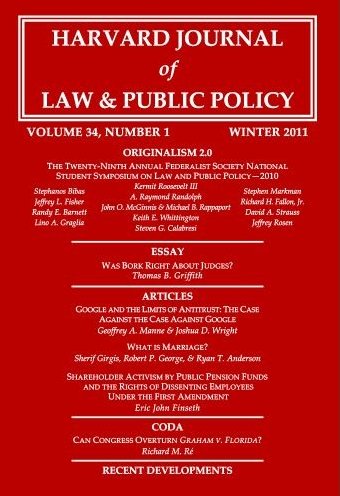
This is the second of two complimentary law review articles I am releasing this year dealing with privacy policy. The first, “The Pursuit of Privacy in a World Where Information Control is Failing,” was published in Vol. 36 of the Harvard Journal of Law & Public Policy
this Spring. (FYI: Both articles focus on privacy claims made against private actors — namely, efforts to limit private data collection — and not on privacy rights against governments.)
My new article on benefit-cost analysis in privacy debates makes a seemingly contradictory argument: benefit-cost analysis (“BCA”) is extremely challenging in online child safety and digital privacy debates, yet it remains essential that analysts and policymakers attempt to conduct such reviews. While we will never be able to perfectly determine either the benefits or costs of online safety or privacy controls, the very act of conducting a regulatory impact analysis (“RIA”) will help us to better understand the trade-offs associated with various regulatory proposals. Continue reading →
Adam Thierer, Senior Research Fellow at the Mercatus Center discusses his recent working paper with coauthor Brent Skorup, A History of Cronyism and Capture in the Information Technology Sector. Thierer takes a look at how cronyism has manifested itself in technology and media markets — whether it be in the form of regulatory favoritism or tax privileges. Which tech companies are the worst offenders? What are the consequences for consumers? And, how does cronyism affect entrepreneurship over the long term?
Download
Related Links
This afternoon, Berin Szoka asked me to participate in a TechFreedom conference on “COPPA: Past, Present & Future of Children’s Privacy & Media.” [CSPAN video is here.] It was a in-depth, 3-hour, 2-panel discussion of the Federal Trade Commission’s recent revisions to the rules issued under the 1998 Children’s Online Privacy Protection Act (COPPA).
While most of the other panelists were focused on the devilish details about how COPPA works in practice (or at least
should work in practice), I decided to ask a more provocative question to really shake up the discussion: What are we going to do when COPPA fails?
My notes for the event follow down below. I didn’t have time to put them into a smooth narrative, so please pardon the bullet points. Continue reading →
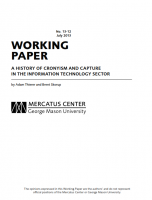 The Mercatus Center at George Mason University has just released a new paper by Brent Skorup and me entitled, “A History of Cronyism and Capture in the Information Technology Sector.” In this 73-page working paper, which we hope to place in a law review or political science journal shortly, we document the evolution of government-granted privileges, or “cronyism,” in the information and communications technology marketplace and in the media-producing sectors. Specifically, we offer detailed histories of rent-seeking and regulatory capture in: the early history of the telephony and spectrum licensing in the United States; local cable TV franchising; the universal service system; the digital TV transition in the 1990s; and modern video marketplace regulation (i.e., must-carry and retransmission consent rules, among others.
Our paper also shows how cronyism is slowly creeping into new high-technology sectors.We document how Internet companies and other high-tech giants are among the fastest-growing lobbying shops in Washington these days. According to the Center for Responsive Politics, lobbying spending by information technology sectors has almost doubled since the turn of the century, from roughly $200 million in 2000 to $390 million in 2012. The computing and Internet sector has been responsible for most of that growth in recent years. Worse yet, we document how many of these high-tech firms are increasingly seeking and receiving government favors, mostly in the form of targeted tax breaks or incentives. Continue reading →
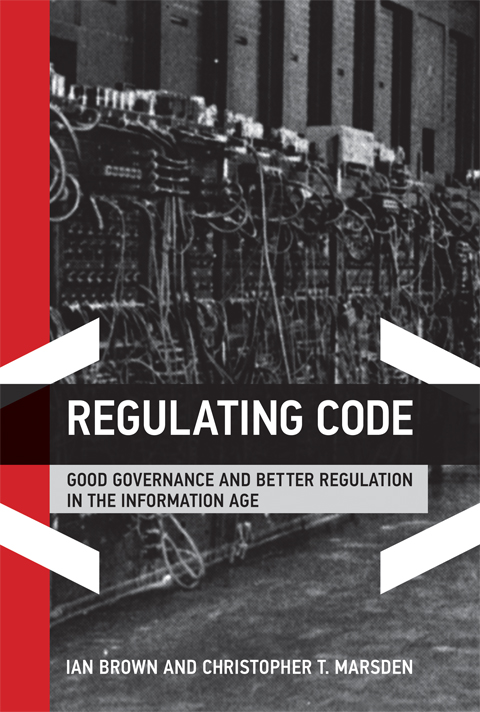
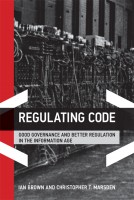 Ian Brown and Christopher T. Marsden’s new book, Regulating Code: Good Governance and Better Regulation in the Information Age, will go down as one of the most important Internet policy books of 2013 for two reasons. First, their book offers an excellent overview of how Internet regulation has unfolded on five different fronts: privacy and data protection; copyright; content censorship; social networks and user-generated content issues; and net neutrality regulation. They craft detailed case studies that incorporate important insights about how countries across the globe are dealing with these issues. Second, the authors endorse a specific normative approach to Net governance that they argue is taking hold across these policy arenas. They call their preferred policy paradigm “prosumer law” and it envisions an active role for governments, which they think should pursue “smarter regulation” of code.
In terms of organization, Brown and Marsden’s book follows the same format found in Milton Mueller’s important 2010 book Networks and States: The Global Politics of Internet Governance; both books feature meaty case studies in the middle bookended by chapters that endorse a specific approach to Internet policymaking. (Incidentally, both books were published by MIT Press.) And, also like Mueller’s book, Brown and Marsden’s Regulating Code does a somewhat better job using case studies to explore the forces shaping Internet policy across the globe than it does making the normative case for their preferred approach to these issues. Continue reading →
 The Internet’s greatest blessing — its general openness to all speech and speakers — is also sometimes its biggest curse. That is, you cannot expect to have the most widely accessible, unrestricted communications platform the world has ever known and not also have some imbeciles who use it to spew insulting, vile, and hateful comments.
It is important to put things in perspective, however. Hate speech is not the norm online. The louts who spew hatred represent a small minority of all online speakers. The vast majority of online speech is of a socially acceptable — even beneficial — nature.
Still, the problem of hate speech remains very real and a diverse array of strategies are needed to deal with it. The sensible path forward in this regard is charted by Abraham H. Foxman and Christopher Wolf in their new book, Viral Hate: Containing Its Spread on the Internet. Their book explains why the best approach to online hate is a combination of education, digital literacy, user empowerment, industry best practices and self-regulation, increased watchdog / press oversight, social pressure and, most importantly, counter-speech. Foxman and Wolf also explain why — no matter how well-intentioned — legal solutions aimed at eradicating online hate will not work and would raise serious unintended consequences if imposed.
In striking this sensible balance, Foxman and Wolf have penned the definitive book on how to constructively combat viral hate in an age of ubiquitous information flows. Continue reading →
Declan McCullagh, chief political correspondent for CNET and former Washington bureau chief for Wired News, discusses recent leaks of NSA surveillance programs. What do we know so far, and what more might be unveiled in the coming weeks? McCullagh covers legal challenges to the programs, the Patriot Act, the fourth amendment, email encryption, the media and public response, and broader implications for privacy and reform.
Download
Related Links
David Garcia, post doctoral researcher at the Swiss Federal Institute of Technology and co-author of Social Resilience in Online Communities: The Autopsy of Friendster, discusses the concept of social resilience and how online communities, like Facebook and Friendster, withstand changes in their environment.
Garcia’s paper examines one of the first online social networking sites, Friendster, and analyzes its post-mortem data to learn why users abandoned it.
Garcia goes on to explain how opportunity cost and cost benefit analysis can affect a user’s decision whether or not to remain in an online community.
Download
Related Links
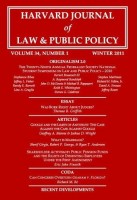 I’m excited to announce the release of my latest law review article, “The Pursuit of Privacy in a World Where Information Control is Failing,” which appears in the next edition (vol. 36) of the Harvard Journal of Law & Public Policy. This is the first of two complimentary law review articles that I will be releasing this year dealing with privacy policy. The second, which will be published later this summer by the George Mason University Law Review, is entitled, “A Framework for Benefit-Cost Analysis in Digital Privacy Debates.” (FYI: Both articles focus on privacy claims made against private actors — namely, efforts to limit private data collection — and not on privacy rights against governments.)
The new
Harvard Journal article is divided into three major sections. Part I focuses on some of normative challenges we face when discussing privacy and argues that there may never be a widely accepted, coherent legal standard for privacy rights or harms here in the United States. It also explores the tensions between expanded privacy regulation and online free speech. Part II turns to the many enforcement challenges that are often ignored when privacy policies are being proposed or formulated and argues that legislative and regulatory efforts aimed at protecting privacy must now be seen as an increasingly intractable information control problem. Most of the problems policymakers and average individuals face when it comes to controlling the flow of private information online are similar to the challenges they face when trying to control the free flow of digitalized bits in other information policy contexts, such as online safety, cybersecurity, and digital copyright.
If the effectiveness of law and regulation is limited by the normative considerations discussed in Part I and the practical enforcement complications discussed in Part II, what alternatives remain to assist privacy-sensitive individuals? I address that question in Part III of the paper and argue that the approach America has adopted to deal with concerns about objectionable online speech and child safety offers a path forward on the privacy front as well. Continue reading →



 The Technology Liberation Front is the tech policy blog dedicated to keeping politicians' hands off the 'net and everything else related to technology.