I caught this tidbit today in a Washington Post article about Julius Genachowski’s tenure as Federal Communications Commission chairman:
He wound up presiding over a crucial period in which the powerful companies of Silicon Valley turned into Washington power players. Lobbying the FCC has become a major economic franchise. Each day, hundreds of dark-suited lawyers crowd the antiseptic, midcentury-modern agency building.
Can anyone think this is a good thing? To be clear, I don’t think Genachowski is solely responsible for Silicon Valley innovators getting more aggressive in Washington or for tech lobbying becoming “a major economic franchise” at the FCC. There’s plenty of blame to go around in that regard. Regardless, every legislative and regulatory action that opens the door to greater regulation of the information economy also opens the door a bit wider to unproductive rent-seeking and cronyist activities. Moreover, every minute and every dollar spent focusing on making legislators and regulators happy is another minute and dollar that could have better been spent making consumers happy in the marketplace. It’s a pure deadweight loss to society.
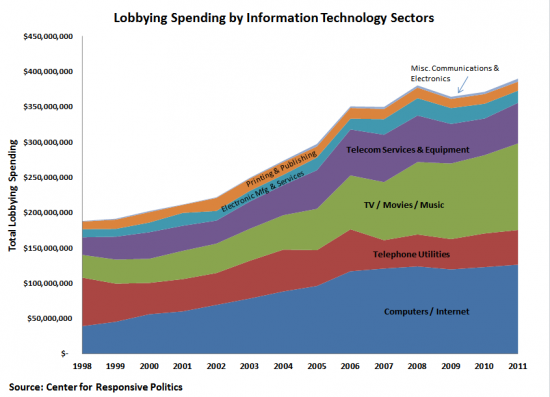
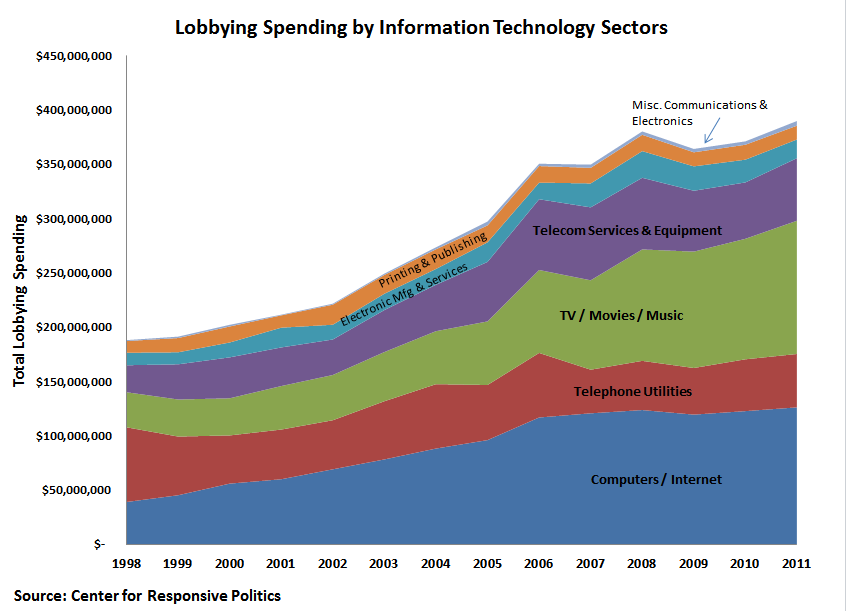
And there has been a remarkable expansion in such tech lobbying activity over the past decade, as the following charts illustrate. The first shows the dramatic growth of lobbying by computer and Internet companies relative to other sectors and the second shows lobbying spending by specific computer and Internet companies. [Click to enlarge.]
Continue reading →
I’ve been hearing more rumblings about “API neutrality” lately. This idea, which originated with Jonathan Zittrain’s book, The Future of the Internet–And How to Stop It, proposes to apply Net neutrality to the code/application layer of the Internet. A blog called “The API Rating Agency,” which appears to be written by Mehdi Medjaoui, posted an essay last week endorsing Zittrain’s proposal and adding some meat to the bones of it. (My thanks to CNet’s Declan McCullagh for bringing it to my attention).
Medjaoui is particularly worried about some of Twitter’s recent moves to crack down on 3rd party API uses. Twitter is trying to figure out how to monetize its platform and, in a digital environment where advertising seems to be the only business model that works, the company has decided to establish more restrictive guidelines for API use. In essence, Twitter believes it can no longer be a perfectly open platform if it hopes to find a way to make money. The company apparently believes that some restrictions will need to be placed on 3rd party uses of its API if the firm hopes to be able to attract and monetize enough eyeballs.
While no one is sure whether that strategy will work, Medjaoui doesn’t even want the experiment to go forward. Building on Zittrain, he proposes the following approach to API neutrality:
- Absolute data to 3rd party non-discrimination : all content, data, and views equally distributed on the third party ecosystem. Even a competitor could use an API in the same conditions than all others, with not restricted re-use of the data.
- Limited discrimination without tiering : If you don’t pay specific fees for quality of service, you cannot have a better quality of service, as rate limit, quotas, SLA than someone else in the API ecosystem.If you pay for a high level Quality of service, so you’ll benefit of this high level quality of service, but in the same condition than an other customer paying the same fee.
- First come first served : No enqueuing API calls from paying third party applications, as the free 3rd-party are in the rate limits.
Before I critique this, let’s go back and recall why Zittrain suggested we might need API neutrality for certain online services or digital platforms. Continue reading →
Adam Thierer, senior research fellow at the Mercatus Center at George Mason University, discuses recent calls for nationalizing Facebook or at least regulating it as a public utility. Thierer argues that Facebook is not a public good in any formal economic sense, and nationalizing the social network would be a big step in the wrong direction. He argues that nationalizing the network is neither the only nor the most effective means of solving privacy concerns that surround Facebook and other social networks. Nor is Facebook is a monopoly, he says, arguing that customers have many other choices. Thierer also points out that regulation is not without its problems including the potential that a regulator will be captured by the regulated network thus making monopoly a self-fulfilling prophecy.
Listen to the Podcast
Download MP3
Related Links
In my most recent weekly Forbes column, “Common Sense About Kids, Facebook & The Net,” I consider the wisdom of an online petition that the child safety advocacy group Common Sense Media is pushing, which demands that Facebook give up any thought of letting kids under the age of 13 on the site. “There is absolutely no proof of any meaningful social or educational value of Facebook for children under 13,” their petition insists. “Indeed, there are very legitimate concerns about privacy, as well as its impact on children’s social, emotional, and cognitive development.” Common Sense Media doesn’t offer any evidence to substantiate those claims, but one can sympathize with some of the general worries. Nonetheless, as I argue in my essay:
Common Sense Media’s approach to the issue is short-sighted. Calling for a zero-tolerance, prohibitionist policy toward kids on Facebook (and interactive media more generally) is tantamount to a bury-your-head-in-sand approach to child safety. Again, younger kids are increasingly online, often because their parents allow or even encourage it. To make sure they get online safely and remain safe, we’ll need a different approach than Common Sense Media’s unworkable “just-say-no” model.
Think about it this way: Would it make sense to start a petition demanding that kids be kept out of town squares, public parks, or shopping malls? Most of us would find the suggestion ludicrous. Continue reading →
It’s my great pleasure this week to be participating in a 2-day symposium on “Competition in Online Search” that is being hosted by the Antitrust & Competition Policy Blog. Daniel Sokol, Associate Professor of Law at the University of Florida Levin College of Law, was kind enough to invite me to join the fun. Professor Sokol is the editor of the Antitrust & Competition Policy Blog. Others participating in this symposium include: James Grimmelman (NY Law); Eugene Volokh (UCLA); Marvin Ammori (Stanford Law); Mark Jamison (Univ. of Florida); Eric Clemons (Wharton School); Dan Crane (Michigan Law); and both Marina Lao and Frank Pasquale (Seton Hall); and more.
My entry is now live. In it, I focus on how dynamically competitive and innovative the digital economy has been over the past 15 years and question to need for intervention at this time, especially of the “public utility” variety. I’ve re-posted my entry below, but make sure to head over to the Antitrust & Competition Policy Blog to read all the contributions to this excellent symposium. Continue reading →
The Mercatus Center at George Mason University has just released my new white paper, “The Perils of Classifying Social Media Platforms as Public Utilities.” [PDF] I first presented a draft of this paper last November at a Michigan State University conference on “The Governance of Social Media.” [Video of my panel here.]
In this paper, I note that to the extent public utility-style regulation has been debated within the Internet policy arena over the past decade, the focus has been almost entirely on the physical layer of the Internet. The question has been whether Internet service providers should be considered “essential facilities” or “natural monopolies” and regulated as public utilities. The debate over “net neutrality” regulation has been animated by such concerns.
While that debate still rages, the rhetoric of public utilities and essential facilities is increasingly creeping into policy discussions about other layers of the Internet, such as the search layer. More recently, there have been rumblings within academic and public policy circles regarding whether social media platforms, especially social networking sites, might also possess public utility characteristics. Presumably, such a classification would entail greater regulation of those sites’ structures and business practices.
Proponents of treating social media platforms as public utilities offer a variety of justifications for regulation. Amorphous “fairness” concerns animate many of these calls, but privacy and reputational concerns are also frequently mentioned as rationales for regulation. Proponents of regulation also sometimes invoke “social utility” or “social commons” arguments in defense of increased government oversight, even though these notions lack clear definition.
Social media platforms do not resemble traditional public utilities, however, and there are good reasons why policymakers should avoid a rush to regulate them as such. Continue reading →
On Forbes yesterday, I posted a detailed analysis of the successful (so far) fight to block quick passage of the Protect-IP Act (PIPA) and the Stop Online Piracy Act (SOPA). (See “Who Really Stopped SOPA, and Why?“) I’m delighted that the article, despite its length, has gotten such positive response.
As regular readers know, I’ve been following these bills closely from the beginning, and made several trips to Capitol Hill to urge lawmakers to think more carefully about some of the more half-baked provisions.
But beyond traditional advocacy–of which there was a great deal–something remarkable happened in the last several months. A new, self-organizing protest movement emerged on the Internet, using social news and social networking tools including Reddit, Tumblr, Facebook and Twitter to stage virtual teach-ins, sit-ins, boycotts, and other protests. Continue reading →
Here’s the notice I’ve been getting the last few days when, logged into Facebook from a computer, I try to post a comment or update my status.
Clever observers will note that the recommendation to log in from a computer is misplaced, as I get it when I’m logged in from a computer. Facebook gives me no instructions when I log in (or when I log out and log in again), though it did once ask me to change my password, which I did.
Most likely, Facebook’s algorithms believe I’ve violated some part of the Terms of Service, such as by repetitive posting or other spammy behavior. My exclusion from the site began contemporaneous with my attempt to post a single comment that failed for reasons I couldn’t discern in several tries.
Undoubtedly, my friends at Facebook will leap to my aid and clear this up for me in short order, feeling slightly stung that I “went public” with the problem rather than going to them. But I wanted to experience this as an ordinary consumer, not as a member of the digerati with insider access to people at important companies. In the past, I’ve used insider access with services like PayPal and (the now defunct) Bitcoin7 to get help that an ordinary user couldn’t have gotten. Bully for me that I can do that, but my experience is atypical and no basis for observing how the world works.
Some observations: Continue reading →
I highly recommend this important new study on “Why Parents Help Their Children Lie to Facebook about Age: Unintended Consequences of the Children’s Online Privacy Protection Act” by danah boyd of New York University, Eszter Hargittai from Northwestern University, Jason Schultz from University of California, Berkeley, and John Palfrey from Harvard University. COPPA is a complicated and somewhat open-ended law and regulatory regime. COPPA requires that commercial operators of websites and services obtain “verifiable parental consent” before collecting, disclosing, or using “personal information” (name, contact information) of children under the age of 13 if either their website or service (or “portion thereof”) is “directed at children” or they have actual knowledge that they are collecting personal information from a child.
The new study, which surveyed over 1,000 parents of children between the ages of 10 and 14, reveals that, despite the best of intentions, COPPA is having many unintended costs and consequences:
Although many sites restrict access to children, our data show that many parents knowingly allow their children to lie about their age — in fact, often help them to do so — in order to gain access to age–restricted sites in violation of those sites’ ToS. This is especially true for general–audience social media sites and communication services such as Facebook, Gmail, and Skype, which allow children to connect with peers, classmates, and family members for educational, social, or familial reasons.
The authors conclude that “COPPA inadvertently undermines parents’ ability to make choices and protect their children’s data” and that their results “have significant implications for policy–makers, particularly in light of ongoing discussions surrounding COPPA and other age–based privacy laws.” Indeed, this paper could really shake up the debate over online kids’ privacy regulation. I will have more analysis of the paper in my weekly
Forbes column this weekend.
Additional reading for COPPA background and current controversies: Berin Szoka & Adam Thierer, “COPPA 2.0: The New Battle over Privacy, Age Verification, Online Safety & Free Speech,” (May 21, 2009); and Adam Thierer, “Kids, Privacy, Free Speech & the Internet: Finding the Right Balance,” (August 12, 2011).
That’s the question I take up in my latest Forbes column, “The Danger Of Making Facebook, LinkedIn, Google And Twitter Public Utilities.” I note the rising chatter in the blogosphere about the potential regulation of social networking sites, including Facebook and Twitter. In response, I argue:
public utilities are, by their very nature, non-innovative. Consumers are typically given access to a plain vanilla service at a “fair” rate, but without any incentive to earn a greater return, innovations suffers. Of course, social networking sites are already available to everyone for free! And they are constantly innovating. So, it’s unclear what the problem is here and how regulation would solve it.
I don’t doubt that social networking platforms have become an important part of the lives of a great many people, but that doesn’t mean they are “essential facilities” that should treated like your local water company. These are highly dynamic networks and services built on code, not concrete. Most of them didn’t even exist 10 years ago. Regulating them would likely drain the entrepreneurial spirit from this sector, discourage new innovation and entry, and potentially raise prices for services that are mostly free of charge to consumers. Social norms, public pressure, and ongoing rivalry will improve existing services more than government regulation ever could.
Read my full essay for more.

 The Technology Liberation Front is the tech policy blog dedicated to keeping politicians' hands off the 'net and everything else related to technology.