 I’m pretty rough on all the Internet and info-tech policy books that I review. There are two reasons for that. First, the vast majority of tech policy books being written today should never have been books in the first place. Most of them would have worked just fine as long-form (magazine-length) essays. Too many authors stretch a promising thesis into a long-winded, highly repetitive narrative just to say they’ve written an entire book about a subject. Second, many info-tech policy books are poorly written or poorly argued. I’m not going to name names, but I am frequently unimpressed by the quality of many books being published today about digital technology and online policy issues.
The books of Harvard University cyberlaw scholars John Palfrey and Urs Gasser offer a welcome break from this mold. Their recent books, Born Digital: Understanding the First Generation of Digital Natives, and Interop: The Promise and Perils of Highly Interconnected Systems, are engaging and extremely well-written books that deserve to be books. There’s no wasted space or mindless filler. It’s all substantive and it’s all interesting. I encourage aspiring tech policy authors to examine their works for a model of how a book should be done.
In a 2008 review, I heaped praise on Born Digital and declared that this “fine early history of this generation serves as a starting point for any conversation about how to mentor the children of the Web.” I still recommend highly to others today. I’m going to be a bit more critical of their new book, Interop, but I assure you that it is a text you absolutely must have on your shelf if you follow digital policy debates. It’s a supremely balanced treatment of a complicated and sometimes quite contentious set of information policy issues.
In the end, however, I am concerned about the open-ended nature of the standard that Palfrey and Gasser develop to determine when government should intervene to manage or mandate interoperability between or among information systems. I’ll push back against their amorphous theory of “optimal interoperability” and offer an alternative framework that suggests patience, humility, and openness to ongoing marketplace experimentation as the primary public policy virtues that lawmakers should instead embrace. Continue reading →
In this new Money Morning article, “The Antitrust Curse: What Apple Can Learn From Microsoft, IBM,” David Zeiler wonders whether the antitrust lawsuit filed against Apple and several book publishers by the U.S. Department of Justice last week could open the door to a broader case against Apple or, at a minimum, simply become a major distraction to the firm and it’s ability to innovate going forward. He uses IBM and Microsoft as case studies in this regard and notes that, “the problem with being in the DOJ’s gunsight is that it distracts management, makes the company hesitant to innovate, and blemishes the company’s public image. While antitrust woes may not have been entirely responsible for Microsoft and IBM ceding their dominant positions in tech, they were clearly a major factor,” he says. “And worse for Apple, the e-book case could be just the beginning.”
Quite right. I raised the same concern in my recent
Forbes column,”Regulatory, Antitrust and Disruptive Risks Threaten Apple’s Empire,” which Zeiler was kind enough to quote in his essay. In that piece, I argued:
Even if Apple beats back [the eBooks] investigation, broader questions are being raised about the company’s power that could invite a much broader investigation. The danger for Apple is that antitrust becomes an omnipresent threat that must be factored into all ongoing business decisions. Antitrust is a particular danger to Apple because the firm is highly vertically integrated and that integration is the source of many of their innovations. As earlier tech titans like IBM and Microsoft learned, when antitrust hangs like the Sword of Damocles, every decision about how to evolve and innovate becomes a calculated gamble.
Regarding the earlier impact that antitrust Sword of Damocles had on Microsoft, Zeiler unearthed this terrific 2005 quote from Mark Kroese, a general manager of information services at the Microsoft Network, who described the impact of the MS antitrust case on innovation at the firm as follows: “Working at Microsoft today vs. five years ago is different,” Kroese said. “If anyone thinks the antitrust case hasn’t slowed us down, you’re wrong. If I want to meet with a products manager for Windows, there needs to be three lawyers in the room. We have to be so careful, we err on the side of caution. We are on such a fine line of conduct.” Regarding how antitrust chilled IBM, Zeiler cites veteran tech journalist Steve Wildstrom of Tech.pinions who noted, “Twelve years of litigation were an enormous distraction in a time of rapid technological and business change. IBM management became cautious and over-lawyered, constantly looking over its shoulder-a condition that persisted for years after the case ended. The antitrust case was almost certainly a major cause of the serious decline of IBM in the late 1980s and early 90s,” Wildstrom said.
Of course, it is impossible to scientifically determine to what degree antitrust harassment contributed to either IBM or Microsoft’s inability to innovate and adapt to the rapidly changing market conditions. And let’s be clear: both IBM and MS have found ways to rebound and innovate in other ways. But one wonders what was lost in the process as the threat of antitrust constantly loomed and potentially chilled innovative efforts that could have kept both firms on the cutting-edge. Continue reading →
The Mercatus Center at George Mason University has just released my new white paper, “The Perils of Classifying Social Media Platforms as Public Utilities.” [PDF] I first presented a draft of this paper last November at a Michigan State University conference on “The Governance of Social Media.” [Video of my panel here.]
In this paper, I note that to the extent public utility-style regulation has been debated within the Internet policy arena over the past decade, the focus has been almost entirely on the physical layer of the Internet. The question has been whether Internet service providers should be considered “essential facilities” or “natural monopolies” and regulated as public utilities. The debate over “net neutrality” regulation has been animated by such concerns.
While that debate still rages, the rhetoric of public utilities and essential facilities is increasingly creeping into policy discussions about other layers of the Internet, such as the search layer. More recently, there have been rumblings within academic and public policy circles regarding whether social media platforms, especially social networking sites, might also possess public utility characteristics. Presumably, such a classification would entail greater regulation of those sites’ structures and business practices.
Proponents of treating social media platforms as public utilities offer a variety of justifications for regulation. Amorphous “fairness” concerns animate many of these calls, but privacy and reputational concerns are also frequently mentioned as rationales for regulation. Proponents of regulation also sometimes invoke “social utility” or “social commons” arguments in defense of increased government oversight, even though these notions lack clear definition.
Social media platforms do not resemble traditional public utilities, however, and there are good reasons why policymakers should avoid a rush to regulate them as such. Continue reading →
Venture capitalist Bill Gurley asked a good question in a Tweet late last night when he was “wondering if Apple’s 30% rake isn’t a foolish act of hubris. Why drive Amazon, Facebook, and others to different platforms?” As most of you know, Gurley is referring to Apple’s announcement in February that it would require a 30% cut of app developers’ revenues if they wanted a place in the Apple App Store.
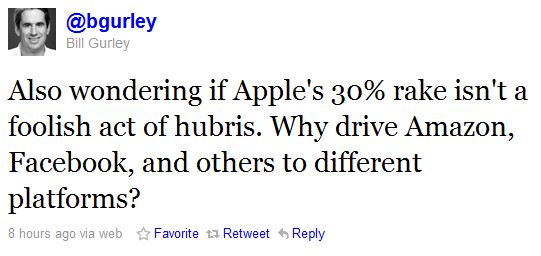 Indeed, why would Apple be so foolish? Of course, some critics will cry “monopoly!” and claim that Apple’s “act of hubris” was simply a logical move by a platform monopolist to exploit its supposedly dominant position in the mobile OS / app store marketplace. But what then are we to make of Amazon’s big announcement yesterday that it was jumping in the ring with its new app store for Android? And what are we to make of the fact that Google immediately responded to Apple’s 30% announcement by offering publishers a more reasonable 10%-of-the-cut deal? And, as Gurley notes, you can’t forget about Facebook. Who knows what they have up their sleeve next. They’ve denied any interest in marketing their own phone and, at least so far, have not announced any intention to offer a competing app store, but why would they need to? Their platform can integrate apps directly into it! Oh, and don’t forget that there’s a little company called Microsoft out there still trying to stake its claim to a patch of land in the mobile OS landscape. Oh, and have you visited the HP-Palm development center lately? Some very interesting things going on there that we shouldn’t ignore.
What these developments illustrate is a point that I have constantly reiterated here: Continue reading →
I want to thank Tim Wu for continuing to engage in a discussion here about his book, The Master Switch, with his various comments to my ongoing rants. After pouring out about 15,000 words over the past 4 days, I suspect I’m beginning to sound a bit like his cyber-stalker! I feel a bit bad about this because I really do like Tim a lot and find him to be one of the all-around coolest and most laid-back guys in the Net policy business. But, as I’ve noted in my ongoing series [see parts 1, 2, 3, & 4], we have profoundly different worldviews when it comes to information history and policy. And some of the recent comments he made to my 3rd post deserve a serious response.
In one of those comments he asks, “The question, then, is how you get, essentially, limited, controlled government in regulatory affairs; how you duplicate, in some sense, the limits imposed on other dangerous gov’t functions like the army. I don’t think this is having things both ways; I think this is trying to learn from what has gone wrong in the past.” In the other, he says: “The question I’m asking in the end of the book is whether we can do better; try to have rules against the worse forms abuse without a creeping regulation that turns into capture. I suspect you think that’s impossible, but I don’t.”
So, here’s my response (and I’m making it a new, dedicated post here instead of just a comment in an old thread because I feel we are getting to the heart of the difference between cyber-libertarians (like myself) and cyber-collectivists (or whatever Tim would call himself). Continue reading →
I was just digging through some old files and came across a quote that I found entertaining. Back in 2003, when he was still president and chief operating officer of Viacom, Mel Karmazin said with reference to Microsoft, AOL-Time Warner, and Comcast: “I can’t imagine being a competitor with any of these guys.” At the time, some media worrywarts made great hay of Mel’s quip and claimed, as Gene Kimmelman of Consumers Union argued at the time, that it proved how “Media moguls themselves admit their desire to avoid real competition within their industry.”
Utter rubbish. In fact, just six years after Karmazin spoke those words, Microsoft finds itself in a heated war with Google on all fronts, AOL-Time Warner has crumbled (even Time Warner Cable and Time Warner Entertainment got divorced!), and Comcast is now squaring off against telco and online video competitors that were unfathomable at the time (not to mention traditional satellite TV competitors.) In the meanwhile, Karmazin abandoned Viacom and today, as CEO of Sirius XM, is struggling to find a way to make the satellite radio universe survive the ongoing digital music bloodbath thanks to unforeseen competition from online music services and a little thing called the iPod!
It’s proof positive that media markets and digital technologies
always evolve faster than most people — even smart industry titans like Karmazin — anticipate.
In a week in which neutrality regulation is making a lot of news, I hope that Robert Hahn and Hal Singer’s terrific new study, “Why the iPhone Won’t Last Forever and What the Government Should Do to Promote its Successor” gets some attention. It provides a wonderful overview of how dynamically competitive the mobile marketplace has been over the past two decades and why critics are wrong to get worked up about the short-term “dominance” of Apple’s iPhone. Here’s the abstract of their paper:
Because of the overwhelming, positive response to the iPhone as compared to other smart phones, exclusive agreements between handset makers and wireless carriers have come under increasing scrutiny by regulators and lawmakers. In this paper, we document the myriad revolutions that have occurred in the mobile handset market over the past twenty years. Although casual observers have often claimed that a particular innovation was here to stay, they commonly are proven wrong by unforeseen developments in this fast-changing marketplace. We argue that exclusive agreements can play an important role in helping to ensure that another must-have device will soon come along that will supplant the iPhone, and generate large benefits for consumers. These agreements, which encourage risk taking, increase choice, and frequently lower prices, should be applauded by the government. In contrast, government regulation that would require forced sharing of a successful break-through technology is likely to stifle innovation and hurt consumer welfare.
“New technologies often seemingly emerge from nowhere, but also frequently lose their luster quickly,” Hahn and Singer go on to argue. As evidence they cite the recent examples of Second Life and MySpace, which were hyped as potentially become dominant providers in their respective areas just a few years ago, but now are subjected to intense competition. “[T]he the mobile handset market is subject to these same disruptive forces,” they argue: Continue reading →
 I’m thrilled to hear that the Economist has just launched a new column about business, innovation and entrepreneurship in honor of Joseph Schumpeter (1883-1950), the brilliant Austrian economist who,
argued that innovation is at the heart of economic progress. It gives new businesses a chance to replace old ones, but it also dooms those new businesses to fail unless they can keep on innovating (or find a powerful government patron). In his most famous phrase he likened capitalism to a “perennial gale of creative destruction”.
For Schumpeter the people who kept this gale blowing were entrepreneurs. He was responsible for popularising the word itself, and for identifying the entrepreneur’s central function: of moving resources, however painfully, to areas where they can be used more productively. But he also recognised that big businesses can be as innovative as small ones, and that entrepreneurs can arise from middle management as well as college dorm-rooms.
Schumpeter’s work on the dynamism of high-tech markets (later married with Clayton Christensen‘s concept of “disruptive innovation“) is one of the most persistent themes across cyber-libertarian thinking of all stripes on a wide variety of issues. You can listen to an interview with the new column’s author on the Economist podcast here (MP3). One important point the author makes is that Schumpeter realized that celebrating capitalism did not preclude criticizing individual capitalists when justified and vice versa—something all too often forgotten today.

 The Technology Liberation Front is the tech policy blog dedicated to keeping politicians' hands off the 'net and everything else related to technology.