Posts tagged as:

The Entertainment Software Association, which represents the video game industry, has just released its latest “Essential Facts about the Computer and Video Game Industry” publication.  It’s a handy annual resource that I always look forward to reading. There are many interesting facts and figures found in the report, but here a few worth calling out from the data they have aggregated:

  • 93% of the time parents are present at the time games are purchased or rented
  • 64% of parents believe games are a positive part of their children’s lives
  • 86% of the time children receive their parents’ permission before purchasing or renting a game
  • 48% of parents play computer and video games with their children at least weekly
  • 97% of parents report always or sometimes monitoring the games their children play
  • 76% of parents believe that the parental controls available in all new video game consoles are useful

The survey also bolsters the findings of many other polls and reports which have found that parents employ a variety of what I have labeled “household media rules” to monitor or control their children’s media consumption: Continue reading →

Note to Washington regulators and would-be censors… Don’t look now but parenting is happening!  Yes, it really is true: Parents are parenting. That’s the result of this new survey by Yahoo & Ipsos OTX.  Please pardon my snarky-ness, but I’ve been going at it for years with mobs of people here in DC who think that all parents are asleep at the wheel and kids are heading straight for the moral abyss. It’s a bunch of bunk, as I’ve pointed out here before. This new Yahoo!/Ipsos survey illustrates that, once again, parents are monitoring what their kids are up to online and taking an active role in mentoring them about web use:

  • 78% of parents are concerned about their children’s online safety.
  • 70% of parents talk to their children about online safety at least 2-3 times a year; 45% talk to their children at least once a month.
  • 74% of parents are connected to their children’s profiles on social networking sites.
  • 71% of parents have taken at least one action to manage their children’s use of the Internet or cell phones such as: Check to see where children are searching online; Set time limits for children’s use of computers or cell phones; Set parental controls on video sites; Use filters to limit where children go on the Web.

These results are consistent with what I have found and described in my ongoing PFF special report, Parental Controls & Online Child Protection: A Survey of Tools and Methods.  Obviously, many parents utilize the growing diversity of parental control technologies that are at their disposal to better control/monitor their children’s online activities/interactions. But what’s really impressive (and far more important) is that so many surveys and studies continue to show that the vast majority of parents utilize a variety of household “media consumption rules” as a substitute for, or compliment to, parental control technologies. Continue reading →

The Online Safety and Technology Working Group (OSTWG) has just released its final report to Congress entitled, “Youth Safety on a Living Internet.”  As I mentioned here last year, this government task force was established by the “Protecting Children in the 21st Century Act,” (part of the ‘‘Broadband Data Improvement Act’,’ Pub. L. No. 110-385) and its mission was to review and evaluate:

  • The status of industry efforts to promote online safety through educational efforts, parental control technology, blocking and filtering software, age-appropriate labels for content or other technologies or initiatives designed to promote a safe online environment for children;
  • The status of industry efforts to promote online safety among providers of electronic communications services and remote computing services by reporting apparent child pornography, including any obstacles to such reporting;
  • The practices of electronic communications service providers and remote computing service providers related to record retention in connection with crimes against children; and,
  • The development of technologies to help parents shield their children from inappropriate material on the Internet.

The task force included over 30 experts from academia, industry, advocacy groups, and think tanks. It was my great honor to be a member of OSTWG and to serve as the chair of 1 of the 4 subcommittees. The four subcommittees addressed: data retention, child pornography reporting, educational efforts, and parental controls technologies. I chaired that last subcommittee on parental controls.

Our conclusions will not be surprising to those who have read previous online safety task force reports, which I have summarized in 2009 white paper, “Five Online Safety Task Forces Agree: Education, Empowerment & Self-Regulation Are the Answer.”  Generally speaking, we concluded that there is no silver-bullet technical solution to online child safety concerns. Instead – and again in agreement with previous research and task force reports – we have concluded that a diverse toolbox and a “layered approach” must be brought to bear on these problems and concerns. Here’s how we put it in the report:

Continue reading →

By Berin Szoka & Adam Thierer

This morning, The Progress & Freedom Foundation (PFF) and the Electronic Frontier Foundation (EFF) filed joint comments with the Federal Communications Commission (FCC) in the inquiry “Empowering Parents and Protecting Children in an Evolving Media Landscape.” (MB Docket No. 09-194)  As Adam summarized here before, the stated purpose of this FCC Notice of Inquiry is to:

seek information on the extent to which children are using electronic media today, the benefits and risks these technologies bring for children, and the ways in which parents, teachers, and children can help reap the benefits while minimizing the risks [and] to gather data and recommendations from experts, industry, and parents that will enable us to identify actions that all stakeholders can take to enable parents and children to navigate this promising electronic media landscape safely and successfully.

In our joint comments with Lee Tien and Seth David Schoen of EFF, we warned that the FCC should tread carefully when considering taking action on areas described in their inquiry. The agency simply has no authority to act on many of the topics discussed throughout the NOI, and it should not attempt to preempt successful private sector solutions. Congress never authorized the Commission to regulate Internet media, nor asked the agency to consider doing so.  In fact, Congress plainly declared that the Internet should be kept “unfettered by Federal or State regulation.” Continue reading →

Rep. Bart Stupak, (D-MI) recently introduced the ‘‘Online Age Verification and Child Safety Act’’ (H.R. 4059), which would require mandatory online age verification for “any pornographic website accessible by any computer located within the United States to display any pornographic material, including free content that may be available prior to the purchase of a subscription or product.”  The measure does not specify how such verification is to be administered, saying only that “any website or online service” must “establish and maintain a system of internal policies, procedures and controls to ensure that no such material is displayed to any user attempting to access their site without first verifying that the user is 18 years or older.”

In essence, the Stupak bill is the “Son of COPA,” or the Child Online Protection Act of 1998, a law that has been constitutionally tested and come up short during an epic, decade-long legal battle in which it was made clear that mandatory age verification is unwise, unworkable, and unconstitutional under the First Amendment.

COPA sought to make it a crime for someone to “knowingly” place materials online that were “harmful to minors.” The law provided an affirmative defense from prosecution, however, to those parties who made a “good faith” effort to “restrict[ ] access by minors to material that is harmful to minors” using credit cards or age verification schemes. COPA was immediately challenge, however, and a 10-year court battle ensued.  The law was blocked by lower courts because it was too sweeping in effect and because courts held that there were other “less restrictive means” that parents could use to deal with objectionable content — such as Internet filters.

COPA’s decade-long legal battle finally concluded in January 2009 when the U.S. Supreme Court refused to revisit the law.  COPA had already been reviewed by the Supreme Court twice before — in 2002 and 2004.  Thus, a third visit to the Supreme Court by COPA would have been something of a historical development in the world of First Amendment jurisprudence. But with the Supreme Court’s rejection of the government’s appeal in January, lower court rulings stood and COPA remained unconstitutional and unenforceable. The key recent legal battle occurred in the Third Circuit Court of Appeals, which upheld a lower court ruling striking down COPA. The Third Circuit’s full decision is here. And I penned a 3-part series on the lower court ruling by Judge Lowell Reed Jr., senior judge of the U.S. District Court for the Eastern District of Pennsylvania, here, here, and here. Also make sure to check out this summary of COPA’s legal journey that Alex Harris penned last November.

Many, many times here before I have documented my serious ongoing reservations about mandatory age verification.  [In particular, see this lengthy white paper and this event transcript for all the details.]  Moreover, as I pointed out in a recent PFF white paper (“Five Online Safety Task Forces Agree: Education, Empowerment & Self-Regulation Are the Answer“), every major online safety task force that has studied the possibility of mandatory age verification for the Internet has come to the same conclusion: It won’t work, it’s unconstitutional, and it raises serious privacy concerns. Down below the fold I have pulled some of the relevant language from the five online safety task forces that have met since 2000 and considered this issue.  Continue reading →
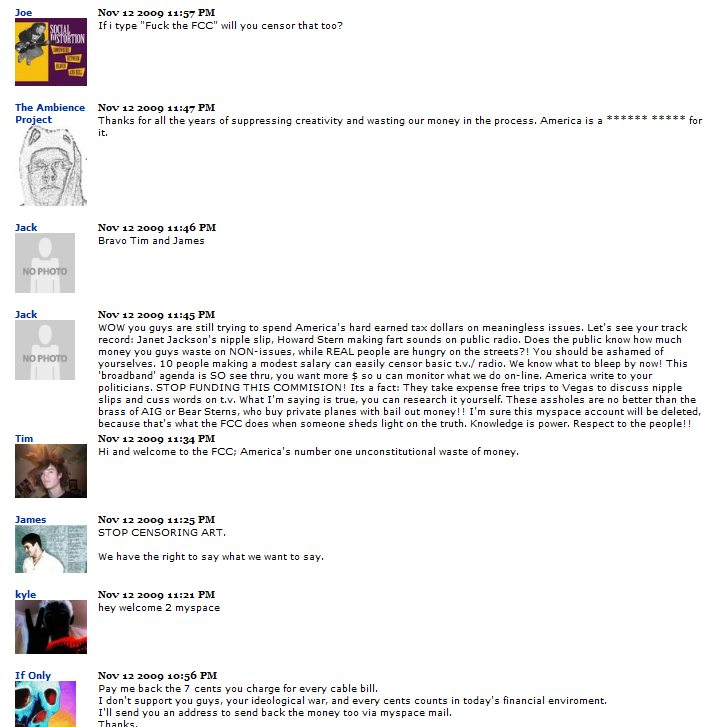
Oh my.  So today, as part of its ongoing effort to look like the hip new regulatory agency on the block, the Federal Communications Commission decided to launch a MySpace page.    Really. Big. Mistake.

I mean, shouldn’t someone over there have known it would take about 2 milliseconds for various cranks to launch into profanity-laced rants that would make George Carlin blush? Sure enough, the page is already littered with some of the most colorful language you’ll ever lay your eyes on, mixed in with some 9/11 conspiracy theories, a plug for the Marijuana Policy Posse, and something about the FCC “build[ing] a cone of terror in [our] homes.”

Go check it out, but avert the children’s eyes first. It ain’t pretty. Which begs the question: Will the FCC apply its  Pacifica indecency standard to its own MySpace page?  Seems like their site is pretty “pervasive” to me, and there could be “children in the viewing audience.”  Time to censor these “fleeting expletives” on the FCC’s MySpace page!

MySpace FCC rants

On Friday, the Federal Communications Commission (FCC) released a new Notice of Inquiry entitled, “Empowering Parents and Protecting Children in an Evolving Media Landscape” (MB Docket No. 09-194).  The purpose of this investigation is to:

seek information on the extent to which children are using electronic media today, the benefits and risks these technologies bring for children, and the ways in which parents, teachers, and children can help reap the benefits while minimizing the risks. (p. 2)… Our goal with this NOI is to gather data and recommend-ations from experts, industry, and parents that will enable us to identify actions that all stakeholders can take to enable parents and children to navigate this promising electronic media landscape safely and successfully. (p. 3)

This Notice builds on the FCC’s August 31st Report to Congress (“Implementation of the Child Safe Viewing Act; Examination of Parental Control Technologies for Video or Audio Programming”) that was required pursuant to the “Child Safe Viewing Act of 2007,” which Congress passed last year and President Bush signed last December. The goal of that bill and the FCC’s proceeding (MB Docket No. 09-26) was to study “advanced blocking technologies” that “may be appropriate across a wide variety of distribution platforms, including wired, wireless, and Internet platforms.” [I filed 150+ pages worth of comments in that proceeding, and here’s my analysis of why the bill and the FCC’s proceedings are worth monitoring. In previous posts here, I also listed all the major filings and reply comments that were submitted to the FCC in the matter.]

While the FCC’s new Notice outlines several positive impacts that media use may have for children, it then goes on to itemize a variety of concerns about media exposure: Continue reading →

“Schools in Beijing are quietly removing the Green Dam filter, which was required for all school computers in July, due to complaints over problems with the software,” notes this Reuters report. Even though China backed down on their earlier requirement to have the Green Dam filter installed on all computers, according to Reuters “schools were still ordered by the Ministry of Industry and Information Technology to install the web filter, which Chinese officials said would block pornography and other unhealthy content.”  The Reuters article mentions a notice carried on the home page of one Beijing high school that reads: “We will remove all Green Dam software from computers in the school as it has strong conflicts with teaching software we need for normal work.”  The article also cites a school technology director, who confirmed that the software had been taken off most computers, as saying “It has seriously influenced our normal work.”

Ironically, many educators and librarians in the United States can sympathize since they currently live under similar requirements.  Under the Children’s Internet Protection Act (CIPA) of 2000, publicly funded schools and libraries must implement a mandatory filtering scheme or run the risk of losing their funding. As the Federal Communications Commission summarizes:

[CIPA] imposes certain types of requirements on any school or library that receives funding for Internet access or internal connections from the E-rate program… Schools and libraries subject to CIPA may not receive the discounts offered by the E-rate program unless they certify that they have an Internet safety policy and technology protection measures in place. An Internet safety policy must include technology protection measures to block or filter Internet access to pictures that are: (a) are obscene, (b) child pornography, or (c) harmful to minors (for computers that are accessed by minors).

Of course, nobody wants kids viewing porn in schools, but CIPA has been know the block far more than that and has become a real pain for many educators, librarians, and school administrators who have to occasionally get around these filters to teach their students about legitimate subjects. Anyway, I just find it ironic that some American lawmakers have been making a beef about mandatory Internet filtering by the Chinese when we have our own mandatory filtering regime right here in the states. For example, Continue reading →

GI JoeSometimes the most revealing conversations about policy issues happen with our loved ones at the breakfast table. Although loyal TLF readers may remember my partner Michael as my “Posterboy for Advertising’s Pro-Consumer Quid Pro Quo,” he doesn’t usually get into the policy issues I cover.  But this morning, we fell into a conversation about the bitterly contentious issue of marketing to kids:

Michael: Growing up in South Korea, on a military base, we didn’t have any commercials on television. We had three channels and all they showed was public service announcements.

Sounds like paradise for anti-advertising zealots like Jeff Chester and the media reformistas who want to re-create the old media scarcity in the name of “media democracy“! Anyway:

We moved back to the U.S. when I was nine, and suddenly, during all my favorite cartoons, there were ads for toys. It was exciting—and more than a little bit overwhelming! It wasn’t just that I wanted these toys; it was that felt this incredible sense of urgency: I thought we had to go get the toys right now or they’d be gone! What did Rousseau call his innocent man, the Noble Savage? That’s what we were: The noble savage, coming into this world of sophisticated toy advertisements. But it didn’t take long for me to get over this initial bewilderment. My parents explained to me that we didn’t really have to go to the store  right away. (They also explained to me that I couldn’t haggle with the staff at Toys ‘R Us the same way I’d haggled with street vendors back in Korea—something that utterly mystified the staff.) After one trip to Toys Toys ‘R Us, I got the toys I wanted most and, over the next few months, realized that they weren’t anywhere near as exciting as I had imagined. After that, I enjoyed the toy ads on TV, but I lost interest in many of the toys I already had, preferring to create my own toys or play outside.

I explained that advertising of toys to kids has long been the cause celebre of anti-advertising crusaders:

Michael: But kids are acquisitive, too! How are they supposed to know about the latest toys if you can’t advertise to them? And what’s the big deal, anyway? I got used to toy ads and I think most kids would, too. The thing that’s different is incentive programs at stores.

Continue reading →

On July 27th, The Progress & Freedom Foundation hosted a Capitol Hill panel discussion entitled “Online Child Safety, Privacy, and Free Speech: An Overview of Challenges in Congress & the States.” The event featured remarks from:

  • Parry Aftab, Executive Director, WiredSafety.org
  • Todd Haiken, Senior Manager of Policy, Common Sense Media
  • Jim Halpert, Partner, DLA Piper
  • Berin Szoka, Senior Fellow, The Progress & Freedom Foundation

We’ve just released the transcript of the event, which I have also pasted down below the fold in a Scribd document reader. Also, the audio for this event can be heard by clicking below:

Download mp3

Here is the full event description: Continue reading →