“Please note that participation in the grant proposal effort does not constitute a commitment by your jurisdiction to be REAL ID compliant.”
That’s an assurance the heads of the American Association of Motor Vehicle Administrators give to state DMV bureaucrats in a January 14 letter asking them to participate in a grant proposal for REAL ID implementation money.
This means that motor vehicle bureacrats in states that have categorically refused to participate in the national ID system may go ahead and build it anyway, thanks to AAMVA and “free” federal money.
Then they will wait around for the political alignments to change. They may not even wait, as they’ve trained up to lobby for it.
Your tax dollars at work.
It’s amazing the pernicious nonsense you can find over at NRO:
My understanding, from talking to experts like Andy McCarthy is that if FISA is not reformed, our entire ability to monitor foreign communications — which makes up about 95 percent of what NSA does and probably 50 or more percent of what CIA and DIA do — will be compromised. Which is why my senior administration official said today: “There’s no reason in the world [Congress] shouldn’t stay here and get it done” … “now.”
This is so amazingly off-base that it’s hard to know where to begin. Well, let me just give you a list:
- FISA has never governed, and does not currently impact, eavesdropping activities that occur overseas.
- FISA has never governed the interception of wireless communications, even if it occurs in the United States.
- “Authorizations” under the PAA don’t expire with the sunsetting of the PAA. Any programs “authorized” by the administration over the last six months will continue to be legal until at least August
- After the PAA expires, the NSA will still be able to seek warrants from the FISA court for eavesdropping activities that aren’t covered by existing “authorizations.”
- The only reason FISA hasn’t been “reformed” is because the president has threatened to veto reform legislation passed by the House in November in order to hold out for retroactive telco amnesty.
- The president, who is supposedly so concerned about losing the ability to eavesdrop on terrorists, actually threatened to veto legislation extending the PAA in order to increase the pressure for amnesty.
I’m not sure what business Kathryn Jean Lopez thinks she’s in, but dispensing warmed-over White House talking points certainly ain’t journalism.
The Department of Homeland Security will increase document checks at the border starting Friday. The costs of doing this outweigh the miniscule security benefits, as I discuss in today’s Detroit News.
A great piece by Dahlia Lithwick on the allegedly ticking terrorist time bomb:
It’s true enough that FISA requires a sober update to account for technological changes since it was drafted in 1978, but the PAA wasn’t sober and it wasn’t justified. Now we must also contend with the added insult of the president’s demand for telecom immunity for the companies that allegedly helped him illegally spy on Americans. Hmmm. Don’t punish phone companies for believing our lies almost sounds plausible, so long as the Bush administration remains on the hook for peddling those lies. But that’s not what the White House wants—it wants telecom immunity, plus more government secrecy, plus no oversight. Sens. Feinstein and Feingold, and others, are pushing for amendments that would keep us safe while preventing the Bush administration from slinking away from its surveillance activities.
Congressional Democrats are in peril of being hoodwinked again in two weeks as they were last August; not by rational argument or even by the parliamentary electric slide, but by their congenital inability to act any time the White House invokes the terrorist alarm clock. If ever there was a game of chicken Democrats can win, this is it: Let’s put the fictions of the convenient-sounding emergency-producing timers to rest. Be it the terrorist alarm clock that justifies illegal surveillance or the “ticking time bombs” that justify illegal torture, the only clock that matters now is the one counting down to a return to the rule of law.
Quite so. For seven years the Democrats have pursued a strategy that amounts to “let’s give the president everything he wants on national security and then he’ll stop picking on us.” Strangely enough, it hasn’t worked. Every Democratic retreat has emboldened the White House to push for more. Every time the Democrats try to meet the president halfway he moves the goal posts.
The president has now staked out a position that, in a sane world, be a PR disaster: “give the telcos retroactive immunity or I’ll veto vital anti-terrorism legislation.” If the Democrats won’t call that bluff, is there
anything the president could demand that would cause them to say no?
When I’ve seen “Free Public Wi-Fi” ad-hoc networks, I always assumed that it was some kind of honey pot. But it turns out that Occam’s Razor applies: it’s just Windows being retarded:
It appears to be a manifestation of a feature of Windows that I wrote about earlier this year. When Windows connects to a network, it retains that network’s name, or SSID, then broadcasts its as an ad hoc network, essentially inviting a connection. You can find more details here. Microsoft has said it will fix this in the next XP service pack; it’s unclear if Windows Vista behaves this way.
So why do you see so many of these? My theory: It’s viral, but not a virus!
What’s the thing almost everyone wants to find when they open a WiFi-enabled notebook and search for a connection? Why, free public WiFi! If you see that — and you don’t know any better — you connect to it.
Wonderful. I’ll refrain from making any smug Mac fanboy comments.
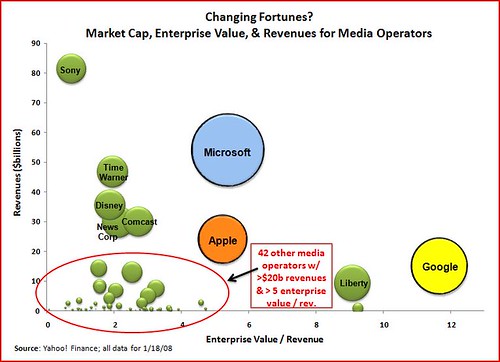
“How many old media companies would you need to stack on top of one another to equal the value of Google?” That question was put to me last year by a reporter who was interviewing me for a story he was doing about the future of traditional media operators. I was explaining to him how many traditional media operators faced three ominous developments / threats that raised serious questions about their long-term viability: (1) Loss of consumer confidence / allegiance; (2) loss of advertiser confidence / allegiance; and, (3) loss of investor confidence / allegiance as a result of trends (1) & (2).
That first threat or trend was discussed in installments #1 and #2 of my ongoing “Media Metrics” series. Those essays documented the explosion of choices in the media marketplace and showed how many consumers are opting for new media and technology options over older media outlets and options. Installment #3 in the series documented the seismic shifts underway in the advertising marketplace, with ad dollars rapidly flowing away traditional media operators and toward new media and technology providers. Here in installment #4, I will discuss how traditional media operators and new media / technology operators are trading places in terms of investor confidence.
Exhibit 1
Continue reading →
My Cato colleague (and sometime Center for Freedom and Prosperity doyenne) Dan Mitchell caught me coming off the elevator the other day and told me he didn’t believe my recent post about Bull’s Blood and Estonian singing.
“What, you think I made up a trip to Eger, Hungary?”
“No, I don’t believe you had a girlfriend.”
The best way I can think of to get him back is not insults in kind. It’s merely to put his presentation skills and humor on display for all the world to see. Next to Dan, the Laffer curve is actually interesting!
http://www.youtube.com/v/fIqyCpCPrvU&rel=1
Obama snags the crucial xkcd endorsement. And for good reasons. I was rooting for Bill Richardson, but with him out of the race Obama’s probably the least-bad option on the Democratic side. And he’s got smart, tech-savvy lefties like Larry Lessig and Tim Wu on his side. It would be cool if they wound up as senior tech policy advisors in an Obama administration.
Update: And while I’m fantasizing about competent presidential advisors, let me second the suggestion that Bruce Schneier running DHS would be amazing. He might actually re-focus the bureaucracy on activities that actually make us safer, instead of confiscating shaving cream and patting down little old ladies.
You might have seen Roger Pilon’s recent op-ed defending the Bush administration’s stance in the FISA debate. As you might imagine, I have a somewhat different take on the issue, as I discuss at the Cato blog:
The dispute is over what safeguards are appropriate to ensure that the intelligence community’s surveillance activities here in the United States are limited to genuine foreign intelligence. Roger’s position appears to be that neither the courts nor Congress may place any restrictions on domestic surveillance activities that the president declares to be related to foreign intelligence gathering. But that’s not good enough. Without judicial oversight, there is no way to know if the executive branch is properly limiting its activities to spies and terrorists, or if they’ve begun to invade the privacy of petty criminals or even law-abiding individuals. This is no hypothetical scenario. The FBI conducted extensive surveillance of Martin Luther King Jr. and other civil rights and anti-war leaders in the 1960s and 1970s, which was one of the reasons Congress enacted new safeguards in the first place…
In short, FISA gave the intelligence community plenty of flexibility to perform the domestic wiretaps they needed to keep Americans safe. But crucially, the government had to tell the court who it was spying on, so that the court could verify that the law was being followed. That’s an important safeguard that ensures that the president doesn’t exceed his constitutional authority and encroach on the privacy of law-abiding citizens. The Protect America Act severely crippled that protection, and it would be a serious mistake for Congress to make the damage permanent.
Julian has a much more thorough and harsher critique of Roger’s piece, amusingly titled “Rogering the Constitution.” One of the interesting statistics that Julian pointed out to me is that the FISA court had never rejected an application until 2003, and through the end of 2006 had rejected a grand total of 5 applications out of more than 20,000 it has reviewed. The idea that this is some kind of intolerable “micromanagement” of government surveillance strikes me as kind of implausible.
Tim’s thoughtful analysis of the slow adoption of the IPv6 protocol turned my mind to a long-standing topic of interest: the illusory value of elegance in technology. A corollary: In technology, as in life, revolutions are rightly rare and usually only visible in hindsight.
The IPv6 transition is a good example of the difference between policy and implementation. This transition raises all sorts of broad policy issues, given its potential costs and the potential for disruption. For certain kinds of network applications, carefully tuned to use existing Internet infrastructure, the transition will be difficult and costly. In some cases, things may just stop working. At the least, those who work on Internet applications and infrastructure will have to learn all the minute details of the new system and its implementation, a surprisingly deep pool of knowledge, while their IPv4 experience fades into irrelevance. These are no small things.
When naive engineers (and those who think like them) drive policy, their recommendations are often to scrap existing systems and start anew with something that’s more elegant that eliminates “cruft” and the like. It’s a fun engineering task to go back to first principles and start over with what we know now that we may not have known when creating earlier standards. It is a rewarding intellectual exercise.
But “muddling through,” as in other domains, is often the best choice in tech policy.
Continue reading →

 The Technology Liberation Front is the tech policy blog dedicated to keeping politicians' hands off the 'net and everything else related to technology.