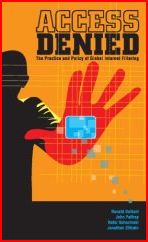
 I previously mentioned the excellent new book, “Access Denied: The Practice and Policy of Global Internet Filtering,” which is edited by Ronald J. Deibert, John G. Palfrey, Rafal Rohozinski, and Jonathan Zittrain. It is a comprehensive survey of the methods governments are using to stifle online expression. The contributors provide a regional and country-by-country overview of the global state of online speech controls and discuss the long-term ramifications of increasing government filtering of online networks.
Business Week has just posted an interview with one of the editors of the book, John Palfrey, executive director of the Harvard Law School’s Berkman Center for Internet & Society. John provides a nice overview of the major themes and issues covered in the book. But make sure you pick up the entire volume. It’s an important resource to have on your bookshelf.
PFF has just releasing an updated edition of my booklet on “Parental Controls and Online Child Protection: A Survey of Tools & Methods.” The new version, Version 3.0, includes two new appendixes and updates to each section to reflect new parental control tools and programs developed in the last nine months.

The updated report is timely as it comes on the heels of the recently-announced Internet Safety Technical Task Force, which is being chaired by the Berkman Center for Internet & Society at Harvard Law School. I am privileged to serve as a member of the Task Force, which is evaluating various online safety technologies and strategies and then reporting back to state attorneys general with our findings.
Those issues and much more are covered in the latest edition of my report. The report explores the market for parental control tools, rating schemes, education efforts, and initiatives aimed at promoting online child safety. I believe that the parental controls and content management tools cataloged in the report represent a better, less restrictive alternative to government regulation. As I conclude after evaluating that state of the market: “There has never been a time in our nation’s history when parents have had more tools and methods at their disposal to help them decide what constitutes acceptable media content in their homes and in the lives of their children.”
Version 3.0 of the special report, now over 200 pages, contains over fifty exhibits and numerous updates in all five sections of the book. Major updates have been made to the Internet, social networking, and mobile media sections, reflecting the growing importance of those sectors and issues. A greatly expanded section on video empowerment technologies has also been included. Finally, two appendices have also been added: a comprehensive legislative index cataloging over thirty bills introduced in Congress on these issues (complied with John Morris of Center for Democracy & Technology), and a glossary of 35 relevant terms and cases.
The report is available free-of-charge on the PFF website, as are the previous editions. And I am happy to provide hard copies to those who are interested.
http://documents.scribd.com/ScribdViewer.swf?document_id=2887320&access_key=key-um5xjvf98bfnuu8811v&page=&version=1&auto_size=true
Julian has a great piece in the American Spectator reminding conservatives that they used to care about civil liberties:
After the humiliations of Watergate, however, conservative legal thinkers began to insist that Congress and the courts had overstepped their bounds. During the Reagan administration, the Heritage Foundation began urging repeal of the Foreign Intelligence Surveillance Act, which had been passed in 1978 as a result of the Church Committee’s findings.
The campaign stalled due in large part not to the hand wringing of civil libertarians but to the opposition of the intelligence community. “We hear people say we can’t get the surveillance we need or can’t meet the court’s standard,” said Edward O’Malley, who headed the FBI’s intelligence division under President Reagan. “That’s just not true. We have no problem getting the surveillance we need, and the court also has protected the rights of Americans, which is necessary. … We support this 100 percent.”
There were then, as there are now, exceptions on the right. The FISA law — now damned by conservatives as an impossibly burdensome, possibly even unconstitutional obstacle to legitimate executive surveillance — was opposed by the New York Times’s designated conservative columnist William Safire, who feared that it would “turn every telephone instrument in every home into a suspected household spy.”
Acknowledging conservatives “natural inclination to help the law,” Safire nevertheless urged that it be trumped by “a responsibility to protect the law-abiding individual from the power of government to intrude.” By then, however, he was probably in the minority among right wingers.
I’m heading off to the Tech Policy Summit shortly. It’s taking place from Wed-Friday out in LA. Very impressive agenda of speakers and topics, ranging from privacy law, copyright policy, child safety, broadband and spectrum issues, and international competitiveness. I am speaking on a panel on day 2 of the event, but I might try to do some live blogging out there if I have the time.
 I’ve been meaning to plug this here for a while and this week seems like the perfect time. Cord Blomquist and I have been producing a podcast called In Conversation that might be up your alley. We bill it as a weekly show for nerds and while it’s not focused on tech policy, we talk a lot of tech and other related geekery.
In this week’s episode we’re joined by another TLF contributor, Tim Lee, and we discuss the sneaky Safari update for Windows, whether the stimulus payment is a welfare check, Twitter and other low-intensity and low-cost web technologies, Cord’s mystery conference, FriendFeed vs. Facebook and open vs. closed, the viability of Mahalo.com, Clay Shirky’s new book Here Comes Everybody, distributed campaign phone banks (really amazing), and hipster hating.
I hope you’ll give it a listen, and if you like it you can subscribe in iTunes or via RSS.
Jerry and Cord are weirdly bashful about tooting their own horns, but I’ve got no such reservations. I was honored to be the first-ever guest on Jerry Brito and Cord Blomquist’s critically-acclaimed In Conversation podcast. Check it out.
One of the books I had planned to review next was True Enough: Learning to Live in a Post-Fact Society by Salon tech & media blogger Farhad Manjoo. Manjoo argues that new communications technologies are loosening our culture’s grip on what people once called “objective reality.” Truth, he argues, is becoming a relative thing in a world of information overload.
But I’m not sure I need to review Manjoo’s book at all now since my comments would mostly repeat everything Steven Johnson had to say in his exchange with Manjoo on Slate last week. Here’s one clip from Johnson’s sharp response:
Saying that the Web amplifies deception is, to me, a bit like saying that New York is more dangerous than Baltimore because it has more murders. Yes, in absolute numbers, there are more untruths on the Web than we had in the heyday of print or mass media, but there are also more truths out there. We’ve seen that big, decentralized systems like open-source software and Wikipedia aren’t perfect, but over time they do trend toward more accuracy and stability. I think that will increasingly be the case as more and more of our news migrates to the Web.
That’s why I think it’s important to note that many of your key examples are dependent on old-style, top-down media distribution. You talk about the American public’s continuing belief in a connection between 9/11 and Saddam Hussein; the Swift Boat Veteran ads that distorted the truth of Kerry’s record; Lou Dobbs ranting on CNN. These are all distortions that speak to the power of the old mass-media model or the even older political model of the executive branch.
Anyway, read their entire exchange. I certainly think Johnson gets the better of it.
L-1 Identity Solutions is acquiring the ID Systems business of REAL ID supporter Digimarc.
Presumably, this will get Digimarc out of the national ID business – and the national ID advocacy business. We’ll see what L-1 does.
It is possible to make money with biometrics outside of a national ID infrastructure, of course. Indeed, it’s penny-wise and pound-foolish for folks in this industry to pursue the small, government-centered market REAL ID would create when there could be a big, diverse identity and credentialing marketplace.
I want to associate myself with Adam’s excellent comments about Jonathan Zittrain’s book. I haven’t read the book yet, so I won’t try to comment on the specifics of Zittrain’s argument, but it strikes me that if Adam is summarizing the book fairly, ZIttrain’s thesis is strikingly similar to the thesis of Larry Lessig’s Code: The open Internet is great, but if we don’t take action soon it will turn into a bad, proprietary, corporatized network. I’ve been mildly surprised at how little comment there’s been on how spectacularly wrong Lessig’s specific predictions in Code turned out to be. Lessig was absolutely convinced that a system of robust user authentication would put an end to the Internet’s free-wheeling, decentralized nature. Not only has that not happened, but I suspect that few would seriously defend Lessig’s specific prediction will come to pass.
But while Lessig’s specific prediction turned out to be wrong, the general thrust of his argument—that open systems are unstable and will implode unless managed just right—is alive and well. I think that basic claim is still wrong. And I think it’s not a coincidence that these kinds of critiques often come from the left-hand side of the political spectrum (I don’t actually know Zittrain’s politics, but Lessig is certainly a leftie). It seems to me that left-of-center techies are in a bit of an awkward position because on the one hand they’ve fallen in love with the open, decentralized architecture that is epitomized by the Internet, but are predisposed to criticize the open, decentralized economic system called the free market. As a result, they wind up taking the somewhat incongruous stance that to preserve the decentralized nature of our technological systems, we need to have more centralization of our economic and political system. Zittrain’s choice of the Manhattan Project as a metaphor for the way to preserve the Internet’s openness is particularly striking, because of course the Manhattan Project was the absolute antithesis of the philosophy behind TCP/IP. It was a hierarchical, secret, centrally planned effort that left no room for dissent, diversity or public scrutiny.
Continue reading →
As I noted in previous installments of this series, our government seems to have an increasingly hard time keeping tabs on sensitive data. Unfortunately, there’s been another incident on this front. The Washington Post reported this morning that:
“A government laptop computer containing sensitive medical information on 2,500 patients enrolled in a National Institutes of Health study was stolen in February, potentially exposing seven years’ worth of clinical trial data, including names, medical diagnoses and details of the patients’ heart scans. The information was not encrypted, in violation of the government’s data-security policy. NIH officials made no public comment about the theft and did not send letters notifying the affected patients of the breach until last Thursday — almost a month later. They said they hesitated because of concerns that they would provoke undue alarm.”
Undue alarm? Geez, I can’t imagine why! My friend Leslie Harris of CDT notes in story that, “The shocking part here is we now have personally identifiable information — name and age — linked to clinical data. If somebody does not want to share the fact that they’re in a clinical trial or the fact they’ve got a heart disease, this is very, very serious. The risk of identity theft and of revealing highly personal information about your health are closely linked here.”
But hey, we wouldn’t want to provoke “undue alarm” by telling those folks about the data breach! Pathetic. As I’ve pointed out before, if this happened in the private sector, trial lawyers would be salivating and lawsuits would be flying. By contrast, when the government loses personal information—information that his usually more sensitive than that which private actors collect—about the most that ever comes out of it is another GAO report calling for “more accountability.”
I can’t wait to see how well all our health care records are “secured” once we have socialized medicine in this country.

 The Technology Liberation Front is the tech policy blog dedicated to keeping politicians' hands off the 'net and everything else related to technology.