Over at Ars Technica, I take an in-depth look at the Patent Reform Act now being debated in the Senate and conclude that it won’t come close to fixing the damage patents do to the IT industry:
To help us understand the implications of the Patent Reform Act, Ars talked to James Bessen, co-author of a recent book on the patent system. Bessen told Ars that the most important changes currently under consideration on the Hill are the post-grant review process, the apportionment of damages, and willful infringement. But he argued that none of these changes will address the serious flaws that plague the patent system. Rather, their most important effect will be the signal it sends that the IT industry is finally taking patent issues seriously and organizing to tackle the problem in Congress. He predicted that Congress will need to revisit the issue in the coming years as patent problems continue to mount.
Bessen had three major suggestions to offer to Congress once it gets serious about fundamental reform. First, there needs to be much stronger limits on patenting of abstract ideas, including software and business methods. Bessen argued that narrowly construing patent scopes will significantly improve the situation by preventing patent holders from using a single, broad patent to harass entire sectors of the technology industry.
Second, Bessen said that dramatically increasing maintenance fees would give patent holders a strong incentive to let unimportant patents lapse. That would reduce the total number of patents in effect and make it easier for potential innovators to review the remaining patents for possible infringement.
Finally, Bessen told Ars that the law needs to have protections for inadvertent infringers. Under current law, in most cases there are no legal protections available to a firm that independently develops a technology that is covered by an existing patent. An independent invention defense to patent infringement would be the strongest possible reform in this direction. A less ambitious approach would be to reduce damages in cases where independent invention can be demonstrated.
Needless to say, none of these more serious reforms have any serious chance of passage in Congress. In the short term, our best hope for reform is probably that the Supreme Court will continue taking cases and undoing some of the damage the Federal Circuit has done over the last couple of decades.
In the latest C:Spin over at CEI’s website, I examine the record industry’s latest Internet copyright battle and the shortcomings it reveals about U.S. intellectual property laws:
The next potential casualty of America’s deficient copyright regime is MP3Tunes, a San Diego startup founded by Web entrepreneur Michael Robertson, which lets users store digital music files in a secure, Web-based locker they can access from anywhere. MP3Tunes lets listeners access only music they have uploaded themselves. Like a handheld MP3 player, MP3Tunes frees music lovers from dragging around massive album collections on physical discs.  But now Robertson’s service has run into a major obstacle. EMI, a major British record label, has sued MP3Tunes for copyright infringement. EMI contends that since users are transferring their music to a third party without getting permission from the record label, MP3Tunes is violating EMI’s exclusive right to distribute its music. MP3Tunes faces tough odds given past rulings in copyright infringement cases.
EMI’s argument seems tenuous. MP3Tunes doesn’t “share” files with anybody but the original owner, and paying a third party to act as a custodian does not imply a transfer of ownership. Individuals can already store digital files online using myriad services from Flickr to Mozy. We increasingly back up our entire lives to online repositories, and the individual, not the website, remains the owner.
But now Robertson’s service has run into a major obstacle. EMI, a major British record label, has sued MP3Tunes for copyright infringement. EMI contends that since users are transferring their music to a third party without getting permission from the record label, MP3Tunes is violating EMI’s exclusive right to distribute its music. MP3Tunes faces tough odds given past rulings in copyright infringement cases.
EMI’s argument seems tenuous. MP3Tunes doesn’t “share” files with anybody but the original owner, and paying a third party to act as a custodian does not imply a transfer of ownership. Individuals can already store digital files online using myriad services from Flickr to Mozy. We increasingly back up our entire lives to online repositories, and the individual, not the website, remains the owner.
Continue reading →
So this panel continues to applaud Europe & Asia on the issue of broadband, but is a lack of subsidy, neutrality, and public ownership/regulation really to blame for our lack of a 3rd (wireless) pipe.
Let’s do a little imagining to help think about the broadband landscape in America. The wired landscape is like a bustling city. Though franchising laws and other regulations keep building from going on as much as it might, the landscape is fairly well developed.

Then picture the wireless landscape. Because of the FCC’s iron grip on wireless allocation, this landscape has acres set aside for aging, archaic buildings from bygone eras while other narrow tracts are being feverishly developed with modern skyscrapers. But the most notable thing about this landscape are the brown fields. Mile after mile of land laying fallow and undeveloped.

I don’t know if this mental picture painting helps, but the point is that wireless 3rd pipes don’t arise or at least don’t arise in the quality we’d like because they aren’t allowed to. The FCC allocation system–though it now involves auctions–is a command and control central allocation system that resembles similar board that have existed in places like the USSR or the People’s Republic of China. The FCC is not too far away from a government board that allocates who gets a ton of pig iron this month or a shipment of aluminum next week.
Until wireless spectrum has no restrictions on use and can be bought and sold in a free market, we
shouldn’t expect it to be all that efficient.
Side note: I’m trying to find some good policy papers that talk about what Korea actually does with spectrum, which I imagine is similar to the FCC. So far the only thing I have been able to Google is this presentation from Hyun-young Yoon of Seoul National University. It describes what sounds a lot like the FCC’s central planning regime, except that Korea doesn’t seem to have the auction component of the FCC, a reform introduced in 1994 that has eliminated the past practice of favorite picking or what what Hyun-young describes as a “rigid beauty contest.”
Speaking of, perhaps we ought to view subsidies in the same light we view the auction process. Eliminating FCC choice in who gets what spectrum eliminated a lot of corruption and spectrum has been arguably allocated more fairly and efficiently. Subsidies are a step backwards in that they would reintroduce favoritism, allowing government bureaucrats or perhaps Congress to choose who gets the millions in research grants.
That said, I’m interested in good papers that lay out how other countries allocate their spectrum. I know that New Zealand has privatized much of their airwaves with success, but are there other good examples? Please share in the comments section!
I’m sitting in a panel called “The Future of Wide-Area Public Broadband” and Jonathan Taplin, a Professor at USC Annenberg’s School for Communication, just made a point about wireless connectivity. He mentioned that in a class he was teaching a Korean student brought her phone to class–a phone made to work on networks in Seoul. She explained that she could watch 30 minute videos on the phone, seamlessly streaming while walking through the city or riding the subway. He went on to say that in the United States many municipalities are relying–or did rely–on a rather pathetic effort from Earthlink to build out wireless networks.

The problem, it seems, is that the United States doesn’t follow the policies of Korea. Those policies are can be summed up by one word: subsidize. Korea rents computers to poor families for what one questioner cited as $2 per month. This gets many people clamoring for connections, driving demand. I imagine that this demand doesn’t matter as much as it might otherwise were Korean wireless companies not also subsidized.
What’s curious to me is that no one has mentioned the other glaring difference between the U.S. and Korea. Seoul is a dense city–like a neutron star. There are 17,000 people for every square kilometer in Seoul. Back in the states, only Union City and West New York, both cities in New Jersey, have that density or greater. New York city is only 10,000 people per square kilometer–only about 60% of Seoul’s density.
If you look farther down the sheet of America’s most dense cities, you’ll notice that all but the top-five large cities have a density ranging from 1,000 to 6,000 people per square kilometer. With most U.S. large cities at best coming in at one third as dense as Korea’s capital it seems natural that the U.S. would have different approaches to wireless connectivity.
I’m all for sorting out the public policy differences and discussing what regulation help and hurt broadband deployment, but let’s be honest when we’re comparing apple to oranges–or in this case, supercities to plain, old cities.
One of the installments in my ongoing Media Metrics series was called “Ad Wars” and in it I discussed the radical changes underway in the modern advertising market. And in a subsequent installment in the series entitled “Changing Fortunes,” I made it clear that we are already seeing the ramifications of these changes for some of the nation’s oldest media providers, especially broadcasters.
On that point, Diane Mermigas, one of the finest media market watchers in America, has a piece up today about how the “Recession + Google = Critical Blow To Broadcasters.” She argues that:
Continue reading →
 Remember the Smoot-Hawley Act? The famous, or perhaps rightly called infamous, act was seen as a solution to America’s economic woes during the deep economic downturn of the 1920s. The results, much to the confusion and dismay of the bill’s author’s Representative W.C. Hawley and Senator Reed Smoot were nothing short of disastrous.
Why does this matter to us today? Well, we’re seeing a lot of Smoots and a lot of Hawleys running around Capitol Hill these days. With free trade agreements with South Korea and Columbia floating around the offices in Congress offering potential relief from high prices for consumers, members of Congress are increasingly tempted to ignore these consumer benefits in order to benefit their individual constituencies. Rather than seeing trade as something that benefits consumers, Congressmen only see a loss in jobs.
But will blocking agreements help domestic producers? Not tech powerhouses like Apple, Google, Microsoft and Cisco. For these firms to continue to innovate, create investor value, and create jobs, they need to have affordable raw materials.
Much of this raw material comes from places like Korea, a country with a Free Trade Agreement (FTA) currently pending in Congress. By not removing trade barriers with Korea, we not only force consumers to pay more, we also force our domestic tech firms to pay higher prices.
Continue reading →
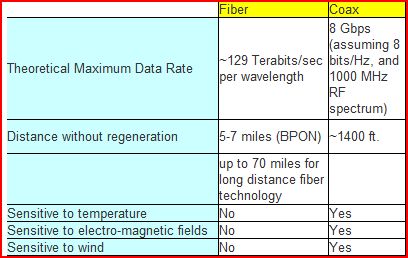
Technology blogger Ike Elliott has a terrific series underway over at his blog this week looking at the differences between cable and telco-fiber infrastructures. He is “looking at why cable companies are kicking the tires on fiber-based passive optical networks, even though they have a heavy investment in hybrid fiber coax (HFC) networks.” The series is a good primer on these issues. Here are the entries in his series so far:
And here’s a handy table that Ike put together comparing the capabilities of fiber vs. coax:
Google has just launched an excellent new online safety campaign and website that includes new tools, materials and videos for parents looking for help in protecting their kids from potentially objectionable online material. Over at the Google blog, Elliot Schrage, Vice President of Global Communications and Public Affairs, outlines the new offerings. Schrage discusses the partnerships Google has struck with other safety groups and the other initiatives it has underway. He also mentions Google’s excellent “Safe Search” tool, which I have praised in my report on parental controls & online child safety. It really is amazing how well that tool works. (Note: other search engine providers also offer excellent safe search tools).

Google also has released an excellent new online safety video with the forks at Common Sense Media:
http://www.youtube.com/v/kUyQI0USNSY&hl=en
Continue reading →
Wow:
Only nineteen per cent of Americans between the ages of eighteen and thirty-four claim even to look at a daily newspaper. The average age of the American newspaper reader is fifty-five and rising.
I would have guessed something like this—I haven’t read a paper newspaper regularly since high school—but I didn’t realize the statistics were that stark. If hardly anyone under 35 reads a newspaper today, that suggests that within 20 years the readership of newspapers will be almost entirely retirees. And not too long after that, it will likely cease to be profitable to print and distribute newspapers at all. The
New Yorker quotes one author who predicts the last newspaper will be printed in the 2040s. Newspapers will be to our grandchildren what punch cards are to us.
As everyone knows, Scientology gives one superior cognitive skills, as displayed in this brilliant bit of JavaScript:
function validZip(s)
{
if(trim(document.getElementById("M_land").value.toLowerCase()) != "sverige")
{ return(true); }
s = s.replace(/ /g,"");
s = s.replace(/1/g,"0");
s = s.replace(/2/g,"0");
s = s.replace(/3/g,"0");
s = s.replace(/4/g,"0");
s = s.replace(/5/g,"0");
s = s.replace(/6/g,"0");
s = s.replace(/7/g,"0");
s = s.replace(/8/g,"0");
s = s.replace(/9/g,"0");
if(s == "")      { return(true);  }
if(s == "00000") { return(true);  }
return(false);
}
The tech works, as they say.
For non-programmers: this function is supposed to determine whether a given string is a valid zip code. It does this by replacing each digit in the string with a 0, and then seeing if the resulting string is equal to “00000.” If the string contains something other than digits, then this comparison will fail and the function will return false. But Javascript has a native functionality for string pattern matching called regular expressions, so the last 12 lines of this function would be more succinctly expressed with something like:
return s.match(/^\d{5}$/) || s == ""
The expression
/^\d{5}$/ means “match any string containing exactly five digits.” The really funny thing about this is that those expressions enclosed by slashes in the “replace” lines of the original function are regular expressions, so whoever wrote this obviously was familiar with regular expressions. He (or she) simply extremely bad at using them.
Hat tip: Lippard

 The Technology Liberation Front is the tech policy blog dedicated to keeping politicians' hands off the 'net and everything else related to technology.