The Singing Revolution is now available on DVD.
Over at TVNewsday, Harry A. Jessell writes:
I don’t like the way the new FCC is shaping up. There’s something missing.
My concern has nothing to do with Julius Genachowski, whom the president has reportedly tapped for chairman….
What I’m having trouble with are the names popping up for the Republican seat….
All [the rumored candidates] work or used to work on Capitol Hill. They are basically experts on policymaking, crafting legislation and Washington politics, but not much else.
The seat is turning into a reward for loyalty and a test of whose boss has the most clout.
Bad idea.
As the professed champion of business, the Republicans should award the seat to a businessman or a businesswoman.
I’m talking about somebody who has actually done some hiring and firing, made a payroll in tough times, sweated a big sale, produced goods or services, acquired another company, got a loan to expand operations or survive a downturn and struggled to untangle and comply with federal regulations.
There’s a double standard here.
Ajit Pai, for example, who is one of the Republican candidates, is Deputy General Counsel of the FCC. He served as Chief Counsel of the U.S. Senate Judiciary Committee’s Subcommittee on the Constitution, Senior Counsel at the Office of Legal Policy at the U.S. Department of Justice, Deputy Chief Counsel of the U.S. Senate Judiciary Committee’s Subcommittee on Administrative Oversight and the Courts, an Honors Program trial attorney in the Telecommunications Task Force at the U.S. Department of Justice’s Antitrust Division and a law clerk to Judge Martin L.C. Feldman of the U.S. District Court for the Eastern District of Louisiana. He graduated with honors from Harvard College and from the University of Chicago Law School, where he was an editor of the University of Chicago Law Review.
I hate the term “cloud computing” because it denies the duties and responsibilities of network operators and software and database managers.
It’s like a George Carlin bit: “I didn’t breach the data. The cloud did it! It was out in the cloud! How did the government get my private data? It got it from the cloud. The cloud gave the government the data . . . .”
Steve Schultze and I don’t agree about network neutrality regulation, but he and Shubham Mukherjee recently gave a fantastic talk on public access to court records. By law, federal court proceedings are not subject to copyright protection. However, the federal courts have a byzantine web-based reporting system called PACER that offers 1990s-era search functionality and charges eight cents per page for access to court documents. Astonishingly, this includes search results. Run a search on PACER that turns up no results, and the federal judiciary will charge you eight cents for the privilege of learning that your search returned no results. Run a search on PACER that turns up a lot of results and you get charged as much as $2.40 for a single search. The system has no keyword search, and there isn’t a single, integrated PACER system: each district and circuit court maintains its own records, and so you must already know which court’s PACER web site to visit before you conduct your search.
The system generates about $60 million per year in revenues for the court system, at an incalculable cost to the rest of us. Access to these documents is essential to understanding the laws that govern us. They are not subject to copyright, and they should be made as widely and cheaply available as technically feasible. Twenty years ago, PACER was a great step forward when it was first implemented more than a decade ago, but it’s now painfully behind the times. Steve and Shubham are working on a paper on this topic, and I’m looking forward to reading it.
I’ve been hammering Jonathan Zittrain pretty hard here over the past year for the thesis he sets forth in The Future of the Internet and How to Stop It that digital “generativity” is at risk today. The reason I have been doing so is because all signs point in the exact opposite direction, and more so with each passing day. Contrary to Jonathan’s fear that the Internet and digital technologies are growing more closed, tethered, and sterile, I have argued that the facts on the ground show us how the world is actually becoming far more open, untethered, and innovative. And that’s true even for the technology that Jonathan singles out in the book for special scorn — the iPhone.
Consider David Pogue’s post today on the New York Times‘ technology blog today entitled “So Many iPhone Apps, So Little Time.” Pogue reports that:
there are now 15,000 programs available on the App Store, and so many more are flooding in that Apple’s army of screeners can’t even keep up. I keep meaning to write a thoughtful, thorough roundup of the very best of these amazing programs, but every day that I don’t do it, the job becomes more daunting. […] Apple, which runs the store, keeps 30 percent of each sale. Even so, Ocarina [an application Pogue discusses in his essay] demonstrates that a programmer can make a staggering amount of money from the iPhone store. It’s a crazy new software model that I don’t remember seeing anywhere else. It’s not a boxed software program for $600, or even a shareware program you download for $25. It’s a buck a copy. The beauty here is that at these prices, there’s very little risk in trying something out. How many software programs have you bought for your Mac or PC? Two? Four? Well, the average iPhone owner may wind up installing 10, 20 or 30 programs. In all, according to Apple, iPhone owners have downloaded 500 million copies of these programs. Half a billion–since last July. There’s a lot of gloom in the tech industry (and every industry, for that matter). But even when the economy is crashing down around us, there’s still amazing power in a single good idea. And the one on display here–pricing software so low that millions of people buy it without batting an eye–is turning a few clever programmers into millionaires.
I ask you: Does this sound like a world that is growing less generative, as Zittrain argues? Because it sure doesn’t sound like it to me. Moreover, if you still don’t think the iPhone is open enough, then there’s always a simple solution to that: just buy another phone!
I’m pleased and humbled to have been named one of the Ars Technica/Tech Policy Central “People to Watch” in 2009. Along with my opposition to the REAL ID national identification scheme, they cite my work opposing the E-Verify national worker background check system (which would ultimately require a national ID).
Considering how the economic stimulus bill may be a vehicle for mandating broader use of E-Verify, the first thing you might see from watching me in 2009 might be an angry and disappointed advocate for liberty.
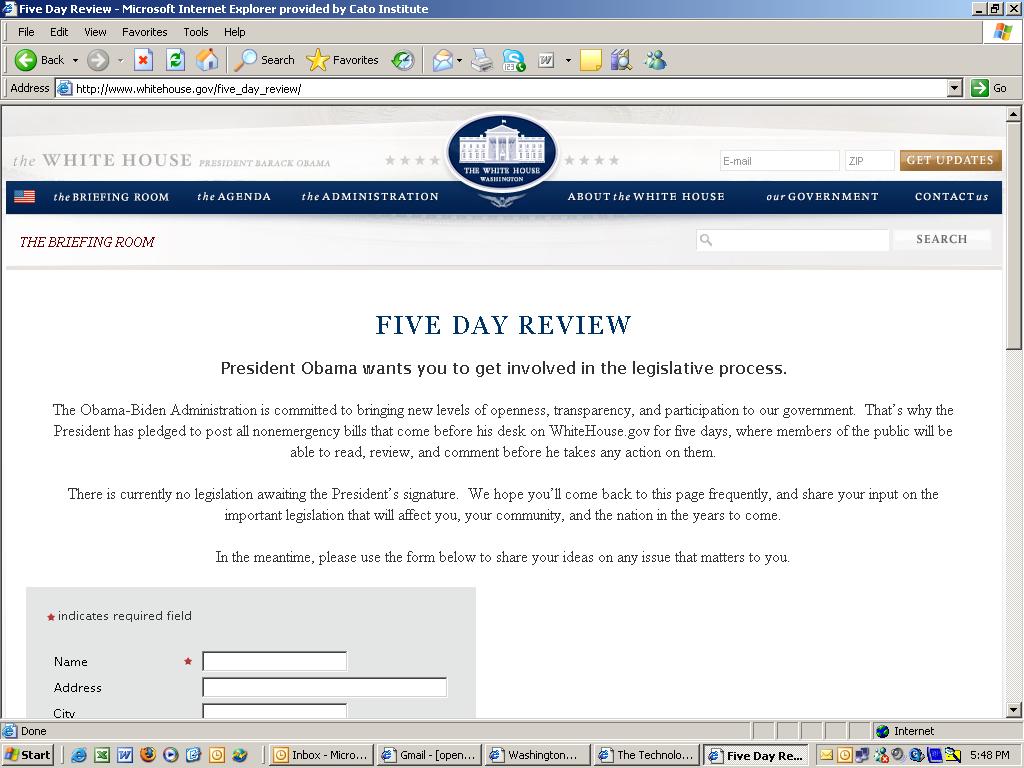
Here’s a screen grab of the Whitehouse.gov five-day review page. I figured I should preserve it because it is not likely to be on the site for long. President Obama just signed his second piece of legislation into law, and it didn’t get the five-day review either.
Here’s what that page says:
FIVE DAY REVIEW President Obama wants you to get involved in the legislative process. The Obama-Biden Administration is committed to bringing new levels of openness, transparency, and participation to our government. That’s why the President has pledged to post all nonemergency bills that come before his desk on WhiteHouse.gov for five days, where members of the public will be able to read, review, and comment before he takes any action on them. There is currently no legislation awaiting the President’s signature. We hope you’ll come back to this page frequently, and share your input on the important legislation that will affect you, your community, and the nation in the years to come. In the meantime, please use the form below to share your ideas on any issue that matters to you.
Uh, yeah, there’s no legislation awaiting the President’s signature because he signed it right away!
I wrote more about this step away from transparency here.
 The Technology Liberation Front is the tech policy blog dedicated to keeping politicians' hands off the 'net and everything else related to technology.