 From the Portland Press Herald:
Wanted: 250 Maine drivers willing to let a stranger put a black box under their dashboard.
The reward: $895 and the opportunity to speak their minds about the highway tax experiment to a researcher.
University of Iowa researchers are seeking 250 motorists in Cumberland, York and Sagadahoc counties willing to have a computer tracking system installed in their cars for 10 months. The system could someday be used to tax drivers according to the number of miles they drive, rather than the amount of gasoline they consume.
This is not only gets the award for most Orwellian government program of the week, but also the irony in incentives bonus prize. The new tax is meant to make up for the loss in gas revenue from more fuel efficient cars and folks using less gas during the recession. In doing so, this black-box tax would essentially be punishing motorists for driving more efficient cars, which is supposed to be a goal of the gas tax (other than raising revenue).
Bottom line: If you need more money for highways, build more tolls or raise the gas tax, don’t track your citizens.
Great piece in Wired by Fred Vogelstein asking “Why Is Obama’s Top Antitrust Cop Gunning for Google?” It paints a pretty good picture of the coming antitrust ordeal that Google is likely to be subjected to by the Obama Administration. And, as usual, I couldn’t agree more with the skepticism that Eric Goldman of Santa Clara University Law School articulates when he notes: “The problem for antitrust in high tech is that the environment changes so rapidly. Someone who looks strong today won’t necessarily be strong tomorrow.” More importantly, as Vogelstein’s article notes, we’ve been down this path before with less than stellar results when you look at the IBM investigation in the 70s and the Microsoft case from the 90s (a fiasco that is still going on today):
After the government initiated its case against IBM, the company spent two decades scrupulously avoiding even the appearance of impropriety. By the time the suit was dropped in the early 1980s, company lawyers were weighing in on practically every meeting and scrutinizing every innovation, guarding against anything that could be seen as anticompetitive behavior. A decade later, innovation at Big Blue had all but ceased, and it had no choice but to shrink its mainframe business. (It has since reinvented itself as a services company.)
Microsoft took the opposite approach. Gates and company were defiant, to the point of stonewalling regulators and refusing to take the charges seriously. “Once we accept even self-imposed regulation, the culture of the company will change in bad ways,” one former Microsoft executive told
Wired at the time. “It would crush our competitive spirit.” Gates put it even more directly: “The minute we start worrying too much about antitrust, we become IBM.” Microsoft’s hostility to the very idea of regulation resulted in several avoidable missteps—including remarkably antagonistic deposition testimony from Gates—that ultimately helped the DOJ rally support for its ongoing antitrust suit against the company. Although Microsoft ultimately settled, the public beating appears to have taken a toll on the company, which has been unable to maintain its reputation for innovation and industry leadership.
Read the whole article for all the gory details. This is going to be the biggest antitrust case of all-time once it is finally launched and I feel confident predicting that it will make many lawyers and consultants very, very rich while doing absolutely nothing to help consumer welfare. But perhaps those DOJ lawyers can at least get Google to lower the prices for all those services they offer. Oh, wait, they’re all free. But don’t worry, I’m sure Beltway bureaucrats will do a great job of running something as complex as search algorithms and online advertising markets. Right.
Well, here we go again. Harvard’s Jonathan Zittrain has penned another gloomy essay about how “freedom is at risk in the cloud” and the future of the Internet is in peril because nefarious digital schemers like Apple, Facebook, and Google are supposedly out to lock you into their services and take away your digital rights. And so, as I have done here many times before (see 1, 2, 3, 4, 5 + video!), I will offer a response arguing that Jonathan’s cyber-Chicken Little-ism is largely unwarranted.
Zittrain’s latest piece is entitled “Lost in the Cloud” and it appears in today’s New York Times. It closely tracks the arguments he has set forth in his book The Future of the Internet–And How to Stop It, which I named the most important technology policy book of 2008, but not because I agreed with its central thesis. Zittrain’s book and his new NYT essay are the ultimate exposition of Lessigite technological pessimism. I don’t know what they put in the water up at the Berkman Center to make these guys so remarkably cranky and despondent about the future of of the Internet, but starting with Lawrence Lessig’s Code in 1999 and running through to Zittrain’s Future of the Internet we have been forced to endure endless Tales of the Coming Techno-Apocalypse from these guys. Back in the late 90s, Prof. Lessig warned us that AOL and some other companies would soon take over the new digital frontier since “Left to itself, cyberspace will become a perfect tool of control.” Ah yes, how was it that we threw off the chains of our techno-oppressors and freed ourselves from that wicked walled garden hell? Oh yeah, we clicked our mouses and left! And that was pretty much the end of AOL’s “perfect control” fantasies. [See my recent debate with Prof. Lessig over at Cato Unbound for more about this “illusion of perfect control,” as I have labeled it.]
But Zittrain is the equivalent of the St. Peter upon which the Church of Lessigism has been built and, like any good disciple, he’s still vociferously preaching to the unconverted and using fire and brimstone sermons to warn of our impending digital damnation. In fact, he’s taken it to all new extremes. In
Future of the Internet, Jonathan argues that we run the risk of seeing the glorious days of the generative, open Net and digital devices give way to more “sterile, tethered devices” and closed networks. The future that he hopes to “stop” is one in which Apple, TiVo, Facebook, and Google — the central villains in his drama — are supposedly ceded too much authority over our daily lives because of a combination of (a) their wicked ways and (b) our ignorant ones.
Continue reading →
If you’re like me, you’ve really connected with TechDirt over the years – really become a fan. You’re looking for a way to express your appreciation for the good work they do, and show others that you’re a smart, forward-thinking person.
Well, now you can do just that by buying a limited edition TechDirt t-shirt, among many other enticing packages of rivalrous goods.
 by Eric Beach & Adam Thierer
In our ongoing “Privacy Solutions Series” we have been outlining various user-empowerment or user “self-help” tools that allow Internet users to better protect their privacy online. These tools and methods form an important part of a layered approach that we believe offers a more effective alternative to government-mandated regulation of online privacy. [See entries 1, 2, 3, 4] In this installment, we will be exploring CCleaner, a free Windows-based tool created by UK-based software developer Piriform that scrubs you computer’s hard drive and cleans its registry. We’ll describe how CCleaner helps you destroy data and protect your private information.
Whenever you move files to the recycling bin and subsequently purge the recycling bin, the affected files remain on your computer. In other words, deleting files from the recycling bin does not remove them from the computer. The reason for this is important and, in many ways, beneficial. In some respects, many computer file systems work like an old library catalog system. A file is like a catalog card and contains the reference to the actual place on the hard drive where the information contained in the file is stored. When a user deletes a file, the computer does not actually clean all the affected hard drive space. Instead, to extend the analogy, the computer simply removes the card catalog entry that points to the hard drive space where the file is contained and frees up this space for new files. The reason this is usually beneficial is that cleaning the hard drive space occupied by a file can take a while. If you want evidence of this, look no further than the length of time required to reformat a hard drive (reformatting a hard drive actually clears the disk’s contents). The practical implication of the way hard drives work is that when you delete an important memo from your computer, it is not actually gone. Similarly, when you clear your browsing history, it is not gone. The bottom line is that an individual who can access your hard drive (a thief, the government, etc.) could view many or all of the files you deleted.
The solution to this problem is to ensure that when a file is deleted, the space on the hard drive occupied by that file is not simply flagged as available space but is entirely rewritten with unintelligible data. One of the best programs for accomplishing this is CCleaner (which formerly stood for “Crap Cleaner”!)
Continue reading →
Evgeny Morozov has an op-ed in the New York Times today that makes the case that cyberattacks are not an existential threat to the country or anything even close. He also argues that more secrecy around cybersecurity is exactly the wrong way to address the problem, citing the old geek adage “given enough eyeballs, all bugs are shallow.” He even explains that “Much of the real computer talent today is concentrated in the private sector,” and that “It’s no secret that many computer science graduates perceive government jobs as an ‘IT ghetto.'”
So far so good. Bravo, in fact. Unfortunately, he suggests that “To inject more talent into government IT jobs, it is necessary to raise their visibility and prestige, perhaps by creating national Tech Corps that could introduce talent into sectors that need it most.”
As Jim Harper has noted, given that cyberattacks may not be as serious a threat as many assume, it might be better to allow the private sector (which has the talent and the incentive) to protect its own infrastructure. DHS and the military can protect the .govs and the military the .mils. The government could benefit from private R&D on run-of-the-mill cybersecurity, and they can focus on protecting critical and secret assets, which in any case should not be connected directly to the wider internet.
After cracking down on both international and domestic journalists, Iran is now looking to America for ways to squelch dissent. So, naturally, they’re copying America’s disastrous experience with censorship: the so-called “Fairness Doctrine” imposed by the FCC (despite the First Amendment’s plain language) in 1949 until its repeal in 1987:
Iran’s State Inspectorate Organization, a sort of superregulatory agency that supervises a wide range of government administrations, said the guidelines will ensure that any criticism communicated through state media is “constructive,” “nonjudgmental” and doesn’t “stray from objectivity,” Iran’s state-controlled English-language news site Press TV quoted SIO chief Mostafa Pourmohammadi as saying.
He didn’t give details of the new rules, and it wasn’t clear which outlets are being specifically targeted — the government-controlled media or the heavily monitored independent press. It is also unclear how much clout the agency has in pursuing violations or referring them to authorities for enforcement.
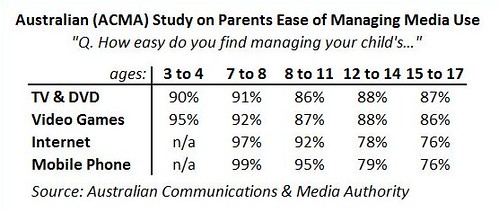
An interesting new survey has just been released by the Australian Communications and Media Authority (ACMA), which is the rough equivalent of the Federal Communications Commission here in the U.S., but with somewhat broader authority. ACMA’a latest report is entitled Use of Electronic Media and Communications: Early Childhood to Teenage Years and it takes a look at media technology usage among Australian youngsters in 5 age groupings (3 to 4 years of age, 7 to 8, 8 to 11, 12 to 14, and 15 to 17).
The survey also asked Australian parents “How easy do you find managing your child’s ___ use.” They asked that question for four different media or communications technologies: TV & DVD; video games; Internet; and mobile devices. They results, summarized in the table below, were quite interesting and seem to indicate that Australian parents find it much easier to manage their children’s media use than some of their elected leaders imagine.
Continue reading →
I’ve just had a new article published by the American Legislative Exchange Council (ALEC) in which I make the case against “techno-panics,” which refers to public and political crusades against the use of new media or technologies by the young. The article is entitled “Parents, Kids & Policymakers in the Digital Age: Safeguarding Against ‘Techno-Panics‘” and it appears in the July 2009 Inside ALEC newsletter. This is something I have spent a lot of time writing about here in recent years (See 1, 2, 3, 4, 5) and I finally got around to putting it altogether in a concise essay here. I have pasted the full text below. [And I just want to send a shout-out to my friend Anne Collier of Net Family News.org, whose work on this topic has been very influential on my thinking.]
“Parents, Kids & Policymakers in the Digital Age: Safeguarding Against ‘Techno-Panics‘”
by Adam Thierer
A cursory review of the history of media and communications technologies reveals a reoccurring cycle of “techno-panics” — public and political crusades against the use of new media or technologies by the young. From the waltz to rock-and-roll to rap music, from movies to comic books to video games, from radio and television to the Internet and social networking websites, every new media format or technology has spawned a fresh debate about the potential negative effects they might have on kids.
Inevitably, fueled by media sensationalism and various activist groups, these social and cultural debates quickly become political debates. Indeed, each of the media technologies or outlets mentioned above was either regulated or threatened with regulation at some point in its history. And the cycle continues today. During recent sessions of Congress, countless hearings were held and bills introduced on a wide variety of media and content-related issues. These proposals dealt with broadcast television and radio programming, cable and satellite television content, video games, the Internet, social networking sites, and much more. State policymakers, especially state Attorneys General (AGs), have also joined in such crusades on occasion. The recent push by AGs for mandatory age verification for all social networking sites is merely the latest example.
What is perhaps most ironic about these techno-panics is how quickly yesterday’s boogeyman becomes tomorrow’s accepted medium, even as the new villains replace old ones. For example, the children of the 1950s and 60s were told that Elvis’s hip shakes and the rock-and-roll revolution would make them all the tools of the devil. They grew up fine and became parents themselves, but then promptly began demonizing rap music and video games in the ‘80s and ‘90s. And now those aging Pac Man-era parents are worried sick about their kids being abducted by predators lurking on MySpace and Facebook. We shouldn’t be surprised if, a decade or two from now, today’s Internet generation will be decrying the dangers of virtual reality.
Continue reading →

 The Technology Liberation Front is the tech policy blog dedicated to keeping politicians' hands off the 'net and everything else related to technology.