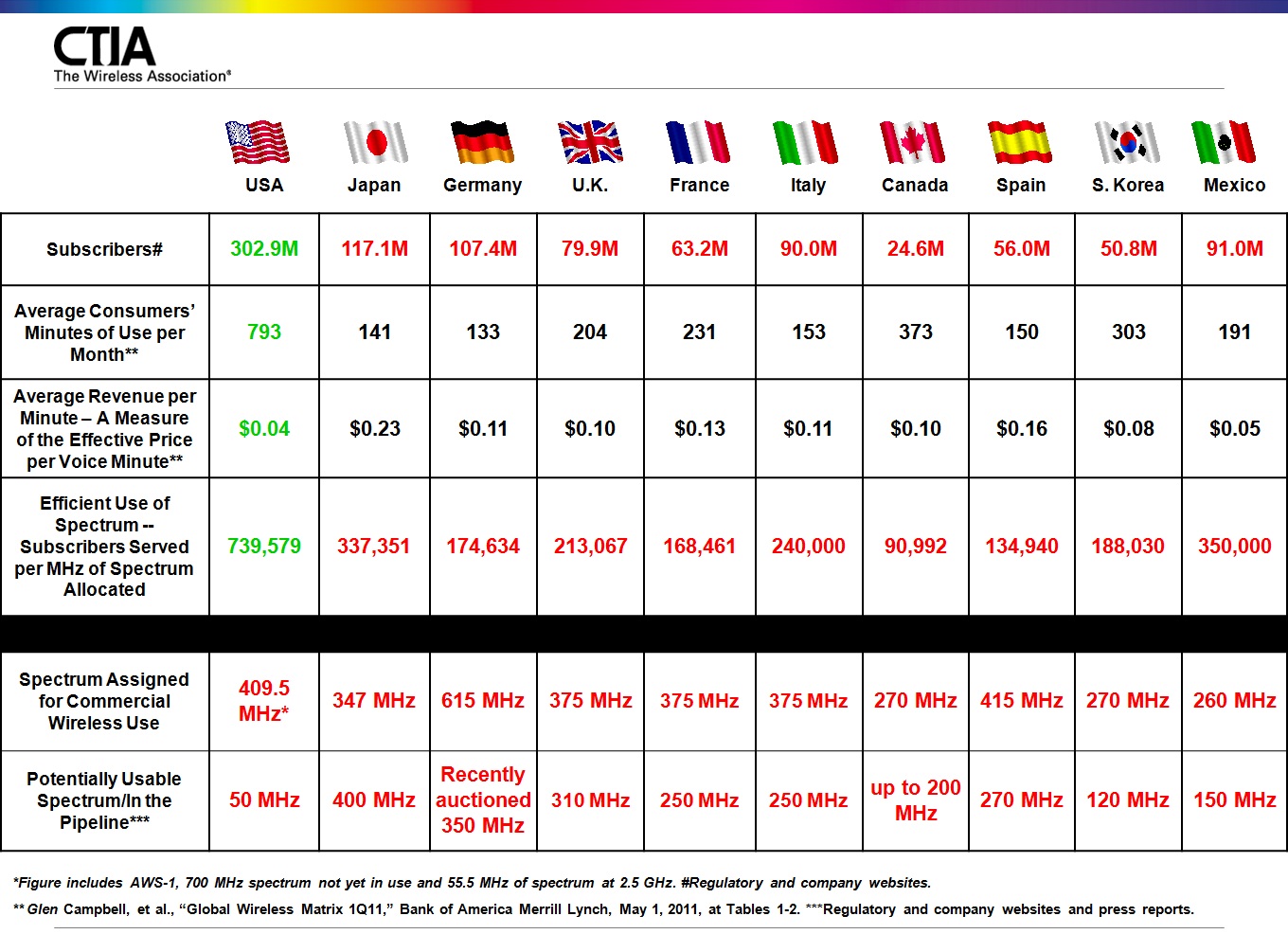
Here’s a terrifically useful chart from CTIA that offers some international wireless use and spectrum availability comparisons. [Click on chart to expand.] The average minutes of use and average revenue per minute differences are fairly staggering. But the really important takeaway from this chart is the last line, which depicts how little spectrum is dripping out of the faucet right now. Having just 50 MHz of “potentially usable spectrum in the pipeline” is troubling and needs to be addressed by policymakers immediately. America’s wireless demands continue to explode, but supply isn’t keeping up.
My latest Mercatus Center white paper is entitled “Kids, Privacy, Free Speech & the Internet: Finding The Right Balance.” From the intro:
Concerns about children’s privacy are an important part of [the ongoing privacy debate]. The Children’s Online Privacy Protection Act of 1998 (COPPA) already mandates certain online-privacy protections for children under the age of 13. The goal of COPPA was to enhance parents’ involvement in their children’s online activities and better safeguard kids’ personal information online. The FTC is currently considering an expansion of COPPA, and lawmakers in the House of Representatives introduced legislation that would expand COPPA and apply additional FIPPS regulations to teenagers. Some state-based measures also propose expanding COPPA
While well-intentioned, efforts to expand privacy regulation along these lines would cause a number of unintended consequences of both a legal and economic nature. In particular, expanding COPPA raises thorny issues about online free speech and anonymity. Ironically, it might also require that
more information about individuals be collected to enforce the law’s parental-consent provisions. There are better ways to protect the privacy of children online than imposing burdensome new regulatory mandates on the Internet and online consumers. Education, empowerment, and targeted enforcement of unfair and deceptive practice policies represent the better way forward.
The paper can be downloaded on SSRN, Scribd, or directly from the Mercatus website at the link above.
 For CNET this morning, I offer five crucial corrections to the Protect IP Act, which was passed out of committee in the Senate back in May.
Yesterday, Rep. Bob Goodlatte, co-chair of the Congressional Internet Caucus, told a Silicon Valley audience that the House was working on its own version and would introduce it in the next few weeks.
Protect IP would extend efforts to combat copyright infringement and trademark abuse online, especially by websites registered outside the U.S.
Since Goodlatte promised the new bill would be “quite different” from the Senate version, I thought it a good time to get out my red pen and start crossing off the worst mistakes in policy and in drafting in Protect IP.
The full details are in the article, but in brief, here’s what I hope the House does in its version:
- Drop provisions that tamper with the DNS system in an effort to block U.S. access to banned sites.
- Drop provisions that tamper with search engines, indices, and any other linkage to banned sites.
- Remove a private right of action that would allow copyright and trademark holders to obtain court orders banning ad networks and financial transaction processors from doing business with banned sites.
- Scale back current enforcement abuses by the Department of Homeland Security under the existing PRO-IP Act of 2008.
- Focus the vague and overinclusive definition of the kind of websites that can be banned, limiting it to truly criminal enterprises.
Continue reading →
On the podcast this week, Ryan Calo, a scholar at Stanford’s Center for Internet and Society, discusses his new article in the Maryland Law Review entitled “Open Robotics.” Robots are frequently used in war, manufacturing, warehouse management, and even in surgery. Now, personal robots are poised to be the new explosive technology, and Calo anticipates their social effect to be on par with that of the personal computer. He discusses why he believes personal robots are more likely to thrive if they are built on an open model–rather than closed or proprietary framework–even though robots open to third-party tinkering may be subject to greater legal liability than closed, discrete-function robots. To protect open-model innovation, Calo recommends immunity for manufacturers of open robotic platforms for what end users do with these platforms, akin to the immunity enjoyed under federal law by firearms manufacturers and websites.
Related Links
To keep the conversation around this episode in one place, we’d like to ask you to comment at the webpage for this episode on Surprisingly Free. Also, why not subscribe to the podcast on iTunes?
Paul Vixie, a renowned Internet pioneer who runs the Internet Systems Consortium, has written an article in ACM Queue attacking “those who would unilaterally supplant or redraw the existing Internet resource governance or allocation systems.” The publication of this article is a sign of a growing, important debate around the reform of IP address registries in the age of IPv4 exhaustion.
Vixie defends the Regional Internet Registries monopoly on IP address registration services and its current, needs-based policies toward address transfers. I am sure that Paul sincerely believes in the arguments he makes, but it’s also true that Vixie is the chairman of the Board of The American Registry for Internet Numbers (ARIN), the regional address registry for North America. When Vixie argues that ARIN’s exclusive control over Whois and address transfer services is beneficial and “in the physics” he is also defending the authority and revenue model of his own organization against a perceived threat.
And that takes us to another relevant fact. The argument Vixie makes is cast in generalities, but he is really attacking a specific firm, a holding company known as Denuo. Denuo has formed both a secondary marketplace called Addrex for the legitimate trading of IPv4 number blocks, and an IP Address Registrar company known as Depository. Let’s set aside Depository for the moment (I will come back to it) and concentrate on Addrex, which has become the first end-to-end platform for legacy address holders to sell their IPv4 number blocks. Famously, Addrex scored a major success as the intermediary for the Nortel-Microsoft trade. But Nortel-Microsoft was unusually visible because it had to go through bankruptcy court. Is anything else happening? I spoke to Addrex’s President Charles Lee since then to find out. “We are very busy signing up a growing number of global corporate and governmental customers to sell their unused assets,” he said. I asked him what the buyer side of the marketplace was beginning to look like and he said “Our value proposition to large Asian network operators has resonated quite effectively and we expect to enter into many agreements with them over the coming months.” Surely Vixie and the ARIN Board have gotten wind of this. So when Vixie begins a public attack on this company and its business model, he is signaling to the rest of us that ARIN is worried. Continue reading →
The Technology Liberation Front (TLF) turned 7 yesterday. We got underway on Aug 14, 2004 with this post. For more of the backstory of how things got started, see this post upon the occasion of our 5th anniversary. We’re now up to 5,800+ posts and we’ve received almost 34,400 comments on those entries.
The goal of the TLF was to bring together liberty-loving technology policy analysts who were concerned about rising calls for government control of the Internet, digital technologies, and media and communications platforms. While we’ve slowed down a bit here in recent years, I’m quite proud of what we’ve done over the years to advance that vision and want to I thank everyone involved in the effort and all those readers who found it worth their time to stop by.
We’ll keep fighting the good fight for technology and information freedom!
Republished from the Daily Caller
U.K. Prime Minister David Cameron has declared “everything necessary will be done to restore order” in Britain’s riot-racked cities. With respect to the right honorable gentleman, what distinguishes free from unfree societies is not order, but ordered liberty. As the great Tory philosopher Edmund Burke taught, reconciling liberty and order is the fine art of democratic statecraft. Tweaking that balance as technology evolves requires the most careful and judicious deliberation. Only where cooler heads prevail can ordered liberty thrive.
Cameron’s government has hesitated to escalate physical force with rubber bullets and water cannons, lest they lend moral sanction to the brutal tactics used by China and in the Middle East to suppress dissent. Yet however noble his intentions, Cameron could do more to undermine ordered liberty with “bloodless” measures targeting social media services like Twitter and Facebook, and improperly using photo identification.
Cameron, who championed Internet-driven revolutions in Egypt and Tunisia, told Parliament that the “free flow of information can be used for good, but it can also be used for ill.” His vague response: “We are working with the police, the intelligence services and industry whether it will be right to stop people communicating via these websites and services.”
So far, the only clear call for shutting down social media outright came from a Labour MP, not Cameron’s Tories. David Lammy, who represents the London neighborhood where rioting began, has demanded the suspension of BlackBerry Messenger (BBM) service for “helping rioters outfox Police.” Such a response befits Beijing, not Britain, the birthplace of ordered liberty.
Free societies can and should silence those who incite acts of violence — but not by shutting down speech platforms for all users. Even America’s speech-protective First Amendment allows punishment of speech that is “directed to inciting or producing imminent lawless action and is likely to incite or produce such action.” That standard protects legitimate expression without preventing prosecution of those individuals stoking and organizing riots. The same standard should determine when government may properly force social media systems to take down seditious posts, photos and videos. Continue reading →
I’m no grammar Nazi. In fact, I’m closer to being a grammar anarchist. I’ve been fighting teachers and editors for years about split infinitives (they rock!), contractions (fine in small doses), and run-on sentence (OK, they are probably right about that one, but I just can’t control myself). Nonetheless, it makes sense to have some basic ground rules for grammar and good writing. Sometimes, however, those rules just can’t be found.
I raise this issue because I’m finishing up my next book and I find myself struggling with the proper hyphenation and capitalization of various Internet terms. After much consultation with the Mercatus Center’s grammar czar Jennifer Zambone, I think I have finally grown comfortable with two rules I have long ignored (or just been horribly schizophrenic about using consistently) in my past writing. They are: Continue reading →
States are ratcheting up legislation in order to capture sales taxes from on-line retailers, even as companies like Amazon.com aggressively push back.
A closely-watched bill in the Texas legislature that defines Amazon’s distribution center in Ft. Worth as a physical nexus, thereby obligating the on-line retailing giant to collect taxes on sales to residents of the Lone Star State, passed on a second go-through of this year’s session, overcoming an initial veto by Gov. Rick Perry.
The next move is up to Amazon. Its distribution center is essentially a warehouse that fulfills online orders and employs 200. Amazon previously said it would close the center if the bill passed, but has yet to make good on the threat. However, it is dangerous to dismiss it as a bluff. When South Carolina passed a similar bill, the company closed a distribution center there; only to return once the legislation was reversed.
The collection of taxes from on-line sales has become touchy among even the free-market-minded. Brick-and-mortar store owners have become increasingly vocal as to what they see as a purposeful scheme of “tax avoidance” that puts them at an unfair disadvantage against on-line retailers. Research, such as an April paper from the University of Tennessee’s Center for Business and E-Commerce Research, stoke the flames by calling the current sales tax rules a tax subsidy for online merchants.
The heart of the Texas dispute is whether a distribution center counts as a nexus. The case law is
Quill Corp. v. North Dakota and National Bellas Hess v. Illinois Department of Revenue, which, as broadly understood, stipulate that a business must have a nexus, that is, brick-and-mortar store, in the state in order to be liable for tax collection. If there is a viable court test to either or both of these decisions, the contention that a distribution center constitutes a nexus may have the most potential.
Continue reading →
On the podcast this week, David Brin, a physicist and Hugo and Nebula award-winning science fiction writer, wrote the prescient 1997 nonfiction book, The Transparent Society, which won the Freedom of Speech Award of the American Library Association. He’s written a new essay revisiting the themes of that book and discusses how the ideas presented in The Transparent Society relate to his new essay and to the world today. The government continues to increase its ability to look in on citizens, creating an Orwellian-like society that people may find alarming. According to Brin, reciprocal accountability, which is the ability for people to look back at the government and hold it accountable, is key to minimizing undesirable effects and behaviors. Brin goes on to discuss the benefits of a more pragmatic approach to transparency as opposed to immediate and radical transparency like WikiLeaks.
Related Links
To keep the conversation around this episode in one place, we’d like to ask you to comment at the webpage for this episode on Surprisingly Free. Also, why not subscribe to the podcast on iTunes?

 The Technology Liberation Front is the tech policy blog dedicated to keeping politicians' hands off the 'net and everything else related to technology.