Privacy, Security & Government Surveillance

As a cyber-libertarian, I’ve been lucky enough to work with people of all ideological stripes in pursuit of various public policy objectives.  I’ve made selective alliances with people on the Right on economic policy issues (like opposing Net Neutrality regulation, Internet taxes, etc) and also worked closely with folks on the Left on speech and culture issues (content controls, anonymity, online safety concerns, etc).

While engaging with with people on both sides of the political fence, I’m often struck by some of their internal inconsistencies.  Conservatives, for example, talk about a big game about personal responsibility on some issues, but quickly abandon that notion when they claim media content or online speech should be regulated by the State (typically “for the children.”)  In this essay, I’d like to discuss interesting inconsistencies on the political Left, especially among advocates of strong privacy regulation (most of whom tend to be Left-leaning in their worldview).  In particular, here are the two things I find most interesting about modern privacy advocates:

(1) Most privacy advocates are vociferous First Amendment supporters, yet they abandon their free speech values and corresponding constitutional tests when it comes to privacy regulation.  When it comes to proposals to regulate media content or online speech, most folks on the Left have a very principled, clear-cut position: people (or parents) should take responsibility for unwanted information flows in their lives (or the lives of their children). In particular, they rightly argue that the many user empowerment tools on the market (filters, monitoring software, other parental control technologies) constitute a so-called “less-restrictive means” of controlling content when compared to government regulation.

Advocacy groups that I have a great deal of respect for and work with quite closely on these issues–such as EFF, CDT and ACLU—all take this position.  Generally speaking, they argue that, when it comes to speech regulation, “household standards” (user-level controls) should trump “community standards” (government regulation). And in Court—where I frequently file joint amicus briefs with them—they repeatedly employ the “less-restrictive means” test to counter government efforts to regulate information flows.

But when it comes to privacy, they throw all this out the windowContinue reading →

The Washington Post reports today on an article coming out in Foreign Affairs in which Deputy Defense Secretary William J. Lynn III reveals a successful 2008 intrusion into military computer systems. Malicious code placed on a thumb drive by a foreign intelligence agency uploaded itself onto a network run by the U.S. military’s Central Command and propagated itself across a number of domains.

The Post article says that Lynn “puts the Homeland Security Department on notice that although it has the ‘lead’ in protecting the dot.gov and dot.com domains, the Pentagon — which includes the ultra-secret National Security Agency — should support efforts to protect critical industry networks.”

The failure of the military to protect its own systems creates an argument for it to have preeminence in protecting private computer infrastructure? Perhaps the Department of Homeland Security will reveal how badly it has been hacked in order to regain the upper hand in the battle to protect us.

Emotions ran high at this week’s Privacy Identity and Innovation conference in Seattle.  They usually do when the topic of privacy and technology is raised, and to me that was the real take-away from the event.

As expected, the organizers did an excellent job providing attendees with provocative panels, presentations and keynotes talks—in particular an excellent presentation from my former UC Berkeley colleague Marc Davis, who has just joined Microsoft.

Continue reading →

It sounds a little bit like the “pre-crime” unit featured in the 2002 film “Minority Report,” but news that Washington, D.C. will implement software to “predict” crime is not quite as worrisome as it might seem at first blush.

Beginning several years ago, the researchers assembled a dataset of more than 60,000 various crimes, including homicides. Using an algorithm they developed, they found a subset of people much more likely to commit homicide when paroled or probated. Instead of finding one murderer in 100, the UPenn researchers could identify eight future murderers out of 100. Berk’s software examines roughly two dozen variables, from criminal record to geographic location. The type of crime, and more importantly, the age at which that crime was committed, were two of the most predictive variables.

Unlike applying data mining to detection of terrorism planning or preparation, which is exceedingly rare, using tens of thousands of examples of recidivism to discover predictive factors is a good way to focus supervision resources where they are most likely to be effective.

The article describes use of this software for monitoring parolees and probationers. Using data mining to justify anything approaching extra punishment would be a misuse, and many far more difficult issues would arise if it were used on the general population.

The Progress and Freedom Foundation has just published a white paper I wrote for them titled “The Seven Deadly Sins of Title II Reclassification (NOI Remix).”  This is an expanded and revised version of an earlier blog post that looks deeply into the FCC’s pending Notice of Inquiry regarding broadband Internet access. You can download a PDF here.

I point out that beyond the danger of subjecting broadband Internet to extensive new regulations under the so-called “Third Way” approach outlined by FCC Chairman Julius Genachowski, a number of other troubling features in the Notice indicate an even broader agenda for the agency with regard to the Internet. Continue reading →

Recent revelations about Microsoft’s internal debate over Internet Explorer’s handling of tracking cookies, as chronicled by The Wall Street Journal earlier this month, have prompted harsh criticism from self-described privacy groups, who’ve called on Congress to investigate Microsoft’s actions. But as Jim Harper pointed out in an excellent WSJ essay, Web users stand to lose a great deal if online tracking is squelched by the hand of government. Data gathering on the Internet is largely harmless, and individually targeted advertising coexists with robust privacy safeguards.

Over on AOLNews.com, my colleague Carolyn Homer discusses these privacy tradeoffs, arguing that Microsoft and other Internet firms have a strong incentive to set privacy defaults that align with their users’ preferences. She points out that most consumers are, in practice, quite willing to live with allegedly “pervasive” tracking in exchange for the enormous benefits that targeted advertising makes possible. While many surveys and polls indicate consumers are very worried about their privacy, the actual decisions that consumers make every day tell a very different story (as documented extensively by Berin Szoka). From Carolyn’s piece:

A body of research reveals a sizable disparity between how much people say they value privacy and how willing they are to actually protect it. In a 2003 Duke Law Journal article, Michael Staten and Fred Cate found that fewer than 10 percent of users exercise their right to opt out and share less. Conversely, if given the opposite choice, fewer than 10 percent of users elect to opt in and share more. The vast middle is apparently indifferent. If consumers were required to affirmatively opt in before sharing data, the Internet’s prevailing advertising-based business model would be decimated. The effectiveness of online advertising in Europe, for example, fell 65 percent after the European Union in 2002 required a blanket opt-in system. For more than a decade, the Internet has thrived on the assumption that most people believe it is a fair trade to receive free content in exchange for viewing ads. Mere advertisements shouldn’t be equated with gross privacy violations.

She goes on to discuss how privacy settings are evolving as consumer preferences adapt to new technologies and firms experiment with new ways to use and collect data. You can read the rest over at the AOL News website.

As I mentioned earlier, I’m attending the pii2010 conference (privacy, identity & innovation) this week in Seattle (18-19)! If you’re at the conference or in the area, I hope you’ll join me and my fellow TLFers Larry Downes and Carl Gipson for an “Alcohol Liberation Front” happy hour (cash bar) after the conference ends tomorrow, Wednesday the 18th at Kells Irish Pub at 1916 Post Alley–just a short walk from the Bell Harbor International Conference Center, where the conference will take place (Google maps walking directions). The conference reception wraps up at 7:30, so we’ll mosey on over to Kells by 7:45 for drinks and food.

Just look for the TLF sticker when you get there (or the conference badges)! Carl, Larry and I should all be there. Please RSVP on Facebook if you’re coming!

I have a piece on Internet privacy in the Wall Street Journal today. It’s one side of a “debate” on Internet privacy and tracking. I say be careful what you give up if you thwart online tracking—personalization, free content, and other goodies may go by the wayside.

My “opponent” is Nicholas Carr, whose identity and arguments I didn’t know as I wrote, nor likely did he mine. His is a good piece that lays out the many legitimate concerns with online tracking. Must be nice to be the maximal-privacy “good guy”!

For the sake of making it interesting I’ll pick out one important point that highlights the nub of the issue.

Privacy tradeoffs have always been a part of life, Carr says, “But now, thanks to the Net, we’re losing our ability to understand and control those tradeoffs—to choose, consciously and with awareness of the consequences, what information about ourselves we disclose and what we don’t.”

This sentence brought back to me a memorable moment from law school. In a seminar course, the professor called upon a fellow student who rather dopily apologized, “Sorry, I didn’t have time to do the reading.”

“In fact you did have time to do the reading,” replied the teacher, “but you just didn’t take it. Isn’t that correct?”

It was funny, if embarrassing for my colleague, and a great illustration of precision with language.

Holding to that standard of precision, I’ll disagree with Carr’s statement: The Net is not affecting our ability to understand and control privacy tradeoffs. Its development has outstripped that capacity. Developing consumers’ understanding of information flows, information uses, and consequences will position them to restore privacy.

I don’t think Carr would disagree with that sentiment in the main. Later he says, agreeably to me, “We need to take personal responsibility for the information we share whenever we log on.”

And I do think that’s the heart of the problem: “Education is the hard way, and it is the only way, to get consumers’ privacy interests balanced with their other interests.”

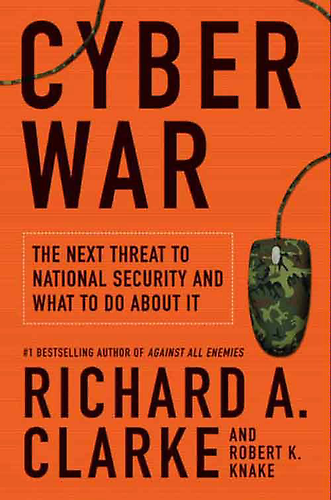
While on vacation last week, I finished up a few new cyber-policy books and one of them was  Cyber War: The Next Threat to National Security and What to Do About It by Richard A. Clarke and Robert K. Knake.  The two men certainly possess the right qualifications for a review of the subject.  Clarke was National Coordinator for Security, Infrastructure Protection, and Counterterrorism during the Clinton years and also served in the Reagan and two Bush administrations. Knake is an international affairs fellow at the Council on Foreign Relations where he specializes in cybersecurity.

Clarke and Knake’s book is important if for no other reason than, as they note, “there are few books on cyber war.” (p. 261) Thus, their treatment of the issue will likely remain the most relevant text in the field for some time to come.

They define cyber war as “actions by a nation-state to penetrate another nation’s computers or networks for the purposes of causing damage or disruption” (p. 6) and they argue that such actions are on the rise.  And they also claim that the U.S. has the most to lose if and when a major cyber war breaks out, since we are now so utterly dependent upon digital technologies and networks.

At their best, Clarke and Knake walk the reader through the mechanics of cyber war, who some of the key players and countries are who could engage in it, and identify what the costs of such of war would entail.  Other times, however, the book suffers from a somewhat hysterical tone, as the authors are out here not just to describe cyber war, but to also issue a clarion call for regulatory action to combat it.  Ryan Singel of Wired, for example, has taken issue with the book’s “doomsday scenario that stretches credulity” and claims that “Like most cyberwar pundits, Clarke puts a shine on his fear mongering by regurgitating long-ago debunked hacker horror stories.”  Bruce Schneier and Jim Harper have raised similar concerns elsewhere.

Continue reading →

If you’re as fascinated as I am by the interplay of privacy, identity and innovation, I hope to see you at the pii2010 conference in Seattle, August 17-19! Organized by the folks who’ve put on the top-notch Tech Policy Summit since 2003, and co-sponsored by The Progress & Freedom Foundation (among others), this event offers a truly unique perspective on privacy—not just another policy food fight, but a true roll-up-our-sleeves, in-depth seminar on what to do about privacy, especially through technological innovation.

I’ll be on the “pii & Digital Advertising: Navigating the Regulatory Landscape” panel on the 18th at 10am, giving my usual talk about the need to be careful about the trade-offs inherent in privacy regulation. Check out the detailed agenda here.

TLFers Larry Downes and Carl Gipson will also be attending, so we’re planning a long-overdue “Alcohol Liberation Front” happy hour after the conference on August 18—details to be announced soon.

Check out the discussion around the #pii2010 hashtag on Twitter. And register today! Mid-August is supposed to be paradise in Seattle, and the week of the conference also happens to be Seattle GeekWeek, so there are a bunch of other events worth checking out in town before and after the pii2010 conference.