With renewed interest in the failings of the Computer Fraud and Abuse Act and the role of prosecutorial discretion in its application in light of the tragic outcome in the Aaron Swartz case, I went back to what I wrote about the law in 2009.
Back then, the victim of both the poorly-drafted amendments to CFAA that expanded its scope from government to private computer networks and the politically-motivated zeal of federal prosecutors reaching for something—anything—with which to punish otherwise legal but disfavored behavior was trained on Lori Drew, a far less sympathetic defendant.
But the dangers lurking in the CFAA were just as visible in 2009 as they are today. Those who have recently picked up the banner calling for reform of the law might ask themselves where they were back then, and why the ultimately unsuccessful Drew prosecution didn’t raise their hackles at the time.
The law was just as bad in 2009, and just as dangerously twisted by the government. Indeed, the Drew case, as I wrote at the time, gave all the notice anyone needed of what was to come later. Continue reading →
Tuesday was a big day for the FCC. The Senate Commerce, Science and Transportation Committee held an oversight hearing with all five Commissioners, the same day that reply comments were due on the design of eventual “incentive auctions” for over-the-air broadcast spectrum. And the proposed merger of T-Mobile USA and MetroPCS was approved.
All this activity reflects the stark reality that the Commission stands at a crossroads. As once-separate wired and wireless communications networks for voice, video, and data converge on the single IP standard, and as mobile users continue to demonstrate insatiable demand for bandwidth for new apps, the FCC can serve as midwife in the transition to next-generation networks. Or, the agency can put on the blinkers and mechanically apply rules and regulations designed for a by-gone era. Continue reading →
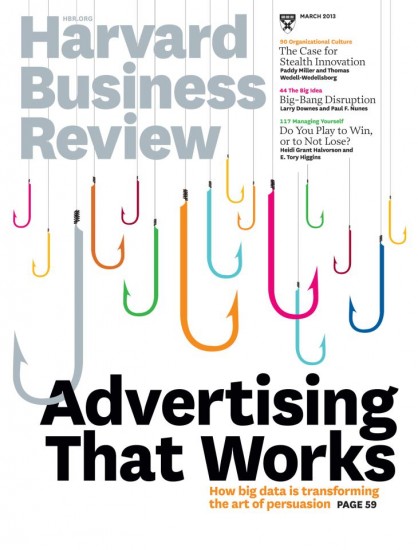
In the upcoming issue of Harvard Business Review, my colleague Paul Nunes at Accenture’s Institute for High Performance and I are publishing the first of many articles from an on-going research project on what we are calling “Big Bang Disruption.”
The project is looking at the emerging ecosystem for innovation based on disruptive technologies. It expands on work we have done separately and now together over the last fifteen years.
Our chief finding is that the nature of innovation has changed dramatically, calling into question much of the conventional wisdom on business strategy and competition, especially in information-intensive industries–which is to say, these days, every industry.
The drivers of this new ecosystem are ever-cheaper, faster, and smaller computing devices, cloud-based virtualization, crowdsourced financing, collaborative development and marketing, and the proliferation of mobile everything. There will soon be more smartphones sold than there are people in the world. And before long, each of over one trillion items in commerce will be added to the network.
The result is that new innovations now enter the market cheaper, better, and more customizable than products and services they challenge. (For example, smartphone-based navigation apps versus standalone GPS devices.) In the strategy literature, such innovation would be characterized as thoroughly “undiscplined.” It shouldn’t succeed. But it does. Continue reading →
When the smoke cleared and I found myself half caught-up on sleep, the information and sensory overload that was CES 2013 had ended.
There was a kind of split-personality to how I approached the event this year. Monday through Wednesday was spent in conference tracks, most of all the excellent Innovation Policy Summit put together by the Consumer Electronics Association. (Kudos again to Gary Shapiro, Michael Petricone and their team of logistics judo masters.)
The Summit has become an important annual event bringing together legislators, regulators, industry and advocates to help solidify the technology policy agenda for the coming year and, in this case, a new Congress.
I spent Thursday and Friday on the show floor, looking in particular for technologies that satisfy what I coined the The Law of Disruption: social, political, and economic systems change incrementally, but technology changes exponentially.
What I found, as I wrote in a long post-mortem for Forbes, is that such technologies are well-represented at CES, but are mostly found at the edges of the show–literally. Continue reading →
by Larry Downes and Geoffrey A. Manne
Now that the election is over, the Federal Communications Commission is returning to the important but painfully slow business of updating its spectrum management policies for the 21st century. That includes a process the agency started in September to formalize its dangerously unstructured role in reviewing mergers and other large transactions in the communications industry.
This followed growing concern about “mission creep” at the FCC, which, in deals such as those between Comcast and NBCUniversal, AT&T and T-Mobile USA, and Verizon Wireless and SpectrumCo, has repeatedly been caught with its thumb on the scales of what is supposed to be a balance between private markets and what the Communications Act refers to as the “public interest.” Continue reading →
On Friday evening, I posted on CNET a detailed analysis of the most recent proposal to surface from the secretive upcoming World Conference on International Telecommunications, WCIT 12. The conference will discuss updates to a 1988 UN treaty administered by the International Telecommunications Union, and throughout the year there have been reports that both governmental and non-governmental members of the ITU have been trying to use the rewrite to put the ITU squarely in the Internet business.
The Russian federation’s proposal, which was submitted to the ITU on Nov. 13th, would explicitly bring “IP-based Networks” under the auspices of the ITU, and would in specific substantially if not completely change the role of ICANN in overseeing domain names and IP addresses.
According to the proposal, “Member States shall have the sovereign right to manage the Internet within their national territory, as well as to manage national Internet domain names.” And a second revision, also aimed straight at the heart of today’s multi-stakeholder process, reads: “Member States shall have equal rights in the international allocation of Internet addressing and identification resources.” Continue reading →
On Friday, California Governor Jerry Brown signed SB 1161, which prohibits the state’s Public Utilities Commission from any new regulation of Voice over Internet Protocol or other IP-based services without the legislature’s authorization.
California now joins over twenty states that have enacted similar legislation.
The bill, which is only a few pages long, was introduced by State Senator Alex Padilla (D) in February. It passed both houses of the California legislature with wide bi-partisan majorities.
California lawmakers and the governor are to be praised for quickly enacting this sensible piece of legislation.
Whatever the cost-benefit of continued state regulation of traditional utilities such as water, power, and landline telephone services, it’s clear that the toolkit of state and local PUCs is a terrible fit for Internet services such as Skype, Google Voice or Apple’s FaceTime. Continue reading →
On Forbes today, I have a long article on the progress being made to build gigabit Internet testbeds in the U.S., particularly by Gig.U.
Gig.U is a consortium of research universities and their surrounding communities created a year ago by Blair Levin, an Aspen Institute Fellow and, recently, the principal architect of the FCC’s National Broadband Plan. Its goal is to work with private companies to build ultra high-speed broadband networks with sustainable business models .
Gig.U, along with Google Fiber’s Kansas City project and the White House’s recently-announced US Ignite project, spring from similar origins and have similar goals. Their general belief is that by building ultra high-speed broadband in selected communities, consumers, developers, network operators and investors will get a clear sense of the true value of Internet speeds that are 100 times as fast as those available today through high-speed cable-based networks. And then go build a lot more of them.
Google Fiber, for example, announced last week that it would be offering fully-symmetrical 1 Gbps connections in Kansas City, perhaps as soon as next year. (By comparison, my home broadband service from Xfinity is 10 Mbps download and considerably slower going up.)
US Ignite is encouraging public-private partnerships to build demonstration applications that could take advantage of next generation networks and near-universal adoption. It is also looking at the most obvious regulatory impediments at the federal level that make fiber deployments unnecessarily complicated, painfully slow, and unduly expensive.
I think these projects are encouraging signs of native entrepreneurship focused on solving a worrisome problem: the U.S. is nearing a dangerous stalemate in its communications infrastructure. We have the technology and scale necessary to replace much of our legacy wireline phone networks with native IP broadband. Right now, ultra high-speed broadband is technically possible by running fiber to the home. Indeed, Verizon’s FiOS network currently delivers 300 Mbps broadband and is available to some 15 million homes.
Continue reading →
On CNET today, I’ve posted a long critique of the recent report by the President’s Council of Advisors on Science and Technology (PCAST) urging the White House to reverse course on a two-year old order to free up more spectrum for mobile users.
In 2010, soon after the FCC’s National Broadband Plan raised alarms about the need for more spectrum for an explosion in mobile broadband use, President Obama issued a Memorandum ordering federal agencies to free up as much as 500 MHz. of radio frequencies currently assigned to them.
After a great deal of dawdling, the National Telecommunications and Information Administration, which oversees spectrum assignments within the federal government, issued a report earlier this year that seemed to offer progress. 95 MHz. of very attractive spectrum could in fact be cleared in the ten years called for by the White House.
But reading between the lines, it was clear that the 20 agencies involved in the plan had no serious intention of cooperating. Their cost estimates for relocation (which were simply reported by NTIA without any indication of how they’d been arrived at or even whether NTIA had been given any details) appeared to be based on an amount that would make any move economically impossible. Continue reading →
During the 1970’s, I remember a bumper sticker that summed up the prevailing anti-colonial attitude that had developed during the late 1960’s: “U.S. Out of North America.”
That sentiment reflects nicely my activities this week, which include three articles decrying efforts by regulators to oversee key aspects of the Internet economy. Of course their intentions—at least publicly—are always good. But even with the right idea, the unintended negative consequences always overwhelm the benefits by a wide margin.
Governments are just too slow to respond to the pace of change of innovations in information technology. Nothing will fix that. So better just to leave well enough alone and intercede only when genuine consumer harm is occurring. And provable.
The articles cover the spectrum from state (California), federal (FCC) and international (ITU) regulators and a wide range of truly bad ideas, from the desire of California’s Public Utilities Commission to “protect” consumers of VoIP services, to the FCC’s latest effort to elbow its way into regulating broadband Internet access at the middle milel, to a proposal from European telcos to have the U.N. implement a tariff system on Internet traffic originating from the U.S.
Continue reading →