Articles by Adam Thierer 
 Senior Fellow in Technology & Innovation at the R Street Institute in Washington, DC. Formerly a senior research fellow at the Mercatus Center at George Mason University, President of the Progress & Freedom Foundation, Director of Telecommunications Studies at the Cato Institute, and a Fellow in Economic Policy at the Heritage Foundation.
The week-long Cato Unbound online debate about the 10th anniversary of Lawrence Lessig’s Code and Other Laws of Cyberspace continues today with Prof. Lessig’s response to Declan McCullagh’s opening essay, “What Larry Didn’t Get,” Jonathan Zittrain’s follow-up essay, and my essay on, “Code, Pessimism, and the Illusion of ‘Perfect Control.’” Needless to say, Prof. Lessig isn’t too happy with my response. You should jump over to the Cato site to read the entire thing, but here are a couple of excerpts and my response.
To my suggestion that there is a qualitative difference between law and code, Prof. Lessig says:
I’ve argued that things aren’t quite a simple as some libertarians would suggest. That there’s not just bad law. There’s bad code. That we don’t need to worry just about Mussolini. We also need to worry about DRM or the code AT&T deploys to help the government spy upon users. That public threats to liberty can be complemented by private threats to liberty. And that the libertarian must be focused on both. […]
Of course, law is law. Who could be oblivious to that? And who would need a book to explain it? But the fact that “law is law” does not imply that it has a “much greater impact in shaping markets and human behavior.” Sometimes it does — especially when that “law” is delivered by a B1 bomber. But ask the RIAA whether it is law or code that is having a “greater impact in shaping markets” for music. Or ask the makers of Second Life whether the citizens of that space find themselves more constrained by the commercial code of their geo-jurisdiction or by the fact that the software code of Second Life doesn’t permit you simply to walk away (so to speak) with another person’s scepter. Whether and when law is more effective than code is an empirical matter — something to be studied, and considered, not dismissed by banalities spruced up with italics.
Well, I beg the professor’s pardon for excessive use of italics. [I won’t ask for an apology for misspelling my last name in his piece!] Regardless, it’s obvious that we’ll just never see eye-to-eye on the crucial distinction between law and code. Again, as I stated in my essay: “With code, escape is possible. Law, by contrast, tends to lock in and limit; spontaneous evolution is supplanted by the stagnation of top-down, one-size-fits-all regulatory schemes.”
Lessig largely dismisses much of this with that last line above, suggesting that we just need to keep studying the matter to determine the right mix of what works best. To be clear, while I’m all for studying the impact of law vs. code as “an empirical matter,” that in turn begs the question of how we define effectiveness or success. I suspect that the professor and I would have a “values clash” over some rather important first principles in that regard. This is, of course, a conflict of visions that we see throughout the history of philosophy; a conflict between those who put the individual and the individual’s rights at the core of any ethical political system versus those who would place the rights of “the community,” “the public” or some other amorphous grouping(s) at the center of everything. It’s a classic libertarian vs. communitarian / collectivist debate.
Continue reading →
Ted Dziuba has penned a humorous and sharp-tongued piece for The Register about last week’s Adblock vs. NoScript fiasco. For those of you who aren’t Firefox junkies, a nasty public spat broke out between the makers of these two very popular Firefox Browser extensions (they are the #1 and #3 most popular downloads respectively). To make a long and complicated story much shorter, basically, NoScript didn’t like Adblock placing them on their list of blacklisted sites and so they fought back by tinkering with the NoScript code to evade the prohibition. Adblock responded by further tinkering with their code to circumvent the circumvention! And then, as they say, words were exchanged.
Thus, a war of words and code took place. In the end, however, it had a (generally) happy ending with NoScript backing down and apologizing. Regardless, Mr. Dzuiba doesn’t like the way things played out:
The real cause of this dispute is something I like to call Nerd Law. Nerd Law is some policy that can only be enforced by a piece of code, a public standard, or terms of service. For example, under no circumstances will a police officer throw you to the ground and introduce you to his friend the Tazer if you crawl a website and disrespect the robots.txt file.
The only way to adjudicate Nerd Law is to write about a transgression on your blog and hope that it gets to the front page of Digg. Nerd Law is the result of the pathological introversion software engineers carry around with them, being too afraid of confrontation after that one time in high school when you stood up to a jock and ended up getting your ass kicked.
Dziuba goes on to suggest that “If you actually talk to people, network, and make agreements, you’ll find that most are reasonable” and, therefore, this confrontation and resulting public fight could have been avoided. They “could have come to a mutually-agreeable solution,” he says.
But no. Sadly, software engineers will do what they were raised to do. And while it may be a really big hullabaloo to a very small subset of people who Twitter and blog their every thought as if anybody cared, to the rest of us, it just reaffirms our knowledge that it’s easy to exploit your average introvert. After all, what’s he gonna do? Blog about it?
OK, so maybe the developers could have come to some sort of an agreement if they had opened direct channels of communications or, better yet, if someone at the Mozilla Foundation could have intervened early on and mediated the dispute. At the end of the day, however, that did not happen and a public “Nerd War” ensued. But I’d like to say a word in defense of Nerd Law and public fights about “a piece of code, a public standard, or terms of service.”
Continue reading →
Over at the Verizon Policy Blog, Link Hoewing has a sharp piece up entitled, “Of Business Models and Innovation.” He makes a point that I have often stressed in my debates with Zittrain and Lessig, namely, that the whole “open vs. closed” debate is typically greatly overstated or misunderstood. Hoewing correctly argues that:
The point is not that open or managed models are always better or worse. The point is that there is no one “right” model for promoting innovation. There are examples of managed and open business models that have been both good for innovation and bad for it. There are also examples of managed and open models that have both succeeded and failed. The point is in a competitive market to let companies develop business models they believe will serve consumers best and see how things play out.
Exactly right. Moreover, the really important point here is that there exists a diverse spectrum of innovative digital alternatives from which to choose. Along the “open vs. closed” spectrum, the range of digital technologies and business models continues to grow and grow
in both directions. Do you want wide-open, tinker-friendly devices, sites, or software? You got it. Do you want a more closed, simple, and safe online experience? You can have that, too. And there are plenty of choices in between.
This is called progress!
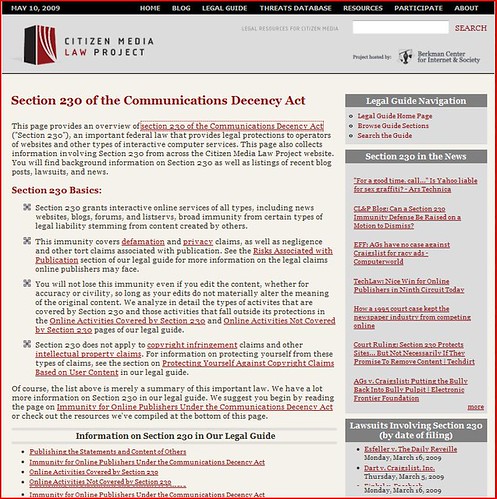
If you’re a cyberlaw geek or tech policy wonk who needs to keep close tabs on Sec. 230 developments, here’s a terrific resource from the Citizen Media Law Project up at the Harvard Berkman Center. The site offers a wealth of background info, including legislative history, all the relevant case law surrounding 230, and breaking news on this front. Just a phenomenal resource; a big THANK YOU! to the folks at CMLP who put this together.
If you’re interested in these issues, you might also want to check out this friendly debate that Harvard’s John Palfrey and I engaged in over at Ars recently as well as my essay on how Sec. 230 has spawned a “utopia of utopias” online.
The Cato Unbound online debate about the 10th anniversary of Lawrence Lessig’s Code and Other Laws of Cyberspace continues today with my response to Declan McCullagh’s opening essay, “What Larry Didn’t Get,” as well as Jonathan Zittrain’s follow-up.
In my response, “Code, Pessimism, and the Illusion of ‘Perfect Control,'” I begin by arguing that:
The problem with peddling tales of a pending techno-apocalypse is that, at some point, you may have to account for your prophecies — or false prophecies as the case may be. Hence, the problem for Lawrence Lessig ten years after the publication of his seminal book, Code and Other Laws of Cyberspace.
I go on to argue that:
Lessig’s lugubrious predictions proved largely unwarranted. Code has not become the great regulator of markets or enslaver of man; it has been a liberator of both. Indeed, the story of the past digital decade has been the exact opposite of the one Lessig envisioned in Code.
After providing several examples of just how wrong Lessig’s predictions were, I then ask:
[W]hy have Lessig’s predictions proven so off the mark? Lessig failed to appreciate that markets are evolutionary and dynamic, and when those markets are built upon code, the pace and nature of change becomes unrelenting and utterly unpredictable. With the exception of some of the problems identified above, a largely unfettered cyberspace has left digital denizens better off in terms of the information they can access as well as the goods and services from which they can choose. Oh, and did I mention it’s all pretty much free-of-charge? Say what you want about our cyber-existence, but you can’t argue with the price!
Continue reading →
As I mentioned on Monday, the folks over at Cato Unbound have put together an online debate about the impact of Lawrence Lessig’s Code and Other Laws of Cyberspace as it turns 10 this year.
The opening essay from Declan McCullagh, “What Larry Didn’t Get,” took Lessig to task for favoring rule by “technocratic philosopher kings” over the spontaneous invisible hand of code. In Round 2 of the debate, Harvard’s Jonathan Zittrain comes to Lessig’s defense and suggests that the gap between Lessig and libertarians is not as wide as Declan suggests:
The debate between Larry and the libertarians is more subtle. Larry says: I’m with you on the aim — I want to maintain a free Internet, defined roughly as one in which bits can move between people without much scrutiny by the authorities or gatekeeping by private entities. Code’s argument was and is that this state of freedom isn’t self-perpetuating. Sooner or later government will wake up to the possibilities of regulation through code, and where it makes sense to regulate that way, we might give way — especially if it forestalls broader interventions.
Run over to Cato Unbound to read the rest. My response will be going up next (on Friday) and then Prof. Lessig’s will be up next Monday.
 Lawrence Lessig’s Code and Other Laws of Cyberspace turns 10 this year and the folks over at Cato Unbound have put together an online debate about the book and its impact on cyberlaw, which I am honored to be taking part in. The discussion begins today with a lead essay from Declan McCullagh of CNet News and then continues throughout the week with responses from Harvard’s Jonathan Zittrain, myself, and then Prof. Lessig himself.
Declan’s lead essay, “What Larry Didn’t Get,” starts things off with a bang:
[Lessig] prefers what probably could be called technocratic philosopher kings, of the breed that Plato’s The Republic said would be “best able to guard the laws and institutions of our State — let them be our guardians.” These technocrats would be entrusted with making wise decisions on our behalf, because, according to Lessig, “politics is that process by which we collectively decide how we should live.”
Declan goes on to cite a litany of high-profile legislative and regulatory failures that have unfolded over the past decade, calling into question the wisdom of Prof. Lessig’s approach. Declan continues:
One response might be that the right philosopher-kings have not yet been elevated to the right thrones. But assuming perfection on the part of political systems (especially when sketching plans to expand their influence) is less than compelling. The field of public choice theory has described many forms of government failure, and there’s no obvious reason to exempt Internet regulation from its insights about rent-seeking and regulatory capture.
Sounds like it could be a heated discussion! Jonathan Zittrain is up next with an essay due to be posted on Wednesday and then my response will follow on Friday. Prof. Lessig’s response will go up a week from today. I look forward to this exchange and the responses it generates. I encourage readers to head over to the Cato Unbound site and check out the essays as they appear. I’ll post reminders here as the installments go live on the Cato site.
I’ve been blathering on about this week’s big Supreme Court decision in FCC v. Fox, [See Parts 1, 2, 3, 4, 5], so I thought I would just wrap this series of essays up with a collection of other articles and views on the decision in case readers are looking for alternative perspectives:
Mainstream Media Stories
Conservative, Religious, & “Family” Groups
Free Speech Advocates or Other Views
I’ve been commenting on yesterday’s Supreme Court decision in FCC v. Fox, and criticizing the logic of the majority’s decision the case, which was driven solely by procedural / admin law considerations. [See Part 3.] I also discussed Justice Thomas’s very interesting concurring opinion, which took a serious look at the constitutional issues in play here and signaled his willingness to potentially overturn Red Lion and Pacifica. [See Part 4.] In this fifth installment, I will briefly outline some of the dissenting arguments.
Justice Stephen Breyer penned a lengthy dissent and was joined by Justices Stevens, Souter and Ginsburg. Like the Scalia majority decision, the Breyer dissent also focused on the procedural / APA-related issues at stake in the case. Breyer, however, was not buying the FCC’s assertion that it had adequately justified its significant expansion of indecency enforcement in recent years. Whereas the majority deferred to the agency and found “no basis in the Act or this Court’s opinions for a requirement that all agency change be subjected to more searching review,” the four dissenting justices saw things quite differently. Breyer noted that while the “law grants those in charge of independent administrative agencies broad authority to determine relevant policy,” it “does not permit them to make policy choices for purely political reasons nor to rest them primarily upon unexplained policy preferences.” He goes on to appropriately note that:
Federal Communications Commissioners have fixed terms of office; they are not directly responsible to the voters; and they enjoy an independence expressly designed to insulate them, to a degree, from “‘the exercise of political oversight.’” [citations omitted] That insulation helps to secure important governmental objectives, such as the constitutionally related objective of maintaining broadcast regulation that does not bend too readily before the political winds. But that agency’s comparative freedom from ballot-box control makes it all the more important that courts review its decision making to assure compliance with applicable provisions of the law — including law requiring that major policy decisions be based upon articulable reasons.
Breyer goes on to restate much of what is already clear from the APA and all that surrounds it. “[A]n agency must act consistently. The agency must follow its own rules,” he notes. Moreover: Continue reading →
Today, the U.S. Department of Commerce’s National Telecommunications and Information Administration (NTIA) announced the members of the new Online Safety and Technology Working Group (OSTWG). I am honored to be among those chosen to participate in this new task force and I look forward to continuing the work started last year with the Harvard Berkman Center’s Internet Safety Technical Task Force (ISTTF), which I also served on. I was very proud of the work done by the ISTTF and the impressive final report that Prof. John Palfrey crafted to reflect our findings. I am eager to investigate these issues further and take a look at the latest research and technologies that can help us better understand how to protect our kids online while also protecting the free speech and privacy rights of Netizens.
The new NTIA working group, which was established under the “Protecting Children in the 21st Century Act,” will report to the Assistant Secretary of Commerce for Communications and Information on industry-implemented online child safety tools and efforts. Within a year of convening its first meeting, the group will submit a report of its findings and make recommendations on how to increase online safety measures.
Below the fold I have listed the complete roster of OSTWG task force members. I very much looking forward to working with this outstanding group. And I’m happy to report that my TLF blogging colleague Braden Cox will be joining me on this task force!
Continue reading →

 The Technology Liberation Front is the tech policy blog dedicated to keeping politicians' hands off the 'net and everything else related to technology.