Articles by Adam Thierer

Avatar photoSenior Fellow in Technology & Innovation at the R Street Institute in Washington, DC. Formerly a senior research fellow at the Mercatus Center at George Mason University, President of the Progress & Freedom Foundation, Director of Telecommunications Studies at the Cato Institute, and a Fellow in Economic Policy at the Heritage Foundation.


TLF at 5 logoFive years ago today the Technology Liberation Front (the “TLF”) got underway with this post.  The idea for the TLF came about after I asked some tech policy wonks whether it was worth put together a blog dedicated to covering Internet-related issues from a cyber-libertarian perspective.  The model I had in mind was a “Volokh Conspiracy for Tech Issues,” if you will. I wanted to bring together a collection of sharp, liberty-loving wonks (most of whom worked in the think tank world) to talk about their research on this front and to give them a place to post their views on breaking tech policy developments.  It was to be a sort of central clearinghouse for libertarian-oriented tech policy analysis and advocacy.

At first, Tim Lee and I debated whether it even made sense to have that sort of narrow focus, but I think the passage of time and the rise of plenty of competition on this front shows that it was worthwhile.  And I’ve been very pleased with the tag-team effort of all our TLF contributors and the way—without anyone planning it, in true libertarian fashion—we’ve sort of developed a nice division of labor on various tech policy issues.

Perhaps a few stats are in order on this occasion to mark our progress 5 years in. The best indication of our success is the fact that our Pagerank (Google’s logarithmic scale of website importance based on links to that site) has reached 7/10—the same score shared by the Volokh Conspiracy (our model), as well as Techmeme (the leading tech news aggregator), the Cato Institute, CDT, etc. (For comparison: ArsTechnica and EFF are 8s.) Unfortunately, we’ve only been using Google Analytics for three of the past five years, so it’s impossible to get a authoritative accounting of traffic growth since Day 1. But here are few markers:

So, what’s our #1 post of all-time? Continue reading →

libertyby Adam Thierer & Berin Szoka — (Ver. 1.0 — Summer 2009)

We are attempting to articulate the core principles of cyber-libertarianism to provide the public and policymakers with a better understanding of this alternative vision for ordering the affairs of cyberspace. We invite comments and suggestions regarding how we should refine and build-out this outline. We hope this outline serves as the foundation of a book we eventually want to pen defending what we regard as “Real Internet Freedom.” [Note:  Here’s a printer-friendly version, which we also have embedded down below as a Scribd document.]

I. What is Cyber-Libertarianism?

Cyber-libertarianism refers to the belief that individuals—acting in whatever capacity they choose (as citizens, consumers, companies, or collectives)—should be at liberty to pursue their own tastes and interests online.

Generally speaking, the cyber-libertarian’s motto is “Live & Let Live” and “Hands Off the Internet!”  The cyber-libertarian aims to minimize the scope of state coercion in solving social and economic problems and looks instead to voluntary solutions and mutual consent-based arrangements.

Cyber-libertarians believe true “Internet freedom” is freedom from state action; not freedom for the State to reorder our affairs to supposedly make certain people or groups better off or to improve some amorphous “public interest”—an all-to convenient facade behind which unaccountable elites can impose their will on the rest of us.

Continue reading →

What Unites Advocates of Speech Controls & Privacy Regulation? [pdf]

by Adam Thierer & Berin Szoka The Progress & Freedom Foundation, Progress on Point No. 16.19

Anyone who has spent time following debates about speech and privacy regulation comes to recognize the striking parallels between these two policy arenas. In this paper we will highlight the common rhetoric, proposals, and tactics that unite these regulatory movements. Moreover, we will argue that, at root, what often animates calls for regulation of both speech and privacy are two remarkably elitist beliefs:

  1. People are too ignorant (or simply too busy) to be trusted to make wise decisions for themselves (or their children); and/or,
  2. All or most people share essentially the same values or concerns and, therefore, “community standards” should trump household (or individual) standards.

While our use of the term “elitism” may unduly offend some understandably sensitive to populist demagoguery, our aim here is not to launch a broadside against elitism as Time magazine culture critic William H. Henry once defined it: “The willingness to assert unyieldingly that one idea, contribution or attainment is better than another.”[1] Rather, our aim here is to critique that elitism which rises to the level of political condescension and legal sanction. We attack not so much the beliefs of some leaders, activists, or intellectuals that they have a better idea of what it in the public’s best interest than the public itself does, but rather the imposition of those beliefs through coercive, top-down mandates.

That sort of elitism—elitism enforced by law—is often the objective of speech and privacy regulatory advocates. Our goal is to identify the common themes that unite these regulatory movements, explain why such political elitism is unwarranted, and make it clear how it threatens individual liberty as well as the future of free and open Internet. As an alternative to this elitist vision, we advocate an empowerment agenda: fostering an environment in which users have the tools and information they need to make decisions for themselves and their families. Continue reading →

I’ve spent a lot of time here deconstructing and criticizing the proposals set forth by the Free Press, the radical media “reformista” group founded by the prolific Marxist media theorist Robert McChesney.  I have been trying to shine more light on their proposals and activities because I believe they are antithetical to freedom of speech and a free society.  That’s because, as media scholar Ben Compaine has noted, “What the hard core reformistas really want, it seems, is not diversity or an open debate but a media that promotes their own vision of society and the world.”  That’s exactly right and, more specifically, as I argued in my 2005 Media Myths book, the media reformistas want to impose this control by taking the fantasy that “the public owns the [broadcast] airwaves” and extending it to ALL media platforms and outlets.  In other words, McChesney and the Free Press want an UnFree Press.  To cast things in neo-Marxist terms that they could appreciate, they want to take control of the information means of production.  And it begins, McChesney argues, by all of us having to give up this “sort of religious attachment to the idea of a ‘free-press'” from which we all suffer.

Some people accuse me of “red-baiting” or “McCarthyite” tactics when I use the “M-word” (Marxism) or the “S-Word” (socialism) to describe McChesney, the Free Press, and the movement they have spawned.  But these are labels with real meaning and ones that McChesney himself embraces in his work. In his 1999 book Rich Media, Poor Media, he says that “Media reform cannot win without widespread support and such support needs to be organized as part of a broad anti-corporate, pro-democracy movement.” He casts everything in “social justice” terms and speaks of the need “to rip the veil off [corporate] power, and to work so that social decision making and power may be made as enlightened and as egalitarian as possible.”  What exactly would all that mean in practice for media? In his 2002 book Our Media, Not Theirs: The Democratic Struggle against Corporate Media with John Nichols of The Nation, McChesney argues that media reform efforts must begin with “the need to promote an understanding of the urgency to assert public control over the media.” They go on to state that, “Our claim is simply that the media system produces vastly less of quality than it would if corporate and commercial pressures were lessened.”

If you want additional proof of his intentions, then I encourage you to read this lengthy interview with McChesney that appears in the new edition of The Bullet, an online newsletter produced by the Canada-based “Socialist Project.”  (If you ask me, there’s something strangely appropriate about a socialist newsletter named “The Bullet” in light of the millions of people who died while living under socialist tyranny!)  Anyway, let’s ignore that and focus on what neo-Marxist media reform entails according to McChesney.  Because never before has he laid his cards on the table as clearly as he does in this interview. Continue reading →

The Economist magazine has just released an important feature article entitled, “Sex Laws: Unjust and Ineffective.” In an indirect way, the article makes a point that I have been trying to get across in my work on this issue: If you want to keep your kids safe from real sex offenders, we need to scrap our current sex offender registries and completely rethink the way we define and punish sex offenses in this country.  That’s because, currently, a significant percentage of those people listed in sex offender registries pose almost no threat to children, making it difficult for us to know who really does pose a threat to our kids and what we should do about them.

Simply stated, we’ve dumbed-down the notion of “sex crimes” in this country. As a nation, we have foolishly come to equate almost all sex offenses equally.  While sex offender registry laws vary from state to state, many basically say that that two teens caught engaging in consensual oral sex in high school belong on the same list alongside child rapists. That is insanity. And it leaves many in the public, especially parents, thinking that the whole world is full of predators lurking on every corner just waiting to snatch, rape, and kill their children. [ For the actual facts, see the appendix I have included down below: “Is America Suffering from a National Child Abduction Epidemic”?]  In reality, as The Economist feature story points out, the truth is quite different: Continue reading →

iphoneDespite my frequent disagreements with his policy conclusions, Farhad Manjooo of Slate is one of the most gifted tech policy pundits around today and everything he writes is worth reading (and I whole-heartedly agreed with his recent article on the high-tech and antitrust).  Alas, I find myself again disagreeing with him again today.

In his latest column, “The Great iPhone Lockdown: Should the FCC force Apple to sell Google’s apps?” Manjoo responds to a recent essay by TLF contributor Ryan Radia (“Newsflash to FCC: The iPhone is a Closed Platform, and Consumers Love It“). In that essay, Ryan generally argued that: (a) a lot of people own and love the iPhone despite some silly restrictions on certain apps; and (b) if they don’t like that, there are plenty of other options from which they can choose. Consequently, regulation seems unwarranted and likely highly misguided in light of the potential unitended consequences in might yield.  It’s an argument I very much agree with, of course.  Anyway, Manjoo responds:

Radia’s argument isn’t crazy. Just the other day, I argued that the government shouldn’t go after Google for antitrust violations because the tech industry is fluid; companies that are on top today can fall tomorrow. So what if Apple rejects apps capriciously? If its actions are so terrible, consumers will eventually abandon it.

But then Manjoo counters that argument and goes completely off-the-rails with several assertions that I find quite perplexing: Continue reading →

CCI’m not sure how I missed this, but someone just pointed out to me that in late July, the city of Amherst, NY, “failed to approve a game license for [Chuck E. Cheese’s] the kids-themed food and entertainment venue… citing concerns about violent video games and bad behavior by patrons that require police intervention.”  That is according to this article by Sandra Tan in The Buffalo News.  Tan reports that the Amherst Town Board deadlocked 3-3 when considering the license for Chuck E. Cheese’s, apparently meaning that the pizza and arcade hot spot for kids will no longer be able to offer games at their Amherst venue. According to her article, game content considerations drove the move:

Council Member Shelly Schratz said she was disturbed by several “action-packed shoot-and-kill games” that were accessible to children as young as 4.  “When I see 6-year-olds, 8-year-olds playing those games, when all the time we’re opening the paper and seeing those stories on youth violence, do we need those games to make money?” she said.  Schratz was one of three board members who voted against renewing the establishment’s game room license, which is necessary for the business to legally run its arcade games, a major draw for families that patronize the chain’s 500-plus locations from coast to coast.

I find the actions of Amherst in this case to be quite troubling. Here are a few quick thoughts about this incident: Continue reading →

Over at Twitter, our TLF blogging colleague Jerry Brito asks a smart question about the Federal Communications Commission’s recently-opened investigation of the Apple-Google spat over Apple’s recent decision to reject the Google Voice app from the iPhone App Store.  Jerry asks: “Maybe I should know this, but what authority does the FCC have to demand that Apple explain anything?”  Good question, Jerry!  But no, I don’t think there’s anything you’re missing.  We might consider this merely the latest chapter of the agency’s rogue operator history: If you can’t find the authority to do something, just assert it anyway and go for broke!  The idea of living within the confines of the law and paying attention to statutory authority seems like an alien concept to the FCC.  As my PFF colleagues Barbara Esbin and Adam Marcus have pointed out in their amazing recent law review article, “The Law Is Whatever the Nobles Do: Undue Process at the FCC,” when all else fails, the agency just asserts “ancillary jurisdiction” and claims that the whole world is their oyster. They argue:

The FCC’s means of asserting regulatory authority over broadband Internet service providers’ (“ISP”) network management practices is unprecedented, sweeping in its breadth, and seemingly unbounded by conventional rules of interpretation and procedure. We should all be concerned, for apparently what we have on our hands is a runaway agency, unconstrained in its vision of its powers.

Of course, even if we ignore the agency’s cavalier attitude about the law and statutory authority, there are other reasons to be concerned about FCC interference in this matter. Continue reading →

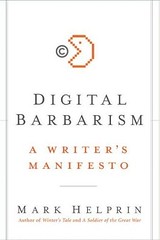
Last month, Digital Barbarism book cover National Review magazine published a review that I penned of Mark Helprin’s new book, Digital Barbarism: A Writer’s Manifesto.  Helprin’s book is both a passionate defense of copyright law as well as a mini-autobiography.  Helprin is one of the great novelists and essayists of the past half-century, and his book A Soldier of a Great War is one of my all-time favorite novels.  I cannot in strong enough words encourage you to read that book; it is profoundly moving. (I almost named my son after the lead character in the book!)

Thus, I was quite excited when I learned that Helprin had penned a defense of copyright and I jumped at the chance to review it when the folks at National Review asked me to do so.  Alas, as you will see in my review, I was terribly disappointed.  I wish Helprin would have stuck with the very reasonable tone he adopted in this excellent podcast interview he did recently with John J. Miller of National Review Online. Unfortunately, he went a different direction in the book, as I make clear in my review:


National Review July 20, 2009

“Man, Machine, and Copyright” a review of Digital Barbarism: A Writer’s Manifesto, by Mark Helprin by Adam Thierer

It would be difficult to think of anyone more ideally suited to pen a passionate defense of copyright law than novelist Mark Helprin.  Helprin has written several of the finest works of modern literature, including his masterpiece, A Soldier of the Great War, a narrative of transcendent beauty. In Digital Barbarism, Helprin sets out to use his formidable gift for the written word to repel the “cyber mob” that has attacked copyright law and called for its curtailment, or even abolition.

Unfortunately, while Helprin occasionally rises to great heights in his defense of copyright, he too often sinks to lamentable lows — by resorting to the same unbecoming rhetorical tactics used by the mob he seeks to condemn. Indeed, his book is filled with gratuitous vitriol and neo-Luddite ramblings about the Internet and Information Age that severely detract from his defense of copyright. This is a shame, because, in places, Digital Barbarism makes a fine case against those critics who wrongly view copyright as an impediment to the creation and diffusion of content. “The availability of information is not and will not be restrained by the copyright system any more than it is or will be restrained by the delivery systems that make it possible,” Helprin argues. Why, he asks, “must ‘content’ be free” when everything else — access to the Internet, digital devices, etc. — costs good money? He notes that the movement that advocates “free,” universal access to all copyrighted material in the name of “openness” and “the public good” would, ironically, “destroy the dream it advocates”: Continue reading →

A key point that Berin and I try to get across in our Forbes editorial today about the Yahoo!-Microsoft deal is that the high-tech marketplace evolves too rapidly for creaky Analog Era antitrust laws to keep up. We wanted to say more on that point in our piece, but we had a tight deadline (and a strict word limit!)  Well, turns out that we really don’t need to do so now because Farhad Manjoo of Slate has done a better job than we ever could have making that point in this essay today entitled, “The Case Against the Case Against Google“:

But if the government was right on the facts [in the Microsoft case], it was wrong on the big picture. The theory behind the prosecution was that Microsoft’s mobster tactics would raise the price of software and slow down innovation. But that didn’t happen. In 2002, Microsoft settled the antitrust case with the Bush administration; it faced no substantial penalties for its years of bad behavior. At that point, it still looked unbeatable—it had the same OS monopoly, office-software monopoly, and Web-browser monopoly. And you know what happened? It got beat anyway. Many of Microsoft’s assets turned out not to matter, because upstarts like Google and old foes like Apple found ways to innovate around them.

Continue reading →