Articles by Adam Thierer 
 Senior Fellow in Technology & Innovation at the R Street Institute in Washington, DC. Formerly a senior research fellow at the Mercatus Center at George Mason University, President of the Progress & Freedom Foundation, Director of Telecommunications Studies at the Cato Institute, and a Fellow in Economic Policy at the Heritage Foundation.
The Berkman Center for Internet & Society at Harvard Law School has just announced the formation of the Internet Safety Technical Task Force, and they were kind enough to ask me to serve as a member. According to the press release they sent out this morning:
The Task Force will evaluate a broad range of existing and state-of-the-art online safety technologies, including a review of identity authentication tools to help sites enforce minimum age requirements. The Task Force is a central element of the Joint Statement on Key Principles of Social Networking Safety announced in January 2008 by MySpace and the Attorneys General Multi-State Working Group on Social Networking. Fifty Attorneys General adopted the “Joint Statement” with the goal of improving online safety standards industry-wide.
[I discussed the details of that My Space-AG “joint statement in this report back in January.] The Task Force is composed of industry-leading Internet businesses, non-profit organizations, and technology companies, including: AOL, Aristotle, AT&T, Bebo, Center for Democracy & Technology, Connectsafely.org, Comcast, Enough is Enough, Facebook, Google, the Family Online Safety Institute, iKeepSafe, the Institute for Policy Innovation, Linden Lab, Loopt, IDology, Microsoft, MySpace, NCMEC, Progress and Freedom Foundation, Sentinel Tech, Symantec, Verizon, WiredSafety.org, Xanga, and Yahoo! The Task Force will be chaired by John Palfrey, executive director of the Berkman Center.
Over the past year, I have been very active on many of the issues that will be at the core of the task force’s mission, including the identify authentication / age verification debate. For those who might be interested, I’ve included the relevant PFF studies and links down below the fold. I’m looking forward to working with the other members of the Task Force to conduct a comprehensive review of these issues. I’m sure I will be reporting here occasionally on our progress.
Continue reading →
As I mentioned way back in 2005, the specter of FCC content controls for cell phone and other mobile media devices is growing. And, according to this new Radio Ink report, it’s now under serious consideration at the FCC:
FCC Commissioner Deborah Taylor Tate says the FCC is looking into how its indecency regulations could extend to the increasing availability of audio and video content delivered to mobile devices. In a recent speech delivered at the Association of National Advertisers Advertising Law and Business Affairs Conference, Tate said, “As we enter the age of content delivery over mobile devices, there is a whole new set of questions to address regarding how to provide ratings, how to block objectionable content, and whether the FCC has a role to play in this arena.”
To be fair, Commissioner Tate also praised the voluntary steps that industry has already taken to empower parents to deal with this privately. And Tate also said that, “market-based solutions are the best way to achieve our shared goals and to provide parents the tools they need to be the first line of defense for their children.” But the threat of more aggressive intervention by the FCC still looms in light of her earlier comments. Stay tuned; much more to come on this front.
Tom Bell–who I regarded as the the equivalent of my Jedi master in the mid-90s–suggested in a post earlier today that:
“Copyright holders thus understandably fear that their customers have begun to treat expressive works like common property, free for all to use. That, the specter of copyism, does risk upsetting copyright policy, leading to a market failure in the production of expressive works. Even as we recognize that threat, however, we should also appreciate that technological advances have greatly reduced the costs of creating and distributing new works of authorship. Thanks to that deflation, we can increasingly count on authors who care little about the lucre of copyright — blockheads, as Samuel Johnson called them — to supply us with original expressive works.”
As his once lowly Padawan learner, I know to be cautious when questioning my old master’s wisdom. But I must humbly ask: How, dear master, does a video game this frickin cool and complex get created in a world devoid of serious copyright protections? It’s a question I have asked before here and I have never received an answer that satisfied my fear of losing some of the truly great content that gets created only because of the protections afforded by existing copyright standards.
I await your enlightenment, my master. Because I can’t imagine many “blockheads” providing us with expressive works like this without some sort of guarantee that their creative efforts will not be completely expropriated.
http://image.com.com/gamespot/images/cne_flash/production/media_player/proteus/gs/proteus_embed.swf
[More videos of “Star Wars: The Force Unleashed” can be found here.]
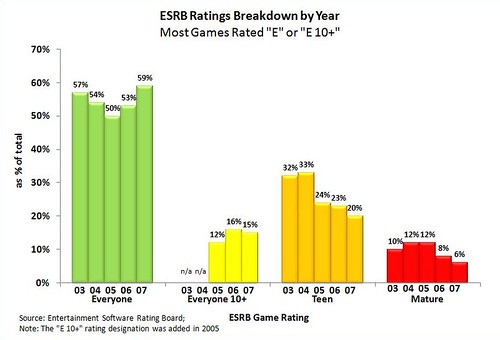
If the comments of some lawmakers and video game critics were any guide, the public would be led to believe that most video games are filled with explicit violence or sexual themes. But that’s a myth. The fact is, as I pointed out in my 2006 PFF study “Fact and Fiction in the Debate Over Video Game Regulation,” the vast majority of video games are appropriate for young kids. That is, the majority of video games are rated “E” for “Everyone” or “E 10+” for “Everyone 10 and older” by the Entertainment Software Rating Board (ESRB).
I decided to put together an updated chart illustrating this fact in preparation for a keynote address I will be delivering at a Penn State University conference in early April entitled, “Playing to Win: The Business and Social Frontiers of Videogames.” Here is the breakdown of ratings by major category from 2003-2007.
Continue reading →
One of the many reasons that those of who us cherish free markets and limited government oppose net neutrality regulation is because we believe it will be a major step down the slippery slope to far more comprehensive regulation of the Internet. Once we let this regulatory genie out of the bottle and the bureaucrats get their tentacles around the Net, a host of other misguided restrictions on Internet activities will likely follow.
One of the more destructive of these potential outcomes would be full-blown structural separation of broadband networks, such that government would force network owners to spin off their retail arms and become pure wholesalers of access (on government-set terms and price-controlled rates, of course). In a nutshell, this is the old regulatory playbook that did very little to benefit consumers or competition. Amazingly, however, we already have someone suggesting it as the logical next step after we get done slapping net neutrality mandates on the Internet. Writing in the
Boston Globe on Saturday, David Weinberger a fellow at the Harvard Berkman Center, says we need to take the next step and think about busting up broadband networks into atomistic bits:
“An Internet delivered by a tiny handful of old-technology providers, even if constrained by Net neutrality, doesn’t get us to the second vision. It doesn’t give us access laid like a blanket over the entire country, rich and poor alike. It doesn’t give us a Net that we make together, rather than a Net the contents of which we consume. For that, we need more than Net neutrality. We need a structural change. We gave the incumbent providers their chance. They have failed. The FCC could decide to once again require them to act as wholesalers to local Internet Service Providers, which would offer genuine competition on price, access, reliability, services, and whatever other differentiators an open market would devise.”
Back in 2002, Wayne Crews and I penned a paper for Cato entitled, “The Digital Dirty Dozen: The Most Destructive High-Tech Legislative Measures of the 107th Congress,” and we named a structural separation proposal floating through Congress at that time as the single most destructive measure of the year. What we said then of structural separation for older wireline telecom networks is every bit as true today regarding proposals to impose structural separation on broadband networks–perhaps even more so since we would be talking about structural separation for telco, cable and wireless networks. As Wayne and I argued back in ’02:
Continue reading →
I hate to disagree with my friend Larry Magid, a technology analyst for CBS News, who writes this week in favor of a uniform online sales tax regime. Magid says he “can’t think of any good reason why customers of online retailers should shop tax-free while people who spend their money locally have to pay sales tax.” Well, I’ve got a couple of good reasons, Larry.
Back in 2003, Veronique de Rugy [now of the Mercatus Center] and I penned a lengthy Cato Institute white paper on this issue entitled, “The Internet Tax Solution: Tax Competition, Not Tax Collusion.” In that study, we addressed the arguments in favor of the so-called Streamlined Sales Tax Project (SSTP) and noted that a move toward more simplified tax regimes was certain laudable. In reality, however, the effort by states to build a “uniform” sales tax regime for online sales was less about achieving simplicity and more about raising taxes and imposing tax collection burdens on interstate commerce. Veronique and I pointed out that this created both economic and constitutional concerns since the SSTP was tantamount to a state-run sales tax cartel:
Continue reading →
Got busy last week and failed to blog about this Wall Street Journal column by my colleague Bret Swanson and tech visionary George Gilder about the dangers of net neutrality regulation. They argue that:
The petitions under consideration at the FCC and the Markey net neutrality bill would set an entirely new course for U.S. broadband policy, marking every network bit and byte for inspection, regulation and possible litigation. Every price, partnership, advertisement and experimental business plan on the Net would have to look to Washington for permission. Many would be banned. Wall Street will not deploy the needed $100 billion in risk capital if Mr. Markey, digital traffic cop, insists on policing every intersection of the Internet.
And there’s another editorial in today’s WSJ by business author Andy Kessler entitled “Internet Wrecking Ball.” Kessler also points to the innovation-killing nature of NN regulation:
“With net neutrality, there will be no new competition and no incentives for build outs. Bandwidth speeds will stagnate, and new services will wither from bandwidth starvation. … The trick to an open and innovative Internet is not sneaky technical fixes nor more rules and regulations and bureaucracies to enforce them. The Internet will only expand based on competitive principles, not socialist diktat. The more we can do to clear a path, the greater our national wealth will be.”
Make sure to read both pieces.
Anthony Prestia of Laws of Play, a blog dedicated to covering legal developments in the gaming industry, somehow got some face time with Supreme Court Justice Scalia and was able to ask for his feelings concerning the constitutionality of recent state video game legislation. “In particular,” Prestia says, “I asked him whether as an originalist he believed that state laws banning the sale of mature-rated video games to minors ran afoul of the First Amendment.” Here’s Prestia’s summary and analysis of Scalia’s answer:
In his most succinct reply of the day, Justice Scalia replied that he did believe such legislation was constitutional. He began by explaining his belief that sound constitutional precedent holds that minors may be subjected to prohibitions that adults are not–-he instantly drew the parallel to regulation of pornography sales. However, Justice Scalia emphasized that unprotected speech, such as obscenity–which he was unwilling to define for reasons that are immediately evident to any constitutional scholar–-can be prohibited from sale regardless of the purchaser’s age. I think the important thing to note here is that Justice Scalia did not suggest that violent and/or sexual content in games rises to the level of unprotected speech. In fact, he did not even suggest that video games themselves are not protected by the First Amendment despite his strict originalist beliefs.
That’s an interesting response in that Scalia’s latter comments imply that even older, more conservative judges are coming around to understanding how video games are a form of artistic expression deserving the protection of the First Amendment. But Scalia’s earlier suggestion that state laws banning sales of certain video games to minors maybe constitutional deserves a response.
Continue reading →
So here we have one of the world’s leading pornographers lecturing Google & Yahoo about doing more to protect kids for online porn. Just bizarre. Next thing you know, Larry Flynt and Hugh Hefner will be lecturing pay TV operators for not doing enough to stop people from viewing adult VOD channels!
But before Mr. Hirsch makes silly statements like “None of the search engines and portals, but particularly Yahoo and Google, has taken any significant steps” to keep children from viewing online pornography, perhaps he should click on the “Safe Search” buttons on each of those sites to see what each search provider already offers. As I pointed out in my book on “Parental Controls & Online Child Protection,” those safe search tools are surprisingly effective in rooting out most of that porn that Mr. Hirsch and his colleagues produce.
Update: Harold Feld and I often clash on issues, but he’s an incredibly gifted writer and it shows in this absolutely hilarious response to the Hirsch episode. The first paragraph is just priceless:
Every now and then, hypocrisy reaches a level of such cognitive dissonance that it approaches the level of art — or perhaps really low humor. Such is the case of Vivid Entertainment co-founder Steven Hirsch, who recently expressed his deep concern that Google, Yahoo! and other search engines may expose children to porn. Hirsch called on search engines to “erect strong barriers” to children finding pornography. No doubt he also offered to “increase the size of their filtering package” so that their defenses against “naked porn stars and exxxplicit sex acts” could be “rock hard.” Sadly, his personal emails to Eric Schmidt and Jerry Yang on the subject keep getting caught in their spam filters.
I wanted to make sure that everyone saw the filings that Richard Bennett and George Ou made this week to the FCC in the proceedings regarding broadband network management policies. They are excellent. [Richard and George have both been guests on the TLF podcast and discussed these issues here and here in detail.] I thought I’d clip a few of the highlights here, but make sure to read them all the way through.
Here’s some of what Richard had to say:
The four prongs of the Policy Statement do not include a “right to be free of delay” or a “right to
infinite bandwidth”, and in the real world someones ox must be gored when the load offered to a
network segment exceeds its capacity. Hence, the petition for declaratory ruling must be
rejected.
[…]
So this is the choice that Comcast has on its network of today: should it allow a handful of
BitTorrent users to degrade the performance of VoIP and web users to the point of distraction, or
should it limit the bandwidth that BitTorrent users can consume? This is not a hard choice to
make, and the only interesting implications it has concern methods employed and obligations for
disclosure owing to the customer.
[…]
If ISPs have the freedom to experiment with different methods and business models, and
consumers have reasonably broad choices, the market will sort this matter out. Hence the policy
priority should be the promotion of market-based competition between Fiber, DOCSIS, DSL, and
wireless.
[…]
It’s worthwhile to point out that Internet2 schools practice traffic shaping and policing on their
campus networks, for the same reasons that public carriers such as Comcast do: it’s not
economically feasible to build networks around the excessive bandwidth appetites of a few users.
[…]
There are alternative methods and policies that may be employed by ISPs to address problems of network congestion and overload; the market should decide among these, not the government.
Continue reading →

 The Technology Liberation Front is the tech policy blog dedicated to keeping politicians' hands off the 'net and everything else related to technology.