Articles by Adam Thierer 
 Senior Fellow in Technology & Innovation at the R Street Institute in Washington, DC. Formerly a senior research fellow at the Mercatus Center at George Mason University, President of the Progress & Freedom Foundation, Director of Telecommunications Studies at the Cato Institute, and a Fellow in Economic Policy at the Heritage Foundation.
Business Week media columnist Jon Fine penned a “Requiem for Old-Time Radio” this week that illustrates the troubles facing one of America’s oldest media sectors. Fine expresses the same sort of reverence and nostalgia I often do when talking about what radio meant to some of us in our youth:
“I remember what we now call “terrestrial radio” with ridiculous fondness. I recall huddling with it long past bedtime, the volume set low, hoping to hear something I loved. Thus the truism of how radio is the most intimate medium: You’re in bed with the lights out, the music and the DJ’s voice going straight into your brain, the images created are yours alone.”
Radio really did inspire the imagination of a entire generations like that in the past. But, as Fine notes, those generations got old, and so did radio. “Realities of the music world—the explosion in both expression and availability, first on independent labels and now everywhere, thanks to the Internet—began overtaking commercial radio stations well over 20 years ago.” Indeed, as I documented in part 5 of my “Media Metrics” series, the competition for our ears has never been more intense:
Continue reading →
Mari Silbey of MediaExperiences2Go has an interesting post about “The Changing Face of Concurrency.” She examines the various metrics companies and analysts use to study bandwidth flows or to model network activity. These include households passed, penetration ratio, concurrency ratio, and bandwidth. Concurrency represents the number of subscribers likely to be tuned in or logged on at any given time, which is obviously important for cable bandwidth measures or estimated since it is a shared network. It’s not enough to simply be examining penetration ratios or aggregate bandwidth measures when debating network management policies. Concurrency ratios give us a better way to measure what is possible on existing cable infrastructure.
More broadly speaking, the reason all this is important is because we need to have a common set of metrics when evaluating issues that come up in Net neutrality debates since opponents often use different terms and measures when discussing these issues. Anyway, just thought I would highlight her article for that reason.
I have long been intrigued with the effort to regulate online gaming activities because it represents the most sophisticated effort by our government yet to eradicate a specific class of online speech or commerce. (My TLF colleague Tom Bell has done seminal work in this field). In her weekly “The Regulators” column, The Washington Post’s outstanding regulatory columnist Cindy Skrzycki writes about the enforcement challenges at work here:
It’s not easy making rules for a U.S. law intended to deter illegal Internet gambling by choking off the flow of funds to offshore sites. That’s because no one seems to agree on what the law covers. Officials at the Treasury Department and the Federal Reserve found that out after sifting through more than 200 comments from banks, gamblers, church groups and members of Congress on recommendations for the Unlawful Internet Gambling Enforcement Act of 2006. The basic sentiment was that their Oct. 4 proposal, which depends on financial institution enforcement, won’t work.
The outcome will affect 23 million online gamblers, some 2,500 Internet sites and the growth of an industry with an estimated $15 billion in annual global revenue. The law bars financial institutions from processing payments involving Internet gambling — with the notable exceptions of Indian gaming, state gaming and horse racing. “If the federal agencies themselves cannot agree on the law, what hope is there that banks can resolve these confounding legal issues?” the American Bankers Association said in commenting on a conflict between the Treasury and Justice departments on the legality of betting on horses. The Washington trade group said the suggested rules are more likely to catch its members in a compliance trap than stop profits from illegal gambling from escaping offshore.
Continue reading →
Just wanted to let everyone know that two new contributors–Bret Swanson and Ryan Radia–will be joining us here at the TLF.
Bret recently joined PFF to start a new program on trade, globalization & technology policy issues. It’s called the Center for Global Innovation. He’s fighting back against the foolish push to close off our borders to free trade or to limit the flow of technology and e-commerce globally. He’s also working on a big new book about the role of China in the new global economy.
Ryan Radia, a researcher with the Competitive Enterprise Institute, is also joining us. At CEI, Ryan does great work on technology policy along with our own Cord Blomquist. Ryan is also going to be helping us out with TLF podcast production in coming months.
We’re glad to have Bret and Ryan join us and look forward to their contributions to our little “virtual think tank” here at the TLF!
In the previous installment of my ongoing “Media Metrics” series, I highlighted the radical metamorphosis taking place in the market for audible information and entertainment. I showed that this previously stable sector now finds itself in a state of seemingly constant upheaval, especially thanks to the blistering pace of technological change we are witnessing today.
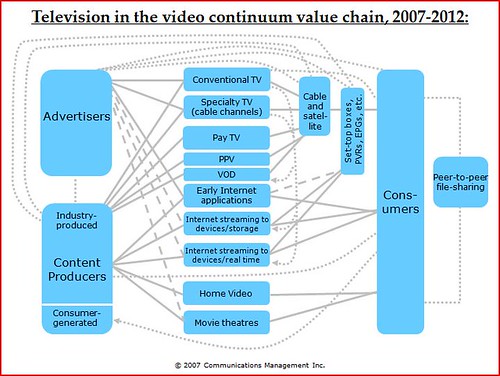
In this sixth installment of the Media Metrics series, we will see how a similar transformation has taken place in the video marketplace over the past three decades. Again, using the analytical framework I presented in the first installment, we will see that today we have more choice, competition, and diversity in every part of the video value chain. [You might also be interested in reviewing the third installment in this series dealing with advertising competition and the fourth installment dealing with changing media fortunes.]
Kenneth Goldstein of Winnipeg, Canada-based Communications Management, Inc., has put together a set of enlightening television value chains that compares the state of the marketplace in 1975 to present.
Exhibit 1
 Exhibit 2
Continue reading →
Wow, look at the lineup for this Google and Stanford Law School event that I am speaking at next week as part of a “Legal Futures Summit,” which is billed as “a conversation between some of the world’s leading thinkers about the future of privacy, intellectual property, competition, innovation, globalization, and other areas of the law undergoing rapid change due to technological advancement.”
I have no idea what I’ll be saying at this event, but I’m really looking forward to just interacting with this impressive group of intellectual powerhouses. [Apparently the second day of the event–next Saturday–is open to the public. So Silicon Valley locals might want to come and hear the fun.] Anyway, here’s the lineup…
Continue reading →
The Australian Communications and Media Authority (ACMA), Australia’s content and communications regulatory agency, has just released a comprehensive new report on “Developments in Internet Filtering Technologies and Other Measures for Promoting Online Safety.” It’s 120 pages long and contains a survey of all the various tool and methods that Australians can use to deal objectionable online content or communications.
What I like best about the report is that the ACMA ultimately came to the exact same conclusion that I did after conducting a thorough review of these issues in my “Parental Controls and Online Child Protection” report. Namely, (1) there is no single “silver-bullet” technical solution (rather, some combination of many tools and methods must be used), and (2) education is essential. Here’s how they put it on page 91 of the report:
“there is no single mitigation measure that is effective against all online risks. Neither is there a single mitigation measure that is effective in addressing even one category of online risks, that is, content risks, e-security risks and communications risks”…
“Education campaigns appear to be effective in addressing a broad range of online risks.
Of the range of alternative risk mitigation measures, education is to the most effective measure in addressing risks associated with illegal online contact. Education is a viable alternative or supplement to filtering in targeting risks associated with inappropriate content, particularly for older children who may endeavor to circumvent filtering that they perceive to be restrictive. There is evidence from programs deployed in other countries that eduction can be deployed to address bullying.”
Absolutely correct. As I argued in my report, “there isn’t any one, silver bullet tool or method that will get the job done on its own. … [W]e will need to adopt a ‘layered’ approach to parental controls and online child protection to do the job right” that involves a combination of “rules, tools, schools, and talk” with education at the heart of all those strategies.
I suspect many of these issues will be considered by the new Internet Safety Technical Task Force that I will be serving on and which I discussed here this week. The Australian report will serve as a good resource for us as we begin our review.
GamePolitics.com reports on a murder trial in Alabama in which the attorney for a disturbed teenager is blaming video games for his barbaric behavior:
The lawyer for a man being tried for murder is trying to convince an Alabama jury that the defendant believed he was acting out a video game when he murdered an 80-year-old man on Halloween, 2005.
As reported by the Decatur Daily, Andrew Reid Lackey, 24, does not dispute that he stabbed, shot and gouged out the eye of his victim, Charlie Newman. However, Lackey’s attorney, Randy Gladden, is pointing the finger at video games. From the newspaper report:
Actions that led to a deadly confrontation between a defendant and an 80-year-old widower resembled a video game to the accused… [Attorney] Gladden described Lackey… as a computer geek who had immersed himself in video games and lived in “a different world than you and I.”
Tapes of a 911 call made by the victim during the fatal confrontation, however, indicate that old-school greed may have been the motive. Lackey is heard to demand of the victim, ”Where’s the vault?” seven different times. Charlie Newman’s grandson had previously told Lackey that the victim kept a large sum of money in a vault under the stairs. However, no such vault existed.
It’s just disgraceful–but perhaps not all that surprising–that this desperate defense attorney would employ tactics like this. Video games have become the universal excuse
du jour for violent behavior. It’s absurd for all the reasons I have pointed out here before. It’s abundantly clear that old fashion greed and a disturbed mind motivated this particular crime, and if you think that sort of thing didn’t happen before video games came along, then you just haven’t read any history. Of course, they instead just blamed movies, comics, and books for the crimes back then! There’s always someone else or something else to blame. It’s the never-ending search for a universal scapegoat for irrational or criminal behavior. The twisted logic = Don’t blame the individual, blame the media.
Pathetic.

 The Technology Liberation Front is the tech policy blog dedicated to keeping politicians' hands off the 'net and everything else related to technology.