Articles by Adam Thierer 
 Senior Fellow in Technology & Innovation at the R Street Institute in Washington, DC. Formerly a senior research fellow at the Mercatus Center at George Mason University, President of the Progress & Freedom Foundation, Director of Telecommunications Studies at the Cato Institute, and a Fellow in Economic Policy at the Heritage Foundation.
Several of us here have outlined our reservations about the proposal to allocate a block of the Advanced Wireless Services (AWS) spectrum for a free, nationwide wireless service. (Here’s a filing I signed on to that critiques the portion of the plan that requires censorship of the entire band once allocated).
But, strictly from an economic perspective, this is the best overview and critique of the plan I have seen so far: “The Static and Dynamic Inefficiency of Abandoning Unrestricted Auctions for Spectrum,” by Bob Hahn, Allan Ingraham, Greg Sidak, and Hal Singer. It’s a response to a paper favoring the M2Z plan that was penned by Simon Wilkie of USC, who also formerly served as the Chief Economist of the FCC. (Wilkie’s work on behalf of M2Z can be found on the M2Z site here). It’s a good debate and I encourage you to look at both papers if you are interested in this issue.
My ongoing media DE-consolidation series represents an effort to set the record straight regarding one of the leading myths about the media marketplace today: the notion that rampant consolidation is taking place and that operators are only growing larger and devouring more and more companies.
Nothing could be further from the truth. Over the past 3 to 5 years, traditional media operators and sectors have been coming apart at the seams in the face of unprecedented innovation and competition. The volume of divestiture activity has been quite intense, and most traditional media operators have been getting smaller, not bigger. “Traditional media’s numbers are shrinking,” argued FCC Commissioner Robert McDowell in a recent speech. “The ironic truth is,” McDowell continued, that “in many cases, media consolidation has actually become media divestiture. Companies… have been shedding properties to raise capital for new ventures.”
And so that trend continues today with the announcement from Cox Enterprises that it will be selling almost all its newspapers. According to the The Atlanta Journal-Constitution:
Continue reading →
Lately I’ve been writing about potentially historic upcoming First Amendment case of FCC v. Fox Television Stations. The Supreme Court will hear the case on Tuesday, November 4th. All the briefs in the case are in and can be found on the ABA website here. But I’ve pasted the links for all of them below as well. In coming days and weeks I might be highlighting some of the comments from the briefs. [The docket number for the case is 07-582]. The amicus brief I filed with my friends at CDT can be found here, and I wrote about it last week here on the TLF.
The
FCC v. Fox case is the indecency case involving the FCC’s new policy for “fleeting expletives.” I wrote about the Second Circuit Court of Appeals decision here. The full decision is here. The FCC v. Fox case could become the most important First Amendment-related Supreme Court case since FCC v. Pacifica Foundation, which just turned 30 years old last month. Anyway, here are all the briefs in the case, starting with the merit briefs by the lead parties:
Continue reading →
Catherine Holahan of Business Week points out that consumer and children’s advocacy groups are looking to expand their efforts to regulate fatty and sugary food advertising in the name of “protecting the children”:
Having successfully lobbied the government to place limits on junk food ads on TV, they now target marketing to kids via the Web. “While there are some rules for TV, there are no rules when you move online,” says Patti Miller, vice-president of children’s advocacy group Children Now and a member of the Federal Communications Commission’s Task Force on Media & Childhood Obesity. “We don’t want to reduce junk food advertising to kids [on TV] and then find that it has just moved to another platform.”
And so another classic case study in regulatory creep is born and the Net gets a little more regulated in the process as Uncle Sam becomes our Super Nanny. What’s that you say? Parents should take more responsibility for what their kids watch and eat? Silly you. Don’t you know that it takes a village to raise a village idiot? Or something like that.

I used to get endless grief from pro-regulatory media activists here in DC when I put forward the argument in days past that Google was a media company and a major player in the battle for eyes, ears and ad dollars in America’s media marketplace. Increasingly, however, more people are coming around to seeing that point, even the crusty old media giants themselves.
In a smart essay over at the Freedom to Tinker blog, David Robinson takes the New York Times to task for an article today again wondering, “Is Google a Media Company?” As David rightly argues:
Continue reading →
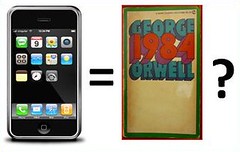 Channeling Jonathan Zittrain, Alex Curtis of Public Knowledge continues his incessant ranting against Apple and the iPhone for supposedly not being open enough and, therefore, somehow harming consumers and 3rd party developers. In his essay today about the supposed evils of the iPhone App Store, he accuses Apple of an “1984 kind of total control.”
Hmmm, let’s see… Apple creates a great new product that is so insanely sexy and innovative that even Apple-haters like me are forced to admit that it is the most brilliant tech gadget of the decade. Millions of people have flocked to Apple stores, stood in lines so long that you’d think they were giving away free pot and floor bongs inside, and then voluntarily handed over seemingly all their disposable monthly income to get their hands on one of these things.
OK, so how is this like
1984 again? Is evil Steve Jobs forcing the masses to buy this product? Of course not. So it strikes me that we can easily dispense with analogies to a book about coercive, totalitarian government control like 1984.
And if all this anti-iPhone ranting is just about the degree of control that Steve Jobs and Apple exercise over product add-ons then hey, I’ve got an easy answer for you: go get a different phone!
Continue reading →
Over at Reason’s “Hit and Run” blog, Matt Welch has penned a piece pointing out how it is impossible to make the anti-media activists happy. Welch notes that radical activist groups like Free Press go around demonizing media moguls like Rupert Murdoch because he supposedly symbolizes the fact that will live in an age of media monopolists who puppeteer all our news and entertainment from on high. It’s all 100% B.S., of course, as we have shown here again and again.
But even when confronted by the rise of alternative owners and ownership models, the Free Press fanatics show their true colors by saying that won’t work for them either. Walsh notes, for example, that the skake-up of the old Tribune empire and the emergence of Sam Zell as an independent owner of the Trib — and an owner hellbent on downsizing the old empire, no less — should be exactly what Free Press wants:
Continue reading →
… if I lived in the San Fran area. Gever Tulley’s “Tinkering School” encourages kids to play with pocket knives, power tools, and fire. It also requires that kids take apart various household appliances just to figure out how they work. And, my personal favorite — kids get to drive cars. (Our own Tim Lee will be tickled by the portion of the camp where the kids are encouraged to break the DMCA by learning how to rip and repackage music, although I can’t imagine they really need much encouragement from adults to do that!)
The reason I found this idea for a summer camp so refreshing when I heard about it on NPR this week is because I have spent the better part of the last few months signing endless liability waiver forms for my daughter’s summer camps, including the tennis camp she’s in right now. After all, don’t you know how dangerous flying tennis balls can be!! And my kids like to swim at a local pool that not only has endless waiver forms and rules, but also no high diving boards for fear of liability from scumbag trial lawyers.
We have become a nation of over-protective wusses. As Tulley points out in his great little lecture below on “5 dangerous things you should let your kids do,” we practically wrap our kids in bubble wrap before we send them out the door to play these days — assuming we let them out the door at all. It’s crazy. Our kids need to be experiencing life, the elements, and yes, a little danger. I have already started teaching my kids how to use power tools and they are both under the age of 8. One of my wussy yuppie friends stopped by one day to get something and saw my kids playing with hammers, nails and saws and he thought I was nuts. But it is he who is nuts for shielding his kids to the joys of learning to build something with their own hands (and for denying them the skills to actually do some honest to God manual labor when they get older).
Anyway, enjoy this video. If this guy starts a camp on the East Coast, I am putting my kids on the waiting list.
http://static.videoegg.com/ted/flash/loader.swf
Portland’s muni wi-fi experiment has failed. [Add it to the list of failures]. According to Broadband Reports, taxpayers are going to be on the line for $60K:
Portland had high hopes of being one of those cities where citywide wireless networks might actually work but those hopes did not pan out. Earlier this summer, Wi-Fi provider MetroFi announced that the company could not afford to continue operating the network there. Attempts to sell it off failed and the network was shut down. That’s not the end of the story, though. In order to launch the network, MetroFi had to set up 600 (arguably unsightly) antennas throughout the city. The company had claimed that these antennas would be removed by the end of July but they remain up; MetroFi says that they still plan to follow through on removing them but city staff members report fears that the company is too strapped for cash to keep their end of this bargain. Estimates for removal are around $90,000; subtracting out a $30,000 bond for removal that was part of the MetroFi contract would still mean that Portland’s taxpayers could pay up to $60,000 to get those antennas taken down.

 The Technology Liberation Front is the tech policy blog dedicated to keeping politicians' hands off the 'net and everything else related to technology.