Articles by Adam Thierer 
 Senior Fellow in Technology & Innovation at the R Street Institute in Washington, DC. Formerly a senior research fellow at the Mercatus Center at George Mason University, President of the Progress & Freedom Foundation, Director of Telecommunications Studies at the Cato Institute, and a Fellow in Economic Policy at the Heritage Foundation.
John Markoff had an interesting article in the New York Times this weekend entitled “Internet Traffic Begins to Bypass the U.S..” In the piece, Markoff notes that “The era of the American Internet is ending” since “data is increasingly flowing around the United States,” instead of all flowing though our country, as it once did. Markoff focuses on how that “may have intelligence — and conceivably military — consequences.”
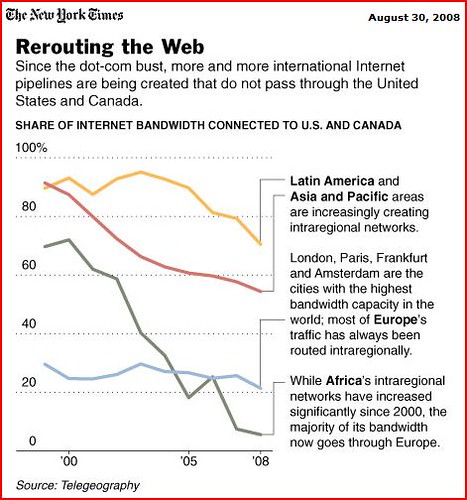 Indeed, it may. But what I also found interesting about this fact is the implications it will have for the future of content regulation. As Harvard’s Yochai Benkler told the
Times, “This is one of many dimensions on which we’ll have to adjust to a reduction in American ability to dictate terms of core interests of ours.” Content controls are one way that lawmakers enforce what they perceive to be a country’s “core interests.” As less and less Internet traffic flows through the U.S., it could become increasingly difficult for American lawmakers to impose their particular vision or morality on the Internet.
Indeed, it may. But what I also found interesting about this fact is the implications it will have for the future of content regulation. As Harvard’s Yochai Benkler told the
Times, “This is one of many dimensions on which we’ll have to adjust to a reduction in American ability to dictate terms of core interests of ours.” Content controls are one way that lawmakers enforce what they perceive to be a country’s “core interests.” As less and less Internet traffic flows through the U.S., it could become increasingly difficult for American lawmakers to impose their particular vision or morality on the Internet.
And that’s both good and bad news.
Continue reading →
 Well, another four months have passed since I last asked this question, but let me pose it again: Where exactly is the FCC’s Video Competition Report and why is it taking so long to get it out the door? It wouldn’t have anything to do with a certain Chairman Ahab still trying to get his cable whale, would it? No, of course not. I’m sure there’s a perfectly rational reason that this 13th Annual report is now something like 18 months past due altogether. Right.
And keep in mind that the data in the 13th report is for a period ending on June 30, 2006, so whenever the report finally comes out the data in it will be well over two years old! That won’t exactly reflect the true state of the video programming market considering the significant changes we have since that time, especially the continued explosive growth of online video, VOD, and DVRs.
The reason that I have been making a big deal out of this issue is because this gets to the question of just how “scientific” and “independent” of an agency the FCC really is. We are talking about facts here. Basic data. This is stuff the FCC should be routinely collecting and reporting on a timely basis — indeed that is what Congress
requires the agency to do in this specific case. And yet the agency can’t do it because its Chairman is on this Moby Dick-like crusade against the cable industry. By the time this 13th annual report finally sees the light of day, the 15th annual report might be due! Outrageous. (And you wonder why many of us here are so skeptical about empowering the FCC regulating the Internet via Net neutrality mandates! If an over-zealous Chairman can politicize this issue, just think what might happen once we give the agency the authority to regulate the Net.)
Anyway, down below you will find the paper that Barbara Esbin and I wrote about the issue four months ago. Perhaps we should place a little ticker somewhere here on the site that counts each day that passes as we wait for the Commission to produce this report. We can take bets on when the agency’s data holdout will end.
Continue reading →
Stephen Schultze is an up-and-coming technology policy analyst who is a fellow at the Berkman Center for Internet and Society at Harvard University. He is also finishing up his Masters of Science in Comparative Media Studies up at MIT. He’s been kind enough to stop by here at the TLF on occasion and comment on some of the things we have written — usually to give us grief, but we welcome that too! He’s very sharp and always has something of substance to say, and he says it in a respectful way. So I look forward to many years of intellectual combat with him. (Incidentally, we also share a mutual admiration for the work of Ithiel de Sola Pool, especially his 1983 classic, “Technologies of Freedom: On Free Speech in an Electronic Age , which I have noted is my favorite tech policy book of all-time.]
Anyway, Stephen has just posted his master’s thesis: “The Business of Broadband and the Public Interest: Media Policy for the Network Society.” It’s a noble attempt to defend and extend the “public interest” concept in the Digital Age. Stephen attempts to “identify the several dimensions in which it remains relevant today.” In his thesis, Stephen cites some of my past work on the issue since I have articulated a very different view on the issue. Specifically, he cites a line of mine that I have used in multiple studies and essays on the issue:
“The public interest standard is not really a “standard” at all since it has no fixed meaning; the definition of the phrase has shifted with the political winds to suit the whims of those in power at any given time.”
I stand by that quote and down below I have pasted a lengthy passage on the mythology surrounding the public interest standard, which I pulled directly from my old 2005 “Media Myths” book. It explains in more detail why I feel that way.
“Right now is a critical point of media in transition that will affect the shape communications ecosystem going forward,” Stephen states in his thesis. I couldn’t agree more, but I completely disagree that that somehow justifies breathing new life into a standard-less standard that justifies open-ended, arbitrary governance of the Internet and digital media. Read on to understand why I feel that way…
Continue reading →
Over at Ars, Ben Kuchera has a review of Ask.com’s redesign of its web portal for kids, AskKids.com. It’s a great new addition to the growing list of safe seach tools and web portals geared toward younger surfers.

I’m also a big fan of KidZui, the new browser for kids that provides access to over 800,000 kid-friendly websites, videos, and pictures that have been pre-screened by over 200 trained teachers and parents. The company employs a rigorous 5-step “content selection process” to determine if it is acceptable for kids between 3-12 years of age. My kids, both under the age of 7, just love it, but I can’t see many kids older than 10 enjoying it because it is mostly geared toward the youngest web surfers.

Last year, as part of my 10-part series coinciding with “Internet Safety Month,” I wrote about the market for safe search tools and web portals for kids. I generally divide these sites and services into two groups:
(1)
“Safe Search” Tools and Portals for Kids
(2)
Child- and Teen-Oriented Websites
Below I will describe each group and list the many sites and services currently available. I encourage readers to offer additional suggestions for sites that belong on the list. (I keep a running list of these sites and services in my book, “Parental Controls and Online Child Protection: A Survey of Tools & Methods.”)
Continue reading →
 In-flight Internet access is finally starting to be rolled out by some carriers, and as they do so the inevitable question of what to do about objectionable material is already being debated. Surprisingly, many airlines have decided to not filter in-flight Internet access but instead rely on “peer pressure and the presence of flight attendants,” according to Tim Maxwell, Vice President of Marketing for Aircell, the company providing American’s broadband service.
But others are wondering if that’ll be enough. I share that concern. I can only imagine how ugly things will get on a flight once somebody starts streaming porn from their aisle seat. Flight attendants are going to become “fight” attendants once that happens. And you better believe that somebody in Congress is already cooking up legislation with some snappy title like “The Family Friendly Flights Act” to impose a regulatory solution. (Oh wait, a bill with that title was already introduced last year!! I wrote about it here. But that bill was just for violent movies, not Net access. So expect another measure soon mandating in-flight Net censorship).
Before things get ugly and bills start flying up on the Hill, the airlines need to think about crafting some constructive solutions to this problem. Here are three possibilities:
Continue reading →


 I was a HUGE fan of Mattel handheld games back in the late 70s, and I played “Football I” and “Football II” for countless hours with friends. And now you can get it on the iPhone!
Sure it’s probably still primitive as hell — you could only run the ball in Football I ! — but I bet it’s still a lot of fun.
I still have the old Football II handheld at my house and have been trying to teach my kids how to play it. (Colleco’s handheld Football game was actually better but I don’t have that one anymore). My kids don’t quite get the fun in frantically mashing buttons to move little red LED hashes across the screen. They are spoiled I tell you!
The Battlestar Galactica game was just awesome too. Video games have come a long, long way since then, but these old handheld games were addictive in their own right.
 … environmental attorney Dusty Horwitt, who recently published this outlandishly stupid and highly offensive editorial in the Washington Post calling for an information tax to reduce the supply of information in society. “[I]n our information-overloaded society,” he argues, “the concept of [too much information] is no joke. The information avalanche coming from all sides — the Internet, PDAs, hundreds of television channels — is burying us in extraneous data that prevent important facts and knowledge from reaching a broad audience.” His repressive solution?
It’s possible that over time, an energy tax, by making some computers, Web sites, blogs and perhaps cable TV channels too costly to maintain, could reduce the supply of information. If Americans are finally giving up SUVs because of high oil prices, might we not eventually do the same with some information technologies that only seem to fragment our society, not unite it? A reduced supply of information technology might at least gradually cause us to gravitate toward community-centered media such as local newspapers instead of the hyper-individualistic outlets we have now.
Mike Masnick of TechDirt and Richard Kaplar of the Media Institute do a fine job of ripping Mr. Horwitt’s absurd proposal to shreds. As Kaplar argues, it is “sheer lunacy” to “tax the technologies of freedom.” Unlike gasoline, there are no good reasons — not one — for government to ever take steps to reduce the supply of information. Mr. Horwitt is calling for public officials to use their taxing powers to destroy or limit opportunities for human communications and the free exchange of speech and expression. It is completely antithetical to a free society.
Moreover, if Mr. Horwitt really thinks there is too much information in this world, then perhaps he should lead by example and take his own site offline first! The rest of us will take a world of information abundance over a world of information scarcity any day of the week.
 Having covered free speech and media policy issues for many years now, one of the arguments I hear a lot is that we moderns have an unnatural fascination with murder, mayhem, and violence as well as gossip and celebrities. Social critics and proponents of media content regulation often wax nostalgic about the supposed “good ol’ days” when all we thought and talked about was enlightened and enriching topics.
It’s all complete nonsense. Anyone who has seriously studied our nation’s history — or, for that matter, the history of any country or civilization — knows that we humans have
always been fascinated by the morbid and tales of debauchery, especially when those tales involve public officials or celebrities.
I was reminded of this again today when reading two articles in the
Washington Post.
Continue reading →
How much platform competition is too much competition? For example, what is the optimal number of mobile operating systems or video game consoles that will spur competition and innovation in those respective sectors?
It is an interesting business question, but it also has some policy implications since some might propose laws or regulations to remedy a perceived lack of platform competition in various sectors. After all, many people would answer the above question by saying that there is
never such a thing as too much competition. The more platforms the better. But there can be costs associated with too much competition. Let’s consider those two case studies mentioned above: mobile operating systems or video game consoles.
Mobile Operating Systems
As my colleague Berin Szoka has pointed out, we are witnessing the rapid proliferation of mobile operating systems, especially on the open source front. So, we’ve got Apple’s iPhone platform, Microsoft’s Windows Mobile, Symbian, Google’s Android, the LiMo platform, and OpenMoko.
One one hand, all this platform competition sounds great. But as Ben Worthen of the
Wall Street Journal’s “Business Tech Blog” points out in a piece today:
Continue reading →

 The Technology Liberation Front is the tech policy blog dedicated to keeping politicians' hands off the 'net and everything else related to technology.