Articles by Adam Thierer

Avatar photoSenior Fellow in Technology & Innovation at the R Street Institute in Washington, DC. Formerly a senior research fellow at the Mercatus Center at George Mason University, President of the Progress & Freedom Foundation, Director of Telecommunications Studies at the Cato Institute, and a Fellow in Economic Policy at the Heritage Foundation.


Writing at Slate, Tim Wu tries to make Obama out to be the real Big Government candidate on media policy, who will deliver “if not a chicken in every pot, a fiber-optic cable in every home.” By contrast, Wu implies that McCain is just another pro-big business lackey who doesn’t understand “that the media and information industries are special—that like the transportation, energy, or financial industries, they are deeply entwined with the public interest.” Wu goes on to say:

Ultimately, most of the difference in Obama’s and McCain’s media policies boils down to questions about whether the media is special and a dispute over how much to trust the private sector. Camp McCain would tend to leave the private sector alone, with faith that it will deliver to most Americans what they want and deserve. The Obama camp would probably administer a more frequent kick in the pants, in the belief that good behavior just isn’t always natural.

First, as a factual matter, Wu is just wrong about McCain being some sort of a radical hands-off, pro-market liberalizer on media policy issues. Oh, if only that were true! But for those of us who have been in DC covering telecom and media policy for many years, it is widely understood there is no nailing down John McCain on any tech, telecom or media policy issue. He’s been all over the board. While he has sponsored or supported some deregulatory initiatives on the telecom front in the past, he’s also been a supporter of other regulatory causes. His battles with broadcasters and cable, for example, are well-known. Most recently, McCain has been leading the effort to impose a la carte mandates on cable and satellite operators. Continue reading →

Over on the Poynter Online blog, Amy Gahran has a very smart piece on some of the confusion surrounding debates about “media localism.” In her essay asking “How Important is Local, Really?”, she challenges some of the assumptions underlying the Knight Foundation’s new Commission on the Information Needs of Communities in a Democracy.

I particularly like her line about how, “in many senses, ‘local’ is just one set of ripples on the lake of information — especially when it comes to ‘news.’ And for many people, it’s not even the biggest or most important set of ripples.” That is exactly right. Today, local choices are just a few more choices along the seemingly endless continuum of media choices. It’s foolish to assume that “media localism” in a geographic sense is as important now as it was in the past for the reasons Gahran makes clear in her essay:

I’m glad that the Knight Foundation is asking basic questions about what kinds of information people need support community and democracy. However, I question the Commission’s strong focus on geographically defined local communities. It seems to me that with the way the media landscape has been evolving, geographically defined local communities are becoming steadily less crucial from an information perspective. I suspect that defining communities by other kinds of commonalities (age, economic status/class, interests, social circles, etc.) would be far more relevant to more people — although more complex to define.

Continue reading →

By Adam Thierer & Berin Szoka

The goal of our “Privacy Solution Series,” as we noted in the first installment, is to detail the many “technologies of evasion” (i.e., user-empowerment or user “self-help” tools) that allow web surfers to better protect their privacy online—and especially to defeat tracking for online behavioral advertising purposes.  These tools and methods form an important part of a layered approach that, in our view, provides an effective alternative to government-mandated regulation of online privacy.

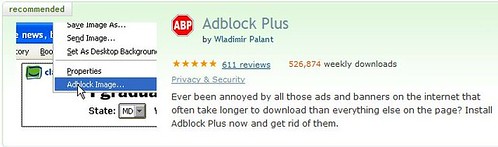
In this second installment in this series, we will highlight Adblock Plus (ABP), a free downloadable extension for the Firefox web browser (as well as for the Flock browser, though we focus on the Firefox version here).

Adblock Plus

Purpose: The primary purpose of Adblock Plus is to block online ads from being downloaded and displayed on a user’s screen as they browse the Web.  In a broad sense, this functionality might be considered a “privacy” tool by those who consider it an intrusion upon, or violation of, their “privacy” to be “subjected” to seeing advertisements as they browse the web.  But if one thinks of privacy in terms of what others know about you, Adblocking is not so much about “privacy” as about user annoyance (measured in terms of distracting images cluttering webpages or simply in terms of long download times for webpages).  In this sense, ABP may not qualify as a “technology of evasion,” strictly speaking.  But, as explained below the fold, ABP does allow its users to “evade” some forms of online tracking by blocking the receipt of some, but not all, tracking cookies.

Cost: Like almost all other Firefox add-ons, both the ABP extensions and the filter subscriptions on which it relies (as described below) are free.

Popularity / Adoption: While there are a wide variety of ad-blocking tools available, Adblock Plus is far and away the leader.  ABP has proven enormously popular since its release in November 2005 as the successor to Adblock, which was first developed in 2002 and reached over 10,000,000 downloads before being abandoned by its developer and even today garners nearly 40,000 downloads a week.  This history of Adblock provides further details.

ABP was named one the 100 best products of 2007 by PC World magazine and is now the #1 most downloaded add-on for Firefox with over 500,000 weekly downloads, up significantly for just a few months.  In a blog post last month, ABP creator Wladimir Palant estimated that “no more than 5% of Firefox users have Adblock Plus installed,” but that percentage is bound to grow larger as more people discover Adblock.  As one indicator of ABP’s popularity, the number of Google searches for “Adblock” has nearly eclipsed the number of searches for “identity theft,” which seems like a far more serious concern than having to look at web ads. Continue reading →

Crop circles prove it!

Firefox crop circles

(Note: For the record, I do not believe extraterrestrials are visiting Earth).

[Note: I updated this discussion and chart in a subsequent essay. See: “Are You An Internet Optimist or Pessimist? The Great Debate over Technology’s Impact on Society.”]

A number of very interesting books have been released over the past year or two which debate how the Internet is reshaping our culture and the economy. I’ve reviewed a couple of them here but I have been waiting to compile a sort of mega-book review once I found a sensible way to conceptually group them together. I’m not going to have time to cover each of them here in the detail they deserve, but I think I have at least found a sensible way to categorize them. For lack of better descriptors, I’ve divided these books and thinkers into two camps: “Internet optimists” versus “Internet Pessimists.” Here’s a list of some of the individuals and books (or other articles and blogs) that I believe epitomize these two camps of thinking:

Adherents & Their Books / Writings

Internet Optimists

Internet Pessimists

Yochai Benkler, The Wealth of Networks

Andrew Keen, The Cult of the Amateur

Chris Anderson, The Long Tail and “Free!”

Lee Siegel, Against the Machine

Clay Shirky, Here Comes Everybody

Nick Carr, The Big Switch

Cass Sunstein, Infotopia

Cass Sunstein, Republic.com

Don Tapscott, Wikinomics

Todd Gitlin, Media Unlimited

Kevin Kelly & Wired mag in general

Alex Iskold, “The Danger of Free

Mike Masnick & TechDirt blog

Mark Cuban

And here’s a rough sketch of the major beliefs or key themes that separate these two schools of thinking about the impact of the Internet on our culture and economy:

Beliefs / Themes

Internet Optimists

Internet Pessimists

Culture / Social

Net is Participatory

Net is Polarizing

Net yields Personalization

Net yields Fragmentation

a “Global village

Balkanization

Heterogeneity / Diversity of Thought

Homogeneity / Close-mindedness

Net breeds pro-democratic tendencies

Net breeds anti-democratic tendencies

Tool of liberation & empowerment

Tool of frequent misuse & abuse

Economics / Business

Benefits of “free” (“Free” = future of media / business)

Costs of “free” (“Free” = end of media / business)

Increasing importance of “Gift economy

Continuing importance of property rights, profits, firms

“Wiki” model = wisdom of crowds; power of collective intelligence

“Wiki” model = stupidity of crowds; errors of collective intelligence

Mass collaboration

Individual effort

So, what to make of this intellectual war? Who’s got the story right?

Continue reading →

By Adam Thierer & Berin Szoka

Whatever ordinary Americans actually think about online privacy, it remains a hot topic inside the Beltway. While much of that amorphous concern focuses on government surveillance and government access to information about web users, many in Washington have focused on targeted online advertising by private companies as a dire threat to Americans’ privacy — and called for prophylactic government regulation of an industry that is expected to more than double in size to $50.3 billion in 2011 from $21.7 billion last year.

In 1998, when targeted advertising was in its infancy, the FTC proposed four principles as the basis for self-regulation of online data collection: notice, choice, access & security. In 2000, the Commission declared that too few online advertisers adhered to these principles and therefore recommended that Congress mandate their application in legislation that would allow the FTC to issue binding regulations. Subsequent legislative proposals (indexed by CDT by Congress here along with other privacy bills) have languished in Congress ever since. During this time self-regulation of data collection (e.g., the National Advertising Initiative) has matured, the industry has flourished without any clear harm to users and the FTC has returned to its original support for self-regulation over legislation or regulatory mandates.

But over the last year, the advocates of regulation have succeeded in painting a nightmarish picture of all-invasive snooping by online advertisers using more sophisticated techniques of collecting data for targeted advertising. The Federal Trade Commission (FTC) has responded cautiously by proposing voluntary self-regulatory guidelines intended to address these concerns, because the agency recognizes that this growing revenue stream is funding the explosion of “free” (to the user) online content and services that so many Americans now take for granted, and that more sophisticated targeting produces ads that are more relevant to consumers (and therefore also more profitable to advertisers).

Continue reading →

According to this new survey by NDS:

Americans rank the DVR [digital video recorders] as the third most indispensable household item (62%), after the washing machine (97%) and the microwave oven (86%) — Americans rank the DVR as the second most essential household technology item they can’t live without (81%), beaten only by the mobile phone (92%) — 3 out of 4 respondents with partners say that having a DVR makes for a happier home life

When you think about, it is incredible that DVRs only came on the scene in the late 1990s and yet now — less than a decade later — they are considered an “indispensable” technology by most people.

This has some important policy implications for debates over content regulation. In a paper I penned last October entitled, “Parental Control Perfection? The Impact of the DVR and VOD Boom on the Debate over TV Content Regulation,” I outlined how new video technologies, such as digital video recorders (DVRs) and video on demand (VOD) services, are changing the way households consume media and are helping parents better tailor viewing experiences to their tastes and values. I provided evidence showing the rapid spread of these technologies and discussed how parents are using these tools in their homes. Finally, I argued that these developments will have profound implications for debates over the regulation of video programming. As parents are given the ability to more effectively manage their family’s viewing habits and experiences, it will lessen—if not completely undercut—the need for government intervention on their behalf.

If you are interested, I have embedded the paper down below. Today’s survey results from NDS make it clear that the process I discuss in my paper is happening at an even fast pace than I originally predicted.

Continue reading →

When the definitive history of Kevin Martin’s regulatory reign of terror against the cable industry is finally written, I have a feeling that Ted Hearn of Multichannel News will be the man who pens it. There is no one who has been reporting on these issues longer or with more investigative vigor than Ted. In an absolutely scathing piece today about a former Martin staffer, Ted does a nice job summarizing the major elements of Martin’s war on cable. It reads like the list of grievances against King George found in the Declaration. (Think: “He has erected a multitude of New Offices, and sent hither swarms of Officers to harrass our people, and eat out their substance.”)  Anyway, I just thought I’d throw Ted’s list up here for those keeping score at home:

— He secretly rewrote an FCC study issued in November 2004 that had concluded that cable a la carte was a bad idea. — He walked away from a handshake agreement with NCTA, Comcast and Time Warner that the rollout of family programming packages would end his a la carte jihad. — He stripped cable’s control over critical wiring in apartment buildings, affirming the identical policy that a court had previously struck down. — He voided exclusive contracts between cable operators and apartment building owners just a few years after the FCC gave the green light to such deals. — He required cable operators to carry must carry TV stations in analog and digital for three years after voting against such a policy in February 2005. — He extended program access rules for five years, a gift to DirecTV and Dish Network even though the two satellite providers are larger than every cable company in the U.S. except Comcast and Time Warner. — He imposed expensive set-top box equipment mandates on cable, making it vastly more costly for Comcast and Time Warner to reach the goal of all-digital platforms. — He capped cable ownership at 30% of pay-TV subscribers nationally—the same limit that a federal court kicked back to the FCC as unlawful—while letting AT&T and Verizon basically divide the country’s phone market. — He slashed cable leased access rates to zero in an act of bureaucratic malice that a federal appeals court has now blocked and that the Office of Management and Budget has rejected as a violation of the Paperwork Reduction Act. — He decided to brand Comcast an Internet outlaw when all the company did was occasionally frustrate a tiny minority of customers whose massive consumption of Web porn and pirated Hollywood films was destroying the service for others.

So, if Tim Wu’s thesis is correct that the broadband marketplace is “a cartel,” should we be reading headlines in today’s Wall Street Journal and CNET News.com like this: “Price War Erupts For High-Speed Internet Service” and “Broadband Price War Brews“? From the WSJ story:

The battle between cable and phone companies to sign up new customers for high-speed Internet service is heating up, creating fresh opportunities for consumers to cut their bills. […] While the most generous offers are coming from the phone companies, some analysts expect cable companies will also become more aggressive in their own promotions as they compete to retain customers.

Geez, if that’s a cartel, give me more of them!

Variations on a theme:

  • “The net regards censorship as a failure, and routes around it.” —  John Gilmore, SUN Microsystems & EFF co-founder.

  • “The net regards hierarchy as a failure, and routes around it.” — Mark Pesce, Writer, consultant, Sydney, Australia

  • “The web regards centralization as a failure, and routes around it… by moving to the edge.” — Stowe Boyd, /Message blog

  • “The net regards the middleman as a failure, and routes around it.” — Terry Heaton, PoMo Blog

Anybody have any others to add?

Person John Gilmore
Right click for SmartMenu shortcuts