Articles by Adam Thierer

Avatar photoSenior Fellow in Technology & Innovation at the R Street Institute in Washington, DC. Formerly a senior research fellow at the Mercatus Center at George Mason University, President of the Progress & Freedom Foundation, Director of Telecommunications Studies at the Cato Institute, and a Fellow in Economic Policy at the Heritage Foundation.


Planet GoogleI finally got around to reading Planet Google: One Company’s Audacious Plan to Organize Everything We Know, by Randall Stross. It’s very well done. Stross is a frequently contributor to the New York Times and the author of several other interesting books on the technology industry. He knows how to weave a story together, and it helps that Google’s story is a pretty amazing one.

Each chapter discusses a different part of Google’s growing family of services — GMail, Google Maps, Google Earth, Book Search, and YouTube. Of course, it all started with search and Stross does a good job explaining how the ingenious Google search algorithm has grown from dorm room project to the greatest aggregator of human knowledge that the world has ever known. This, in turn, has powered Google’s hugely successful online advertising system. The real secret of their success with online advertising, Stross argues, is that “Google’s impersonal, mathematical approach search also provides you with the ability to serve advertisements that are tailored to a search, rather than to the person submitting the search request, whose identity would have to be known.”

Despite the benefits of such generally anonymous searching, as Google has grown and added new services and capabilities, concerns about the sheer volume of data that the company collects have led to heightened privacy concerns. Indeed, privacy is a core theme that Stross uses in the book to tie many of the chapters and issues together. Google is constantly struggling to strike the right balance between providing more access to the world’s information while also being careful not to raise privacy concerns. But it’s unclear exactly how much more information collection that users (or public officials) will tolerate before advocating stricter limits on Google’s reach.  As Stross points out:

Guided by its founding mission, to organize all the world’s information, Google has created storage capacity that allows it to gain control of what its users are you doing in a comprehensive way that no other company has done, and to preserve those records indefinitely, without the need to clear out old records to make way for new ones. Moreover, Google differentiates its service by refining its own proprietary software formula to mine and massage the data, technology that it zealously protects from the sight of rivals. This sets up a conflict between Google’s wish to operate a “black box” (completely opaque to the outside) and its users’ wish for transparency.

Continue reading →

As I am getting ready to watch the Super Bowl tonight on my amazing 100-inch screen via a Sanyo high-def projector that only cost me $1,600 bucks on eBay, I started thinking back about how much things have evolved (technologically-speaking) over just the past decade. I thought to myself, what sort of technology did I have at my disposal exactly 10 years ago today, on February 1st, 1999?  Here’s the miserable snapshot I came up with:

  • 10 years ago today, I did not own a high-definition television set, as they were too expensive (I bought my first one from Sears on an installment plan a few months later. It was a boxy 42-inch, 4×3 monstrosity that rolled around on the floor on casters and it took up half the room). Moreover, only a few HDTV signals could be picked up locally and none were yet available from my cable or satellite provider.
  • 10 years ago today, the biggest television in my house was a 32-inch 4×3 ProScan analog set, which I thought was massive. (Of course, it was in terms of weight. It was over 125 lbs).
  • 10 years ago today, I was still using a dial-up, 56k narrowband Internet connection even though I lived in downtown Washington, DC just 6 blocks from our nation’s Capitol.
  • 10 years ago today, my computer was a Compaq laptop that weighed more than my dog, had barely any storage or RAM, and had a screen that was only slightly brighter than an Etch-A-Sketch.
  • 10 years ago today, I was still occasionally using an old CompuServe e-mail address that had nine digits in it. (But at least I wasn’t one of the 20 million or so people paying $20 bucks per month to graze around inside AOL’s walled garden!)
  • 10 years ago today, I was still backing up files on 3 1/2 inch floppy disks. I had boxes full of those things. (And, sadly, I still had 5 1/4 inch floppies in my possession that I was saving “just in case” I ever needed those old files. Pathetic!)

Continue reading →

Just wanted draw everyone’s attention to a couple of great podcasts about online safety issues that include comments from members of the Internet Safety Technical Task Force (ISTTF). As I mentioned a few weeks ago, the ISTTF project and final report represent a major milestone in the discussion about online safety in America, and I was honored to serve as a member of this task force.

This in-depth “Radio Berkman” podcast featuring ISTTF director John Palfrey and co-director Dena Sacco is a really excellent (but lengthy!) overview of the ISTTF’s word. Here’s a shorter podcast that Prof. Palfrey did with Larry Magid of CNet. And I also recommend this excellent NPR “On the Media” podcast featuring my friend Stephen Balkam of the Family Online Safety Institute (FOSI).

For those interested, down below you will find a running list I have been keeping of coverage of the ISTTF. (I will try to keep updating this list here).

Continue reading →

I’m intrigued by this new bill that Rep. Peter King has introduced to prevent video voyeurism. H.R. 414, the “Camera Phone Predator Alert Act” finds that “children and adolescents have been exploited by photographs taken in dressing rooms and public places with the use of a camera phone.”  To remedy this problem, King’s “Phone Predator Alert” bill would require that:

any mobile phone containing a digital camera that is manufactured for sale in the United States shall sound a tone or other sound audible within a reasonable radius of the phone whenever a photograph is taken with the camera in such phone. A mobile phone manufactured after such date shall not be equipped with a means of disabling or silencing such tone or sound.

In other words, cameras would have to get noisy again!  Old timers will recall the days when our cameras were noisier than a box of rocks. Today’s digital cameras and camera phones, by contrast, are increasingly silent, but that also opens up the door to potential abuse by some creeps out there. While I don’t believe there’s evidence pointing to a national epidemic of digital voyeurism, there’s no doubt that some people — including many youngsters — are having their privacy invaded in this fashion.

I find King’s solution at once to be both ingenious and futile. It’s ingenious in that, if we could truly force it upon everyone, it might actually go along way towards solving this problem. The noisy camera would again act as the prime deterrent to such an act.

Continue reading →

The Entertainment Consumers Association (ECA) is a group that does some good things to mobilize gamers to fight misguided regulation of video games. I greatly appreciate their tireless efforts to fight stereotypes and myths about games and gamers, and to specifically counter the hysteria about video games that we sometimes see in the press, and definitely see in political circles on a regular basis.  They’re a great ally in the fight for freedom of speech and artistic expression in this field.

That’s why I was so sorry to see the ECA launch a new campaign that encourages gamers to petition their congressional leaders and encourage them to regulate the high-tech economy more and waste more taxpayer dollars on inefficient universal service programs and subsidies:

Net Neutrality and Universal Broadband are not only great for America; they allow us to play the games we want at high speeds! … ECA believes that Universal Broadband and Net Neutrality are vital for the development of the national infrastructure, and believes that this bill is an important opportunity to let Congress know that you agree.

Continue reading →

Some sensible thinking here about broadband pork stimulus plans from Saul Hansell of the New York Times. In his piece on the NYT Bits blog this week, “Does Broadband Need a Stimulus?” he argues that people should stop grumbling about the “relatively small sum” of $6 billion that the new administration has proposed for wiring rural areas and urban centers. Hansell argues:

This also seems to be a rather sound policy choice because, as I look at it, the noise about a broadband gap is hooey. With new cable modem technology becoming available, 19 out of 20 American homes eventually will be able to have Internet service that is faster than any available now anywhere in the world. And that’s without one new cable being laid. That fact hasn’t prevented a lot of folks involved in telecommunications policy from calling for a lot of money to be spent on backhoes and cable riggers. For example, the Communications Workers of America and the Telecommunications Industry Association called for $25 billion in subsidies to network providers as well as tax breaks. The Free Press, a group that advocates for media diversity, recommended spending $44 billion, with an emphasis on subsidizing companies to compete with existing cable and phone companies. Running a new fiber-optic cable to every American home may well increase competition in broadband providers, but it isn’t needed to deliver high-speed Internet service. Current cable modems use just one of the more than 100 channels on a typical cable system and can often offer speeds of 16 megabits per second or more. The next generation of modems, using a technology called Docsis 3, allows several of those video channels to be combined to offer what ultimately can be Internet service as fast as 1 gigabit per second — 10 times faster than is offered in Japan, which generally is regarded as having the fastest broadband infrastructure.

Continue reading →

Many folks are discussing Christopher Ferguson’s latest paper on “The School Shooting / Violent Video Game Link: Causal Relationship or Moral Panic?” And with good reason. It’s an important look at how “moral panics” develop in modern society, in this case around video games. [Moral panics is a subject I have written on at length here many times before.  Alice Marwick’s brilliant article on “technopanics” is also worth reading in this regard].

As I’ve noted here before, Ferguson has penned many important articles raising questions about the claims made by some other psychologists (and politicians) that there is causal relationship between exposure to violent video games and youth aggression. Ferguson has shown there are reasons to be skeptical of such claims — both methodologically and practically-speaking. More on that down below.

In his latest piece, however, Ferguson, a professor at Texas A&M’s Department of Behavioral, Applied Sciences and Criminal Justice, is more fully developing moral panic theory, which he describes as follows: “A moral panic occurs when a segment of society believes that the behavior or moral choices of others within that society poses a significant risk to the society as a whole.”  To illustrate the various forces at work that drive moral panics, Ferguson uses this “Moral Panic Wheel”:

Moral Panic Wheel [Ferguson] Continue reading →

My problem with what Nick Carr is saying about Wikipedia here — as well as in his book The Big Switch — is that he always seems to assume that Wikipedia constitutes the totality of most searches for information online. I suppose it does for some people, but I have a hard time accepting the argument that everyone’s search for enlightenment ends there, even if Wikipedia does rank high in many search results today.

For me, Wikipedia is just a launch pad; a great starting point in the search for truth. I take much of what I read on Wikipedia with a large grain of salt, however, because I know not every entry is as trustworthy as others, and entries could change at any moment. But that’s true of much of what one finds online!  If one adopts a sort of caveat emptor attitude toward Wikipedia, and then uses it to seek out truth from alternative sources found in each entry, or from other searches, then were is the harm?  Only if one could show that the search for truth ends with Wikipedia would I be as concerned as Carr and other Internet pessimists and Wikipedia critics (like Lee Siegel and Andrew Keen). But I just don’t believe that is the case.

Moreover, it is impossible for me to believe that we have fewer authoritative sources of information at our disposal today than we did in the past.   Continue reading →

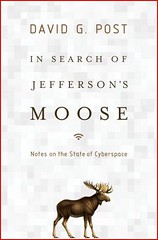
Post Jeffersons MooseI used to have a (semi-crazy) uncle who typically began conversations with lame jokes or bad riddles. This sounds like one he might have used had he lived long enough: What do Thomas Jefferson, a moose, and cyberspace have in common?

The answer to that question can be found in a new book, In Search of Jefferson’s Moose: Notes on the State of Cyberspace, by David G. Post, a Professor of Law at Temple University. Post, who teaches IP and cyberspace law at Temple, is widely regarded as one of the intellectual fathers of the “Internet exceptionalist” school of thinking about cyberlaw.  Basically, Post sees this place we call “cyberspace” as something truly new, unique, and potentially worthy of some special consideration, or even somewhat different ground rules than we apply in meatspace. More on that in a bit.

[ Full disclosure: Post’s work was quite influential on my own thinking during the late 1990s, so much so that when I joined the Cato Institute in 2000, one of the first things I did was invite David to become an adjunct scholar with Cato. He graciously accepted and remains a Cato adjunct scholar today. Incidentally, Cato is hosting a book forum for him on February 4th that I encourage you to attend or watch online. Anyway, it’s always difficult to be perfectly objective when you know and admire someone, but I will try to do so here.]

Post’s book is essentially an extended love letter — to both cyberspace and Jefferson. Problem is, as Post even admits at the end, it’s tough to know which subject this book is suppose to teach us more about. The book loses focus at times — especially in the first 100 pages — as Post meanders between historical tidbits of Jefferson’s life and thinking and what it all means for cyberspace. But the early focus is on TJ.  Thus, those who pick up the book expecting to be immediately immersed in cyber-policy discussions may be a bit disappointed at first.  As a fellow Jefferson fanatic, however, I found all this history terrifically entertaining, whether it was the story of Jefferson’s Plow and his other agricultural inventions and insights, TJ’s unique interest in science (including cryptography), or that big moose of his.

OK, so what’s the deal with the moose? When TJ was serving as a minister to France in in the late 1780s, at considerable expense to himself, he had the complete skeleton, skin and horns of a massive American moose shipped to the lobby of his Paris hotel. Basically, Jefferson wanted to make a bold statement to his French hosts about this New World he came from and wake them up to the fact that some very exciting things were happening over there that they should be paying attention to. That’s one hell of way to make a statement!

Continue reading →

Jason Kuznicki of the Cato Institute is asking some very sharp questions about Jonathan Zittrain’s book The Future of the Internet and How to Stop. He’s echoing a lot of the same concerns and criticisms I have raised here many times before about how overblown Zittrain’s fears are regarding the supposed death of digital generativity and online openness. Kuznicki argues:

First, the example he uses is far from perfect. The Internet abounds with descriptions of iPhone hacks, many of them well-documented and remarkably successful. The menacing control exists, but it’s often a paper tiger. And although Apple didn’t originally publish an iPhone software development kit, it does now. So which one is it? Is the iPhone still not hacky enough? Or should we find another, better example? But the hacking community delights in finding supposedly uncrackable devices, and in cracking them — often within days of release. Offhand, I can’t think of a single recently released Internet-enabled device that someone hasn’t hacked. (Another of Zittrain’s purported bad examples, the Xbox 360, supports an avid hacking community, albeit with far less support from Microsoft. It isn’t a community for everyone, but then, hacking isn’t for everyone. Neither is macrame.)

Continue reading →