Leave it to the English—famous for their superior fluency in the language that bears their name—to reach unparalleled heights of hysteria in the war of words being waged against Google. The Guardian’s Henry Porter claims that “Google is just an amoral menace: The ever-growing empire produces nothing but seems determined to control everything.”
Porter declares that Google is the world’s “most prominent WWM,” his acronym for the “worldwide monopolies that sweep all before them with exuberant contempt for people’s rights, their property and the past.”
Google is in the final analysis a parasite that creates nothing, merely offering little aggregation, lists and the ordering of information generated by people who have invested their capital, skill and time. On the back of the labour of others it makes vast advertising revenues – in the final quarter of last year its revenues were $5.7bn, and it currently sits on a cash pile of $8.6bn.
Let’s review Google’s 2008 Annual Report. Of Google’s 2008 Revenue ($21.78 billion), two-thirds ($14.41 billion) came from advertising on Google sites and just under one-third ($6.71 billion) came from advertising on Google Content Network (GCN) web sites (made up of publishers that sell their ad space to advertisers through Google AdSense). On this revenue, Google made a net profit of $4.2 billion after taxes. To put these numbers in context, Microsoft (Google’s closest peer) earned three times ($60.42 billion) Google’s revenue and produced 4.21 times ($17.68 billion) Google’s profit. Google’s revenue was just 0.1528% of 2008 U.S. GDP and its net income, 0.0294%.
So what does Google actually
create with all that revenue? The answer is free content and services.
First, Google cross-subsidizes dozens of its own free services—starting with its search engine but also including email, a free browser, YouTube, a word processing suite, IM, maps, news, and much more.
Second, as the world’s leading ad network, Google supports a significant percentage of the free content and services offered by others. In 2008, Google paid out $5.28 billion (24.22% of revenue) to GCN publishers—significantly more than the $4.2 billion Google earned in net income (19.3% of revenue). Continue reading →
This week, a federal judge blocked a prosecutor from filing child pornography charges against three teenage girls in northeastern Pennsylvania over risque cell phone pictures they took of themselves. This respite from the bizarre “sexting” scandal allows time for a national dialogue on an issue that goes deeper than simple changes in technology.
“Sexting” is short for “sex texting,” or the practice of sending racy pictures via text message. Twenty percent of teens admit to distributing nude photos of themselves, according to a recent survey by the National Campaign to Support Teen and Unplanned Pregnancy — a statistic that probably disturbs parents but shouldn’t surprise anyone who remembers what being a teenager was like.
Teenage hormones are almost always raging, and many teens are reckless and looking for attention. Deploying child pornography laws to deal with this reality is like using a sledgehammer to kill a fly. If the girls are found guilty of these overblown charges, they would face not only the possibility of jail time, but also the requirement to register as sexual offenders for at least 10 years.
Clearly, such harsh punishment would be overkill, but the situation is indicative of the growing mentality that government must play the central role in fixing every problem society encounters.
Whether disciplining teens or restructuring failed automobile companies, government is more often than not becoming the “go-to” place for help. Those on both the political left and right have been involved in this slow move to relinquish individual responsibility in favor of government control, so there is plenty of blame to go around.
[…]
Read more
here.
Usually we hear that the Internet has created overabundance — an overload of information, communications, choices, all within easy grasp of a single mouse click. So it came as a bit of a surprise when I read yesterday’s New York Times article about event tickets, and how the Internet is making it harder — not easier — on fans:
Fans complain that the once simple process of getting tickets has been transformed into a complex and expensive digital chore.
The article goes on to mention Craigslist, eBay, and TicketsNow as places where fans can go to purchase tickets. The perception is that tickets go very quickly on first sale (usually through Ticketmaster) and that the only real alternative is through the secondary market, where tickets for high demand events can be expensive.
And it’s possible that the Internet has increased the ability to purchase — and abuse — the process of buying tickets when they first go on sale. But compared to the old way, the Internet is a much better buying experience and increases opportunities for fans. I remember having to wait in line at the local Waxie Maxie record store for my tickets. Sometimes the system was slow and wouldn’t respond well (or was it the pimply-faced teen that didn’t give a darn behind the counter?). The sale would end before I even got to the counter. Overall, it was a painful experience. And while it may have been singular (as in only one option), it was certainly not simple to drive somewhere, wait in line, and only use cash (I’m dating myself).
So why this Times article, at this time? Concerts are way more important today. Continue reading →
There’s a great article in Online Media Daily that sums up all the reasons why New Jersey should not pass proposed legislation that requires social networking websites to be liable for abusive and harassing communications occurring on their sites.
A3757 was introduced this session and is part of a package of Internet safety legislation put forth by Attorney General Anne Milgram. The bill essentially strong-arms social networking sites into placing a conspicuous “report abuse” icon on web pages and to respond to and investigate alleged reports of harassment and bullying, or else be liable for violating the state’s consumer fraud act.
There are lots of problems to this bill. First, how to define what is and isn’t a social networking website? Social networking is not limited to just Facebook, MySpace or LinkedIn. There are thousands of other sites that have social networking features but aren’t thought of as a pure social network site. Define “social networking” too narrowly, and you may not include these other sites where harassment and bullying can occur. However, define “social networking” broadly and you create burdens and potential liability on many sites (particularly smaller) where there’s no real need for report abuse icons and formal procedures.
The article cites Prof. Eric Goldman at Santa Clara Law School saying that Sect. 230 of the Communications Decency Act would preempt civil lawsuits against websites. But would it preempt state enforcement of the fraud act? I’m not sure.
The article also cites Sam Bayard, assistant director of the Citizen Media Law Project, who says Continue reading →
Almost a year ago, I wrote about the newly-launched Seasteading Institute, which promises to break the cozy cartel of world governments by developing the technology required to found affordable autonomous communities on the open oceans. It’s an audacious plan, and I expressed some skepticism about whether it can be made to work. But the Institute, led by Patri Friedman, has made an impressive amount of progress in the last year. They’ve done preliminary engineering work on a small seastead design. They hosted a conference that was by all accounts well-attended. And they’ve generated an impressive amount of press coverage.
So I’m excited to see that Friedman will be giving a talk at Cato about his project on April 7. If I lived in DC, I’d definitely be there. I’m still not convinced Seasteading is the wave of the future, but I’m glad there are people giving it their best shot.
The “Jefferson 1” – feted by TLF with a fundraiser some months ago – has sued the Park Police. She was arrested at the Jefferson Memorial in 2008 for dancing to celebrate Jefferson’s birthday.
TLF wishes well her effort to vindicate our First and Fourth Amendment rights.
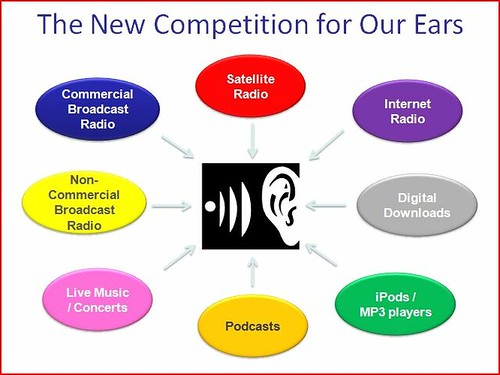
Much ink is spilled over the expanding array of video marketplace choices that are competing for the attention of our eyeballs, but much less is usually written about the competition for our ears. As this excellent new Business Week article by Olga Kharif makes clear, competition and innovation in the audio marketplace has never been more vibrant. It’s something I’ve pointed out here before and here’s a chart I created for my Media Metrics report to highlight all the new competition for our ears. We’ve come a long way since the days of my youth, when transistor radios and vinyl records were the extent of audio competition!
“I have bought this wonderful machine — a computer … it seems to me to be an Old Testament god, with a lot of rules and no mercy.”
– Joseph Campbell, trailblazing comparative mythologist, b. 1904 (Thanks to The Writer’s Almanac)
Speaking of socializing media, acting FCC Chairman Michael Copps is someone who has devoted much of his life to regulating the media marketplace into the ground. If he had his way, federal bureaucrats would be controlling virtually every aspect of the media universe. Nothing would get done with Big Nanny’s permission.
That’s what makes his recent comments about the impact of media regulation so delicious.. and hypocritical. According to an article Bloomberg ran on Thursday, Copps is now saying that, with newspapers struggling to remain afloat, the FCC should now reconsider regulations that prohibit combined ownership of broadcast stations and newspapers. The agency should “visit this whole problem” before long, Copps apparently told Bloomberg.
“Visit this problem before long”?? Please! Congress and the FCC have had opportunities to “visit” and revisit this problem for many years now, but it has been Michael Copps and his merry band of media reformistas who have stopped every reform effort dead in its tracks. (See my essays “Congress Fiddles, Newspapers Burn” and “Media Deregulation is Dead” for more evidence of how these radicals hijacked media policy in this country.) As I documented in my 2005 Media Myths book, these charlatans have used hyperbolic rhetoric, shameless fear-mongering, and unsubstantiated claims in opposition to each and every sensible effort to reform our nation’s outdated media ownership policies. Those laws and regulations have created artificial market structures and hindered the ability of media operators to find new business models that might throw them a lifeline in difficult times.
Consider the fact that it was just 14 months ago that then-Commissioner Copps issued this gem of a hysteria-ridden statement in response to the agency’s last effort to ever-so-slightly loosen the newspaper-broadcast cross ownership rule:
Continue reading →

 The Technology Liberation Front is the tech policy blog dedicated to keeping politicians' hands off the 'net and everything else related to technology.
