[This is a draft of a section of a forthcoming study on “A Flexible Governance Framework for Artificial Intelligence,” which I hope to complete shortly. I welcome feedback. I have also cross-posted this essay at Medium.]
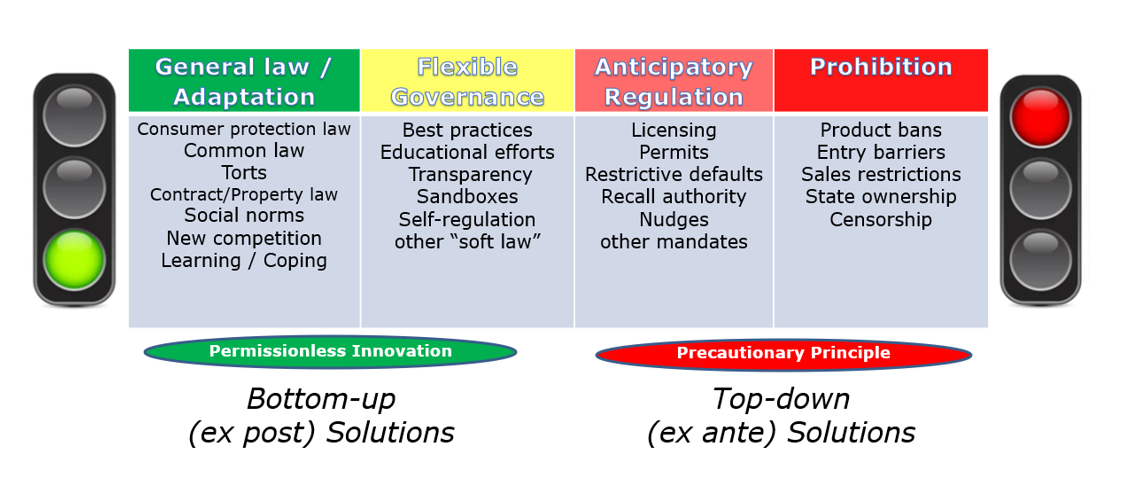
Debates about how to embed ethics and best practices into AI product design is where the question of public policy defaults becomes important. To the extent AI design becomes the subject of legal or regulatory decision-making, a choice must be made between two general approaches: the precautionary principle or the proactionary principle.[1] While there are many hybrid governance approaches in between these two poles, the crucial issue is whether the initial legal default for AI technologies will be set closer to the red light of the precautionary principle (i.e., permissioned innovation) or to the green light of the proactionary principle (i.e., (permissionless innovation). Each governance default will be discussed.
There is a war going on in the conservative movement over free speech issues and FCC Commissioner Mike O’Reilly just became a causality of that skirmish. Neil Chilson and I just posted a new essay about this over on the Federalist Society blog. As we note there:
Plenty of people claim to favor freedom of expression, but increasingly the First Amendment has more fair-weather friends than die-hard defenders. Michael O’Rielly, a Commissioner at the Federal Communications Commission (FCC), found that out the hard way this week.
Last week, O’Rielly delivered an important speech before the Media Institute highlighting a variety of problematic myths about the First Amendment, as well as “a particularly ominous development in this space.” In a previous political era, O’Rielly’s remarks would have been mainstream conservative fare. But his well-worded warnings are timely with many Democrats and Republicans – including some in the White House – looking to resurrect analog-era speech mandates and let Big Government reassert control over speech decisions in the United States.
Shortly after delivering his remarks, the White House yanked O’Rielly’s nomination to be reappointed to the agency. It was a shocking development that was likely motivated by growing animosities between Republicans on the question of how much control the federal government–and the FCC in particular–should exercise over speech platforms, including platforms that the FCC has no authority to regulate.
For the 30 years that I have been covering media and technology policy, I’ve heard conservatives rail against the Fairness Doctrine, Net Neutrality and arbitrary Big Government only to see many of them now reverse suit and become the biggest defenders of these things as it pertains to speech controls and FCC regulation. It will certainly be interesting to see what a potential future Biden Administration does with the various new regulations that some in the GOP are seeking to impose. Continue reading →
I’ve always been perplexed by tech critiques that seek to pit “humanist” values against technology or technological processes, or that even suggest a bright demarcation exists between these things. Properly understood, “technology” and technological innovation are simply extensions of our humanity and represent efforts to continuously improve the human condition. In that sense, humanism and technology are compliments, not opposites.
I started thinking about this again after reading a recent article by Christopher Mims of The Wall Street Journal, which introduced me to the term “techno-chauvinism.” Techno-chauvinism is a new term that some social critics are using to identify when technologies or innovators are apparently not behaving in a “humanist” fashion. Mims attributes the term techno-chauvinism to Meredith Broussard of New York University, who defines it as “the idea that technology is always the highest and best solution, and is superior to the people-based solution.” [Italics added.] Later on Twitter, Mims defined and critiqued techno-chauvinism as “the belief that the best solution to any problem is technology, not changing our culture, habits or mindset.”
Everything Old is New Again
There are other terms critics have used to describe the same notion, including: “techno-fundamentalism” (Siva Vaidhyanathan), “cyber-utopianism,” and “technological solutionism” (Evgeny Morozov). In a sense, all these terms are really just variants of what scholars in the field of Science and Technology Studies (STS) have long referred to as “technological determinism.”
As I noted in a recent essay about determinism, the traditional “hard” variant of technological determinism refers to the notion that technology almost has a mind of its own and that it will plow forward without much resistance from society or governments. Critics argue that determinist thinking denies or ignores the importance of the human element in moving history forward, or what Broussard would refer to as “people-based solutions.”
The first problem with this thinking is there are no bright lines in these debates and many “softer” variants of determinism exist. The same problem is at work when we turn to discussions about both “humanism” and “technology.” Things get definitionally murky quite quickly, and everyone seemingly has a preferred conception of these terms to fit their own ideological dispositions. “Humanism is a rather vague and contested term with a convoluted history,” observes tech philosopher Michael Sacasas. And here’s an essay that I have updated many times over the years to catalog the dozens of different definitions of “technology” I have unearthed in my ongoing research. Continue reading →
Over at the Mercatus Center’s Bridge blog, Chad Reese interviewed me about my forthcoming book and continuing research on “evasive entrepreneurialism” and the freedom to innovate. I provide a quick summary of the issues and concepts that I am exploring with my colleagues currently. Those issues include:
free innovation
evasive entrepreneurialism & social entrepreneurialism
technological civil disobedience
the freedom to tinker / freedom to try / freedom to innovate
the right to earn a living
“moonshots” / deep technologies / disruptive innovation / transformative tech
innovation culture
global innovation arbitrage
the pacing problem & the Collingridge dilemma
“soft law” solutions for technological governance
You can read the entire Q&A over at The Bridge, or I have pasted it down below.
“Responsible research and innovation,” or “RRI,” has become a major theme in academic writing and conferences about the governance of emerging technologies. RRI might be considered just another variant of corporate social responsibility (CSR), and it indeed borrows from that heritage. What makes RRI unique, however, is that it is more squarely focused on mitigating the potential risks that could be associated with various technologies or technological processes. RRI is particularly concerned with “baking-in” certain values and design choices into the product lifecycle before new technologies are released into the wild.
In this essay, I want to consider how RRI lines up with the opposing technological governance regimes of “permissionless innovation” and the “precautionary principle.” More specifically, I want to address the question of whether “permissionless innovation” and “responsible innovation” are even compatible. While participating in recent university seminars and other tech policy events, I have encountered a certain degree of skepticism—and sometimes outright hostility—after suggesting that, properly understood, “permissionless innovation” and “responsible innovation” are not warring concepts and that RRI can co-exist peacefully with a legal regime that adopts permissionless innovation as its general tech policy default. Indeed, the application of RRI lessons and recommendations can strengthen the case for adopting a more “permissionless” approach to innovation policy in the United States and elsewhere. Continue reading →
First, my old colleague Dan Rothschild was kind enough to ask me to contribute a post to the R Street Blog entitled, “Bucking the ‘Mother, May I?’ Mentality.” In it, I offered this definition and defense of permissionless innovation as a policy norm:
Permissionless innovation is about the creativity of the human mind to run wild in its inherent curiosity and inventiveness, even when it disrupts certain cultural norms or economic business models. It is that unhindered freedom to experiment that ushered in many of the remarkable technological advances of modern times. In particular, all the digital devices, systems and networks that we now take for granted came about because innovators were at liberty to let their minds run wild.
Steve Jobs and Apple didn’t need a permit to produce the first iPhone. Jeff Bezos and Amazon didn’t need to ask anyone for the right to create a massive online marketplace. When Sergey Brin and Larry Page wanted to release Google’s innovative search engine into the wild, they didn’t need to get a license first. And Mark Zuckerberg never had to get anyone’s blessing to launch Facebook or let people freely create their own profile pages.
All of these digital tools and services were creatively disruptive technologies that altered the fortunes of existing companies and challenged various social norms. Luckily, however, nothing preemptively stopped that innovation from happening. Today, the world is better off because of it, with more and better information choices than ever before.
I also posted an essay over on Medium entitled, ”
Why Permissionless Innovation Matters.” It’s a longer essay that seeks to answer the question: Why does economic growth occur in some societies & not in others? I build on the recent comments of venture capitalist Fred Wilson of Union Square Ventures noted during recent testimony: “If you look at the countries around the world where the most innovation happens, you will see a very high, I would argue a direct, correlation between innovation and freedom. They are two sides of the same coin.” Continue reading →
What follows is a response to Michael Sacasas, who recently posted an interesting short essay on his blog The Frailest Thing, entitled, “10 Points of Unsolicited Advice for Tech Writers.” As with everything Michael writes, it is very much worth reading and offers a great deal of useful advice about how to be a more thoughtful tech writer. Even though I occasionally find myself disagreeing with Michael’s perspectives, I always learn a great deal from his writing and appreciate the tone and approach he uses in all his work. Anyway, you’ll need to bounce over to his site and read his essay first before my response will make sense.
Michael:
Lots of good advice here. I think tech scholars and pundits of all dispositions would be wise to follow your recommendations. But let me offer some friendly pushback on points #2 & #10, because I spend much of my time thinking and writing about those very things.
In those two recommendations you say that those who write about technology “[should] not cite apparent historical parallels to contemporary concerns about technology as if they invalidated those concerns. That people before us experienced similar problems does not mean that they magically cease being problems today.” And you also warn “That people eventually acclimate to changes precipitated by the advent of a new technology does not prove that the changes were inconsequential or benign.”
I think these two recommendations are born of a certain frustration with the tenor of much modern technology writing; the sort of Pollyanna-ish writing that too casually dismisses legitimate concerns about the technological disruptions and usually ends with the insulting phrase, “just get over it.” Such writing and punditry is rarely helpful, and you and others have rightly pointed out the deficiencies in that approach.
That being said, I believe it would be highly unfortunate to dismiss any inquiry into the nature of individual and societal acclimation to technological change. Because adaptation obviously does happen! Certainly there must be much we can learn from it. In particular, what I hope to better understand is the process by which we humans have again and again figured out how to assimilate new technologies into their lives despite how much those technologies “unsettled” well-established personal, social, cultural, and legal norms. Continue reading →
I am pleased to announce the release of my latest book, “Permissionless Innovation: The Continuing Case for Comprehensive Technological Freedom.” It’s a short manifesto (just under 100 pages) that condenses — and attempts to make more accessible — arguments that I have developed in various law review articles, working papers, and blog posts over the past few years. I have two goals with this book.
First, I attempt to show how the central fault line in almost all modern technology policy debates revolves around “the permission question,” which asks:
Must the creators of new technologies seek the blessing of public officials before they develop and deploy their innovations? How that question is answered depends on the disposition one adopts toward new inventions. Two conflicting attitudes are evident.
One disposition is known as the “precautionary principle.” Generally speaking, it refers to the belief that new innovations should be curtailed or disallowed until their developers can prove that they will not cause any harms to individuals, groups, specific entities, cultural norms, or various existing laws, norms, or traditions.
The other vision can be labeled “permissionless innovation.” It refers to the notion that experimentation with new technologies and business models should generally be permitted by default. Unless a compelling case can be made that a new invention will bring serious harm to society, innovation should be allowed to continue unabated and problems, if they develop at all, can be addressed later.
I argue that we are witnessing a grand clash of visions between these two mindsets today in almost all major technology policy discussions today. Continue reading →
Jack Schinasi discusses his recent working paper, Practicing Privacy Online: Examining Data Protection Regulations Through Google’s Global Expansion published in the Columbia Journal of Transnational Law. Schinasi takes an in-depth look at how online privacy laws differ across the world’s biggest Internet markets — specifically the United States, the European Union and China. Schinasi discusses how we exchange data for services and whether users are aware they’re making this exchange. And, if not, should intermediaries like Google be mandated to make its data tracking more apparent? Or should we better educate Internet users about data sharing and privacy? Schinasi also covers whether privacy laws currently in place in the US and EU are effective, what types of privacy concerns necessitate regulation in these markets, and whether we’ll see China take online privacy more seriously in the future.
Robert Scoble, Startup Liaison Officer at Rackspace discusses his recent book, Age of Context: Mobile, Sensors, Data and the Future of Privacy, co-authored by Shel Israel. Scoble believes that over the next five years we’ll see a tremendous rise in wearable computers, building on interest we’ve already seen in devices like Google Glass. Much like the desktop, laptop, and smartphone before it, Scoble predicts wearable computers represent the next wave in groundbreaking innovation. Scoble answers questions such as: How will wearable computers help us live our lives? Will they become as common as the cellphone is today? Will we have to sacrifice privacy for these devices to better understand our preferences? How will sensors in everyday products help companies improve the customer experience?
The Technology Liberation Front is the tech policy blog dedicated to keeping politicians' hands off the 'net and everything else related to technology. Learn more about TLF →


 The Technology Liberation Front is the tech policy blog dedicated to keeping politicians' hands off the 'net and everything else related to technology.