I’ve been floating around in conservative policy circles for 30 years and I have spent much of that time covering media policy and child safety issues. My time in conservative circles began in 1992 with a 9-year stint at the Heritage Foundation, where I launched the organization’s policy efforts on media regulation, the Internet, and digital technology. Meanwhile, my work on child safety has spanned 4 think tanks, multiple blue ribbon child safety commissions, countless essays, dozens of filings and testimonies, and even a multi-edition book.
During this three-decade run, I’ve tried my hardest to find balanced ways of addressing some of the legitimate concerns that many conservatives have about kids, media content, and online safety issues. Raising kids is the hardest job in the world. My daughter and son are now off at college, but the last twenty years of helping them figure out how to navigate the world and all the challenges it poses was filled with difficulties. This was especially true because my daughter and son faced completely different challenges when it came to media content and online interactions. Simply put, there is no one-size-fits-all playbook when it comes to raising kids or addressing concerns about healthy media interactions. Continue reading →
This weekend, The Wall Street Journal ran my short letter to the editor entitled, “We Can Protect Children and Keep the Internet Free.” My letter was a response to columnist Peggy Noonan’s April 9 oped, “Can Anyone Tame Big Tech?” in which she proposed banning everyone under 18 from all social-media sites. She specifically singled out TikTok, Youtube, and Instagram and argued “You’re not allowed to drink at 14 or drive at 12; you can’t vote at 15. Isn’t there a public interest here?”
I briefly explained why Noonan’s proposal is neither practical nor sensible, noting how it:
would turn every kid into an instant criminal for seeking access to information and culture on the dominant medium of their generation. I wonder how she would have felt about adults proposing to ban all kids from listening to TV or radio during her youth.
Let’s work to empower parents to help them guide their children’s digital experiences. Better online-safety and media-literacy efforts can prepare kids for a hyperconnected future. We can find workable solutions that wouldn’t usher in unprecedented government control of speech.
Let me elaborate just a bit because this was the focus of much of my writing a decade ago, including my book, Parental Controls & Online Child Protection: A Survey of Tools & Methods, which spanned several editions. Online child safety is a matter I take seriously and the concerns that Noonan raised in her oped have been heard repeatedly since the earliest days of the Internet. Regulatory efforts were immediately tried. They focused on restricting underage access to objectionable online content (as well as video games), but were immediately challenged and struck down as unconstitutionally overbroad restrictions on free speech and a violation of the First Amendment of the U.S. Constitution. Continue reading →
On Wednesday afternoon, it was my great pleasure to make some introductory remarks at a Family Online Safety Institute (FOSI) event that was held at the Yahoo! campus in Sunnyvale, CA. FOSI CEO Stephen Balkam asked me to offer some thoughts on a topic I’ve spent a great deal of time thinking about in recent years: Who needs parental controls? More specifically, what role do parental control tools and methods play in the upbringing of our children? How should we define or classify parental control tools and methods? Which are most important / effective? Finally, what should the role of public policy be toward parental control technologies on both the online safety and privacy fronts?
In past years, I spent much time writing and updating a booklet on these issues called
Parental Controls & Online Child Protection: A Survey of Tools & Methods. It was an enormous undertaking, however, and I have abandoned updating it after I hit version 4.0. But that doesn’t mean I’m not still putting a lot of thought into these issues. My focus has shifted over the past year more toward the privacy-related concerns and away from the online safety issues. Of course, all these issues intersect and many people now (rightly) considered them to largely be the same debate.
Anyway, to kick off the FOSI event, I offered three provocations about parental control technologies and the state of the current debate over them. I buttressed some of my assertions with findings from a recent FOSI survey of parental attitudes about parental controls and online safety. Continue reading →
 The Supreme Court wasn’t playing games with the First Amendment today. With its 7-2 decision in Brown v. EMA, the Court has protected video game creators and players from unconstitutional restrictions on what we can produce and play.
Today’s decision ensures that video games have First Amendment protection on par with books, film, music and other forms of entertainment and will help block other regulatory efforts that are justified by blindly alluding to the rationale that “it’s for the children.” The decision fits nicely alongside an impressive and growing string of recent First Amendment cases from the Court that significantly raise the bar against legislative efforts to regulate freedom of speech and expression.
Quick background: In May 2010, the Supreme Court announced that it would review a California law regulating the sale of violently-themed video games to minors. The case was Schwarzenegger v. Entertainment Merchants Association, but the name of the case changed to after Jerry Brown became governor of California. The Ninth Circuit Court of Appeals had struck down a California law which prohibited the sale or rental of “violent video games” to minors, but California appealed and the SCOTUS took up the issue. [Note: When we were still with the Progress & Freedom Foundation, Berin Szoka and I filed a big amicus brief with the Court in the case along with some folks at the Electronic Frontier Foundation.] By a 7-2 vote, the Supreme Court backed the Ninth Circuit and overturned the California law. Justice Scalia wrote for the majority. Justices Thomas and Breyer dissented.
The crucial holdings in the decision are as follows: Continue reading →
 I’m still digesting the transcript from Tuesday’s Supreme Court oral arguments in the important First Amendment video game case, Schwarzenegger v. EMA. [Full transcript is here.] I thought I would post just a couple of quick thoughts here. [Reminder: here is the amicus brief that Berin Szoka and I filed in the case, and here is some analysis of the case by Larry Downes.]
On Defining “Deviant Violence”
Much of the discussion during oral arguments was preoccupied with defining the contours of the term “deviant violence.” I was pleased to see the Justices asking some sharp questions about the interpretation of that term for regulatory purposes. In particular, I enjoyed Justice Scalia’s remarks and questions to California Deputy Attorney General Zackery Morazzini, who argued the case on behalf of the state. Scalia said:
I am not just concerned with the vagueness. I am concerned with the vagueness, but I am concerned with the First Amendment, which says Congress shall make no law abridging the freedom of speech. And it was always understood that the freedom of speech did not include obscenity. It has never been understood that the freedom of speech did not include portrayals of violence. You are asking us to create… a whole new prohibition which the American people never — never ratified when they ratified the First Amendment. They knew they were — you know, obscenity was — was bad, but — what’s next after violence? Drinking? Smoking? Movies that show smoking can’t be shown to children? Does — will that affect them? Of course, I suppose it will. But is — is that — are — are we to sit day by day to decide what else will be made an exception from the First Amendment? Why — why is this particular exception okay, but the other ones that I just suggested are not okay? (p. 15-16)
Indeed, that’s what is at stake in this case: The beginning of a new class of exceptions to the First Amendment based upon concerns about children’s exposure to depictions of “excessive” or “deviant” violence.” Once you open up this can of worms, the sky is likely the limit in terms of how far governments might go to regulate speech in the name of “protecting children.” Continue reading →
The website ProCon.org has a new debate online laying out the different perspectives about the question: “Do violent video games contribute to youth violence?” It includes citations for a wide variety of studies that come down on both sides of the question. Simply put, there’s a study for everyone out there. Do you want to find a study suggesting that there’s a strong correlation between violently-themed media and aggression? You can find plenty. Or do you want to hear that there’s no correlation between these things? Well, there’s plenty of studies suggesting that, too.
As someone who briefly flirted with a degree in psychology, I find this an interesting intellectual debate. But here’s the thing I can’t get away from —
lab studies by psychology professors and students are not the real-world. I am consistently shocked and disappointed at the lack of scrutiny these studies receive when they are little more than artificial constructions of reality.
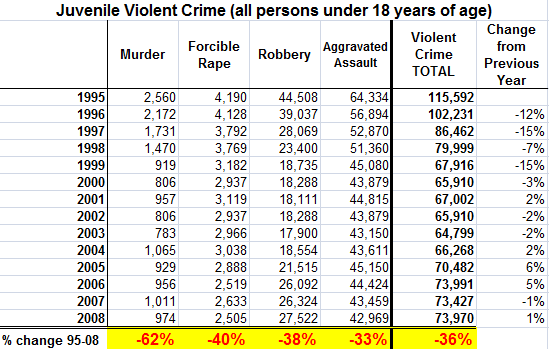
So, how can we determine whether watching depictions of violence will turn us all into killing machines, rapists, robbers, or just plain ol’ desensitized thugs? Well, how about looking at the real world! Whatever lab experiments might suggest, the evidence of a link between depictions of violence in media and the real-world equivalent just does not show up in the data. The FBI produces ongoing Crime in the United States reports that document violent crimes trends. Here’s what the data tells us about overall violent crime, forcible rape, and juvenile violent crime rates over the past two decades: They have all fallen. Perhaps most impressively, the juvenile crime rate has fallen an astonishing 36% since 1995 (and the juvenile murder rate has plummeted by 62%).
Continue reading →
I’ve been meaning to say something about this new paper by Renee Newman Knake of Michigan State University College of Law, which calls for a new paradigm to analyze, and then likely regulate, video game content. Knake’s paper is entitled, “From Research Conclusions to Real Change: Understanding the First Amendment’s (Non)Response to Negative Effects of Mass Media on Children by Looking to the Example of Violent Video Game Regulations.” In it, she proposes to extend an emerging legal philosophy known as “ecogenerism” to the field of video games and the First Amendment treatment thereof. “Ecogenerism” is largely the creation of Barbara Bennett Woodhouse and the theory argues that we should apply lessons or legal frameworks from the field of environmental law to the area of media and children. “Under an ecogenerist model,” states Knake, “media harm decisions should prioritize concern about the level of ‘toxic’ media which children are exposed over free speech interests.” Simply stated, we should treat “toxic media” like toxic chemicals.
There have been other efforts to get courts to relax the legal scrutiny applied to video game content from “strict” to something more relaxed or intermediate in character. For example, there is the “violence as obscenity” approach proposed by Kevin Saunders, who, like Knake, is also with the Michigan State University College of Law. But whereas Saunders has proposed applying an adjacent legal theory or framework (obscenity law) to legal analysis of the constitutionality of regulation of video game content, Woodhouse and now Knake propose a much broader, and more radical, reformulation of First Amendment law along the lines of entirely different body of jurisprudence — again, environment law and regulation.
Of course, this is nuts. The notion that words or images are as “toxic” as chemicals is preposterous, and yet that is exactly what Knake and Woodhouse want us to accept. We can determine with a great deal of certainly the physiological impact of too much mercury or lead on the development of the human brain or body. Generally speaking, we know what dose would kill or deform. The same cannot possibly be said of media, and the very allusion to toxic materials or chemicals is ludicrous to begin with since words and images have never directly killed anyone. EVER! Continue reading →
Berin has already done a fine job tearing apart this latest effort by 10 activist groups to break the Internet by imposing burdensome regulation or punishing legal liability on Internet operators for the crime of trying to deliver relevant advertising to users that can actually pay for the content and services given away to users for free. To that, I would add my deep disappointment that the Electronic Freedom Foundation (EFF) choose to join this cabal. After all, the other members of the coalition are frequently heard calling for regulation of one variety or another. But EFF always prides itself on supposedly avoiding online regulatory schemes. That’s what makes it so surprising that they chose to jump on this bandwagon for an Internet industrial policy in the name of “protecting privacy.”
EFF’s embrace of regulation is particularly inconsistent given their excellent filing in the FCC’s “Child Safe Viewing Act” proceeding this summer. As I’ve previously noted, this proceeding raises the specter of “convergence-era content regulation” with Congress authorizing the FCC to look into “advanced blocking controls” for “wired, wireless, and Internet” platforms. EFF’s comments rightly stressed dangers of expanded content controls or Internet regulation, and noted the many “less-restrictive means” available to the public that provide compelling alternatives to government regulation: “Blocking technologies are widely available in the market and do not require further government support.” And EFF has been instrumental throughout the years of making the case in courts for applying the less-restrictive means test and strict scrutiny when it comes to government efforts to regulate speech.
Why, then, does EFF take the diametrically opposite position when privacy concerns enter the picture? Continue reading →
 The latest edition (Version 4.0) of my PFF special report on “Parental Controls and Online Child Protection: A Survey of Tools & Methods” is now up. For those not familiar with the report, it explores the market for parental control tools, rating schemes, education and media literacy efforts, and various other tools, methods, and initiatives aimed at promoting online child safety. After evaluating that state of this market, I conclude: “There has never been a time in our nation’s history when parents have had more tools and methods at their disposal to help them decide what constitutes acceptable media content in their homes and in the lives of their children.” Moreover, I believe that the parental controls and content management tools cataloged in the report represent a better, less restrictive alternative to government regulation.
Version 4.0 of the report is now over 250 pages long (up from 200 pages in Version 3.0) and it contains almost 70 exhibits (up from 50), 725 references (up from roughly 500), and numerous updates in all five sections of the book. Major updates have been made to the Internet, social networking, and mobile media sections, reflecting the growing importance of those sectors and issues. Other new sections or appendices have also been added to the report, including:
- a new section examining how many households really need parental control tools;
- a new appendix on the downsides of mandatory parental controls and restrictive default settings;
- a new section on the dangers of “deputizing the online middleman” solution as an approach to solving child safety concerns;
- a new appendix reviewing the findings of 5 past online safety task forces;
- … and much more.
I issue major updates once a year and 1 or 2 minor tweaks during the course of the year to reflect the evolution of the parental control and online child safety marketplace and debate. The report is available free-of-charge on the PFF website, and the previous editions of the report are housed there too in case you want to see how it has evolved over the past couple of years. For those interested in taking a quick look at the report, I have embedded it down below the fold as a Scribd file. Finally, as is always the case, I encourage readers to send me updates and suggestions for how to improve the report and I will incorporate them into future versions.
Continue reading →

 The Technology Liberation Front is the tech policy blog dedicated to keeping politicians' hands off the 'net and everything else related to technology.