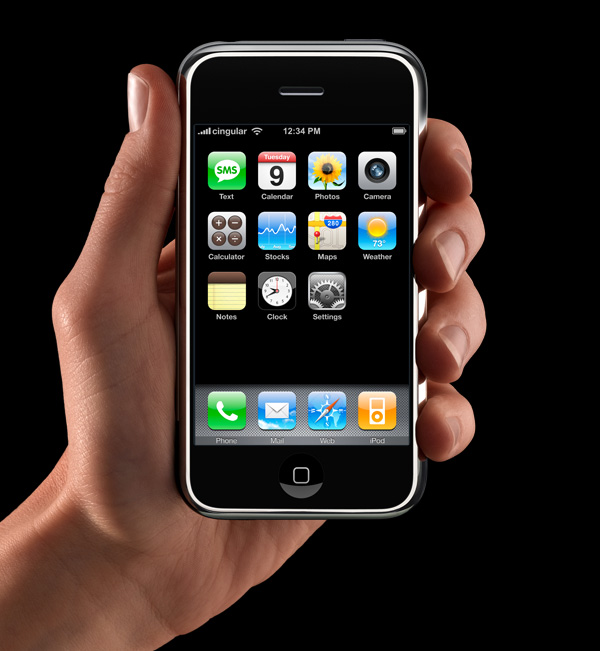
Today marks the 10th anniversary of the launch of the Apple iPhone. With all the headlines being written today about how the device changed the world forever, it is easy to forget that before its launch, plenty of experts scoffed at the idea that Steve Jobs and Apple had any chance of successfully breaking into the seemingly mature mobile phone market.
After all, those were the days when BlackBerry, Palm, Motorola, and Microsoft were on everyone’s minds. Perhaps, then, it wasn’t so surprising to hear predictions like these leading up to and following the launch of the iPhone:
In December 2006, Palm CEO Ed Colligan summarily dismissed the idea that a traditional personal computing company could compete in the smartphone business. “We’ve learned and struggled for a few years here figuring out how to make a decent phone,” he said. “PC guys are not going to just figure this out. They’re not going to just walk in.”
In January 2007, Microsoft CEO Steve Ballmer laughed off the prospect of an expensive smartphone without a keyboard having a chance in the marketplace as follows: “Five hundred dollars? Fully subsidized? With a plan? I said that’s the most expensive phone in the world and it doesn’t appeal to business customers because it doesn’t have a keyboard, which makes it not a very good e-mail machine.”
In March 2007, computing industry pundit John C. Dvorak argued that “Apple should pull the plug on the iPhone” since “There is no likelihood that Apple can be successful in a business this competitive.” Dvorak believed the mobile handset business was already locked up by the era’s major players. “This is not an emerging business. In fact it’s gone so far that it’s in the process of consolidation with probably two players dominating everything, Nokia Corp. and Motorola Inc.”
Adam Thierer, Senior Research Fellow at the Mercatus Center discusses his recent working paper with coauthor Brent Skorup, A History of Cronyism and Capture in the Information Technology Sector. Thierer takes a look at how cronyism has manifested itself in technology and media markets — whether it be in the form of regulatory favoritism or tax privileges. Which tech companies are the worst offenders? What are the consequences for consumers? And, how does cronyism affect entrepreneurship over the long term?
The project is looking at the emerging ecosystem for innovation based on disruptive technologies. It expands on work we have done separately and now together over the last fifteen years.
Our chief finding is that the nature of innovation has changed dramatically, calling into question much of the conventional wisdom on business strategy and competition, especially in information-intensive industries–which is to say, these days, every industry.
The drivers of this new ecosystem are ever-cheaper, faster, and smaller computing devices, cloud-based virtualization, crowdsourced financing, collaborative development and marketing, and the proliferation of mobile everything. There will soon be more smartphones sold than there are people in the world. And before long, each of over one trillion items in commerce will be added to the network.
The result is that new innovations now enter the market cheaper, better, and more customizable than products and services they challenge. (For example, smartphone-based navigation apps versus standalone GPS devices.) In the strategy literature, such innovation would be characterized as thoroughly “undiscplined.” It shouldn’t succeed. But it does. Continue reading →
In this paper, I note that to the extent public utility-style regulation has been debated within the Internet policy arena over the past decade, the focus has been almost entirely on the physical layer of the Internet. The question has been whether Internet service providers should be considered “essential facilities” or “natural monopolies” and regulated as public utilities. The debate over “net neutrality” regulation has been animated by such concerns.
While that debate still rages, the rhetoric of public utilities and essential facilities is increasingly creeping into policy discussions about other layers of the Internet, such as the search layer. More recently, there have been rumblings within academic and public policy circles regarding whether social media platforms, especially social networking sites, might also possess public utility characteristics. Presumably, such a classification would entail greater regulation of those sites’ structures and business practices.
Proponents of treating social media platforms as public utilities offer a variety of justifications for regulation. Amorphous “fairness” concerns animate many of these calls, but privacy and reputational concerns are also frequently mentioned as rationales for regulation. Proponents of regulation also sometimes invoke “social utility” or “social commons” arguments in defense of increased government oversight, even though these notions lack clear definition.
Social media platforms do not resemble traditional public utilities, however, and there are good reasons why policymakers should avoid a rush to regulate them as such. Continue reading →
The National Transportation Safety Board recommended yesterday that states ban all non-emergency use of portable electronic devices while driving, except for devices that assist the driver in driving (such as GPS). The recommendation followed the NTSB’s investigation of a tragic accident in Missouri triggered by a driver who was texting.
Personally I don’t see how someone can pay attention to the road while texting. (I’m having a hard enough time paying attention to a conference presentation while I’m typing this!) But the National Transportation Safety Board’s recommendation is a classic example of regulatory overreach based on anecdote. The NTSB wants to use one tired driver’s indefensible and extreme texting (which led to horrific results) as an excuse to ban all use of portable electronic devices while driving – including hands-free phone conversations. Before states act on this recommendation, they should carefully examine systematic evidence – not just anecdotes — to determine whether different uses of handheld devices pose different risks. They should also consider whether bans on some uses would expose drivers to risks greater than the risk the ban would prevent.
For CNET this morning, I have a long article reviewing the sad recent history of how local governments determine the quality of mobile services.
As it turns out, the correlation is deeply negative. In places with the highest level of user complaints (San Francisco, Washington, D.C.), it turns out that endless delays or outright denials for applications to add towers and other sites as well as new and upgraded equipment is also high. Who’d have thought?
Despite a late 2009 ruling by the FCC that put a modest “shot clock” on local governments to approve or deny applications, data from CTIA and PCIA included in recent comments on the FCC’s Broadband Acceleration NOI suggests the clock has had little to no effect. This is in part because the few courts that have been asked to enforce it have demurred or refused.
Much of the dithering by local zoning boards is unprincipled and pointless, a sign not so much of legitimate concerns over safety and aesthetics but of incompetence, corruption, and the insidious influence of outside “consultants” whose fees are often levied against the applicant, adding insult to injury. Continue reading →
Two data points in the news over the past 24 hours to consider:
A new report on “Smartphone Adoption & Usage” by the Pew Internet Project finds that “one third of American adults – 35% – own smartphones” and that of that group “some 87% of smartphone owners access the Internet or email on their handheld” and “25% of smartphone owners say that they mostly go online using their phone, rather than with a computer.”
According to the Wall Street Journal, the “Average iPhone Owner Will Download 83 Apps This Year.” That’s up from an average of 51 apps downloaded in 2010. (At first I was astonished when I read that, but then realized that I’ve probably downloaded an equal number of apps myself, albeit on an Android-based device.)
As I explain in my latest
Forbes column, facts like these help us understand “How iPhones And Androids Ushered In A Smartphone Pricing Revolution.” That is, major wireless carriers are in the process of migrating from flat-rate, “all-you-can-eat” wireless data plans to usage-based plans. The reason is simple economics: data demand is exploding faster than data supply can keep up.
“It’s been four years since the introduction of the iPhone and rival devices that run Google’s Android software,” notes Cecilia Kang of The Washington Post. “In that time, the devices have turned much of America into an always-on, Internet-on-the-go society.” Indeed, but it’s not just the iPhone and Android smartphones. It’s all those tablets that have just come online over the past year, too. We are witnessing a tectonic shift in how humans consume media and information, and we are witnessing this revolution unfold over a very short time frame. Continue reading →
I spaced out and completely forget to post a link here to my latest Forbes column which came out over the weekend. It’s a look at back at last week’s hullabaloo over “Apple, The iPhone, and a Locational Privacy Techno-Panic.” In it, I argue:
Some of the concerns raised about the retention of locational data are valid. But panic, prohibition and a “privacy precautionary principle” that would preemptively block technological innovation until government regulators give their blessings are not valid answers to these concerns. The struggle to conceptualize and protect privacy rights should be an evolutionary and experimental process, not one micro-managed at every turn by regulation.
I conclude the piece by noting that:
Public pressure and market norms also encourage companies to correct bone-headed mistakes like the locational info retained by Apple. But we shouldn’t expect less data collection or less “tracking” any time soon. Information powers the digital economy, and we must learn to assimilate new technology into our lives.
Read the rest here. And if you missed essay Larry Downes posted here on the same subject last week, make sure to check it out.
I’ve written a long article this morning for CNET (See “Privacy panic debate: Whose data is it?”) on the discovery of the iPhone location tracking file and the utterly predictable panic response that followed. Its life-cycle follows precisely the crisis model Adam Thierer has so frequently and eloquently traced, most recently here on TLF.
In particular, the CNET article takes a close and serious look at Richard Thaler’s column in Saturday’s New York Times, “Show us the data. (It’s ours, after all.)” Thaler uses the iPhone scare as occassion to propose a regulatory fix to the “problem” of users being unable to access in “computer-friendly form” copies of the information “collected on” them by merchants. Continue reading →
There’s a nice piece of reporting from Ian Shapira in today’s Washington Post entitled, “Once the Hobby of Tech Geeks, iPhone Jailbreaking Now a Lucrative Industry.” In the article, Shapira documents the rise of independent, unauthorized Apple apps (especially tethering apps) and points out that what was once a small black market has now turned into a booming, maturing business sector in its own right. In fact, Sharpia notes, there are already “market leaders” in the field:
At the top of the jailbreaking hierarchy sits Jay Freeman, 29, the founder and operator of Cydia, the biggest unofficial iPhone app store, which offers about 700 paid designs and other modifications out of about 30,000 others that are free. Based out of an office near Santa Barbara, Calif., Freeman said Cydia, launched in 2008, now earns about $250,000 after taxes in profit annually. He just hired his first full-time employee from Delicious, the Yahoo-owned bookmarking site, to improve Cydia’s design. “The whole point is to fight against the corporate overlord,” Freeman said. “This is grass-roots movement, and that’s what makes Cydia so interesting. Apple is this ivory tower, a controlled experience, and the thing that really bought people into jailbreaking is that it makes the experience theirs.”
In another sign this black market is now going mainstream, advertisers are apparently flocking to it:
In what might be the ultimate sign that the jailbreak industry is losing its anti-establishment character, Toyota recently offered a free program on Cydia’s store, promoting the company’s Scion sedan. Once installed, the car is displayed on the background of the iPhone home screen, and the iPhone icons are re-fashioned to look like the emblem on the front grill.
Interestingly, however, some people now complain that Cydia is getting too big for its britches and has come to be “as domineering as Apple is in the non-jailbreak world.” What delicious irony! Yet, I do not for one minute believe that Cydia has any sort of “lock” on the “unlocking” marketplace. This is an insanely dynamic sector that is subject to near-constant fits of disruptive technological change. Continue reading →
The Technology Liberation Front is the tech policy blog dedicated to keeping politicians' hands off the 'net and everything else related to technology. Learn more about TLF →


 The Technology Liberation Front is the tech policy blog dedicated to keeping politicians' hands off the 'net and everything else related to technology.