For my latest column in The Hill, I explored the European Union’s (EU) endlessly expanding push to regulate all facets of the modern data economy. That now includes a new effort to regulate artificial intelligence (AI) using the same sort of top-down, heavy-handed, bureaucratic compliance regime that has stifled digital innovation on the continent over the past quarter century.
The European Commission (EC) is advancing a new Artificial Intelligence Act, which proposes banning some AI technologies while classifying many others under a heavily controlled “high-risk” category. A new bureaucracy, the European Artificial Intelligence Board, will be tasked with enforcing a wide variety of new rules, including “prior conformity assessments,” which are like permission slips for algorithmic innovators. Steep fines are also part of the plan. There’s a lengthy list of covered sectors and technologies, with many others that could be added in coming years. It’s no wonder, then, that the measure has been labelled the measure “the mother of all AI laws” and analysts have argued it will further burden innovation and investment in Europe.
As I noted in my new column, the consensus about Europe’s future on the emerging technology front is dismal to put it mildly.
The International Economy journal recently asked 11 experts from Europe and the U.S. where the EU currently stood in global tech competition. Responses were nearly unanimous and bluntly summarized by the symposium’s title: “The Biggest Loser.” Respondents said Europe is “lagging behind in the global tech race,” and “unlikely to become a global hub of innovation.” “The future will not be invented in Europe,” another analyst bluntly concluded. Continue reading →
The race for artificial intelligence (AI) supremacy is on with governments across the globe looking to take the lead in the next great technological revolution. As they did before during the internet era, the US and Europe are once again squaring off with competing policy frameworks.
It seems the EU basically wants to have its cake and eat it too by marrying up an ambitious industrial policy with a precautionary regulatory regime. We’ve seen this show before. Europe is doubling down on the same policy regime it used for the internet and digital commerce. It did not work out well for the continent then, and there are reasons to think it will backfire on them again for AI technologies. Continue reading →
In 2015 after White House pressure, the FCC decided to take the radical step of classifying “broadband Internet access service” as a heavily-regulated Title II service. Title II was created for the AT&T long-distance monopoly and telegraph network and “promoting innovation and competition” is not its purpose. It’s ill-suited for the modern Internet, where hundreds of ISPs and tech companies are experimenting with new technologies and topologies.
Commissioner Brendan Carr was gracious enough to speak with Chris Koopman and me in a Mercatus podcast last week about his decision to vote to reverse the Title II classification. The podcast can be found at the Mercatus website. One highlight from Commissioner Carr:
Congress had a fork in the road. …In 1996, Congress made a decision that we’re going to head down the Title I route [for the Internet]. That decision has been one of the greatest public policy decisions that we’ve ever seen. That’s what led to the massive investment in the Internet. Over a trillion dollars invested. Consumers were protected. Innovators were free to innovate. Unfortunately, two years ago the Commission departed from that framework and moved into a very different heavy-handed regulatory world, the Title II approach.
Along those lines, in my recent ex parte meeting with Chairman Pai’s office, I pointed to an interesting 2002 study in the Review of Economics and Statistics from MIT Press about the stifling effects of Title II regulation:
[E]xisting economics scholarship suggests that a permissioned approach to new services, like that proposed in the [2015] Open Internet Order, inhibits innovation and new services in telecommunications. As a result of an FCC decision and a subsequent court decision in the late 1990s, for 18 to 30 months, depending on the firm, [Title II] carriers were deregulated and did not have to submit new offerings to the FCC for review. After the court decision, the FCC required carriers to file retroactive plans for services introduced after deregulation.
This turn of events allowed economist James Preiger to analyze and compare the rate of new services deployment in the regulated period and the brief deregulated period. Preiger found that “some otherwise profitable services are not financially viable under” the permissioned regime. Critically, the number of services carriers deployed “during the [deregulated] interim is 60%-99% larger than the model predicts they would have created” when preapproval was required. Finally, Preiger found that firms would have introduced 62% more services during the entire study period if there was no permissioned regime. This is suggestive evidence that the Order’s “Mother, May I?” approach will significantly harm the Internet services market.
Thankfully, this FCC has incorporated economic scholarship into its Restoring Internet Freedom Order and will undo the costly Title II classification for Internet services.
The Federal Trade Commission (FTC) is taking a more active interest in state and local barriers to entry and innovation that could threaten the continued growth of the digital economy in general and the sharing economy in particular. The agency recently announced it would be hosting a June 9th workshop “to examine competition, consumer protection, and economic issues raised by the proliferation of online and mobile peer-to peer business platforms in certain sectors of the [sharing] economy.” Filings are due to the agency in this matter by May 26th. (Along with my Mercatus Center colleagues, I will be submitting comments and also releasing a big paper on reputational feedback mechanisms that same week. We have already released this paper on the general topic.)
Relatedly, just yesterday, the FTC sent a letter to Michigan policymakers about restricting entry by Tesla and other direct-to-consumer sellers of vehicles. Michigan passed a law in October 2014 prohibiting such direct sales. The FTC’s strongly-worded letter decries the state’s law as “protectionism for independent franchised dealers” noting that “current provisions operate as a special protection for dealers—a protection that is likely harming both competition and consumers.” The agency argues that:
consumers are the ones best situated to choose for themselves both the vehicles they want to buy and how they want to buy them. Automobile manufacturers have an economic incentive to respond to consumer preferences by choosing the most effective distribution method for their vehicle brands. Absent supportable public policy considerations, the law should permit automobile manufacturers to choose their distribution method to be responsive to the desires of motor vehicle buyers.
The agency cites the “well-developed body of research on these issues strongly suggests that government restrictions on distribution are rarely desirable for consumers” and the staff letter continues on to utterly demolish the bogus arguments set forth by defenders of the blatantly self-serving, cronyist law. (For more discussion of just how anti-competitive and anti-consumer these laws are in practice, see this January 2015 Mercatus Center study, “State Franchise Law Carjacks Auto Buyers,” by Jerry Ellig and Jesse Martinez.) Continue reading →
If there is one thing I have learned in almost 23 years of covering communications and media regulation it is this: No matter how well-intentioned, regulation often has unintended consequences that hurt the very consumers the rules are meant to protect. Case in point: “universal service” mandates that require a company to serve an entire area as a condition of offering service at all. The intention is noble: Get service out to everyone in the community, preferably at a very cheap rate. Alas, the result of mandating that result is clear: You get less competition, less investment, less innovation, and less consumer choice. And often you don’t even get everyone served.
U.S. policy long favored extending service to all. AT&T touted its “universal service” in advertisements more than a century ago. The concept was codified in a 1934 law requiring nationwide “wire and radio services” to reach everyone at “reasonable charges.” In exchange for wiring a community, telecommunications providers often gained a monopoly. Cities made similar deals with cable-TV providers beginning in the 1960s.
The problem, of course, is that while this model allowed for the slow spread of service to
most communities, it came at a very steep cost: Monopoly and plain vanilla service. I documented this in a 1994 essay entitled, “Unnatural Monopoly: Critical Moments in the Development of the Bell System Monopoly.” As well-intentioned regulatory mandates started piling up, competition slowly disappeared. And a devil’s deal was eventually cut between regulators and AT&T to adopt the company’s advertising motto — “One Policy, One System, Universal Service” — as the de facto law of the land. Continue reading →
From the time Tom Wheeler was nominated to become the next FCC Chairman, many have wondered, “What would Wheeler do?” Though it is still early in his chairmanship, the only ruling issued in Chairman Wheeler’s first meeting signals a pro-investment approach to communications regulation.
The declaratory ruling clarified that the FCC would evaluate foreign investment in broadcast licensees that exceeds the 25 percent statutory benchmark using its existing analytical framework. It had previously been unclear whether broadcasters were subject to the same standard as other segments of the communications industry. The ruling recognized that providing broadcasters with regulatory certainty in this respect would promote investment and that greater investment yields greater innovation.
The FCC’s decision to apply the same standards for reviewing foreign ownership of broadcasters as it applies to other segments of the communications industry is very encouraging. It affirms the watershed policy decisions in the USF/ICC Transformation Order, in which the FCC concluded that “leveling the playing field” promotes competition whereas implied subsidies deter investment and are “unfair for consumers.” Continue reading →
Why do mobile carriers sell phones with a subscription? My roommate and I were debating this the other night. Most other popular electronics devices aren’t sold this way. Cable and satellite companies don’t sell televisions with their video service. ISPs don’t sell laptops and desktops with their Internet service. Bundling phones with mobile service subscriptions is pretty unique. (The only mass-market analogs I can think of are satellite radio and GPS service.)
I’ve been wading through the FCC’s latest Mobile Wireless Competition Report, and articles about it trying to make sense of what the the agency might be up to on this front. It’s hard to get a read on where the agency may be going here. As my PFF colleague Mike Wendy suggested in his post on the FCC’s report, “far from press reports which state the FCC clearly determined the market is not ‘effectively competitive,’ well, that’s wrong. In fact, the FCC fails to make any such determination whatsoever.” Moreover, just flipping through the charts and tables of the 237-page report, one is struck by how dynamic this marketplace is, and how crazy it would be for the FCC to declare it anything other than effectively competitive and highly innovative.
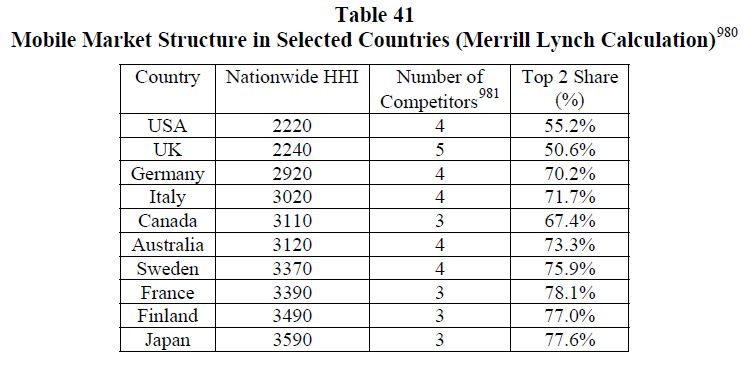
Yet, the FCC and many others seem hung up on industry structure. In particular, there seems to be a lot of hand-wringing about increasing consolidation among the sector’s top players. But the data the FCC reproduces in the report seem to undermine that concern. For example, here’s a snapshot of the “Mobile Market Structure in Selected Countries,” which appears on pg. 197 of the FCC report. It shows how much more consolidated foreign mobile markets are relative to the U.S., which is true of wireline markets too. And you can find much more evidence of how competitive the marketplace is in these two reports.
Yesterday I engaged in a lively luncheon debate about Net neutrality regulation with Ben Scott of Free Press at a Catholic University Law School event on “Implementing the National Broadband Plan.” To open the debate, I made a very quick 5-Part Case against Net Neutrality Regulation. I argued that the the objections to a Net neutrality regulatory regime can be grouped into 5 major categories: (1) Legal; (2) Economic; (3) Engineering; (4) Practical; and (5) Philosophical / Principled. Down below you will find my working notes to see how I then elaborated on each objection in a bit more detail. And then Ben and I engaged in some spirited banter for the next 45 minutes.
Unfortunately, it doesn’t appear that the video of our debate is online just yet, but once it is I will post it here. However, the folks from NextGenWeb asked me to shoot a short 2 1/2 min video clip after the debate summarizing my remarks. If you can stand the sight of my big fat head in your browser for that long, here ya go:
The objections to a Net neutrality regulatory regime can be grouped into 5 major categories: (1) Legal; (2) Economic; (3) Engineering; (4) Practical; and (5) Philosophical / Principled. Each objection will be briefly summarized below: Continue reading →
This morning, the Technology Committee of the New York City Council convened a large hearing on a resolution urging Congress to pass a robust Net Neutrality law. I was supposed to testify, but our narrowband transportation system prevented me from getting to New York. Here, however, is the testimony I prepared. It focuses on investment, innovation, and the impact Net Neutrality would have on both.
The Technology Liberation Front is the tech policy blog dedicated to keeping politicians' hands off the 'net and everything else related to technology. Learn more about TLF →


 The Technology Liberation Front is the tech policy blog dedicated to keeping politicians' hands off the 'net and everything else related to technology.