Are you a student or young scholar looking for opportunities to advance your studies and future career opportunities? The Mercatus Center at George Mason University can help. I’ve been with Mercatus for 12 years now and the most rewarding part of my job has always been the chance to interact with students and up-and-coming scholars who are hungry to learn more and make their mark on the world. Of course, learning and researching takes time and money. Mercatus works with students and scholars in many different fields to help them advance their careers by offering them some financial assistance to make their dreams easier to achieve.
The Mercatus Center’s Academic & Student Programs team (ASP) are the ones that make all this happen. ASP is currently accepting applications for various fellowships running through the 2022-2023 academic year (for students) and 2023 calendar year (for our early-career scholars). ASP recruits, trains, and supports graduate students who have gone on to pursue careers in academia, government, and public policy. Additionally, ASP supports scholars pursuing research on the cutting edge of academia. Mercatus fellows have an opportunity to learn from and interact with an impressive collection of Mercatus faculty, affiliated scholars, and visitors.
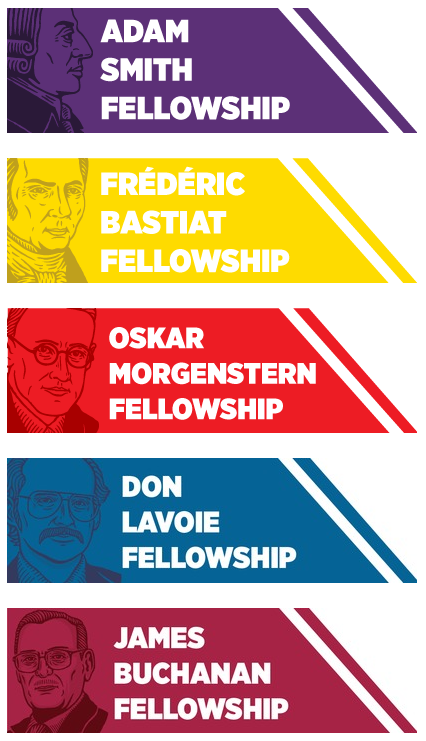
ASP offers several different fellowship programs to suit every need. Our fellows explore and discuss the foundations of political economy and public policy and pursue research on pressing issues. For graduate students who follow this blog and are generally interested in the big questions surrounding innovation, we especially encourage you to consider the Frédéric Bastiat Fellowship which will be premiering its innovation study track for the 2022-2023 academic year. I usually am an instructor at the session on tech and innovation policy.
Here are more details on all the academic fellowships that Mercatus currently offers. Please pass along this information to any students or early-career scholars who might be interested.
We hear a lot these days about “technological moonshots.” It’s an interesting phrase because the meaning of both words in it are often left undefined. I won’t belabor the point about how people define–or, rather, fail to define–“technology” when they use it. I’ve already spent a lot of time writing about that problem. See, for example, this constantly updated essay here about “Defining ‘Technology.'” It’s a compendium I began curating years ago that collects what dozens of others have had to say on the matter. I’m always struck by how many different definitions are out there that I keep unearthing.
The term “moonshots” has a similar problem. The first meaning is the literal one that hearkens back to President Kennedy’s famous 1962 “we choose to go to the moon” speech. That use of the terms implies large government programs and agencies, centralized control, and top-down planning with a very specific political objective in mind. Increasingly, however, the term “moonshot” is used more generally, as I note in this new Mercatus essay about “Making the World Safe for More Moonshots.” My Mercatus Center colleague Donald Boudreaux has referred to moonshots as, “radical but feasible solutions to important problems,” and Mike Cushing of Enterprise Innovation defines a moonshot as an “innovation that achieves the previously unthinkable.” I like that more generic use of the term and think it could be used appropriately when discussing the big innovations many of us hope to see in fields as diverse as quantum computing, genetic editing, AI and autonomous systems, supersonic transport, and much more. I still have some reservations about the term, but I think it’s definitely a better term than “disruptive innovation,” which is also used differently by various scholars and pundits.
I wanted to draw your attention to yet another spectacular speech by Maureen K. Ohlhausen, a Commissioner with the Federal Trade Commission (FTC). I have written here before about Commissioner Ohlhausen’s outstanding speeches, but this latest one might be her best yet.
On Tuesday, Ohlhausen was speaking at U.S. Chamber of Commerce Foundation day-long event on “The Internet of Everything: Data, Networks and Opportunities.” The conference featured various keynote speakers and panels discussing, “the many ways that data and Internet connectiviting is changing the face of business and society.” (It was my honor to also be invited to deliver an address to the crowd that day.)
As with many of her other recent addresses, Commissioner Ohlhausen stressed why it is so important that policymakers “approach new technologies and new business models with regulatory humility.” Building on the work of the great Austrian economist F.A. Hayek, who won a Nobel prize in part for his work explaining the limits of our knowledge to plan societies and economies, Ohlhausen argues that: Continue reading →
Few modern intellectuals gave more serious thought to forecasting the future than Herman Kahn. He wrote several books and essays imagining what the future might look like. But he was also a profoundly humble man who understood the limits of forecasting the future. On that point, I am reminded of my favorite Herman Kahn quote:
History is likely to write scenarios that most observers would find implausible not only prospectively but sometimes, even in retrospect. Many sequences of events seem plausible now only because they have actually occurred; a man who knew no history might not believe any. Future events may not be drawn from the restricted list of those we have learned are possible; we should expect to go on being surprised.[1]
I have always loved that phrase, “a man who knew no history might not believe any.” Indeed, sometimes the truth (how history actually unfolds) really is stranger than fiction (or the hypothetical forecasts that came before it.)
This insight has profound ramifications for public policy and efforts to “plan progress,” something that typically ends badly. Continue reading →
I’m pretty rough on all the Internet and info-tech policy books that I review. There are two reasons for that. First, the vast majority of tech policy books being written today should never have been books in the first place. Most of them would have worked just fine as long-form (magazine-length) essays. Too many authors stretch a promising thesis into a long-winded, highly repetitive narrative just to say they’ve written an entire book about a subject. Second, many info-tech policy books are poorly written or poorly argued. I’m not going to name names, but I am frequently unimpressed by the quality of many books being published today about digital technology and online policy issues.
The books of Harvard University cyberlaw scholars John Palfrey and Urs Gasser offer a welcome break from this mold. Their recent books, Born Digital: Understanding the First Generation of Digital Natives, and Interop: The Promise and Perils of Highly Interconnected Systems, are engaging and extremely well-written books that deserve to be books. There’s no wasted space or mindless filler. It’s all substantive and it’s all interesting. I encourage aspiring tech policy authors to examine their works for a model of how a book should be done.
In a 2008 review, I heaped praise on Born Digital and declared that this “fine early history of this generation serves as a starting point for any conversation about how to mentor the children of the Web.” I still recommend highly to others today. I’m going to be a bit more critical of their new book, Interop, but I assure you that it is a text you absolutely must have on your shelf if you follow digital policy debates. It’s a supremely balanced treatment of a complicated and sometimes quite contentious set of information policy issues.
In the end, however, I am concerned about the open-ended nature of the standard that Palfrey and Gasser develop to determine when government should intervene to manage or mandate interoperability between or among information systems. I’ll push back against their amorphous theory of “optimal interoperability” and offer an alternative framework that suggests patience, humility, and openness to ongoing marketplace experimentation as the primary public policy virtues that lawmakers should instead embrace. Continue reading →
Earlier this year I read Scott Cleland’s new book, Search & Destroy: Why You Can’t Trust Google, Inc., after he was kind enough to send me an advance copy. I didn’t have time to review it at the time and just jotted down a few notes for use later. Because the year is winding down, I figured I should get my thoughts on it out now before I publish my end of year compendium of important tech policy books.
Cleland is President of Precursor LLC and a noted Beltway commentator on information policy issues, especially Net neutrality regulation, which he has vociferously railed against for many years. On a personal note, I’ve known Scott for many years and always enjoyed his analysis and wit, even when I disagree with the thrust of some of it.
And I’m sad to report that I disagree with most of it in
Search & Destroy, a book that is nominally about Google but which is really a profoundly skeptical look at the modern information economy as we know it. Indeed, Cleland’s book might have been more appropriately titled, “Second Thoughts about Cyberspace.” In a sense, it represents an outline for an emerging “cyber-conservative” vision that aims to counter both “cyber-progressive” and “cyber-libertarian” schools of thinking.
After years of having Scott’s patented bullet-point mini-manifestos land in my mailbox, I think it’s only appropriate I write this review in the form of a bulleted list! So, here it goes.. Continue reading →
Over at MediaFreedom.org, a new site devoted to fighting the fanaticism of radical anti-media freedom groups like Free Press and other “media reformistas,” I’ve started rolling out a 5-part series of essays about “The Battle for Media Freedom.” In Part 1 of the series, I defined what real media freedom is all about, and in Part 2 I discussed the rising “cyber-collectivist” threat to media freedom. In my latest installment, I offer an analytical framework that better explains the major differences between the antagonists in the battle over media freedom.
Understanding the Origins of Political Struggles
In his many enlightening books, Thomas Sowell, a great economist and an even better political scientist, often warns of the triumph of good intentions over good economics. It’s a theme that F.A. Hayek and Milton Friedman both developed extensively before him. But Sowell has taken this analysis to an entirely differently level in books like A Conflict of Visions: Ideological Origins of Political Struggles, andThe Vision of the Anointed: Self-Congratulation as a Basis for Social Policy. Sowell teaches us that no matter how noble one’s intentions might be, it does not mean that those ideas will translate into sound public policy. Nonetheless, since “the anointed” believe their own intentions are pure and their methods are sound, they see nothing wrong with substituting their will for the will of millions of individuals interacting spontaneously and voluntarily in the marketplace. The result is an expansion of the scope of public decision-making and a contraction of the scope of private, voluntary action. As a result, mandates replace markets, and freedom gives way central planning.
Sowell developed two useful paradigms to help us better understand “the origins of political struggles.” He refers to the “constrained” versus “unconstrained” vision and separates these two camps according to how they view the nature of man, society, economy, and politics:
“Constrained Vision”
“Unconstrained Vision”
Man is inherently constrained; highly fallible and imperfect
Man is inherently unconstrained; just a matter of trying hard enough; man & society are perfectible
Social and economic order develops in bottom-up, spontaneous fashion. Top down planning is hard because planners aren’t omnipotent.
Order derives from smart planning, often from top-down. Elites can be trusted to make smart social & economic interventions.
Trade-offs & incentives matter most; wary of unintended consequences
Solutions & intentions matter most; less concern about costs or consequences of action
Opportunities count more than end results; procedural fairness is key; Liberty trumps
Outcomes matter most; distributive or “patterned” justice is key; Equality trumps liberty
Prudence and patience are virtues. There are limits to human reason.
Passion for, and pursuit of, high ideals trumps all. Human reason has boundless potential.
Law evolves and is based on the experience of ages.
Law is made by trusted elites.
Markets offer benefit of experience & experimentation and help develop knowledge over time.
Markets cannot ensure desired results; must be superseded by planning & patterned justice
Exponents: Aristotle, Adam Smith, Edmund Burke, James Madison, Lord Acton, F.A. Hayek, Ludwig von Mises, Milton Friedman, James Buchanan, Robert Nozick
Exponents: Plato, Rousseau, William Godwin, Voltaire, Robert Owen, John Kenneth Galbraith, John Dewey, Earl Warren, Bertrand Russell, John Rawls
After all that complaining (and bashing their Soviet Realist-style statue, “Man Controlling Trade”), you might think we had it in for the agency. But as I’ve said repeatedly, we’re actually big fans of the FTC’s core consumer protection mission: holding companies to their promises. (Indeed, we want to make sure they stay focused on that mission, and have the staff, resources and technological tools to pursue it effectively—which might mean, as I’ve pointed out, increased funding rather than increased powers.) We’ve also repeatedly praised the FTC’s efforts to educate kids, parents, and Internet users in general about things like online privacy, advertising, spyware, user empowerment tools, online scams, etc.
But I don’t want to be accused of being only a fair-weather friend of the agency. So I wanted to point out a particularly good concrete example of the FTC doing what we talk about in the abstract: holding companies to their promises. Grant Gross notes that the FTC sent a stern letter earlier this month to the company that is seeking to buy the subscriber info and photos and other assets of the now-defunct XY Magazine, which served primarily gay U.S. teens, warning them that the FTC would hold them to the terms of the privacy policy under which XY collected information from its subscribers.
This is a great example of how the FTC can effectively use its existing authority to protect consumers against clear harms involved in the disclosure of truly sensitive data, sometimes even prophylactically—in this case, outing around 100,000 gay youths and young adults—collected by companies that make unambiguous promises to protect users’ data. This incident also illustrates how privacy law can evolve in an organic fashion from a growing body of such well-justified preemptive warnings, enforcement actions brought against truly bad actors, and ultimately court decisions that decide whether the FTC has properly weighed the interests at stake. In other words, just because we don’t have a privacy code enforced by a Data Protection Authority as in Europe doesn’t mean our legal system doesn’t protect privacy!
by Adam Thierer & Berin Szoka — (Ver. 1.0 — Summer 2009)
We are attempting to articulate the core principles of cyber-libertarianism to provide the public and policymakers with a better understanding of this alternative vision for ordering the affairs of cyberspace. We invite comments and suggestions regarding how we should refine and build-out this outline. We hope this outline serves as the foundation of a book we eventually want to pen defending what we regard as “Real Internet Freedom.” [Note: Here’s a printer-friendly version, which we also have embedded down below as a Scribd document.]
I. What is Cyber-Libertarianism?
Cyber-libertarianism refers to the belief that individuals—acting in whatever capacity they choose (as citizens, consumers, companies, or collectives)—should be at liberty to pursue their own tastes and interests online.
Generally speaking, the cyber-libertarian’s motto is “Live & Let Live” and “Hands Off the Internet!” The cyber-libertarian aims to minimize the scope of state coercion in solving social and economic problems and looks instead to voluntary solutions and mutual consent-based arrangements.
Cyber-libertarians believe true “Internet freedom” is freedom
from state action; not freedom for the State to reorder our affairs to supposedly make certain people or groups better off or to improve some amorphous “public interest”—an all-to convenient facade behind which unaccountable elites can impose their will on the rest of us.
What Unites Advocates of Speech Controls & Privacy Regulation? [pdf]
by Adam Thierer & Berin Szoka
The Progress & Freedom Foundation,
Progress on Point No. 16.19
Anyone who has spent time following debates about speech and privacy regulation comes to recognize the striking parallels between these two policy arenas. In this paper we will highlight the common rhetoric, proposals, and tactics that unite these regulatory movements. Moreover, we will argue that, at root, what often animates calls for regulation of both speech and privacy are two remarkably elitist beliefs:
People are too ignorant (or simply too busy) to be trusted to make wise decisions for themselves (or their children); and/or,
All or most people share essentially the same values or concerns and, therefore, “community standards” should trump household (or individual) standards.
While our use of the term “elitism” may unduly offend some understandably sensitive to populist demagoguery, our aim here is not to launch a broadside against elitism as
Time magazine culture critic William H. Henry once defined it: “The willingness to assert unyieldingly that one idea, contribution or attainment is better than another.”[1] Rather, our aim here is to critique that elitism which rises to the level of political condescension and legal sanction. We attack not so much the beliefs of some leaders, activists, or intellectuals that they have a better idea of what it in the public’s best interest than the public itself does, but rather the imposition of those beliefs through coercive, top-down mandates.
That sort of elitism—elitism enforced by law—is often the objective of speech and privacy regulatory advocates. Our goal is to identify the common themes that unite these regulatory movements, explain why such political elitism is unwarranted, and make it clear how it threatens individual liberty as well as the future of free and open Internet. As an alternative to this elitist vision, we advocate an empowerment agenda: fostering an environment in which users have the tools and information they need to make decisions for themselves and their families. Continue reading →
The Technology Liberation Front is the tech policy blog dedicated to keeping politicians' hands off the 'net and everything else related to technology. Learn more about TLF →







 The Technology Liberation Front is the tech policy blog dedicated to keeping politicians' hands off the 'net and everything else related to technology.