Posts tagged as:

Almost every argument against technological innovation and progress that we hear today was identified and debunked by Samuel C. Florman a half century ago. Few others since him have mounted a more powerful case for the importance of innovation to human flourishing than Florman did throughout his lifetime.

Chances are you’ve never heard of him, however. As prolific as he was, Florman did not command as much attention as the endless parade of tech critics whose apocalyptic predictions grabbed all the headlines. An engineer by training, Florman became concerned about the growing criticism of his profession throughout the 1960s and 70s. He pushed back against that impulse in a series of books over the next two decades, including most notably: The Existential Pleasures of Engineering (1976), Blaming Technology: The Irrational Search for Scapegoats (1981), and The Civilized Engineer (1987). He was also a prolific essayist, penning hundreds of articles for a wide variety of journals, magazines, and newspapers beginning in 1959. He was also a regular columnist for MIT Technology Review for sixteen years.

Florman’s primary mission in his books and many of those essays was to defend the engineering profession against attacks emanating from various corners. More broadly, as he noted in a short autobiography on his personal website, Florman was interested in discussing, “the relationship of technology to the general culture.”

Florman could be considered a “rational optimist,” to borrow Matt Ridley’s notable term [1] for those of us who believe, as I have summarized elsewhere, that there is a symbiotic relationship between innovation, economic growth, pluralism, and human betterment.[2] Rational optimists are highly pragmatic and base their optimism on facts and historical analysis, not on dogmatism or blind faith in any particular viewpoint, ideology, or gut feeling. But they are unified in the belief that technological change is a crucial component of moving the needle on progress and prosperity.

Florman’s unique contribution to advancing rational optimism came in the way he itemized the various claims made by tech critics and then powerfully debunked each one of them. Continue reading →


I really liked this new essay, “Innovation is thriving in the fight against Covid-19,” by Norman Lewis over at Spiked, a UK-based publication. In it, he makes several important points similar to themes discussed in my book launch essay last week (“Evasive Entrepreneurialism and Technological Civil Disobedience in the Midst of a Pandemic.”) Lewis begins by noting that:

There is nothing like a crisis to concentrate the mind. And the Covid-19 catastrophe has certainly done this. It has speeded up latent trends and posed new questions. The issue of our technologically informed capacity to solve problems is just one example.

He continues on to argue:

a crisis like Covid-19 will necessarily pose new urgent questions that could not have been anticipated. New initiatives will rise to meet these. Pre-existing skills, knowledge, technologies and attitudes will always be the starting point of new problem-solving quests. Where and how we focus attention will, in part, be based on prior cultural assumptions and existing technologies, and also on the novelty of the problem to be solved.

Lewis discusses how innovative minds are pushing back against archaic regulatory barriers, business models and government regulations. As he nicely summarizes:

Unimagined solutions are being pushed while a more open attitude towards experimentation, risk-taking and side-stepping onerous and costly regulation is starting to emerge. Human needs are breaking down yesterday’s precautionary approaches.

That last line really resonated with me because it’s a major theme that runs throughout my new book, “Evasive Entrepreneurs and the Future of Governance: How Innovation Improves Economies and Governments.” As I summarized in my book launch essay:

Eventually, people take notice of how regulators and their rules encumber entrepreneurial activities, and they act to evade them when public welfare is undermined. Working around the system becomes inevitable when the permission society becomes so completely dysfunctional and counterproductive.

This was happening before the coronavirus outbreak, but the crisis has supercharged this phenomenon. Evasive entrepreneurs are taking advantage of the growth of new devices and platforms that let citizens circumvent (or perhaps just ignore) public policies that limit innovative efforts. These can include common tools like smartphones, computers, and various new interactive platforms, as well as more specialized technologies like cryptocurrencies, private drones, immersive technologies (like virtual reality), 3D printers, the “Internet of Things,” and sharing economy platforms and services. But that list just scratches the surface and the public is increasingly using these new technological capabilities to assert themselves and push back against laws and regulations that defy common sense and hold back progress.

Lawmakers and regulators need to consider a balanced response to evasive entrepreneurialism that is rooted in the realization that technology creators and users are less likely to seek to evade laws and regulations when public policies are more in line with common sense. Yesterday’s heavy-handed approaches that are rooted in the Precautionary Principle will need to be reformed to make sure progress can happen. 

Read my book to find out more!


In a new essay for the Mercatus Bridge, I ask, “How Many Lives Are Lost Due to the Precautionary Principle?” The essay builds on two recent case studies of how the precautionary principle can result in unnecessary suffering and deaths. The first case study involves the Japanese government’s decision in 2011 to entirely abandon nuclear energy following the Fukushima Daiichi nuclear accident. The second involves Golden Rice, a form of rice that was genetically engineered to contain beta-carotene, which helps combat vitamin A deficiency. Anti-GMO resistance among environmental activists and regulatory officials held up the diffusion of this miracle food. New reports and books now document how these precautionary decisions diminished human welfare instead of improving it. I encourage you to jump over to the Bridge and read the entire story.

I concluded the essay by noting that, “It is time to reject the simplistic logic of the precautionary principle and move toward a more rational, balanced approach to the governance of technologies. Our lives and well-being depend upon it.” Some read that as a complete rejection of  all preemptive regulation. I certainly was not arguing that, so let me clarify a few things. Continue reading →

[originally posted on Medium ]

Today is the anniversary of the day the machines took over.

Exactly twenty years ago today, on May 11, 1997, the great chess grandmaster Garry Kasparov became the first chess world champion to lose a match to a supercomputer. His battle with IBM’s “Deep Blue” was a highly-publicized media spectacle, and when he lost Game 6 of his match against the machine, it shocked the world.

At the time, Kasparov was bitter about the loss and even expressed suspicions about how Deep Blue’s team of human programmers and chess consultants might have tipped the match in favor of machine over man. Although he still wonders about how things went down behind the scenes during the match, Kasparov is no longer as sore as he once was about losing to Deep Blue. Instead, Kasparov has built on his experience that fateful week in 1997 and learned how he and others can benefit from it.

The result of this evolution in his thinking is Deep Thinking: Where Machine Intelligence Ends and Human Creativity Begins, a book which serves as a paean to human resiliency and our collective ability as a species to adapt in the face of technological disruption, no matter how turbulent.

Kasparov’s book serves as the perfect antidote to the prevailing gloom-and-doom narrative in modern writing about artificial intelligence (AI) and smart machines. His message is one of hope and rational optimism about future in which we won’t be racing against the machines but rather running alongside them and benefiting in the process.

Overcoming the Technopanic Mentality

There is certainly no shortage of books and articles being written today about AI, robotics, and intelligent machines. The tone of most of these tracts is extraordinarily pessimistic. Each page is usually dripping with dystopian dread and decrying a future in which humanity is essentially doomed.

As I noted in a recent essay about “The Growing AI Technopanic,” after reading through most of these books and articles, one is left to believe that in the future: “Either nefarious-minded robots enslave us or kill us, or AI systems treacherously trick us, or at a minimum turn our brains to mush.” These pessimistic perspectives are clearly on display within the realm of fiction, where every sci-fi book, movie, or TV show depicts humanity as certain losers in the proverbial “race” against machines. But such lugubrious lamentations are equally prevalent within the pages of many non-fiction books, academic papers, editorials, and journalistic articles.

Given the predominantly panicky narrative surrounding the age of smart machines, Kasparov’s Deep Thinking serves as a welcome breath of fresh air. The aim of his book is finding ways of “doing a smarter job of humans and machines working together” to improve well-being. Continue reading →

I recently finished  Learning by Doing: The Real Connection between Innovation, Wages, and Wealth , by James Bessen of the Boston University Law School. It’s a good book to check out if you are worried about whether workers will be able to weather this latest wave of technological innovation.  One of the key insights of Bessen’s book is that, as with previous periods of turbulent technological change, today’s workers and businesses will obviously need find ways to adapt to rapidly-changing marketplace realities brought on by the Information Revolution, robotics, and automated systems.

That sort of adaptation takes time, but for technological revolutions to take hold and have meaningful impact on economic growth and worker conditions, it requires that large numbers of ordinary workers acquire new knowledge and skills, Bessen notes. But, “that is a slow and difficult process, and history suggests that it often requires social changes supported by accommodating institutions and culture.” (p 223) That is not a reason to resist disruptive forms of technological change, however. To the contrary, Bessen says, it is crucial to allow ongoing trial-and-error experimentation and innovation to continue precisely because it represents a learning process which helps people (and workers in particular) adapt to changing circumstances and acquire new skills to deal with them. That, in a nutshell, is “learning by doing.” As he elaborates elsewhere in the book:

Major new technologies become ‘revolutionary’ only after a long process of learning by doing and incremental improvement. Having the breakthrough idea is not enough. But learning through experience and experimentation is expensive and slow. Experimentation involves a search for productive techniques: testing and eliminating bad techniques in order to find good ones. This means that workers and equipment typically operate for extended periods at low levels of productivity using poor techniques and are able to eliminate those poor practices only when they find something better. (p. 50)

Luckily, however, history also suggests that, time and time again, that process has happened and the standard of living for workers and average citizens alike improved at the same time. Continue reading →

In my previous essay, I discussed a new white paper by my colleague Robert Graboyes, Fortress and Frontier in American Health Care, which examines the future of medical innovation. Graboyes uses the “fortress vs frontier” dichotomy to help explain different “visions” about how public policies debates about technological innovation in the health care arena often play out.  It’s a terrific study that I highly recommend for all the reasons I stated in my previous post.

As I was reading Bob’s new report, I realized that his approach shared much in common with a couple of other recent innovation policy paradigms I have discussed here before from Virginia Postrel (“Stasis” vs. “Dynamism”), Robert D. Atkinson (“Preservationists” vs. “Modernizers”), and myself (“Precautionary Principle” vs. “Permissionless Innovation”). In this essay, I will briefly relate Bob’s’ approach to those other three innovation policy paradigms and then note a deficiency with our common approaches. I’ll conclude by briefly discussing another interesting framework from science writer Joel Garreau. Continue reading →

book cover (small)I am pleased to announce the release of my latest book, “Permissionless Innovation: The Continuing Case for Comprehensive Technological Freedom.” It’s a short manifesto (just under 100 pages) that condenses — and attempts to make more accessible — arguments that I have developed in various law review articles, working papers, and blog posts over the past few years. I have two goals with this book.

First, I attempt to show how the central fault line in almost all modern technology policy debates revolves around “the permission question,” which asks: Must the creators of new technologies seek the blessing of public officials before they develop and deploy their innovations? How that question is answered depends on the disposition one adopts toward new inventions. Two conflicting attitudes are evident.

One disposition is known as the “precautionary principle.” Generally speaking, it refers to the belief that new innovations should be curtailed or disallowed until their developers can prove that they will not cause any harms to individuals, groups, specific entities, cultural norms, or various existing laws, norms, or traditions.

The other vision can be labeled “permissionless innovation.” It refers to the notion that experimentation with new technologies and business models should generally be permitted by default. Unless a compelling case can be made that a new invention will bring serious harm to society, innovation should be allowed to continue unabated and problems, if they develop at all, can be addressed later.

I argue that we are witnessing a grand clash of visions between these two mindsets today in almost all major technology policy discussions today. Continue reading →

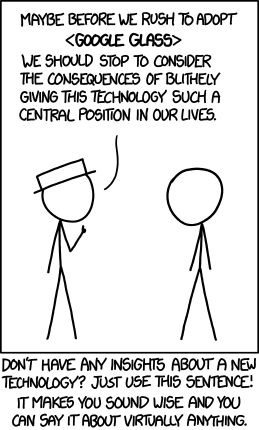
My colleague Eli Dourado brought to my attention this XKCD comic and when tweeting it out yesterday he made the comment that “Half of tech policy is dealing with these people”:

The comic and Eli’s comment may be a bit snarky, but something about it rang true to me because while conducting research on the impact of new information technologies on society I often come across books, columns, blog posts, editorials, and tweets that can basically be summed up with the line from that comic: “we should stop to consider the consequences of [this new technology] before we …”  Or, equally common is the line: “we need to have a conversation about [this new technology] before we…”

But what does that really mean? Certainly “having a conversation” about the impact of a new technology on society is important. But what is the nature of that “conversation”? How is it conducted? How do we know when it is going on or when it is over? Continue reading →

We spend a lot of time here defending the simple proposition that flexible free-market pricing is a good thing. You would think that in 2012 we wouldn’t need to do so, but there’s a growing movement afoot today by some academics, regulatory activists, and public policymakers to have government start asserting more authority over broadband pricing. In particular, they want Congress, the FCC, or state officials to investigate and possibly even regulate efforts by wireline and wireless broadband carriers to use usage-based pricing and data caps as a method of calibrating supply and demand. This was the focus of my last weekly Forbes column, “The Specter Of Broadband Price Controls.” In the piece I note that:

Data caps and usage-based pricing are forms of what economists refer to as price discrimination. Although viewed with suspicion by some policymakers and regulatory-minded academics and activists, price discrimination is widely recognized to improve consumer welfare. Price-differentiated and prioritized services are part of almost every industrial sector in our capitalist economy. Notable examples include airline and hotel reservations, prioritized shipping services, amusement park passes, and fuel and energy pricing. Economists agree that price discrimination represents a sensible way to calibrate supply and demand while ensuring the fixed costs of doing business get covered. Consumers benefit from such pricing experimentation by gaining more options while firms gain more certainty about investment and service decisions.

This is confirmed by an excellent new Mercatus Center working paper on “The Impact of Data Caps and Other Forms of Usage-Based Pricing for Broadband Access,” by Daniel A. Lyons, an assistant professor of law at Boston College Law School. Lyons explains why a return to price controls for communications would be monumentally misguided. Continue reading →

Looking for a concise overview of how Internet architecture has evolved and a principled discussion of the public policies that should govern the Net going forward? Then look no further than Christopher Yoo‘s new book, The Dynamic Internet: How Technology, Users, and Businesses are Transforming the Network. It’s a quick read (just 140 pages) and is worth picking up.  Yoo is a Professor of Law, Communication, and Computer & Information Science at the University of Pennsylvania and also serves as the Director of the Center for Technology, Innovation & Competition there. For those who monitor ongoing developments in cyberlaw and digital economics, Yoo is a well-known and prolific intellectual who has established himself as one of the giants of this rapidly growing policy arena.

Yoo makes two straight-forward arguments in his new book. First, the Internet is changing. In Part 1 of the book, Yoo offers a layman-friendly overview of the changing dynamics of Internet architecture and engineering. He documents the evolving nature of Internet standards, traffic management and congestion policies, spam and security control efforts, and peering and pricing policies. He also discusses the rise of peer-to-peer applications, the growth of mobile broadband, the emergence of the app store economy, and what the explosion of online video consumption means for ongoing bandwidth management efforts. Those are the supply-side issues. Yoo also outlines the implications of changes in the demand-side of the equation, such as changing user demographics and rapidly evolving demands from consumers. He notes that these new demand-side realities of Internet usage are resulting in changes to network management and engineering, further reinforcing changes already underway on the supply-side.

Yoo’s second point in the book flows logically from the first: as the Internet continues to evolve in such a highly dynamic fashion, public policy must as well. Yoo is particularly worried about calls to lock in standards, protocols, and policies from what he regards as a bygone era of Internet engineering, architecture, and policy. “The dramatic shift in Internet usage suggests that its founding architectural principles form the mid-1990s may no longer be appropriate today,” he argues. (p. 4) “[T]he optimal network architecture is unlikely to be static. Instead, it is likely to be dynamic over time, changing with the shifts in end-user demands,” he says. (p. 7) Thus, “the static, one-size-fits-all approach that dominates the current debate misses the mark.” (p. 7) Continue reading →