Posts tagged as:

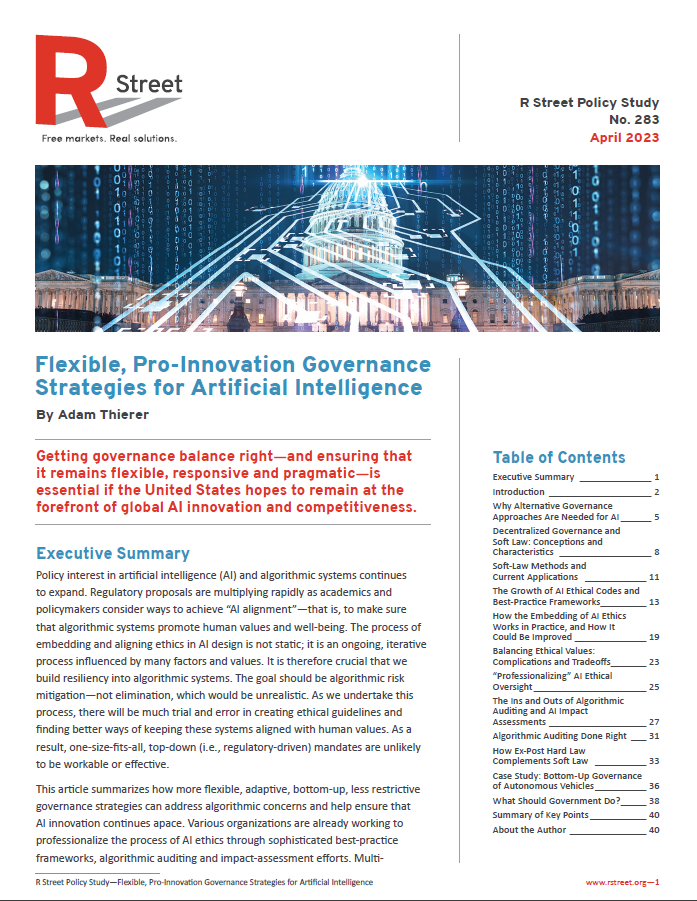
The R Street Institute has just released my latest study on AI governance and how to address “alignment” concerns in a bottom-up fashion. The 40-page report is entitled, “Flexible, Pro-Innovation Governance Strategies for Artificial Intelligence.”

My report asks, is it possible to address AI alignment without starting with the Precautionary Principle as the governance baseline default? I explain how that is indeed possible. While some critics claim that no one is seriously trying to deal with AI alignment today, my report explains how no technology in history has been more heavily scrutinized this early in its life-cycle as AI, machine learning and robotics. The number of ethical frameworks out there already is astonishing. We don’t have too few alignment frameworks; we probably have too many!

We need to get serious about bringing some consistency to these efforts and figure out more concrete ways to a culture of safety by embedding ethics-by-design. But there is an equally compelling interest in ensuring that algorithmic innovations are developed and made widely available to society.

Continue reading →

In my latest R Street Institute report, I discuss the importance of “Getting AI Innovation Culture Right.” This is the first of a trilogy of major reports on what sort of policy vision and set of governance principles should guide the development of  artificial intelligence (AI), algorithmic systems, machine learning (ML), robotics, and computational science and engineering more generally. More specifically, these reports seek to answer the question, Can we achieve AI safety without innovation-crushing top-down mandates and massive new regulatory bureaucracies? 

These questions are particular pertinent as we just made it through a week in which we’ve seen a major open letter issued that calls for a 6-month freeze on the deployment of AI technologies, while a prominent AI ethicist argued that governments should go further and consider airstrikes data processing centers even if the exchange of nuclear weapons needed to be considered! On top of that, Italy became the first major nation to ban ChatGPT, the popular AI-enabled chatbot created by U.S.-based OpenAI.

My report begins from a different presumption: AI, ML and algorithmic technologies present society with enormously benefits and, while real risks are there, we can find better ways of addressing them. Continue reading →

We are entering a new era for technology policy in which many pundits and policymakers will use “algorithmic fairness” as a universal Get Out of Jail Free card when they push for new regulations on digital speech and innovation. Proposals to regulate things like “online safety,” “hate speech,” “disinformation,” and “bias” among other things often raise thorny definitional questions because of their highly subjective nature. In the United States, efforts by government to control these things will often trigger judicial scrutiny, too, because restraints on speech violate the First Amendment. Proponents of prior restraint or even ex post punishments understand this reality and want to get around it. Thus, in an effort to avoid constitutional scrutiny and lengthy court battles, they are engaged in a rebranding effort and seeking to push their regulatory agendas through a techno-panicky prism of “algorithmic fairness” or “algorithmic justice.”

Hey, who could possibly be against FAIRNESS and JUSTICE? Of course, the devil is always in the details as Neil Chilson and I discuss in our new paper for the The Federalist Society and Regulatory Transparency Project on, “The Coming Onslaught of ‘Algorithmic Fairness’ Regulations.” We document how federal and state policymakers from both parties are currently considering a variety of new mandates for artificial intelligence (AI), machine learning, and automated systems that, if imposed, “would thunder through our economy with one of the most significant expansions of economic and social regulation – and the power of the administrative state – in recent history.” Continue reading →

[Cross-posted from Medium.]

[Cross-posted from Medium]

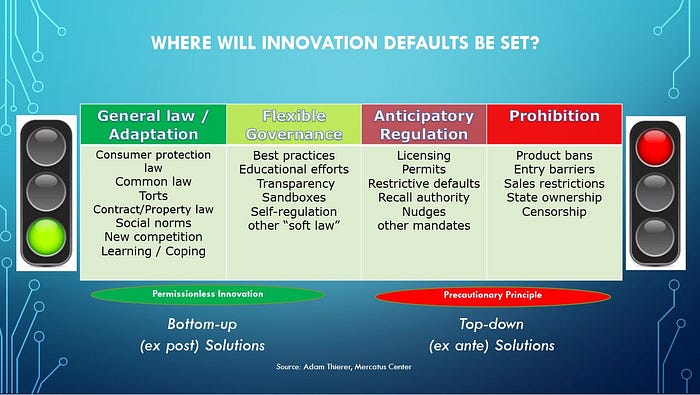
There are two general types of technological governance that can be used to address challenges associated with artificial intelligence (AI) and computational sciences more generally. We can think of these as “on the ground” (bottom-up, informal “soft law”) governance mechanisms versus “on the books” (top-down, formal “hard law”) governance mechanisms.

Unfortunately, heated debates about the latter type of governance often divert attention from the many ways in which the former can (or already does) help us address many of the challenges associated with emerging technologies like AI, machine learning, and robotics. It is important that we think harder about how to optimize these decentralized soft law governance mechanisms today, especially as traditional hard law methods are increasingly strained by the relentless pace of technological change and ongoing dysfunctionalism in the legislative and regulatory arenas.

Continue reading →

[last updated 4/3/2025 – Check my Medium page for latest posts]

This a running list of all the essays and reports I’ve already rolled out on the governance of artificial intelligence (AI), machine learning (ML), and robotics. Why have I decided to spend so much time on this issue? Because this will become the most important technological revolution of our lifetimes. Every segment of the economy will be touched in some fashion by AI, ML, robotics, and the power of computational science. It should be equally clear that public policy will be radically transformed along the way.

Eventually, all policy will involve AI policy and computational considerations. As AI “eats the world,” it eats the world of public policy along with it. The stakes here are profound for individuals, economies, and nations. As a result, AI policy will be the most important technology policy fight of the next decade, and perhaps next quarter century. Those who are passionate about the freedom to innovate need to prepare to meet the challenge as proposals to regulate AI proliferate.

There are many socio-technical concerns surrounding algorithmic systems that deserve serious consideration and appropriate governance steps to ensure that these systems are beneficial to society. However, there is an equally compelling public interest in ensuring that AI innovations are developed and made widely available to help improve human well-being across many dimensions. And that’s the case that I’ll be dedicating my life to making in coming years.

Here’s the list of what I’ve done so far. I will continue to update this as new material is released: Continue reading →

Gabrielle Bauer, a Toronto-based medical writer, has just published one of the most concise explanations of what’s wrong with the precautionary principle that I have ever read. The precautionary principle, you will recall, generally refers to public policies that limit or even prohibit trial-and-error experimentation and risk-taking. Innovations are restricted until their creators can prove that they will not cause any harms or disruptions. In an essay for The New Atlantis entitled, “Danger: Caution Ahead,” Bauer uses the world’s recent experiences with COVID lockdowns as the backdrop for how society can sometimes take extreme caution too far, and create more serious dangers in the process. “The phrase ‘abundance of caution’ captures the precautionary principle in a more literary way,” Bauer notes. Indeed, another way to look at it is through the prism of the old saying, “better to be safe than sorry.” The problem, she correctly observes, is that, “extreme caution comes at a cost.” This is exactly right and it points to the profound trade-offs associated with precautionary principle thinking in practice.

In my own writing about the problems associated with the precautionary principle (see list of essays at bottom), I often like to paraphrase an ancient nugget of wisdom from St. Thomas Aquinas, who once noted in his Summa Theologica that, if the highest aim of a captain were merely to preserve their ship, then they would simply keep it in port forever. Of course, that is not the only goal of a captain has. The safety of the vessel and the crew is essential, of course, but captains brave the high seas because there are good reasons to take such risks. Most obviously, it might be how they make their living. But historically, captains have also taken to the seas as pioneering explorers, researchers, or even just thrill-seekers.

This was equally true when humans first decided to take to the air in balloons, blimps, airplanes, and rockets. A strict application of the precautionary principle would have instead told us we should keep our feet on the ground. Better to be safe than sorry! Thankfully, many brave souls ignored that advice and took the heavens in the spirit of exploration and adventure. As Wilbur Wright once famously said, “If you are looking for perfect safety, you would do well to sit on a fence and watch the birds.” Needless to say, humans would have never mastered the skies if the Wright brothers (and many others) had not gotten off the fence and taken the risks they did. Continue reading →

GMLR coverI’m pleased to announce the release of my latest law review article, “A Framework for Benefit-Cost Analysis in Digital Privacy Debates.” It appears in the new edition of the George Mason University Law Review. (Vol. 20, No. 4, Summer 2013)

This is the second of two complimentary law review articles I am releasing this year dealing with privacy policy. The first, “The Pursuit of Privacy in a World Where Information Control is Failing,” was published in Vol. 36 of the Harvard Journal of Law & Public Policy this Spring. (FYI: Both articles focus on privacy claims made against private actors — namely, efforts to limit private data collection — and not on privacy rights against governments.)

My new article on benefit-cost analysis in privacy debates makes a seemingly contradictory argument: benefit-cost analysis (“BCA”) is extremely challenging in online child safety and digital privacy debates, yet it remains essential that analysts and policymakers attempt to conduct such reviews. While we will never be able to perfectly determine either the benefits or costs of online safety or privacy controls, the very act of conducting a regulatory impact analysis (“RIA”) will help us to better understand the trade-offs associated with various regulatory proposals. Continue reading →

HJLPP coverI’m excited to announce the release of my latest law review article, “The Pursuit of Privacy in a World Where Information Control is Failing,” which appears in the next edition (vol. 36) of the Harvard Journal of Law & Public Policy. This is the first of two complimentary law review articles that I will be releasing this year dealing with privacy policy. The second, which will be published later this summer by the George Mason University Law Review, is entitled, “A Framework for Benefit-Cost Analysis in Digital Privacy Debates.” (FYI: Both articles focus on privacy claims made against private actors — namely, efforts to limit private data collection — and not on privacy rights against governments.)

The new Harvard Journal article is divided into three major sections. Part I focuses on some of normative challenges we face when discussing privacy and argues that there may never be a widely accepted, coherent legal standard for privacy rights or harms here in the United States. It also explores the tensions between expanded privacy regulation and online free speech. Part II turns to the many enforcement challenges that are often ignored when privacy policies are being proposed or formulated and argues that legislative and regulatory efforts aimed at protecting privacy must now be seen as an increasingly intractable information control problem. Most of the problems policymakers and average individuals face when it comes to controlling the flow of private information online are similar to the challenges they face when trying to control the free flow of digitalized bits in other information policy contexts, such as online safety, cybersecurity, and digital copyright.

If the effectiveness of law and regulation is limited by the normative considerations discussed in Part I and the practical enforcement complications discussed in Part II, what alternatives remain to assist privacy-sensitive individuals? I address that question in Part III of the paper and argue that the approach America has adopted to deal with concerns about objectionable online speech and child safety offers a path forward on the privacy front as well. Continue reading →

What Unites Advocates of Speech Controls & Privacy Regulation? [pdf]

by Adam Thierer & Berin Szoka The Progress & Freedom Foundation, Progress on Point No. 16.19

Anyone who has spent time following debates about speech and privacy regulation comes to recognize the striking parallels between these two policy arenas. In this paper we will highlight the common rhetoric, proposals, and tactics that unite these regulatory movements. Moreover, we will argue that, at root, what often animates calls for regulation of both speech and privacy are two remarkably elitist beliefs:

  1. People are too ignorant (or simply too busy) to be trusted to make wise decisions for themselves (or their children); and/or,
  2. All or most people share essentially the same values or concerns and, therefore, “community standards” should trump household (or individual) standards.

While our use of the term “elitism” may unduly offend some understandably sensitive to populist demagoguery, our aim here is not to launch a broadside against elitism as Time magazine culture critic William H. Henry once defined it: “The willingness to assert unyieldingly that one idea, contribution or attainment is better than another.”[1] Rather, our aim here is to critique that elitism which rises to the level of political condescension and legal sanction. We attack not so much the beliefs of some leaders, activists, or intellectuals that they have a better idea of what it in the public’s best interest than the public itself does, but rather the imposition of those beliefs through coercive, top-down mandates.

That sort of elitism—elitism enforced by law—is often the objective of speech and privacy regulatory advocates. Our goal is to identify the common themes that unite these regulatory movements, explain why such political elitism is unwarranted, and make it clear how it threatens individual liberty as well as the future of free and open Internet. As an alternative to this elitist vision, we advocate an empowerment agenda: fostering an environment in which users have the tools and information they need to make decisions for themselves and their families. Continue reading →