Posts tagged as:

Almost every argument against technological innovation and progress that we hear today was identified and debunked by Samuel C. Florman a half century ago. Few others since him have mounted a more powerful case for the importance of innovation to human flourishing than Florman did throughout his lifetime.

Chances are you’ve never heard of him, however. As prolific as he was, Florman did not command as much attention as the endless parade of tech critics whose apocalyptic predictions grabbed all the headlines. An engineer by training, Florman became concerned about the growing criticism of his profession throughout the 1960s and 70s. He pushed back against that impulse in a series of books over the next two decades, including most notably: The Existential Pleasures of Engineering (1976), Blaming Technology: The Irrational Search for Scapegoats (1981), and The Civilized Engineer (1987). He was also a prolific essayist, penning hundreds of articles for a wide variety of journals, magazines, and newspapers beginning in 1959. He was also a regular columnist for MIT Technology Review for sixteen years.

Florman’s primary mission in his books and many of those essays was to defend the engineering profession against attacks emanating from various corners. More broadly, as he noted in a short autobiography on his personal website, Florman was interested in discussing, “the relationship of technology to the general culture.”

Florman could be considered a “rational optimist,” to borrow Matt Ridley’s notable term [1] for those of us who believe, as I have summarized elsewhere, that there is a symbiotic relationship between innovation, economic growth, pluralism, and human betterment.[2] Rational optimists are highly pragmatic and base their optimism on facts and historical analysis, not on dogmatism or blind faith in any particular viewpoint, ideology, or gut feeling. But they are unified in the belief that technological change is a crucial component of moving the needle on progress and prosperity.

Florman’s unique contribution to advancing rational optimism came in the way he itemized the various claims made by tech critics and then powerfully debunked each one of them. Continue reading →


The endless apocalyptic rhetoric surrounding Net Neutrality and many other tech policy debates proves there’s no downside to gloom-and-doomism as a rhetorical strategy. Being a techno-Jeremiah nets one enormous media exposure and even when such a person has been shown to be laughably wrong, the press comes back for more. Not only is there is no penalty for hyper-pessimistic punditry, but the press actually furthers the cause of such “fear entrepreneurs” by repeatedly showering them with attention and letting them double-down on their doomsday-ism. Bad news sells, for both the pundit and the press.

But what is most remarkable is that the press continues to label these preachers of the techno-apocalypse as “experts” despite a track record of failed predictions. I suppose it’s because, despite all the failed predictions, they are viewed as thoughtful & well-intentioned. It is another reminder that John Stuart Mill’s 1828 observation still holds true today: “I have observed that not the man who hopes when others despair, but the man who despairs when others hope, is admired by a large class of persons as a sage.”

Additional Reading:

I (Eye), Robot?

by on May 8, 2019 · 1 comment

[Originally published on the Mercatus Bridge blog on May 7, 2019.]

I became a little bit more of a cyborg this month with the addition of two new eyes—eye lenses, actually. Before I had even turned 50, the old lenses that Mother Nature gave me were already failing due to cataracts. But after having two operations this past month and getting artificial lenses installed, I am seeing clearly again thanks to the continuing miracles of modern medical technology.

Cataracts can be extraordinarily debilitating. One day you can see the world clearly, the next you wake up struggling to see through a cloudy ocular soup. It is like looking through a piece of cellophane wrap or a continuously unfocused camera.

If you depend on your eyes to make a living as most of us do, then cataracts make it a daily struggle to get even basic things done. I spend most of my time reading and writing each workday. Once the cataracts hit, I had to purchase a half-dozen pair of strong reading glasses and spread them out all over the place: in my office, house, car, gym bag, and so on. Without them, I was helpless.

Reading is especially difficult in dimly lit environments, and even with strong glasses you can forget about reading the fine print on anything. Every pillbox becomes a frightening adventure. I invested in a powerful magnifying glass to make sure I didn’t end up ingesting the wrong things.

For those afflicted with particularly bad cataracts, it becomes extraordinarily risky to drive or operate machinery. More mundane things—watching TV, tossing a ball with your kid, reading a menu at many restaurants, looking at art in a gallery—also become frustrating. Continue reading →

Over at the American Institute for Economic Research blog, I recently posted two new essays discussing increasing threats to innovation and discussing how to counter them. The first is on “The Radicalization of Modern Tech Criticism,” and the second discusses, “How To Defend a Culture of Innovation During the Technopanic.”

“Technology critics have always been with us, and they have sometimes helped temper society’s occasional irrational exuberance about certain innovations,” I note in the opening of the first essay. The problem is that the “technology critics sometimes go much too far and overlook the importance of finding new and better ways of satisfying both basic and complex human needs and wants.” I continue on to highlight the growing “technopanic” rhetoric we sometimes hear today, including various claims that “it’s OK to be a Luddite” and push for a “degrowth movement” that would slow the wheels of progress. That would be a disaster for humanity because, as I note in concluding that first essay:

Through ongoing trial-and-error tool building, we discover new and better ways of satisfying human needs and wants to better our lives and the lives of those around us. Human flourishing is dependent upon our collective willingness to embrace and defend the creativity, risk-taking, and experimentation that produces the wisdom and growth that propel us forward. By contrast, today’s neo-Luddite tech critics suggest that we should just be content with the tools of the past and slow down the pace of technological innovation to supposedly save us from any number of dystopian futures they predict. If they succeed, it will leave us in a true dystopia that will foreclose the entrepreneurialism and innovation opportunities that are paramount to raising the standard of living for billions of people across the world.

In the second essay, I make an attempt to sketch out a more robust vision and set of principles to counter the tech critics. Continue reading →

I’ve always been perplexed by tech critiques that seek to pit “humanist” values against technology or technological processes, or that even suggest a bright demarcation exists between these things. Properly understood, “technology” and technological innovation are simply extensions of our humanity and represent efforts to continuously improve the human condition. In that sense, humanism and technology are compliments, not opposites.

I started thinking about this again after reading a recent article by Christopher Mims of The Wall Street Journal , which introduced me to the term “techno-chauvinism.” Techno-chauvinism is a new term that some social critics are using to identify when technologies or innovators are apparently not behaving in a “humanist” fashion. Mims attributes the term techno-chauvinism to Meredith Broussard of New York University, who defines it as “the idea that technology is always the highest and best solution, and is superior to the people-based solution .” [Italics added.] Later on Twitter, Mims defined and critiqued techno-chauvinism as “the belief that the best solution to any problem is technology, not changing our culture, habits or mindset.”

Everything Old is New Again

There are other terms critics have used to describe the same notion, including: “ techno-fundamentalism ” (Siva Vaidhyanathan), “cyber-utopianism,” and “ technological solutionism ” (Evgeny Morozov). In a sense, all these terms are really just variants of what scholars in the field of Science and Technology Studies (STS) have long referred to as “technological determinism.”

As I noted in a recent essay about determinism, the traditional “hard” variant of technological determinism refers to the notion that technology almost has a mind of its own and that it will plow forward without much resistance from society or governments. Critics argue that determinist thinking denies or ignores the importance of the human element in moving history forward, or what Broussard would refer to as “people-based solutions.”

The first problem with this thinking is there are no bright lines in these debates and many “softer” variants of determinism exist. The same problem is at work when we turn to discussions about both “humanism” and “technology.” Things get definitionally murky quite quickly, and everyone seemingly has a preferred conception of these terms to fit their own ideological dispositions. “Humanism is a rather vague and contested term with a convoluted history,” observes tech philosopher Michael Sacasas. And here’s an essay that I have updated many times over the years to catalog the dozens of different definitions of “technology” I have unearthed in my ongoing research. Continue reading →

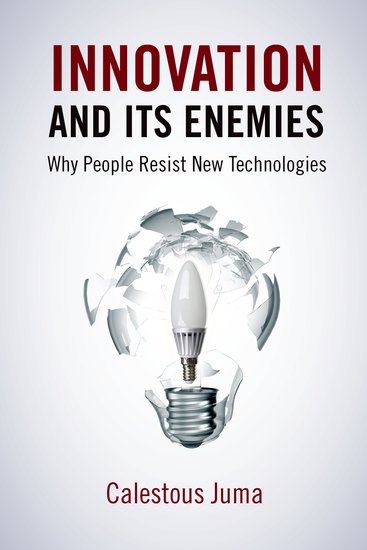
Juma book cover

“The quickest way to find out who your enemies are is to try doing something new.” Thus begins Innovation and Its Enemies, an ambitious new book by Calestous Juma that will go down as one of the decade’s most important works on innovation policy.

Juma, who is affiliated with the Harvard Kennedy School’s Belfer Center for Science and International Affairs, has written a book that is rich in history and insights about the social and economic forces and factors that have, again and again, lead various groups and individuals to oppose technological change. Juma’s extensive research documents how “technological controversies often arise from tensions between the need to innovate and the pressure to maintain continuity, social order, and stability” (p. 5) and how this tension is “one of today’s biggest policy challenges.” (p. 8)

What Juma does better than any other technology policy scholar to date is that he identifies how these tensions develop out of deep-seated psychological biases that eventually come to affect attitudes about innovations among individuals, groups, corporations, and governments. “Public perceptions about the benefits and risks of new technologies cannot be fully understood without paying attention to intuitive aspects of human psychology,” he correctly observes. (p. 24) Continue reading →

How is it that we humans have again and again figured out how to assimilate new technologies into our lives despite how much those technologies “unsettled” so many well-established personal, social, cultural, and legal norms?

In recent years, I’ve spent a fair amount of time thinking through that question in a variety of blog posts (“Are You An Internet Optimist or Pessimist? The Great Debate over Technology’s Impact on Society”), law review articles (“Technopanics, Threat Inflation, and the Danger of an Information Technology Precautionary Principle”), opeds (“Why Do We Always Sell the Next Generation Short?”), and books (See chapter 4 of my new book, “Permissionless Innovation: The Continuing Case for Comprehensive Technological Freedom”).

It’s fair to say that this issue — how individuals, institutions, and cultures adjust to technological change — has become a personal obsession of mine and it is increasingly the unifying theme of much of my ongoing research agenda. The economic ramifications of technological change are part of this inquiry, of course, but those economic concerns have already been the subject of countless books and essays both today and throughout history. I find that the social issues associated with technological change — including safety, security, and privacy considerations — typically get somewhat less attention, but are equally interesting. That’s why my recent work and my new book narrow the focus to those issues. Continue reading →

Last month, Digital Barbarism book cover National Review magazine published a review that I penned of Mark Helprin’s new book, Digital Barbarism: A Writer’s Manifesto.  Helprin’s book is both a passionate defense of copyright law as well as a mini-autobiography.  Helprin is one of the great novelists and essayists of the past half-century, and his book A Soldier of a Great War is one of my all-time favorite novels.  I cannot in strong enough words encourage you to read that book; it is profoundly moving. (I almost named my son after the lead character in the book!)

Thus, I was quite excited when I learned that Helprin had penned a defense of copyright and I jumped at the chance to review it when the folks at National Review asked me to do so.  Alas, as you will see in my review, I was terribly disappointed.  I wish Helprin would have stuck with the very reasonable tone he adopted in this excellent podcast interview he did recently with John J. Miller of National Review Online. Unfortunately, he went a different direction in the book, as I make clear in my review:


National Review July 20, 2009

“Man, Machine, and Copyright” a review of Digital Barbarism: A Writer’s Manifesto, by Mark Helprin by Adam Thierer

It would be difficult to think of anyone more ideally suited to pen a passionate defense of copyright law than novelist Mark Helprin.  Helprin has written several of the finest works of modern literature, including his masterpiece, A Soldier of the Great War, a narrative of transcendent beauty. In Digital Barbarism, Helprin sets out to use his formidable gift for the written word to repel the “cyber mob” that has attacked copyright law and called for its curtailment, or even abolition.

Unfortunately, while Helprin occasionally rises to great heights in his defense of copyright, he too often sinks to lamentable lows — by resorting to the same unbecoming rhetorical tactics used by the mob he seeks to condemn. Indeed, his book is filled with gratuitous vitriol and neo-Luddite ramblings about the Internet and Information Age that severely detract from his defense of copyright. This is a shame, because, in places, Digital Barbarism makes a fine case against those critics who wrongly view copyright as an impediment to the creation and diffusion of content. “The availability of information is not and will not be restrained by the copyright system any more than it is or will be restrained by the delivery systems that make it possible,” Helprin argues. Why, he asks, “must ‘content’ be free” when everything else — access to the Internet, digital devices, etc. — costs good money? He notes that the movement that advocates “free,” universal access to all copyrighted material in the name of “openness” and “the public good” would, ironically, “destroy the dream it advocates”: Continue reading →